THE SHORT ANSWER
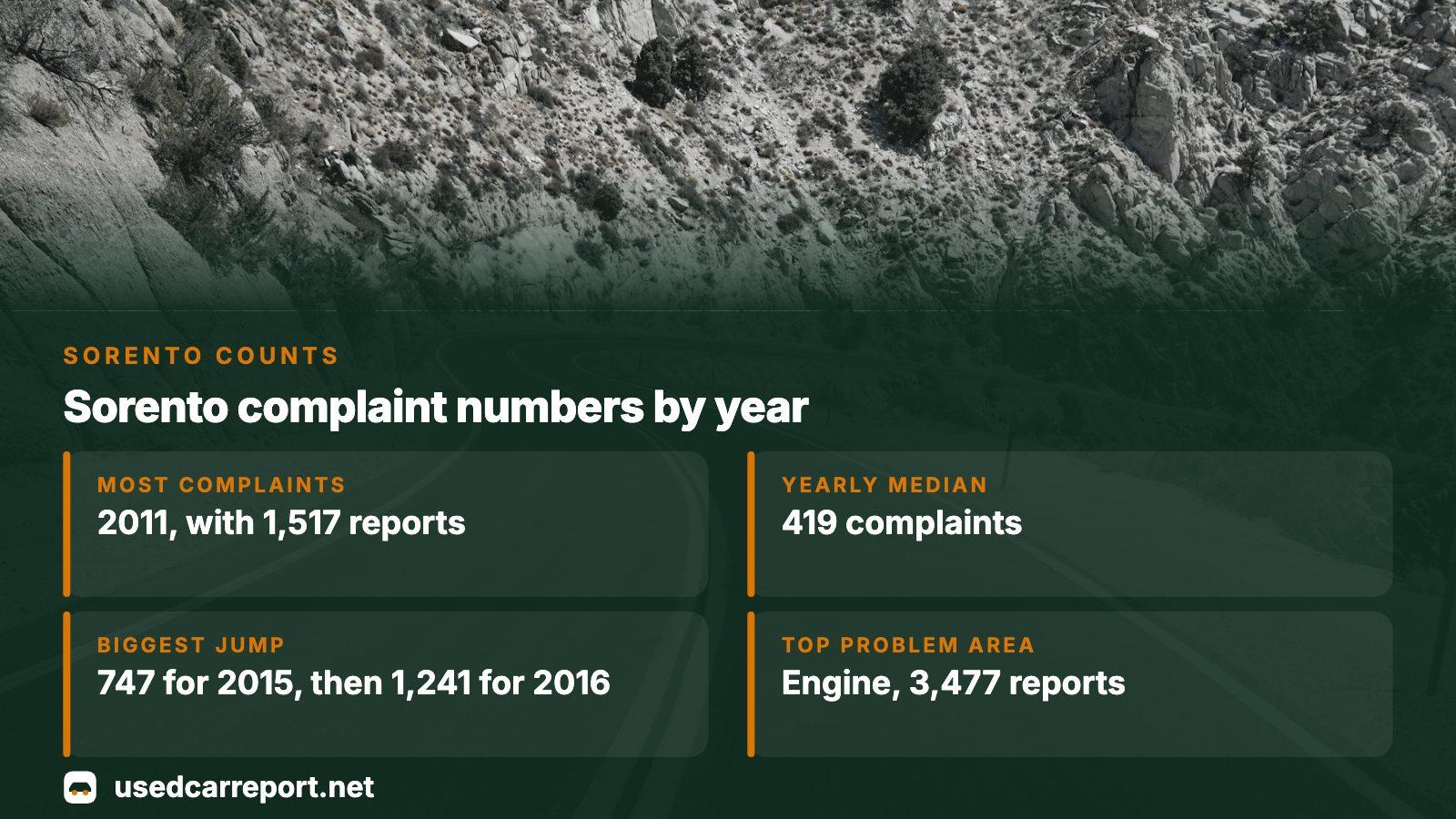
Owners filed 8,451 NHTSA complaints about the Sorento across 2008 to 2022, and the median year holds 419. The 2011 model leads with 1,517, then 2016 with 1,241, 2014 with 982, 2013 with 979 and 2012 with 876. Engine reports are the biggest group at 3,477. The lightest files belong to 2010, 2021, 2009 and 2020. Read the VIN's accident and damage entries first, whatever the year.
- Most complaints
- 2011, with 1,517 reports
- Yearly median
- 419 complaints
- Biggest jump
- 747 for 2015, then 1,241 for 2016
- Top problem area
- Engine, 3,477 reports across all years
Five Sorento years sit well above the median
The record covers 15 model years. Dividing each year's complaints by the nameplate median of 419 gives a multiple, so 3.62 for 2011 means about three and a half ordinary years of filings squeezed into one. Counts come from an August 2026 pull. Recalls sit beside them because a recall means the maker has conceded a fault, whereas a complaint is a single owner's claim that nobody has verified.
| Year | Complaints | Versus median | Recalls |
|---|---|---|---|
| 2011 | 1,517 | 3.62 | 8 |
| 2016 | 1,241 | 2.96 | 8 |
| 2014 | 982 | 2.34 | 6 |
| 2013 | 979 | 2.34 | 5 |
| 2012 | 876 | 2.09 | 5 |
Two more years, 2017 with 795 and 2015 with 747, also finish above the median. Every other year, 2008 through 2010 and 2018 through 2022, lands at or under it.
2011: the busiest year, with a fire recall opened in 2023
NHTSA lists 8 recalls for the 2011 Sorento, tied with 2016 for the most. The newest, 23V877000, arrived in December 2023 for certain 2011 SUVs that can catch fire in the engine bay while moving. Dealers load knock-sensor software and replace the engine where needed. Older campaigns cover a shift interlock that can free the lever from Park with no brake pressed and, on 2011 to 2014 cars, a control-unit fuse with a park-outside warning.
Structure is the second-largest group that year. In NHTSA's current file, 95 of the 268 structure complaints mention a handle or latch, nearly all of them on doors and often the outside handle.
From an NHTSA owner complaint
A 2011 Sorento owner wrote that every dashboard light came on and the engine died on the drive home. While stopped with the hazards on and trying a restart, the SUV was hit from behind, leaving the owner with a concussion for almost two weeks. The insurer totaled it, which the owner says was over the failed engine rather than the impact damage.
On a report that would read as a crash, then a total loss. Check the date order and ask the seller what happened.
2012 to 2017: engine trouble and a string of campaigns
Engine tops the complaint list in every flagged year. Recall 17V224000, for 2012 to 2014 Sorentos, targets machining errors that can wear bearings early and seize the engine; dealers inspect it and replace it if needed. Recall 20V750000 covers 2012 and 2013 SUVs for engine-bay fire. Recall 17V586000 covers 2017 cars with the 3.3L engine, where a crankshaft may fail and stall the engine.
Recall 18V907000 applies to 2012 to 2017 Sorentos that already had a new engine. During that swap the high-pressure fuel line meeting the pump may be left damaged, misaligned or tightened wrongly, with a leak and fire as the risk.
From an NHTSA owner complaint
The owner of a 2013 Sorento wrote that the SUV was recalled over engine knocking, and a dealer visit in 2019 turned up nothing. In 2021 it shut off on a highway, the brakes and steering went heavy, and it was towed to a Kia dealer. By the next day the dealer said the engine qualified for the recall, but the car was rebuilt, so the recall did not apply.
That is one owner's report of a dealer's words, not a ruling, but a brand history is worth learning before you pay.
2016: from 747 complaints to 1,241 in one step
Recalls climb from 3 to 8 over the same step, and the 2016 list is mostly parts other than the engine. SUVs built between late October 2014 and the end of January 2015 fall under 15V089000, where a poorly soldered pedal part can leave the driver unable to accelerate. Others cover rear suspension welds, driver's seatback welds on cars built March 3 to 21, 2016, a front passenger belt buckle that may not latch, and shift-lever parts that may not lock, which allows rollaway. Two tow-hitch harness campaigns, 16V862000 and 22V703000, finish the list.
Several are weld or seat repairs. If a 2016's record shows a collision, ask whether those campaigns were done before or after the body work, and ask to see the repair invoices.
The quiet years, and what a thin file hides
- 2010: 3 complaints and 2 recalls, the lightest record on file.
- 2021: 23 complaints and 4 recalls, a young year with little time to collect reports.
- 2009: 55 complaints and 3 recalls.
- 2020: 131 complaints and 1 recall.
A thin file can mean few were sold as easily as it can mean few faults. The oldest Sorentos face a legal catch too: federal law lifts the duty to repair at no charge when the first buyer purchased the SUV over 15 calendar years ahead of the recall notice, so a campaign announced later may skip a 2008 to 2010 model.
What a ranking cannot see: this Sorento's crash record
A complaint total describes thousands of SUVs. Crash and repair entries, write-off findings, title brands and the mileage trail belong to one VIN, and any of them can sink a fairly priced Sorento from a quiet year. The UsedCarReport report leads with the accident and damage entries, behind a free preview.
From an NHTSA owner complaint
A 2011 Sorento owner described a Kia letter extending warranty cover on the occupant sensor pads, tied to the air bag warning light. The dealer said the repair was covered, then added that the SUV is salvage, so no warranty applies. The owner feared the air bags might not deploy in a crash.
A branded history reached past the sale and into the repair bay. Whatever the rules prove to be in each case, a salvage or rebuilt entry is something to know before signing.
Reading a Sorento's damage entries
| On the report | What to ask next |
|---|---|
| Collision with air bag deployment | Who replaced the restraint parts, and does the warning light behave |
| Total-loss or salvage entry | What caused it, since an engine failure can end in a write-off |
| Rebuilt or salvage brand | What the dealer says about recall and warranty work, and whether the price reflects it |
| Mileage that stalls or drops | Whether service invoices, such as an engine swap, explain it |
An empty result narrows the doubt without removing it. The federal title system's consumer page says states brand damaged cars by their own cost thresholds and that a search can miss history, so no brand does not mean no damage.
Checking the Sorento in front of you
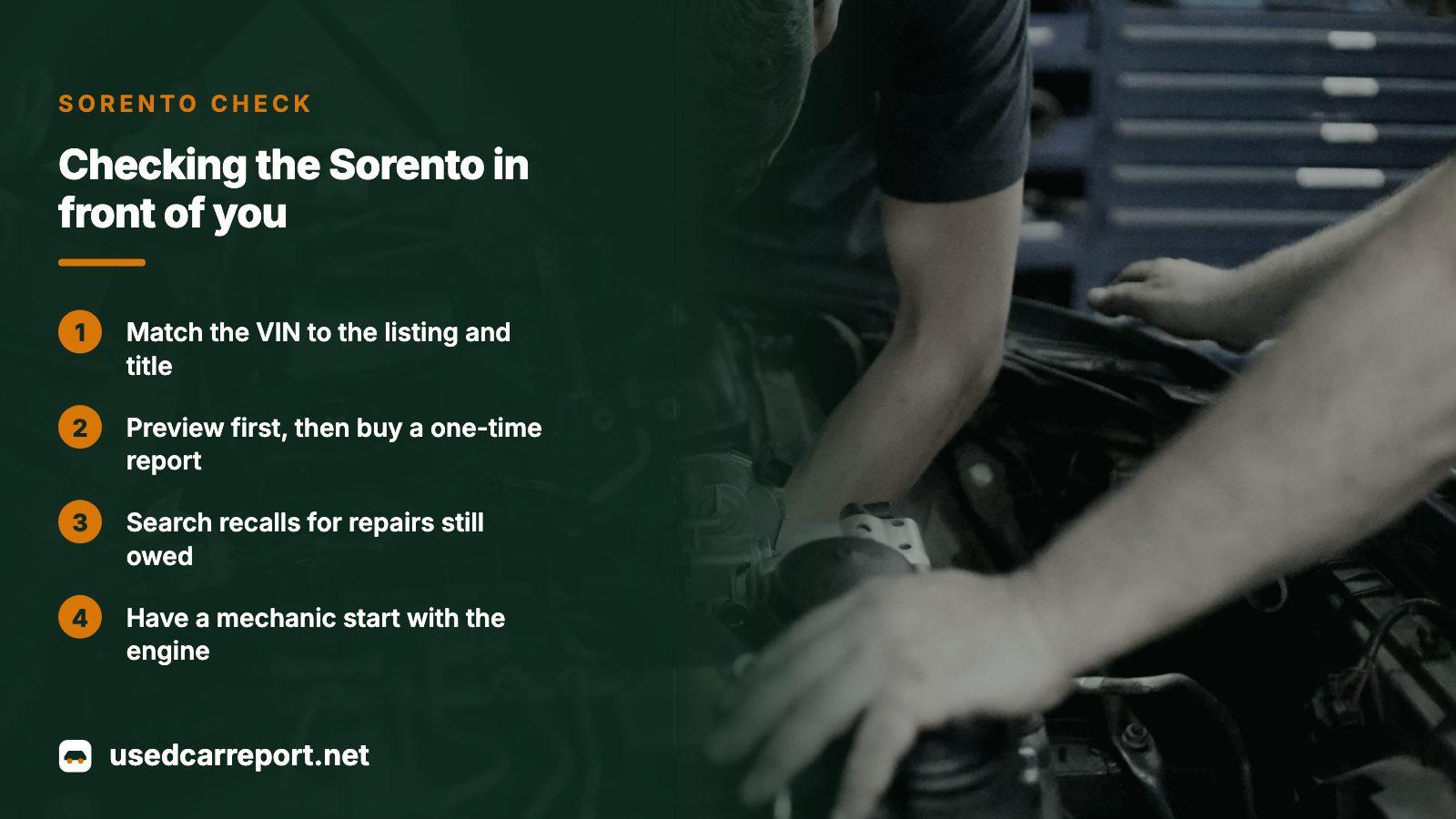
- Match the VIN on the SUV to the listing and the title before spending anything.
- Start with the preview. When the Sorento still seems worth chasing, a one-time report purchase comes next (options are on the pricing page), and its accident and damage entries get read before any other section.
- Type the VIN into NHTSA's recall search, which lists only repairs still owed, then ask to see paperwork for any campaign already completed.
- Compare the build date and engine with each campaign's range, since campaigns cover production windows, not whole years.
- Have a mechanic start with the engine: oil level, leaks and any sign it was replaced.
A flagged year earns more questions and a firmer price. A quiet year proves nothing about the car at the curb.
Where this information comes from
- NHTSA owner complaint 11565459 — owner experience, paraphrased
- NHTSA owner complaint 11424451 — owner experience, paraphrased
- NHTSA owner complaint 11445242 — owner experience, paraphrased
- NHTSA: recalls lookup — Where each campaign above can be checked against one VIN, and what that search leaves out.
- NMVTIS: for consumers — What the federal title system collects, and why a search can miss a damaged car.
- 49 U.S.C. 30120: remedies for defects — The 15-year limit on no-charge recall repairs.
Sources and photos: Facts checked against the sources above in November 2026. Photos by Willian Cittadin, Mustafa Sheikhmouss and Will Truettner on Unsplash; diagrams by UsedCarReport.
Keep reading
- VIN accident check: read the damage records before you buyWhat accident and damage entries show for one car, and where they stop.
- Buying a car with an open recall: read the damage record firstWhat an unfinished campaign means for the price and your first weeks.
- Kia Sportage years to avoid, and the damage record to read firstThe maker's smaller SUV, which shares two campaigns with the Sorento.
- Buying a car with a rebuilt title: read the damage record firstThe branded-title side of the problem, for a Sorento or any other SUV.
Frequently asked questions
Which Kia Sorento model years are the worst?
By NHTSA complaint counts, 2011 stands out with 1,517, ahead of 2016, 2014, 2013 and 2012, against a median of 419 a year. A high count means inspect harder and negotiate; sound Sorentos turn up in each of those years too.
Which Sorento years are the most reliable?
NHTSA does not score reliability, it logs complaints and recalls. By that count 2010, 2021, 2009 and 2020 carry the lightest files, but small counts can reflect sales and age as much as quality. Judge the individual car by its history.
What do Sorento owners complain about most?
The engine. NHTSA holds 3,477 reports under that heading for 2008 through 2022, ahead of 1,124 filed as unknown or other and 1,107 for the electrical system. Write-ups describe stalling, knocking and oil trouble. Start any inspection there and ask for engine repair records.
Does a rebuilt or salvage Sorento get recall repairs?
Two owners told NHTSA that dealers declined recall or warranty work because their SUVs were rebuilt or salvage. Those are single accounts, not rules, so ask Kia or a dealer directly before buying a branded Sorento, and weigh the answer in the price.
Will a VIN check show if a used Sorento was in a crash?
It lists accident and damage entries, total-loss and salvage findings and title brands where they were reported. Reporting is uneven, because states brand damaged cars by their own thresholds, so a spotless result leaves some doubt standing. Add an inspection.
Now check the car itself
The guide explains what to look for. The report shows what this VIN has on record.