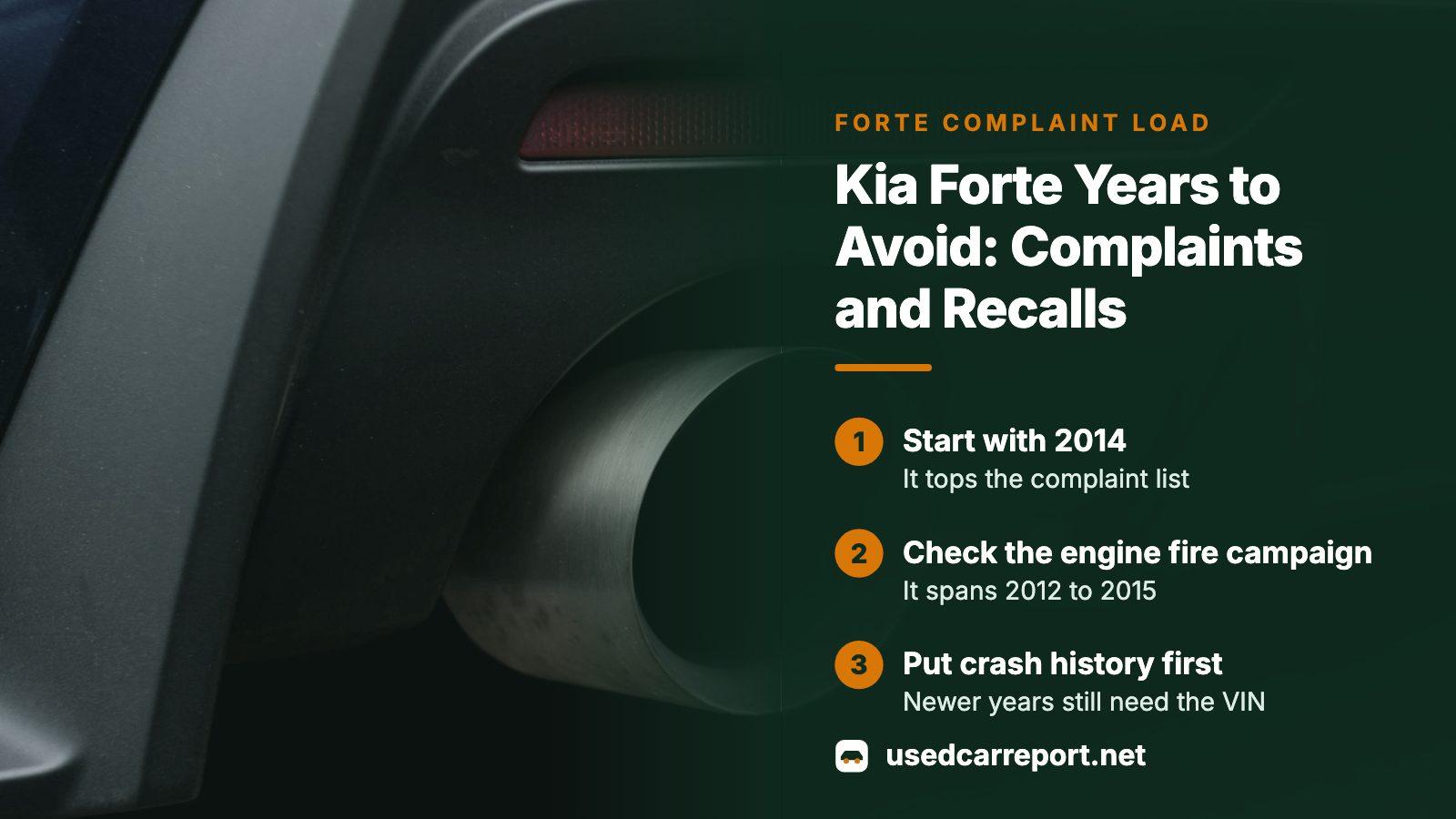
THE SHORT ANSWER
Owners filed 2,451 complaints about the 2010 to 2024 Forte, a median of 150 per year. The 2014 model leads with 444, then 2017 with 305, 2012 with 293 and 2015 with 262. Engine trouble tops most of those years, and 2012 to 2015 share an engine fire recall. Newer years look quieter, but read the VIN's accident and damage record before trusting any label.
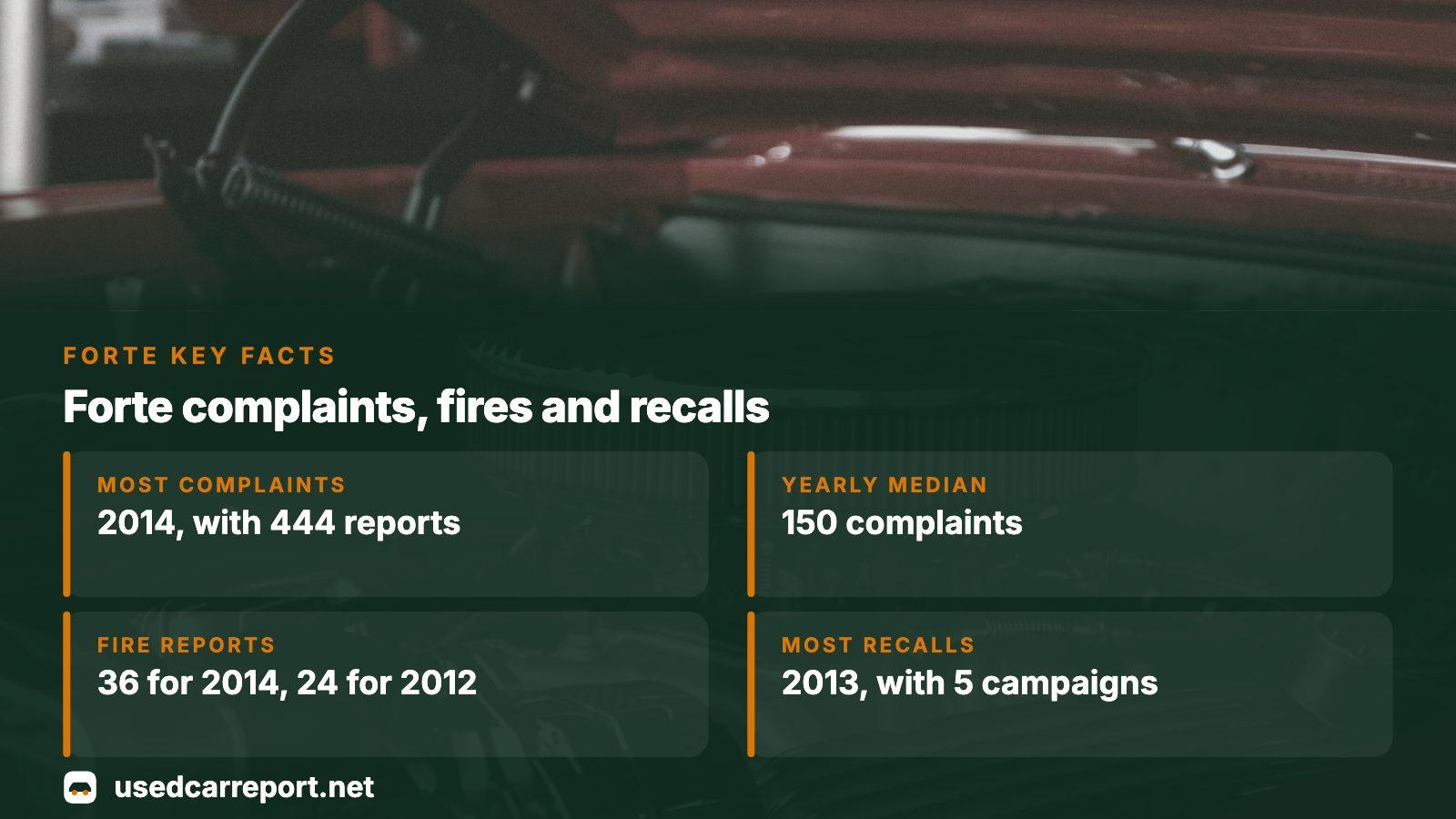
- Most complaints
- 2014, with 444 reports
- Yearly median
- 150 complaints
- Fire reports
- 36 for 2014, 24 for 2012
- Most recalls
- 2013, with 5 campaigns
Five Forte years with the heaviest complaint load
In November 2026 we collected NHTSA's complaint and recall tallies for each Forte year, 2010 through 2024. The middle year of that span has 150 complaints, so dividing each year by 150 shows how far above ordinary it sits. The 2014 car is nearly three times the middle.
| Model year | Complaints | Versus median | Fire reports | Recalls |
|---|---|---|---|---|
| 2014 | 444 | 2.96 | 36 | 3 |
| 2017 | 305 | 2.03 | 10 | 3 |
| 2012 | 293 | 1.95 | 24 | 4 |
| 2015 | 262 | 1.75 | 20 | 1 |
| 2010 | 232 | 1.55 | 5 | 3 |
A complaint is one owner's unverified report. A recall means Kia itself agreed the part is faulty and fixes it for nothing, so it measures something else. Weigh the two columns together.
2012 to 2015: the engine fire campaign
Engine draws the most filings in each of these four years, at 161 reports for 2012, 107 for 2013, 216 for 2014 and 160 for 2015. NHTSA campaign 20V750000, filed in December 2020, names the 2012 to 2015 Fortes for a blaze under the hood that can begin on the road.
The remedy is an inspection for oil or fuel leaks, an engine test, repairs up to a replacement engine where needed, and a software update to the knock sensor monitoring. All of it is free, but only if someone books the visit.
From an NHTSA owner complaint
Newly bought, a 2012 Forte turned out to have the fire recall outstanding; the previous owner knew and held the letters but never visited a dealer. Hours from home, the motor locked up and caught fire beside an interstate, and the family says Kia would not accept responsibility.
What to take from it: an unfinished recall stays with the car when ownership changes, so get the dealer's completion record in hand first.
2010 to 2013: air bag module and brake electronics
The oldest cars have a different problem set. A 2018 campaign, number 18V363000, covers 2010 to 2013 Fortes whose air bag control unit can short circuit, which may stop the front air bags and belt tensioners from firing in a crash. Dealers fit an extension wire harness.
A separate 2023 campaign, 23V652000, covers 2010 to 2013 Fortes for an electrical short in the anti-lock brake control unit that can start an engine compartment fire while parked. Owners were told to leave the car outdoors, away from buildings, until a dealer replaced a fuse. Owner letters went out between March and June 2024, so an older car that changed hands before then may never have received one.
The 2013 model has the most recalls of any year, five in all, including seat belt retractor plates on cars built in a narrow September to October 2012 window.
2014: why it tops the list
The 2014 Forte has 444 complaints, with 216 about the engine, 64 about steering and 63 about air bags. It also has the highest fire count, 36. Its recalls include a cooling fan resistor that can overheat and melt, on cars built from December 2012 to April 2014.
From an NHTSA owner complaint
One 2014 owner reported oil leaking, warning lights staying on at start-up and a burnt smell. The dealer said the engine was failing and needed replacing, at 112,000 miles on the car, and the owner pointed to the engine fire campaign as the likely cause. No repair was made.
Other 2014 owners described a clicking, then seizing, steering wheel that a dealer traced to a failed flex coupling. None of the 2014 campaigns listed by NHTSA names that part, so a test drive with the wheel turned slowly lock to lock is worth the time.
2017 and 2018: oil pump, air bag unit and trunk latch
The 2017 model draws 305 complaints and 2018 draws 136. Both fall under three campaigns. One covers an oil pump on the 2.0 liter engine, where debris can cause pump failure and engine damage, and dealers replace the oil pan. Another covers an air bag control unit whose cover can damage a memory chip, which could leave the air bags off.
The third, for 2016 to 2018 cars, concerns a trunk latch that can break so the lid will not open from inside. Check the trunk release yourself on the lot.
The 2016 year shows only 5 complaints, which looks clean. With a trunk latch recall and so few filings, read that as thin data, not a clean bill.
2019 to 2024: quieter, with steering recalls
From 2019 the numbers fall. The 2019 model has 150, 2020 has 78, 2021 has 69, 2022 has 28, 2023 has 66 and 2024 has 26. A newer car also has had less time to collect filings, which flatters it.
- 2019: a front axle shaft that may not have been heat-treated, and headlights aimed wrong.
- 2021 and 2022: a steering column bolt that may be loose enough to detach the column.
- 2023: a cracking front left steering knuckle, plus a badly welded right front control arm covered by two campaigns.
- 2020 and 2024: no recalls in NHTSA's record for the Forte.
The 2023 control arm notice told owners not to drive the car until the repair was done, so ask whether it was.
Crash history comes before the model year
A Forte from a good year can still be a bad car. Crash reports show up in the Forte complaint record for every year but 2016, from 3 to 32 per year, so these compact sedans do end up in collisions. A repaired collision matters here because several campaigns concern parts that a crash can disturb: air bag modules, steering parts and suspension arms.
- Accident and damage entries, with the point of impact and any photos from an auction or insurer.
- Brands on the title (salvage, rebuilt, flood) and any total-loss entry.
- Odometer readings, to see whether mileage rises steadily.
- Open recalls, so the fire and air bag campaigns above are visible for this exact VIN.
A history report can only show what was reported to its sources. A clean one does not replace an inspection by a mechanic you trust.
Checking the Forte you are looking at
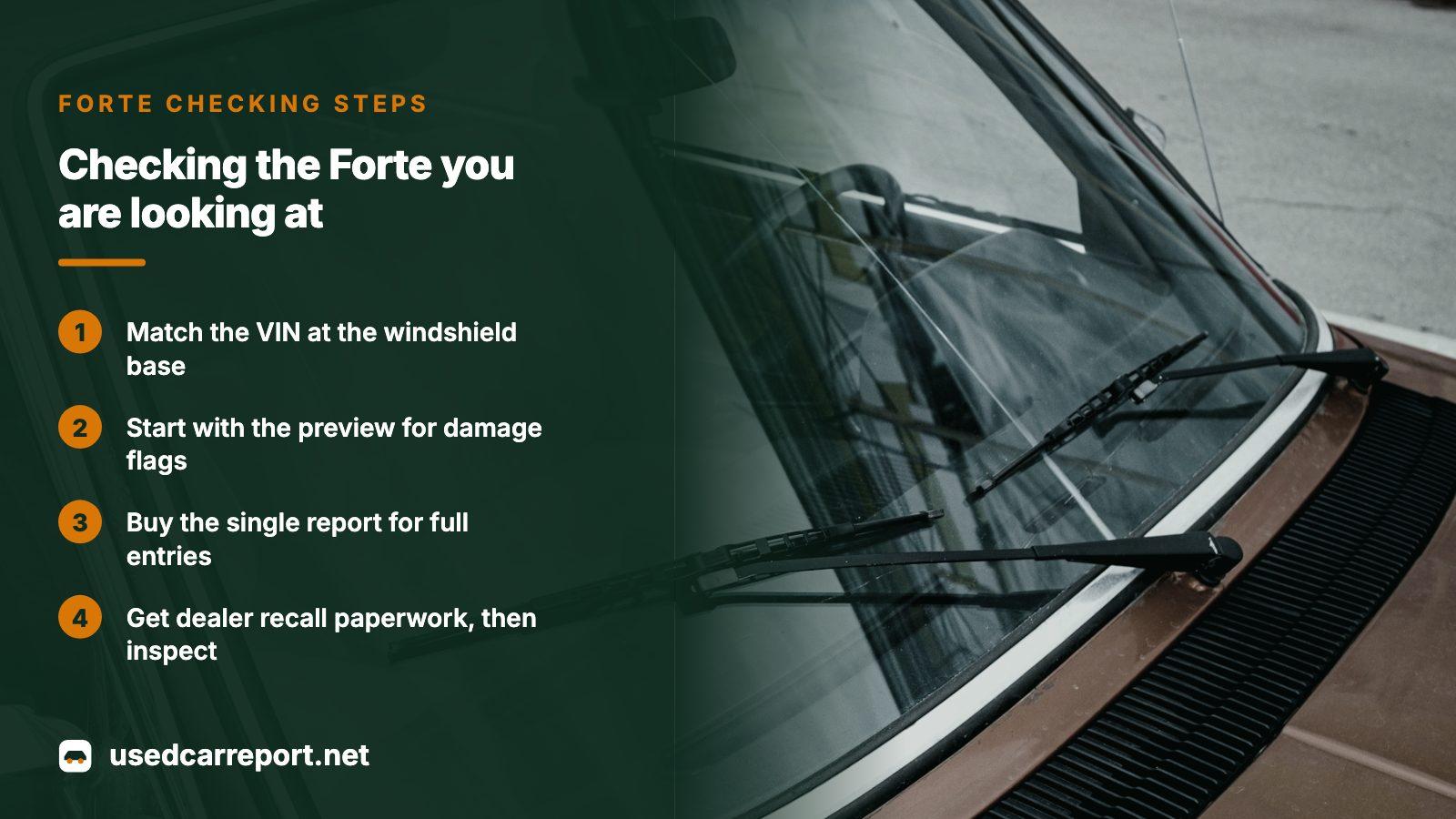
- Write down the VIN printed at the base of the windshield and match it to the title.
- Start with the free preview here, which tells you whether accident, damage or title records exist.
- If you want the full entries, buy the single report for that car. It is a single payment, nothing recurring, and the pricing page lays out the options.
- Ask the seller for dealer paperwork on the recalls that cover that model year.
- Book an inspection that includes the steering, the engine bay and any repaired panels.
If the report lists a crash with air bag deployment or fire damage, treat that car as a different price tier or walk away.
Where this information comes from
- NHTSA owner complaint 11768964 — owner experience, paraphrased
- NHTSA recalls API: Kia Forte — Campaign numbers, dates and remedies by model year.
- NHTSA complaints API: Kia Forte — Complaint counts, components and fire reports by model year.
- NHTSA owner complaint 11705749 — owner experience, paraphrased
- NMVTIS: vehiclehistory.gov — Federal title database that supplies brand and total-loss entries.
Sources and photos: Facts checked against the sources above in November 2026. Photos by Dain Lindo, Max Tokarev and Victor Hughes on Unsplash; diagrams by UsedCarReport.
Keep reading
- VIN accident check: read the damage records before you buyReading crash entries, including the gaps in them.
- Buying a car with an open recall: read the damage record firstWhat an unfixed recall does to the price and to your first week.
- Mazda 3 years to avoid, and the damage record to check firstAnother compact sedan, ranked the same way.
- Frame damage check: start with the accident and damage recordsHow to find out whether a crash reached the structure.
Frequently asked questions
What are the worst Kia Forte years?
On NHTSA complaints, 2014 is the worst at 444, followed by 2017 at 305, 2012 at 293 and 2015 at 262. The 2012 to 2015 cars also share an engine fire recall. The median year has 150, so those four sit well above ordinary.
Which Kia Forte years are the most reliable?
The lowest counts are 2022 with 28 and 2024 with 26, with 2016 at 5 but too thin to trust. Newer cars have had less time to collect reports, so a low count is a good sign, not a guarantee. Run the VIN for crash and recall records.
Is a high-mileage Forte safe to buy?
Mileage matters less than history. A Forte with steady odometer readings, no title brand, no air bag deployment and completed recalls can be a fair buy. A low-mileage one with repaired crash damage or an open fire recall is the riskier car.
Do Kia Forte recalls cost anything?
No. NHTSA's records list every Forte campaign above as a repair done by a dealer free of charge. The catch is that the car must be brought in, and the repair stays open on the VIN until someone does it.
Will a VIN check show a past Forte crash?
It lists crashes and damage that insurers, auctions or agencies reported, with title brands and odometer readings alongside. It cannot show a crash that was never reported, so pair it with an inspection before you pay.
Now check the car itself
The guide explains what to look for. The report shows what this VIN has on record.