THE SHORT ANSWER
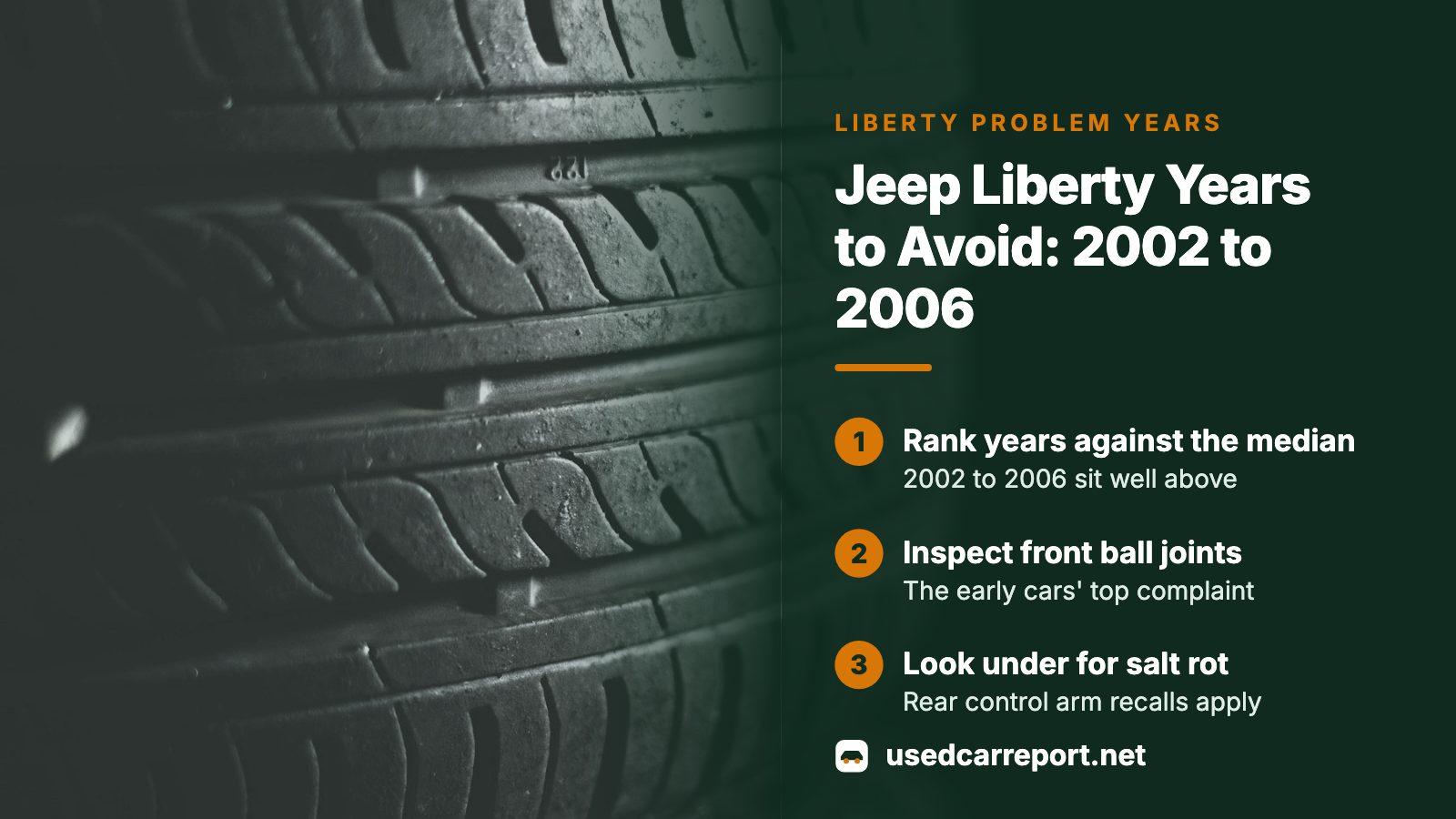
NHTSA holds 8,865 Liberty complaints across 2002 to 2012, and the middle year has 703. Model years 2002 to 2006 sit well above it, from 1.57 times the median in 2004 to 2.57 times in 2002, and each carries five to nine manufacturer recalls. Years 2009 to 2011 are the quietest. A flagged year means a slower inspection and a lower offer, but one car's crash history still decides more than its model year.
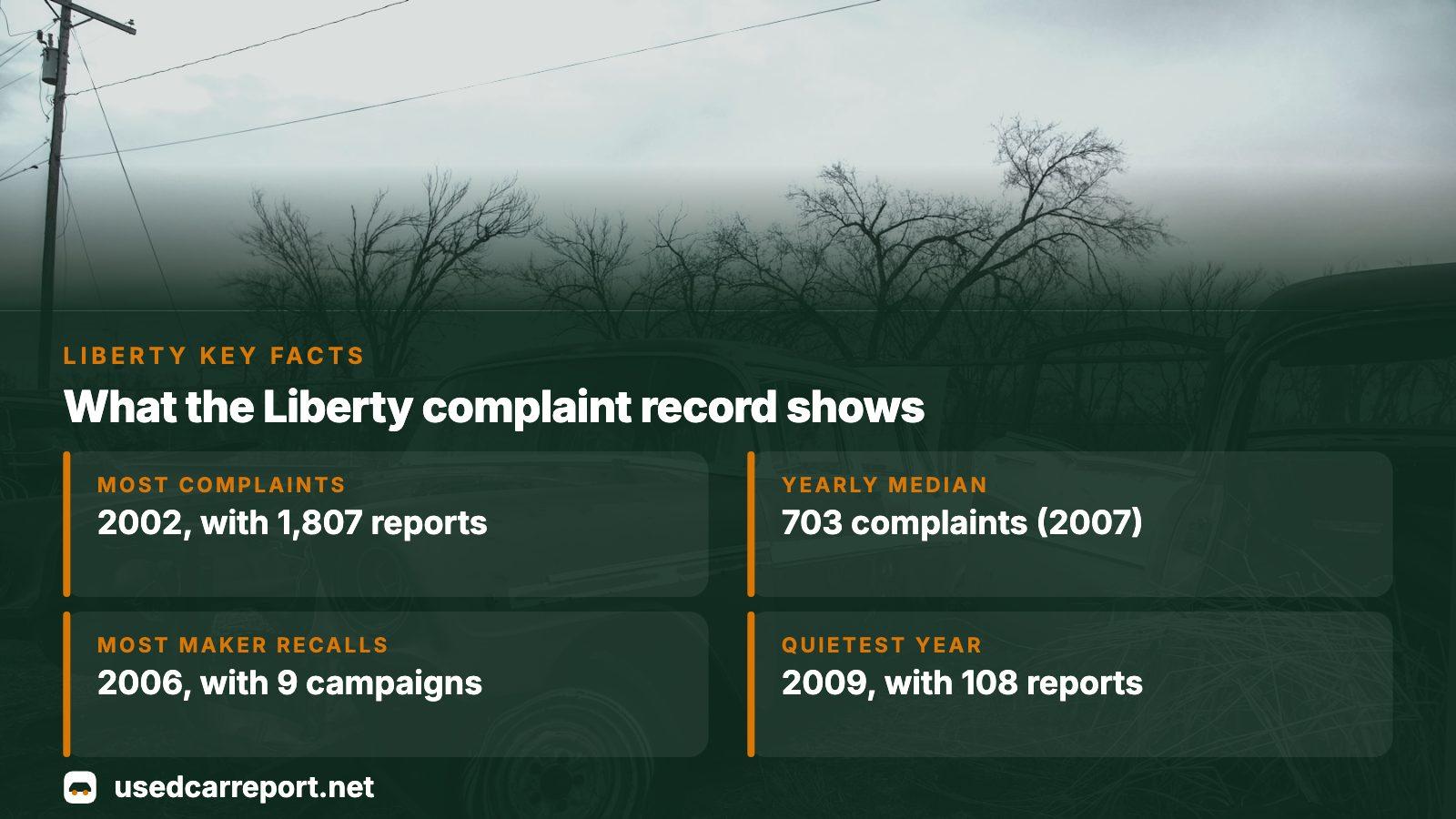
- Most complaints
- 2002, with 1,807 reports
- Yearly median
- 703 complaints (2007)
- Most maker recalls
- 2006, with 9 campaigns
- Quietest year
- 2009, with 108 reports
All eleven Liberty years, ranked against the median
The Liberty was built for model years 2002 through 2012, and I pulled NHTSA's owner complaints and recall campaigns for each one on November 7, 2026. The file holds 8,865 complaints. The middle year is 2007 with 703, so the third column divides each year by that figure. Recalls here count only campaigns issued by the maker, not aftermarket parts recalls that the same database lists.
| Year | Complaints | Versus the median | Crash reports | Maker recalls |
|---|---|---|---|---|
| 2002 | 1,807 | 2.57 | 174 | 8 |
| 2006 | 1,371 | 1.95 | 40 | 9 |
| 2003 | 1,353 | 1.92 | 134 | 7 |
| 2005 | 1,118 | 1.59 | 73 | 5 |
| 2004 | 1,101 | 1.57 | 86 | 7 |
| 2007 | 703 | 1.00 | 25 | 6 |
| 2008 | 541 | 0.77 | 11 | 4 |
| 2012 | 385 | 0.55 | 19 | 2 |
| 2010 | 197 | 0.28 | 13 | 2 |
| 2011 | 181 | 0.26 | 16 | 3 |
| 2009 | 108 | 0.15 | 2 | 0 |
Five years stand clear of the pack, and together 2002 to 2007 hold 7,453 of the 8,865 complaints. Age inflates these totals, since an older SUV has had more years to attract filings. Treat the ranking as a prompt for a closer inspection, never as a ruling on one particular vehicle.
Why 2002 to 2006 top the list: front ball joints
Suspension is named in 1,924 of those 7,453 early complaints. The front lower ball joint is the usual culprit. A 2003 recall (03V460000) covered 2002 and 2003 cars whose joints could lose grease, corrode and separate from the steering knuckle. A second one in 2006 (06V288000) reached 2002 through 2006 for contaminated joints. In 2009 a third (09V119000) covered 42,469 cars from 2002 and 2003 over the upper arm joint.
Recalls do not always settle it. Owners keep filing reports about joints that failed after the fix, or on cars the campaign never reached.
From an NHTSA owner complaint
An owner of a 2006 Liberty told NHTSA the front lower ball joints had "repeatedly failed under recall" and that the dealer now wanted payment to repair them properly.
The takeaway: a recall stamp in the paperwork is not proof the joint is sound. Have a mechanic put the front end on a lift.
Salt-belt cars and the rear control arm recalls
Where a Liberty spent its winters matters for 2004 to 2007. Campaign 12V085000 began in March 2012 and was widened that June, ending up at 346,900 vehicles built from July 3, 2003 to June 29, 2007. Road salt can corrode the rear lower control arm until it fractures, and the maker warned of a loss of control. The first wave targeted Liberties that began life in, or later moved to, the snowy northern states and Washington, DC. In 2018, campaign 18V278000 stretched the fix to more 2004 to 2007 cars that the earlier one left out.
So two Liberties from the same model year can differ sharply. One lived in Arizona, the other in Ohio. A car with a clean history that spent years in a salt state deserves a look underneath, and a VIN that shows registrations in several states tells you where it has been.
- Ask where the Liberty was first sold and registered.
- Check whether the rear arm campaign shows as open or completed.
- Look for flaking, swollen metal at the arm mounts.
Fuel tank and air bag recalls on the early cars
Two safety recalls reach well beyond the suspension. In 2013 the maker said the fuel tank on 2002 to 2007 Libertys could leak in some rear impacts, with fire possible near an ignition source. The remedy was an inspection of the rear structure and a tow hitch fitted or checked at no charge, with work starting in August 2014. Air bag work was also issued for 2002 and 2003 cars in 2012 and 2015, and for 2003 cars again in 2015.
These matter most if the car has been in a rear-end hit. A tank, hitch mount or air bag module repaired in a body shop is a different story from one that never saw a collision. Ask for the open recall status by VIN, and ask what was done in the rear of the car.
The calmer years, 2008 to 2012, and one catch
Complaints fall off sharply after 2007. The 2008 model still draws 541 and four maker recalls, covering a bad windshield adhesive on 494 cars, wiper motors, manual park brakes and a driveshaft heat shield bracket. Then the years 2009, 2010 and 2011 are quiet, with 108, 197 and 181 complaints.
The 2012 model breaks the pattern at 385 reports, and 169 of them mention air bags. A 2017 recall covers the 2012 Liberty, because the unit that triggers the active head restraints can fail and leave them undeployed in a rear-end crash. Owners can have the part replaced at no charge, and the recall began in December 2017.
If your budget allows, the 2009 to 2011 cars carry the least recall and complaint baggage.
What a failed joint looks like from the driver's seat
Complaints put a human face on the numbers. They also show how little warning owners get.
From an NHTSA owner complaint
One 2003 owner's spouse was driving about 35 mph when the front driver's side dropped, the tire went flat and the car veered off the road. A mechanic found a fractured lower ball joint, and the report ties it to the 2006 campaign. It happened near 75,000 miles.
Take from this that mileage alone will not tell you the joints are fine. A fractured joint can be a crash waiting to happen, and a crash can leave its own record on the VIN.
Where the accident and damage check fits
A year ranking describes thousands of SUVs. A collision happened to one. A 2010 Liberty with 197 complaints for its year is no bargain if an insurer once wrote it off, and a 2005 with a clean record can be the easier car to live with. Before comparing years, pull the damage record for the specific VIN you are looking at.
The preview on this site is free and shows whether records exist. One payment unlocks the full report, no plan to cancel later, and it lists accident and damage entries, salvage or auction photos, title brands and odometer readings. See the pricing page for details. It will not tell you whether a ball joint has been replaced, so pair it with an inspection.
A practical order of checks before you hand over money
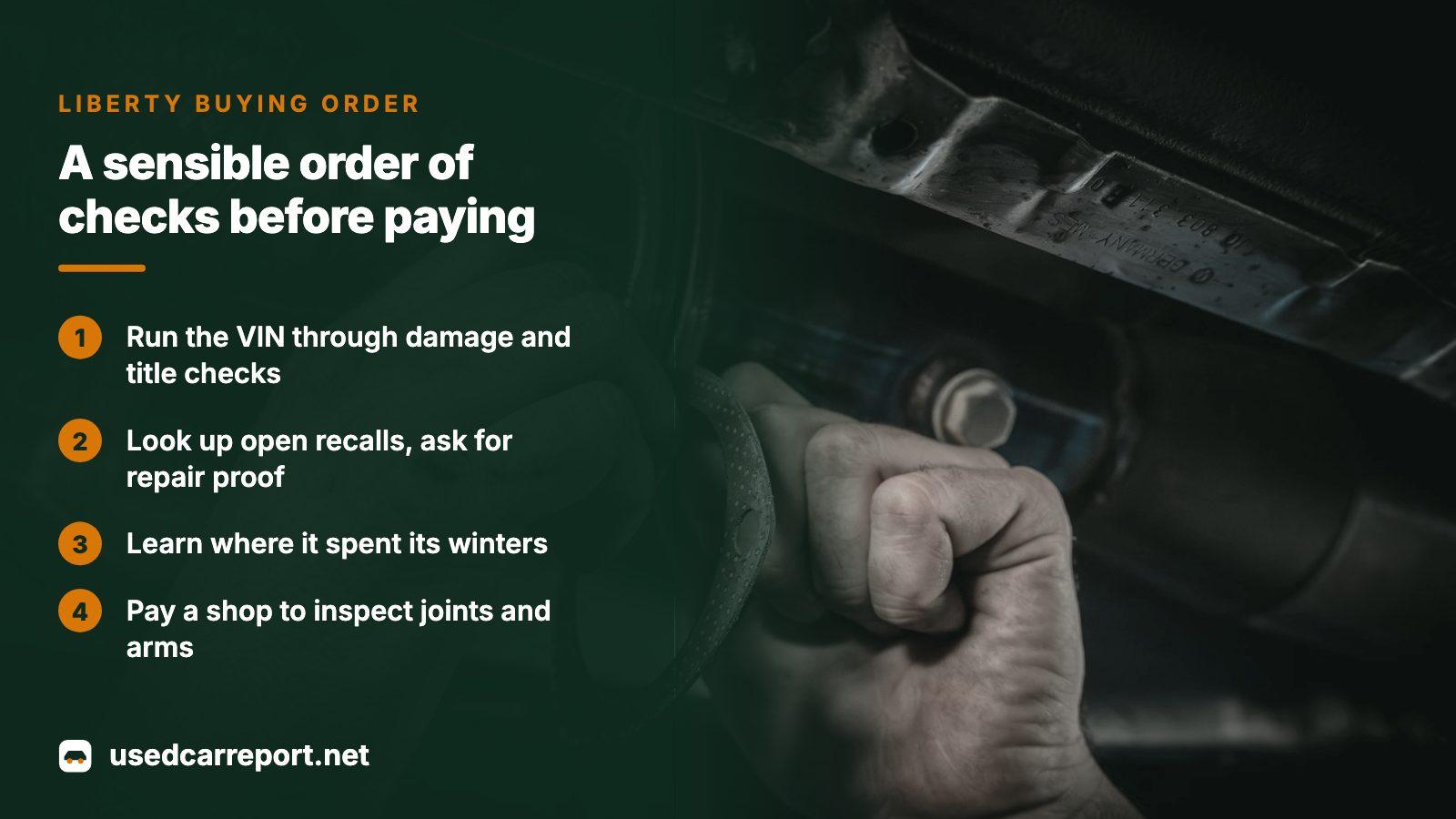
- Pick the model year, then run the VIN through the damage and title check.
- Look up open recalls for that VIN and ask for proof of completed repairs.
- Find out where the Liberty spent its winters, especially for 2004 to 2007.
- Pay a shop to inspect ball joints, rear control arms and the fuel tank area.
- Use any worn part or open recall to push the price down.
A Liberty seller who keeps the VIN to themselves has told you something.
Where this information comes from
- NHTSA owner complaints API: Jeep Liberty 2006 — Source of the complaint, crash and component counts for each model year.
- NHTSA recalls API: Jeep Liberty 2005 — Source of the campaign numbers, dates, vehicle counts and remedies.
- NHTSA owner complaint 11716426 — owner experience, paraphrased
- NHTSA owner complaint 11490014 — owner experience, paraphrased
- VehicleHistory.gov: NMVTIS for consumers — Justice Department explanation of the national title system behind vehicle history reports.
Sources and photos: Facts checked against the sources above in November 2026. Photos by Benjamin Brunner, Martin Fennema and Leo_Visions on Unsplash; diagrams by UsedCarReport.
Keep reading
- Jeep Cherokee years to avoid: 2014, 2015 and 2019, plus the damage checkThe same year-by-year count method applied to the Liberty's successor.
- Buying a car with an open recall: read the damage record firstWhat to do when a VIN shows a recall that was never completed.
- Frame damage check: start with the accident and damage recordsHow to tell whether a hit reached the structure under the car.
- VIN accident check: read the damage records before you buyWhat accident and damage records on a VIN show and where they stop.
Frequently asked questions
What is the worst year for the Jeep Liberty?
On NHTSA owner complaints, 2002 is the worst with 1,807 reports, then 2006 with 1,371 and 2003 with 1,353. It also has 174 crash-flagged complaints, the most of any year. Treat that as a reason to inspect harder, because an individual car's repair and accident history still counts for more.
Which Jeep Liberty years are the most reliable?
By complaint volume, 2009 is quietest with 108, followed by 2011 with 181 and 2010 with 197. Those years also carry the fewest maker recalls. Complaint counts are not a reliability study, since newer cars and low-selling years naturally collect fewer reports, but they point to the better odds.
Was the Jeep Liberty ball joint recall enough?
Not always. Three campaigns addressed ball joints between 2003 and 2009, yet owners still describe joints failing after the fix or on VINs outside the recalls. Have a shop check the front end on any 2002 to 2006 car, whatever the paperwork says.
Does road salt matter when buying a Liberty?
Yes for 2004 to 2007. The rear lower control arm recall was written around corrosion from winter road salt, and it first reached cars from the snowy northern states. Ask where the car lived, check the recall status by VIN, and look at the arms yourself.
Can a VIN check tell me if a Liberty has bad ball joints?
No. A VIN report shows records such as damage entries, title brands and odometer readings, and it can show open recalls. It cannot see worn parts. Use it to rule out a hidden crash or salvage past, then have a mechanic inspect the suspension.
Now check the car itself
The guide explains what to look for. The report shows what this VIN has on record.