THE SHORT ANSWER
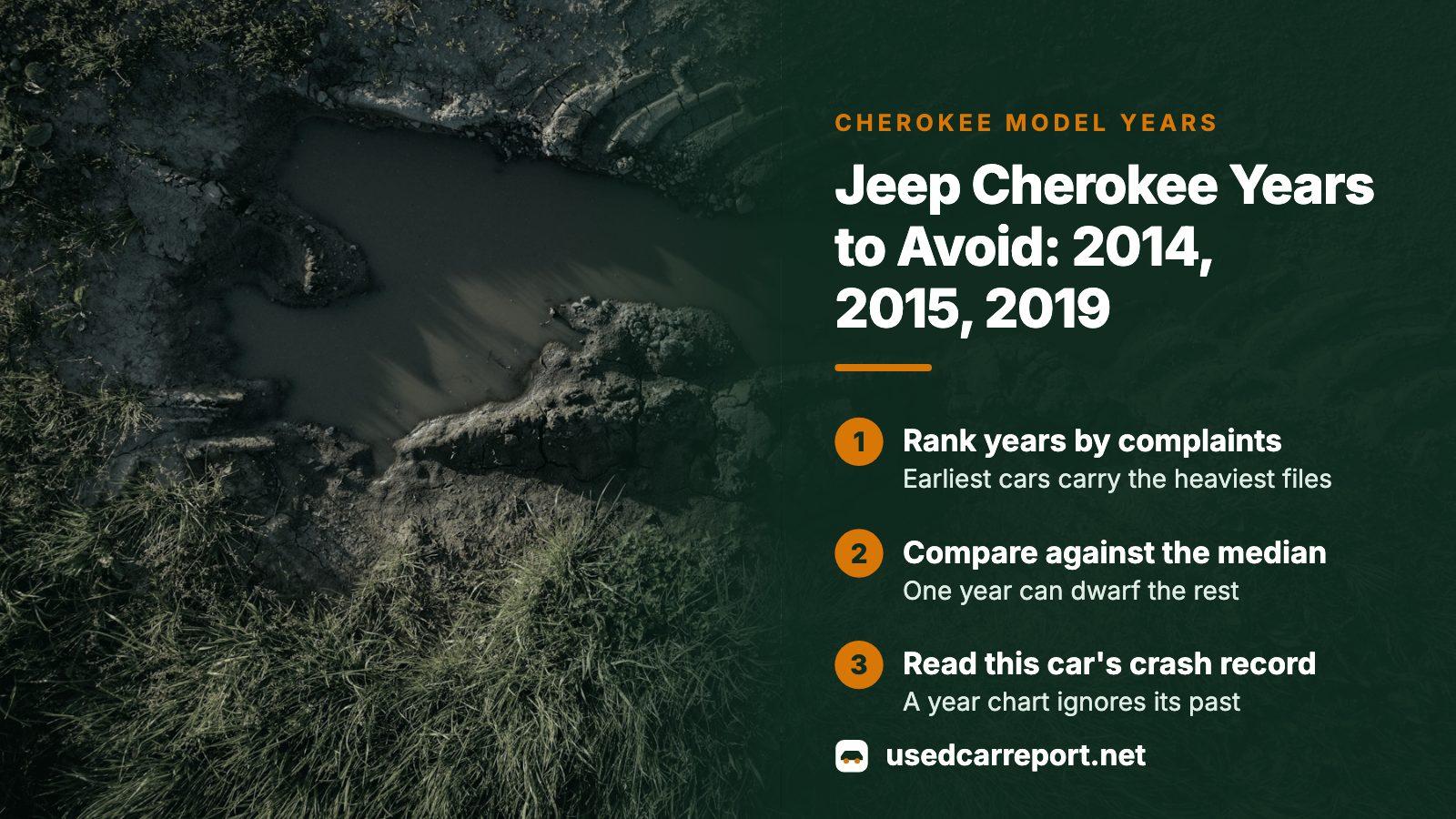
NHTSA holds 9,917 Cherokee complaints for 2014 to 2022, and the median year has 1,325. The heaviest files belong to 2014 with 2,639, 2015 with 1,780 and 2019 with 1,611. The lightest are 2022, 2021 and 2020, though those cars are young. Power train draws the most reports overall. A high-count year calls for a slower inspection, and the VIN's accident and damage history deserves a read before any haggling.
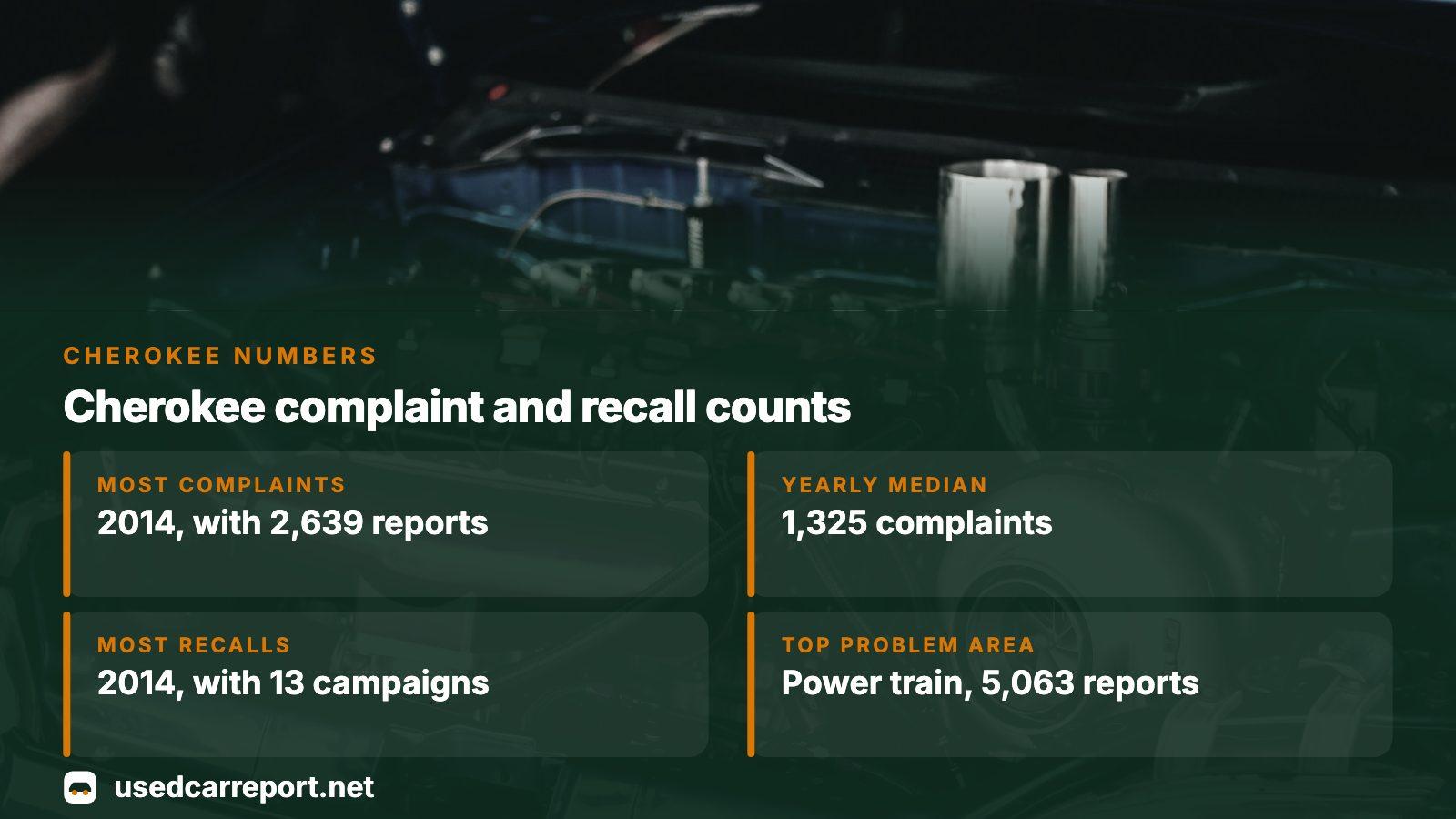
- Most complaints
- 2014, with 2,639 reports
- Yearly median
- 1,325 complaints
- Most recalls
- 2014, with 13 campaigns
- Top problem area
- Power train, 5,063 reports
All nine Cherokee years, ranked by complaints
NHTSA's file on this SUV, the modern one rather than the older boxy Cherokee, runs from 2014 to 2022 and holds 9,917 owner complaints, as pulled in August 2026. The middle year has 1,325, which is the 2017 total, so the third column divides each year by that median. A 1.99 for 2014 means nearly two ordinary years of complaints packed into one.
| Year | Complaints | Versus the median | Recalls |
|---|---|---|---|
| 2014 | 2,639 | 1.99 | 13 |
| 2015 | 1,780 | 1.34 | 11 |
| 2019 | 1,611 | 1.22 | 11 |
| 2016 | 1,403 | 1.06 | 9 |
| 2017 | 1,325 | 1 | 6 |
| 2018 | 681 | 0.51 | 7 |
| 2020 | 279 | 0.21 | 3 |
| 2021 | 151 | 0.11 | 4 |
| 2022 | 48 | 0.04 | 3 |
Three years sit clearly above the rest, and 2016 and 2017 hover at the median. Sales volume bends the picture too: a bestseller piles up more reports than a niche model of equal quality, so each year is measured only against the Cherokee's own median.
Why a damage record can outweigh the year ranking
Set a 2018 Cherokee (681 complaints, 0.51 of the median) beside a 2015 (1,780). On paper the 2018 wins. If it was hit hard, written off by an insurer and patched up, the 2015 that never met a collision may be the one you would rather own. A ranking describes thousands of SUVs; a crash happened to one.
Owners also file complaints about steering (120 reports) and service brakes (480), the very parts a past impact disturbs. A pull under braking could be a habit of the model or a careless repair, and only that SUV's own history can say which. Accident and damage records, title brands and insurance claims come first.
From an NHTSA owner complaint
A 2015 Cherokee owner wrote that the dealer called the car perfect but would not hand over a history report, and that the SUV had not been inspected. By the second day the engine was smoking and losing power, and the brakes needed seconds to slow it. A workshop visit changed nothing.
The lesson for a buyer: get the record in hand before the test drive, and read a seller's refusal as an answer.
2014 and 2015: the earliest cars carry the heaviest files
The 2014 Cherokee leads on complaints at 2,639 and on recalls at 13, with power train its biggest area. The 2015 follows with 1,780 complaints and 11 recalls. They are the oldest cars in the file, so they have had the longest to be driven hard, wrecked, repaired and resold.
Recall work has an age cutoff as well. Federal law at 49 U.S.C. §30120(g) stops requiring a free remedy once 15 years have gone by after first sale, and the 2014 cars are well into that window. Settle any open campaign before agreeing on a price.
From an NHTSA owner complaint
The buyer of a used 2014 Cherokee wrote that 13 recalls turned up later and nobody had mentioned them. In that complaint the owner's mother was driving on a major highway when warnings appeared, the power steering seized and the entire SUV shut off. She guided it to the roadside. No repair or outcome is described.
Worth remembering: a recall count describes a model year, while whether a campaign is still open belongs to one VIN. Ask which were done, and get the paperwork.
2018 to 2019: a quiet year, then a jump
The biggest swing in the table is between two neighboring years. The 2018 cars draw 681 complaints, roughly half the median, with 7 recalls. The 2019 cars draw 1,611, or 1.22 times the median, with 11 recalls. Then the count falls to 279 for 2020.
A swing this size means the two years deserve separate verdicts, and a calm 2018 says little about a 2019. The 2016 and 2017 cars, at 1,403 and 1,325, sit near the middle with 9 and 6 recalls. If a seller leans on the year alone, ask for power train service records and a VIN history instead.
The lightest years, and what a thin file leaves out
- 2022: 48 complaints, 0.04 of the median, 3 recalls.
- 2021: 151 complaints, 0.11 of the median, 4 recalls.
- 2020: 279 complaints, 0.21 of the median, 3 recalls.
These are the quietest records, but they belong to the youngest cars, which have had the fewest owners and the least road time to generate complaints. A thin file also says nothing about one SUV's past: a 2021 Cherokee can still have a salvage auction behind it, and only a record attached to its VIN would show that.
Where Cherokee owners report trouble, and what to test
- Power train, 5,063 reports, the biggest category: drive it from a cold start, feel for hesitation or a harsh shift, and ask whether the transmission has had work.
- Engine, 2,121 reports: ask for service records, listen to a cold start and look for fresh oil underneath.
- Electrical system, 2,002 reports: work every switch, window and screen, and watch the warning lights through a long drive.
- Unknown or other, 1,675 reports: a catch-all with no single part to test.
- Service brakes, 480 reports: brake firmly from road speed and watch for pulling or a soft pedal.
- Steering, 120 reports: check for wander at speed and uneven tire wear, then compare with the damage record.
Use the list as a test-drive order, not a forecast. The totals blend every year from 2014 to 2022, so a mechanic's lift inspection tells you more than any tally.
Mileage is a record you can compare before paying
Private sales make an odometer story hardest to test, because the only evidence is the dash and the seller's word. Dated odometer readings from earlier records give you a line to hold the dash against.
From an NHTSA owner complaint
One 2014 Cherokee buyer in a private sale reported a mileage mismatch: the odometer read 114,000 at purchase and 216,000 when the car was registered. The complaint does not say how it ended.
A reading that jumps or drops between records means pausing the deal until the seller explains.
Run the VIN on the Cherokee you are actually considering
The 17 characters are printed in two spots. One is a tag set low and visible from outside the car, the other a sticker along the edge of the driver's door. Shoot a photo of each and match them against the title. The model year is coded in the tenth position, a fast cross-check of the ad.
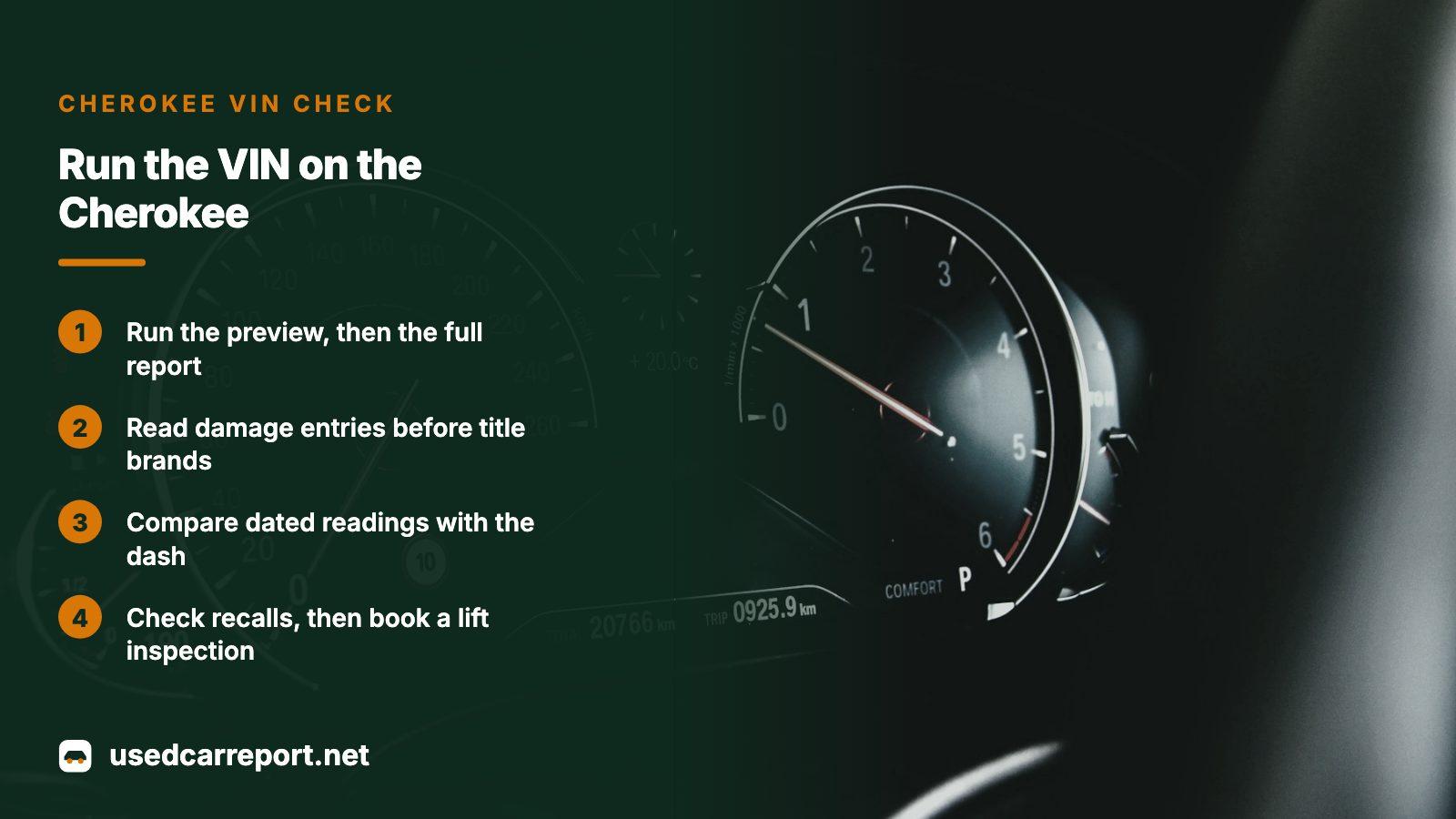
- Enter the VIN in the free preview, then open the full report on any Cherokee still in the running.
- Read accident and damage records first, then title brands, salvage and auction photos, and insurance records.
- Hold the dated odometer readings up against the dash.
- Check open recalls on the report or in NHTSA's lookup, and ask for proof that old ones were fixed.
- Book an independent mechanic for a lift inspection.
Only the preview is free. A full report is bought once and nothing renews, and buyers lining up several Cherokees can take a multi-report set instead. Rates are on the pricing page.
Where this information comes from
- NHTSA: vehicle safety and the complaint database — Where owner complaints about the Cherokee are filed and can be searched by vehicle.
- NHTSA: recalls by vehicle — Looks up open recall campaigns for a single car from its VIN.
- NMVTIS: national motor vehicle title information system — The federal title-record program behind brand and total-loss data on one vehicle.
- NICB: VINCheck — A theft and total-loss screen for one VIN.
- NHTSA owner complaint 11743446 — owner experience, paraphrased
- NHTSA owner complaint 11774521 — owner experience, paraphrased
- NHTSA owner complaint 11665682 — owner experience, paraphrased
Sources and photos: Facts checked against the sources above in November 2026. Photos by Bernd 📷 Dittrich, Viktor Theo and Willian Cittadin on Unsplash; diagrams by UsedCarReport.
Keep reading
- VIN accident check: read the damage records before you buyWhat accident and damage records show on a VIN, and where they fall short.
- Buying a car with an open recall: read the damage record firstHow to handle a campaign that is still unrepaired when you buy.
- Jeep Compass years to avoid: 2018 leads, but read the VIN's damage recordThe same year-by-year complaint comparison for the smaller Jeep.
- Pre-purchase inspection: read the damage records, then hire the mechanicWhat to hand an independent mechanic once the record checks out.
Frequently asked questions
What are the worst years for the Jeep Cherokee?
On NHTSA owner complaints, 2014 is worst with 2,639 reports, followed by 2015 with 1,780 and 2019 with 1,611. The median year has 1,325. A flagged year means a longer inspection and a lower opening bid, and it does not prove any one SUV is bad, so read that SUV's accident and damage record as well.
Is the 2014 Jeep Cherokee a bad year?
Its file is the heaviest of the nine: 2,639 complaints, nearly twice the median, plus 13 recalls, with power train the leading area. It is also the oldest year, so it has had the longest to be driven, crashed and resold. One with service records, finished recalls and a clean damage history can still be a fair buy.
Which Jeep Cherokee years have the fewest complaints?
By count, 2022 (48), 2021 (151) and 2020 (279) have the lightest files. Those cars are young, with fewer owners and less time to report anything. Among the older years, 2018 stands out at 681, but 2019 right after it reaches 1,611.
What do Jeep Cherokee owners complain about most?
Power train, by a wide margin, with 5,063 reports across 2014 to 2022. Engine follows at 2,121 and the electrical system at 2,002. Those totals blend all nine years, so treat them as a test-drive checklist, not a forecast for one Cherokee.
Do I still need an accident check on a Cherokee from a low-complaint year?
Yes. A low count describes how a batch of owners reported problems, not what happened to one SUV. Even a 2021 or 2022 car can carry a collision, a total-loss brand or a salvage auction in its past, and only a record tied to the VIN shows that before you pay.
Now check the car itself
The guide explains what to look for. The report shows what this VIN has on record.