THE SHORT ANSWER
Type in the VIN, then read the accident and damage section before anything else. It shows insurer total-loss decisions, damage entries and salvage auction photos linked to that car. Claims that never reached a database, such as a body shop paid in cash, do not appear, so a quiet result proves little. Treat each entry as a lead to confirm on the car and with the seller.
- Report starts with
- Accident and damage records
- Preview
- Free, before you pay
- Full report
- One payment, no subscription
- Never on file
- Repairs paid out of pocket
What a claim check pulls up for one car
Insurers do not publish claim files, so a history report works from the trail a claim leaves behind. This is what that trail looks like, in the order worth reading it.
| Entry | What it tells you |
|---|---|
| Accident or damage record | A collision or damage event reached a source that reports, though the size of the damage is rarely stated |
| Total loss decision | An insurer wrote the car off, which can follow theft or flood as well as a crash |
| Salvage auction photos | The car was sold on after the claim, often with the damage visible |
| Title brand | A state recorded salvage, rebuilt or flood status on the title |
| Odometer reading with a date | A mileage point to hold against the date of the claim |
How a claim turns into a record you can read
After a collision an adjuster or appraiser usually inspects the car and writes an estimate. When the repair bill is judged too high, the insurer treats the car as a total loss and it moves on to a salvage pool, an auction or a yard. Insurers that underwrite auto coverage must report those salvage and total-loss decisions to the federal title system every month, even when no claim money changes hands, as with a third-party claim.
| Where it sits | What it holds | Who reads it |
|---|---|---|
| Federal title system (NMVTIS) | Insurer total-loss and salvage decisions, title brands, odometer readings | Buyers, through an approved provider |
| NICB VINCheck | Flood damage, theft without recovery, salvage declarations | Anyone who enters a VIN |
| Claims file (CLUE) | Up to seven years of auto claims plus driving behavior data | The person it describes, and insurers |
| Vehicle history report | Accident and damage records, insurer entries, auction photos and brands for the VIN | Whoever buys it |
Steps to run it, and what to read first
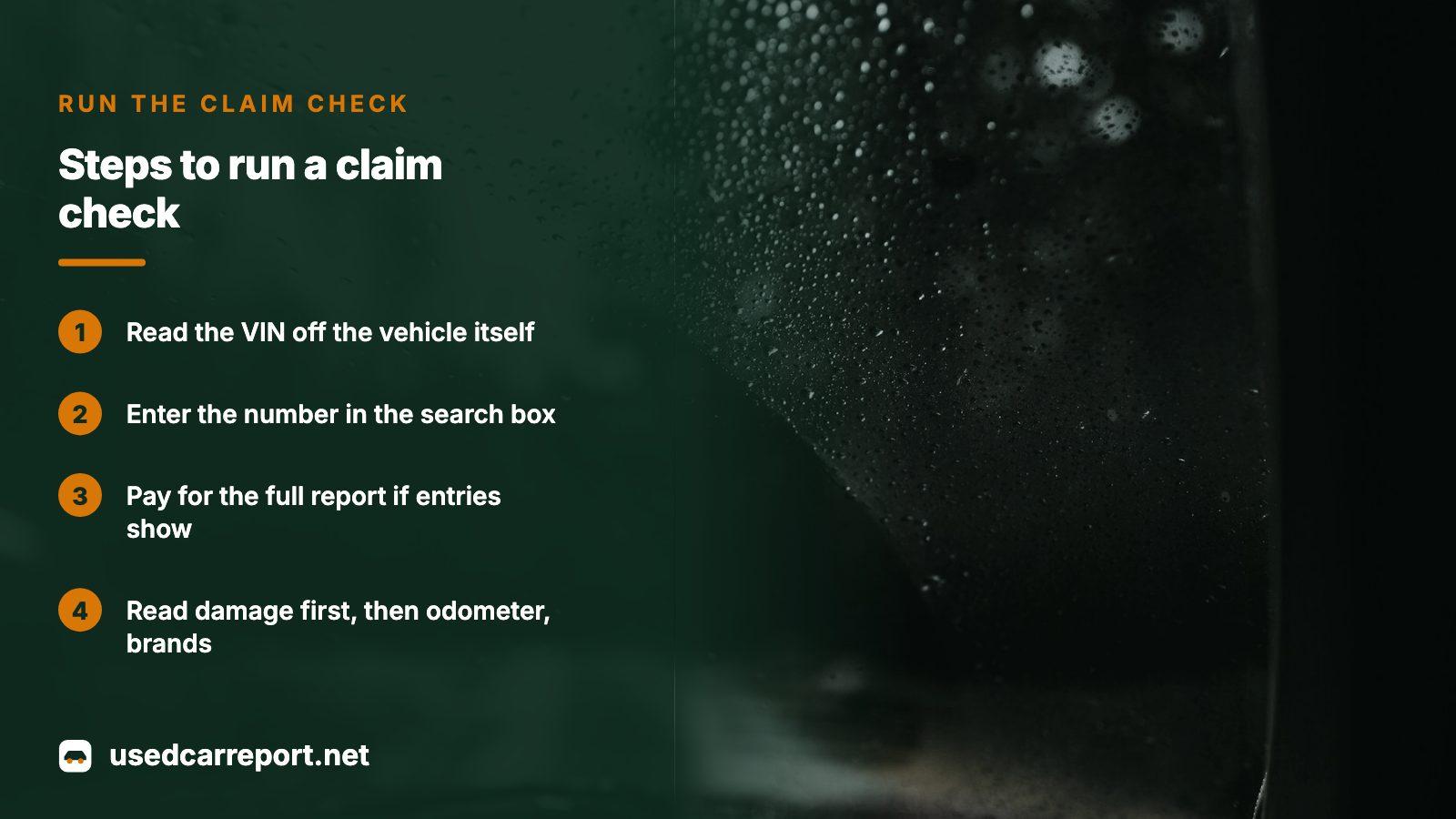
- Read the VIN off the vehicle itself, all 17 characters, and compare it with the title. A dealer's Buyers Guide prints the number too, but a printout can describe another car.
- Put the number into the search box here. The preview carries no charge and lists the record types found for that number.
- Pay for the full report if the preview lists insurer or damage entries, or if you are close to handing over money.
- Open the accident and damage section first, then odometer readings, then title brands. Write down every date.
Dates do the most work here. A damage entry from two owners back reads very differently from one logged last spring.
Reading an entry and choosing your next move
| Entry | What it likely means | Next move |
|---|---|---|
| Damage entry, no insurer named | Something happened, but size and location are unknown | Use it to decide where the inspector looks first |
| Total loss, then a rebuilt brand | The car was written off, then repaired and cleared by safety and anti-theft inspections | Price it as a branded car and pull the state's title file |
| Total loss, no brand shown | Brand rules differ by state, or no brand was ever applied | Ask which state titled it and who did the repair |
| Salvage auction photos | The car sold on after a claim | Match each photographed panel to the real one |
| Mileage drops after a damage date | A rollback or a data error | Get both readings in writing and walk if the drop has no explanation |
A total loss is a judgment call, and states draw the line
California's insurance department says a standard policy generally pays the lesser of the repair cost and the car's actual cash value, which the department equates with fair market value unless the policy states another definition. Texas defines a salvage vehicle by repair cost passing a share of retail value, and says each jurisdiction sets that share. The same damage can therefore be branded in one state and left unbranded in another.
Once a car is written off, its remaining worth is usually set by bids from salvage buyers. That is how a wrecked car ends up in auction listings with photos.
A write-off is not always a wreck
A car stolen and never recovered within 30 days may be written off by its insurer. Found later in good shape, it keeps the write-off label on its record and can still be perfectly drivable. Read the cause and the dates before you read the label.
What a claim check cannot see
A claim check reads records, not cars, and a record exists only if somebody reported. The gaps are predictable.
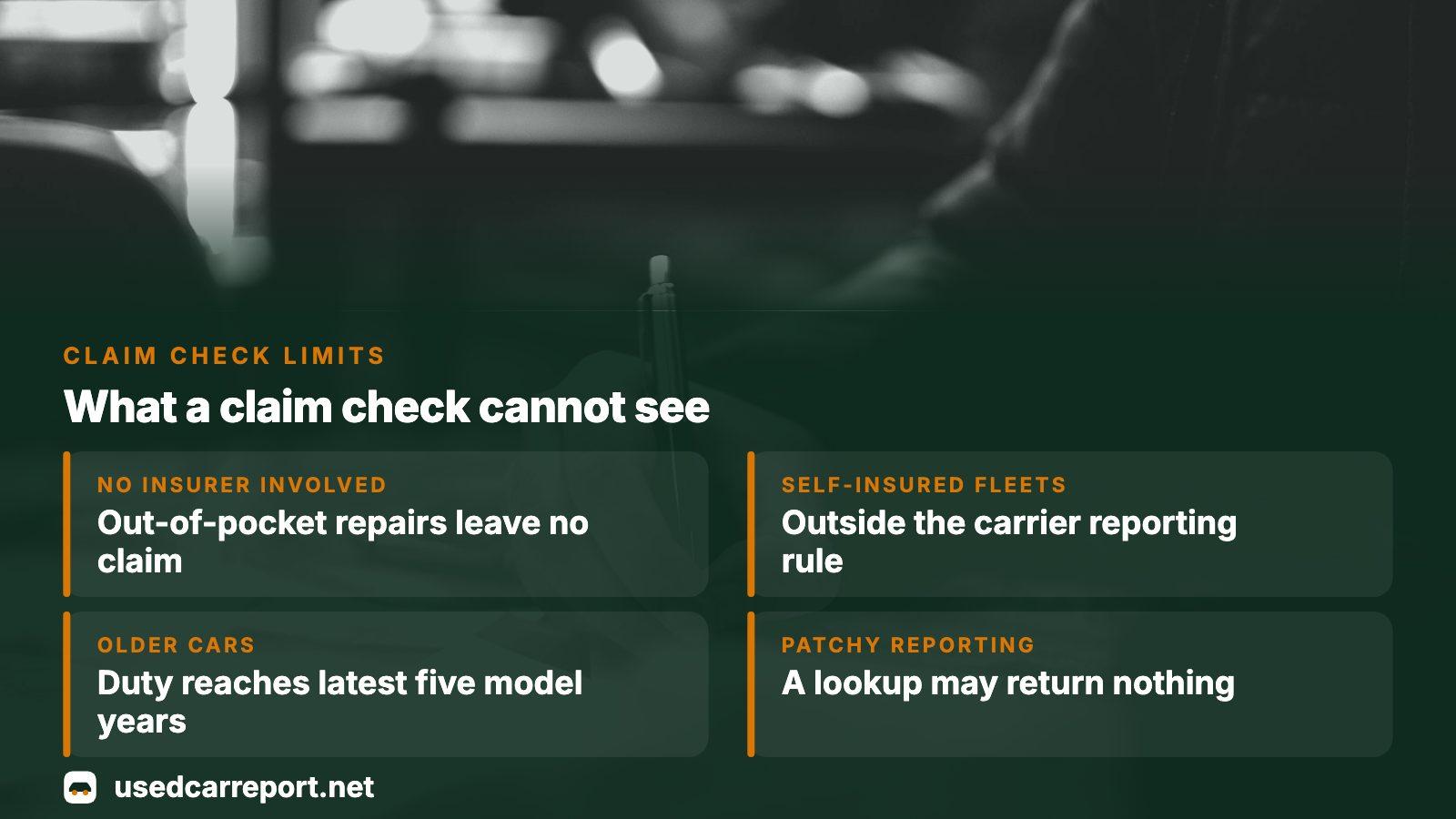
- No insurer involved: a repair paid out of pocket leaves no claim to report.
- Fleets that insure themselves: the carrier reporting rule does not cover them.
- Older cars: the carrier duty reaches only the latest five model years, so for an older car, pull the state's own title file too.
- Patchy reporting: until every entity files, a lookup may return nothing for a car that does have a history, and private databases can have the same holes.
- Repair quality: the federal record leaves repair history out, and reports usually miss mechanical faults.
Asking the seller for a claims history of their own
Insurers lean on a separate claims file known as CLUE, which holds up to seven years of auto claims. According to the CFPB, each person is entitled to one free copy of their own file per 12 months, and firms that owe the free annual copy have 15 days to supply it.
A seller who owns the car can request theirs and show it to you. That takes time, so ask early rather than on the day of the sale. Use it beside the VIN's own history, since each shows a different slice of the record.
What it costs: free preview, then one payment
The preview comes first, at no charge, and says whether insurer or damage entries are attached to the VIN. Reading the whole report takes one payment per car. A shortlist can be covered with a bundle holding 3, 5 or 10 reports. Nothing renews, since no subscription exists, and the pricing page gives the current figures. Buy when the preview shows entries worth reading, or when a hidden write-off would change your offer. Skip it for a car you have already ruled out.
After the check: inspect, price it, or leave
- No entries: you still need the mechanic, because the record only covers what was reported.
- Entries the seller can document: ask for the repair invoice, then let an inspector confirm the work before you negotiate.
- Entries the seller cannot explain, such as an unmatched write-off or a mileage drop: move on to another car.
Get the inspection findings in writing
The FTC suggests hiring an independent mechanic, certified car or not, and requesting a written estimate of repair costs that lists the make, model and VIN. That estimate is your lever on price. A dealer who refuses any independent inspection has told you to shop elsewhere.
Where this information comes from
- NMVTIS: Consumer information — Shows how insurer total-loss decisions appear in the federal title record, and where that record has gaps.
- NMVTIS: Frequently asked questions — Source for the carrier reporting duty: monthly filings, the model-year window and the fleet exemption.
- CFPB: LexisNexis C.L.U.E. report — Explains what the owner's claims file holds and how a person can request a copy.
- California Department of Insurance: After an accident, what next — Covers how adjusters estimate damage, the lesser-of rule for payouts and how salvage value is set.
- Texas DMV: Title check, look before you buy — Defines salvage, rebuilt and junk, and says to add a mechanic's inspection to a history report.
- FTC: Used cars — Points buyers to history reports and to NICB VINCheck for flood, theft and salvage flags.
- FTC: Buying a used car from a dealer — Says a history report is no stand-in for an independent inspection, and how to use a written estimate.
Sources and photos: Facts checked against the sources above in November 2026. Photos by Maxim Tolchinskiy, Justin Cron and Owen Michael Grech on Unsplash; diagrams by UsedCarReport.
Keep reading
- VIN accident check: read the damage records before you buyThe full walk-through of reading a VIN accident check.
- Salvage title check: five steps, damage records firstWhat a salvage or rebuilt brand means after a write-off.
- Car accident history with pictures: what a VIN check showsHow auction and damage photos fit into the record.
- Pre-purchase inspection: read the damage records, then hire the mechanicThe hands-on step that covers what no claim record holds.
Frequently asked questions
Can I see the insurance claims on a car I do not own?
Not as a claims file. The CFPB describes that file as something a person requests for their own record. What a buyer can read is what claims leave on the vehicle: total-loss and salvage decisions, title brands, damage entries and auction photos. Ask the seller to share their own claims report for the owner's side.
Does a claim on a car always mean a crash?
No. A write-off can follow theft or flood as well as a collision. The federal title site says a stolen car can be labeled a total loss after 30 days unrecovered, and the FTC points to NICB VINCheck for flood damage and unrecovered thefts. Check the cause and the date before judging the car.
How soon does a new claim show up?
Not instantly. Carriers file their total-loss and salvage reports monthly, and state title offices update at different speeds, from real time to a few days. A wreck from the past few weeks may therefore be missing. If a car was just repaired, ask the seller for the date of the damage and compare it with the report.
Is a clean claim check enough to skip the inspection?
No. According to the FTC, no history report replaces a mechanic's independent inspection, and reports usually miss mechanical faults. The federal title record leaves repair history out entirely. A mechanic can check the car itself, which is where unreported damage shows up.
The seller's report is clean but mine shows a total loss. Who is right?
Possibly both, since reports draw on different records and none is complete. The federal title site warns that a lookup can return nothing for a car with a history. Ask the seller to explain the entry, pull the state's title file, and have the car inspected before you decide.
Now check the car itself
The guide explains what to look for. The report shows what this VIN has on record.