THE SHORT ANSWER
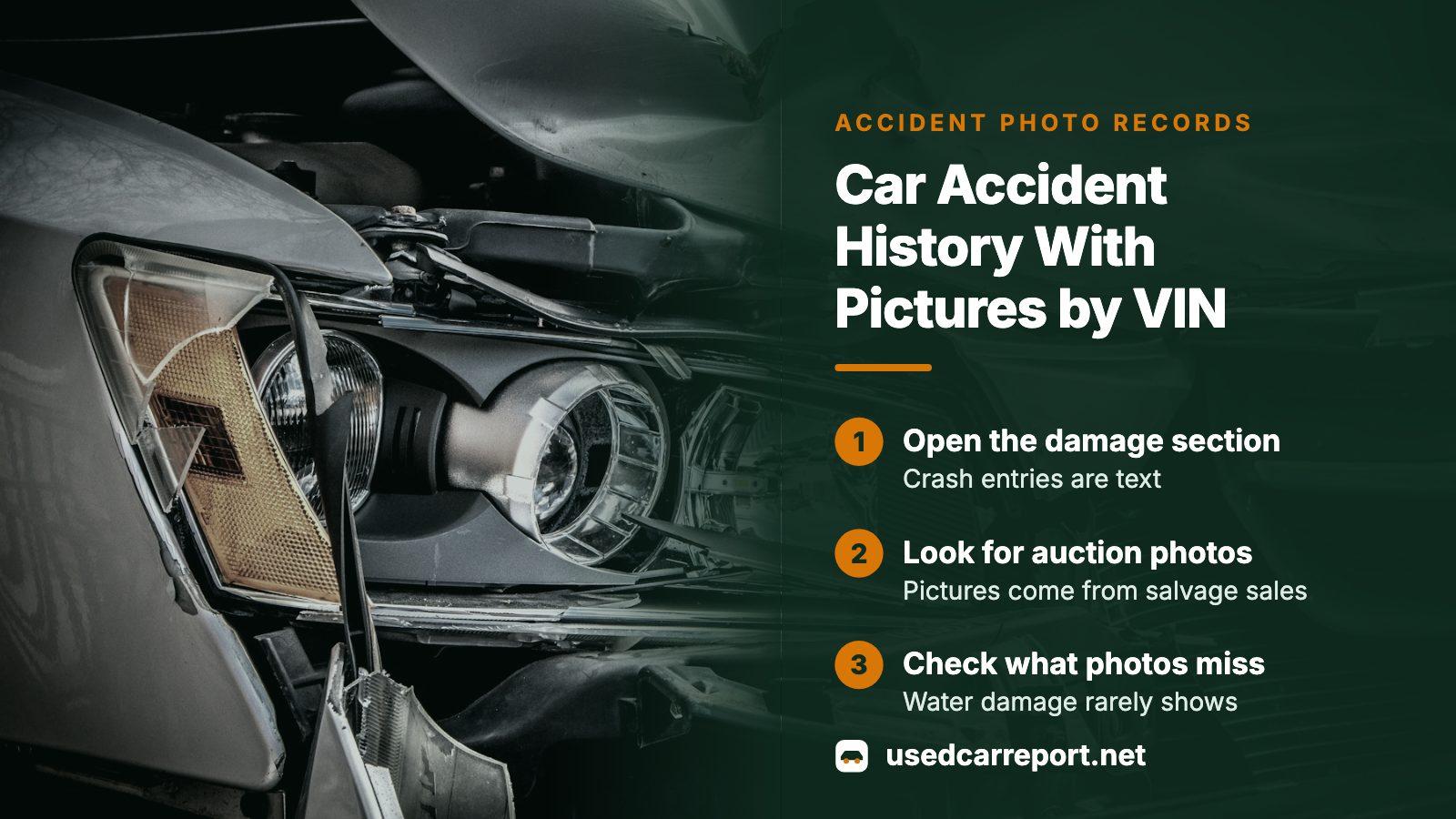
Enter the VIN and open the accident and damage section. Crash entries are text. Pictures appear only where the car went through an auction or salvage sale, because that is when someone photographed the damage. The federal title record holds no photos, so a car with no pictures has not been cleared. Match each photographed panel to the real one, then pay for an inspection.
- Report opens with
- Accident and damage records
- Pictures come from
- Auction and salvage sales
- Preview
- Free, shows which records exist
- Full report
- One payment, no subscription
Entries and photos are different kinds of evidence
People who search for accident history with pictures usually hope to see the crash itself. That image almost never exists. What exists is a set of entries written by whoever reported an event, plus photographs from one specific moment: when a damaged car was offered to bidders. The federal title record behind many reports covers title state, brands, mileage, total loss and salvage history, and none of those five is a picture.
| Record | Where it comes from | Picture on file? |
|---|---|---|
| Accident entry | A collision reported to an insurer, a police agency or another source | No, text only |
| Damage entry | A note that damage happened, often with no size or location | No, text only |
| Total loss or salvage entry | An insurer or salvage yard reporting a car it took in | No, text only |
| Title brand | A state titling agency applying a label | No, text only |
| Auction or salvage listing | A sale of the car in damaged condition | Yes, if that sale was captured |
So the pictures belong to the sale, not to the collision. Keep that in mind when you read them.
Running the VIN before you ask the seller for photos
- Take the 17-character number from the vehicle itself rather than the advert. The Buyers Guide a dealer prints also carries it, which gives you a second copy to compare.
- Enter the VIN on this site and read the preview. Its summary names the record types held for that car, and you have paid nothing at that point.
- Open the full report when the preview shows accident, damage, auction or total loss entries, or when a hidden collision would change your offer.
- Read the accident and damage section first, and look at any photos before the paperwork.
Run this before you travel and the result tells you which panels to examine first. Run it after the visit and it tells you what you walked past.

Reading a photo set: from picture to panel
Auction photos show a car as it arrived, before anybody repaired it. That makes them a work list. Every damaged area in a picture is a place a repairer had to fix, and each one can be checked on the car in front of you.
| In the photos | On the car, check |
|---|---|
| A pushed-in corner or bumper | Gaps and alignment at that corner, paint edges, and lamps that do not match |
| Deployed airbags or a torn dash | Curtain and seat airbags, not only the wheel one, plus the restraint warning light |
| A bent wheel arch or fender | The inner fender structure, where repair work shows |
| Wet carpet or mud in the cabin | Silt under the seats, loose or stained carpet, rust around the doors |
| A panel that looks newer than its neighbors | Why it was painted, and by whom |
Shoot the same views yourself
Take your own photo of each area the report shows, from the same angle, and lay the two sets side by side. A repair that vanishes at arm's length can still show in the seams.
When the report has no pictures
Most cars never reach an auction, so most reports carry no photos. That is neutral, not good news. A car repaired at a private shop and sold on the side leaves no sale to photograph. The records have gaps too. The Justice Department puts the national title system's reach at about 87 percent of vehicles, with more than half of the states reporting, and cautions that a clean search result may reflect a gap rather than a clear car.
- No entries and no photos: the car has no recorded history, which is different from a clean one.
- A total loss with no photos: ask what caused it. A stolen car still missing after 30 days may be booked as a total loss; if it turns up undamaged later, the label stays.
- Photos but no repair invoices: the car was sold damaged, so ask the seller who repaired it and where.
Water damage rarely shows up in a photograph
A flooded car can look fine in a picture. Water leaves its mark in carpet, beneath the seats and inside electrical parts, and saltwater can make electrical systems, airbag sensors among them, more likely to fail. The Justice Department recalls that cars flooded by Hurricane Katrina were reportedly hauled out of Louisiana, dried and cleaned, then sold in other states. Some states brand a flood car and some do not, though a brand once applied stays in the national record.
- Sand or silt under the seats and dashboard
- Carpet that is loose, stained or a poor match for the interior
- Rust around the doors
- Mold, decay or a heavy cleaning-product smell in the cabin or trunk
NICB sees only insured losses
Cars that were flooded, declared salvage, or stolen and never found can turn up on the free NICB VINCheck, provided they were insured when the damage happened.
Signs on the car that no picture reaches
- Inner fender structures that show heavy repair
- Dampness, mold or corrosion beneath the trunk carpet
- A VIN plate secured by something other than rivets
- A restraint warning light that stays on
- Airbag covers that seem to have been opened and closed again
- Safety labels missing from the doors, the hood or the tailgate
No single sign proves a crash. A cluster of them, or one that contradicts the seller's account, is reason enough to book a mechanic. The FTC points to an independent inspection as the way to find hidden damage, whatever a report says.
What it costs: preview first, one payment after
At no cost, the preview names the record types it found for your VIN. The full report, photos included where a sale produced them, is paid for once per car. Bundles of three, five or ten reports exist for anyone weighing several cars. There is no renewal, and current amounts are listed on the pricing page. Pay when the preview lists accident, damage or auction entries. If it shows little and the car is already ruled out, stop at the preview.
After the report: what each result means for your next move
- Nothing found: drive the car, then hand it to a mechanic. A quiet report earns a closer look, not a purchase.
- Entries and photos the seller can explain with invoices: use them to set your price, and let the mechanic confirm the repair.
- Salvage or rebuilt history: phone an insurance agent before you commit, because rebuilt cars are often refused cover. Ask where the repairs were done and whether the frame was aligned.
- A seller who refuses an independent inspection: the FTC suggests looking at another dealer.
Get the findings in writing
Ask the mechanic to put the findings on paper, naming the car's make, model and VIN beside a repair estimate. That estimate gives you a figure to negotiate with.
Local rules can help. California requires a licensed dealer to pull a title report before displaying a used car, and to post a disclosure on one with junk or salvage history or a brand. The DMV concedes that enforcement is difficult when a car arrives from out of state, so run your own check.
Where this information comes from
- DOJ BJA: Understanding an NMVTIS vehicle history report — The five indicators the federal title record holds, and what it leaves to private providers.
- DOJ BJA: NMVTIS for consumers — Coverage figures, false negatives, the total loss caveat and the flood example.
- FTC: Used cars — What history reports can show, and why an inspection still matters.
- FTC: How to steer clear of a flood-damaged car — Signs of flooding and what the NICB lookup covers.
- FTC: Buying a used car from a dealer — Advice on the written mechanic report and on a dealer who refuses an inspection.
- California DMV: Branded titles — Physical signs of past damage and the state's dealer disclosure rules.
- Texas DMV: Rebuilt vehicles — Questions to ask about a rebuilt car and the insurance warning.
Sources and photos: Facts checked against the sources above in November 2026. Photos by Clark Van Der Beken, Alejandro Escamilla and Patrick von der Wehd on Unsplash; diagrams by UsedCarReport.
Keep reading
- VIN accident check: read the damage records before you buyThe written crash and damage entries that sit beside the photos.
- Sample reportSee how the accident and damage section is laid out.
- How to tell if a car was in an accident: check the record, then the carWhat your own eyes can find on the car.
- Pre-purchase inspection: read the damage records, then hire the mechanicThe hands-on step that confirms a repair.
Frequently asked questions
Can I see pictures of a car's accident by VIN?
Only if the car was sold in damaged condition and that sale was captured. Those photos show the damage as it arrived at a salvage or auction sale. The federal title record stores no pictures, so most cars have none, however recently they were hit.
Does a free VIN check show accident photos?
The free tools answer narrower questions. NICB VINCheck screens for salvage, flood and unrecovered theft declarations on insured cars, and the NHTSA lookup lists open recalls. For accident entries and any sale photos, you need a full report after the preview.
Why does my report show an accident but no photos?
The entry and the photos have different sources. An accident entry comes from whoever reported the collision, while photos come only from a sale of the car in damaged condition. A repaired car that never went to auction has the first and not the second.
Is a car with accident photos worth buying?
It can be, at the right price. Compare each photographed area with the car, ask for repair invoices and have a mechanic check the structure. If the title carries a salvage or rebuilt brand, speak to your insurer first.
Can a car with a clean accident history still have been in a crash?
Yes. Reporting is incomplete, and federal guidance says a clean search should not be read as a clean history. A crash repaired privately may leave no record. Treat a clean result as a reason to inspect carefully, not as proof.
Now check the car itself
The guide explains what to look for. The report shows what this VIN has on record.