THE SHORT ANSWER
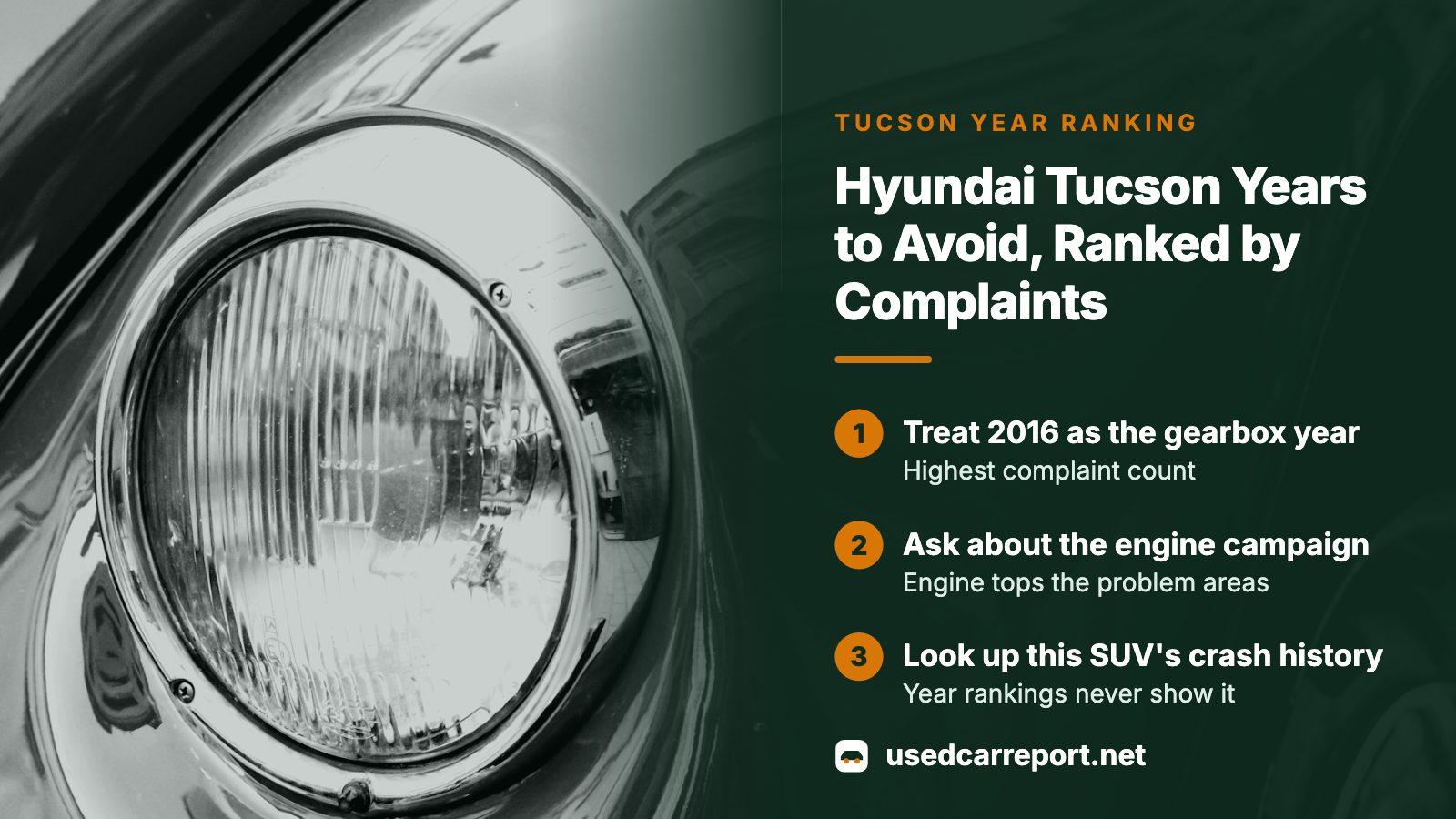
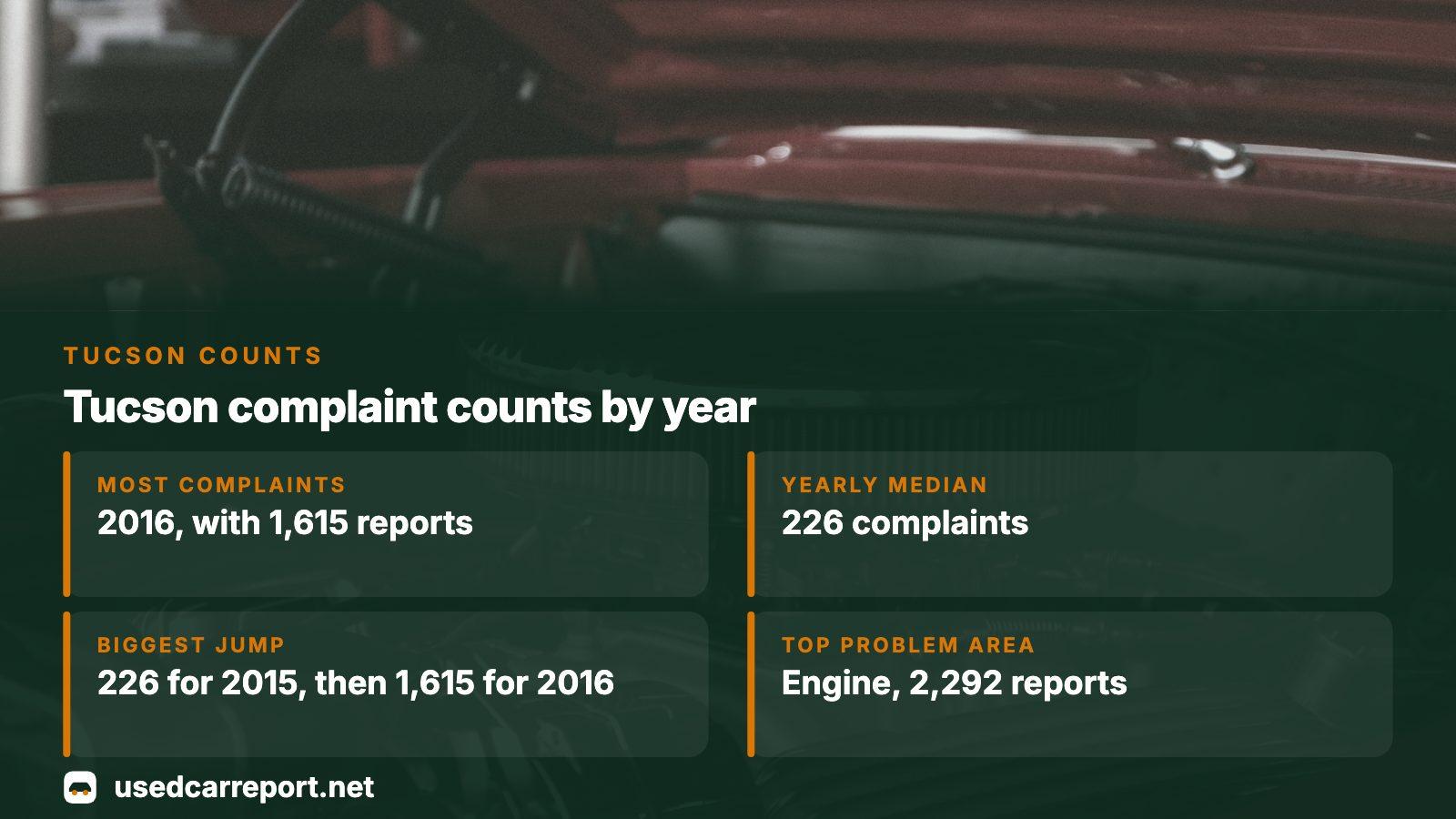
Owners have filed 5,380 NHTSA complaints about the Tucson across 2008 to 2022, and the median year holds 226. The 2016 model leads with 1,615, then 2017 with 1,079, 2022 with 487, 2018 with 388 and 2019 with 371. Power train trouble marks 2016 and engine trouble the years after it. The thinnest records are 2009, 2008, 2010 and 2021. Read the VIN's accident and damage entries before you trust any year.
- Most complaints
- 2016, with 1,615 reports
- Yearly median
- 226 complaints
- Biggest jump
- 226 for 2015, then 1,615 for 2016
- Top problem area
- Engine, 2,292 reports across all years
Five Tucson years sit above the pack
The record covers 15 model years, 2008 to 2022. Dividing each year's filings by the median of 226 gives a multiple, so 7.15 for 2016 means a little over seven ordinary years of complaints packed into one. Counts come from an August 2026 pull.
| Year | Complaints | Versus median | Leading area | Recalls |
|---|---|---|---|---|
| 2016 | 1,615 | 7.15 | Power train | 5 |
| 2017 | 1,079 | 4.77 | Engine | 3 |
| 2022 | 487 | 2.15 | Engine | 3 |
| 2018 | 388 | 1.72 | Engine | 1 |
| 2019 | 371 | 1.64 | Engine | 1 |
Recalls and complaints are not the same currency. A recall means Hyundai has conceded a flaw and owes the repair; a complaint is a single owner's story, unverified. The 2022 row also folds in the hybrids, which NHTSA lists under separate model names.
2016: the gearbox year
Filings leap from 226 for 2015 to 1,615 for 2016, and the power train leads. One campaign fits the pattern: 16V628000 covers 2016 Tucsons built from May 20, 2015 to May 31, 2016 with the seven-speed dual-clutch gearbox. In heat, tapping the pedal over and over could leave the SUV unable to move. Dealers fix it with a software update for the transmission control module, at no charge.
From an NHTSA owner complaint
A used-car buyer who took home a 2016 Tucson Limited Turbo in August 2018 reported hesitation from a standing start, and the dealer kept saying it was "because of the turbo". After a 2020 rear-end crash, the owner later found a brake-unit recall and suspects it was the cause. Warranty work then replaced the transmission, after 49 days without the car, and the engine in 2021. In 2023 the dealer said a warranty company had denied a new claim, and the company said none was filed.
Ask for the repair order showing the gearbox update, and ask whether any warranty is still live and who backs it. Owners also report the same symptoms on cars whose VINs fall outside the campaign, so give any 2016 a long test drive on a warm day.
2017: the engine campaign
Owners filed 1,079 complaints about the 2017, and the engine is named most often. Campaign 21V727000 covers certain 2017 Tucsons and Sonata Hybrids: connecting rod bearings can wear early, which risks engine damage, a stall or a fire. Dealers inspect the engine, replace it when the bearings are damaged and load software that adds knock detection. Owner letters went out in January 2022.
From an NHTSA owner complaint
A second owner who bought a 2017 Tucson in January 2021 wrote that the selling dealer never called or wrote about this recall in two years. A shop doing an oil change found no oil in the engine, though the oil light had never come on. The dealer replied that no recall applied and quoted a diagnostic charge, and a mechanic called the fault internal and refused the job.
NHTSA's lookup works from the VIN, so no letter has to find you first. Run it before you agree to a price, and ask for the invoice if a seller says the engine was inspected.
2018 and 2019: one brake-unit recall
Each year lists a single recall, and it is the same one: 20V543000. Corrosion inside the anti-lock brake control unit can cause a short circuit and set the engine compartment alight. Hyundai opened it for 2019 to 2021 Tucsons in September 2020, then on December 30, 2020 added certain 2016 to 2018 SUVs, so 2020 and 2021 are not clear of it either. Dealers replace a fuse, and until then owners are told to park outside, away from buildings. Brakes rank second behind the engine in the 2019 write-ups.
2022: newer, and still above the median
With 487 complaints, the 2022 is the only year after 2019 above the median, at 2.15 times it, and it is the newest year in the table. Owners' write-ups, many from 2026, keep describing failed fuel injectors that bring misfires, stalls and lost power, and NHTSA's list shows no injector recall. It does list three others: a lamp software fix dealers have finished, roof moldings that can work loose, and an optional tow-hitch wiring harness on 2022 to 2024 SUVs, which owners are told to park outside until it is repaired.
The quiet years, and the catch with each
- 2009: 18 complaints and 1 recall, the lightest record of any year.
- 2008: 43 complaints and 1 recall.
- 2010: 57 complaints but 4 recalls, one a 2023 anti-lock brake fuse campaign, again with park-outside advice.
- 2021: 76 complaints and 1 recall, the brake control unit again.
A low count can reflect how many SUVs were sold as much as how good they are. The oldest Tucsons also face a legal cutoff: once a car was first sold over 15 calendar years before a defect notice goes out, the maker no longer owes a free repair, so a future campaign may leave a 2008 to 2010 owner paying.
What no year ranking shows: this SUV's crash history
A complaint total describes thousands of Tucsons and says nothing about the one on the lot. Accident and damage entries, total-loss and salvage findings, title brands and odometer readings belong to a single VIN, and they can sink a fairly priced Tucson in any year, quiet or flagged.
From an NHTSA owner complaint
The owner of a 2018 Tucson told NHTSA the SUV hit two large deer on a highway. After the body work was done it ran sluggishly, shifted unevenly and ticked, then shut off on the road with the battery light on. The dealer called it a total loss from a blown engine, at under 50,000 miles, with the cause unknown.
The writer never says whether the crash was linked to the engine failure. The lesson is that a repair like that should be on record before anyone starts guessing at an engine fault.
Coverage has gaps, too. The federal title system gathers brands, odometer readings and insurer total-loss findings, but each state sets its own bar for branding a damaged car, so a written-off car can still return a clean search. That is why this site's report puts accident and damage entries first, and why the preview, which is free, is worth running before you drive out to see one.
Checking the Tucson in front of you
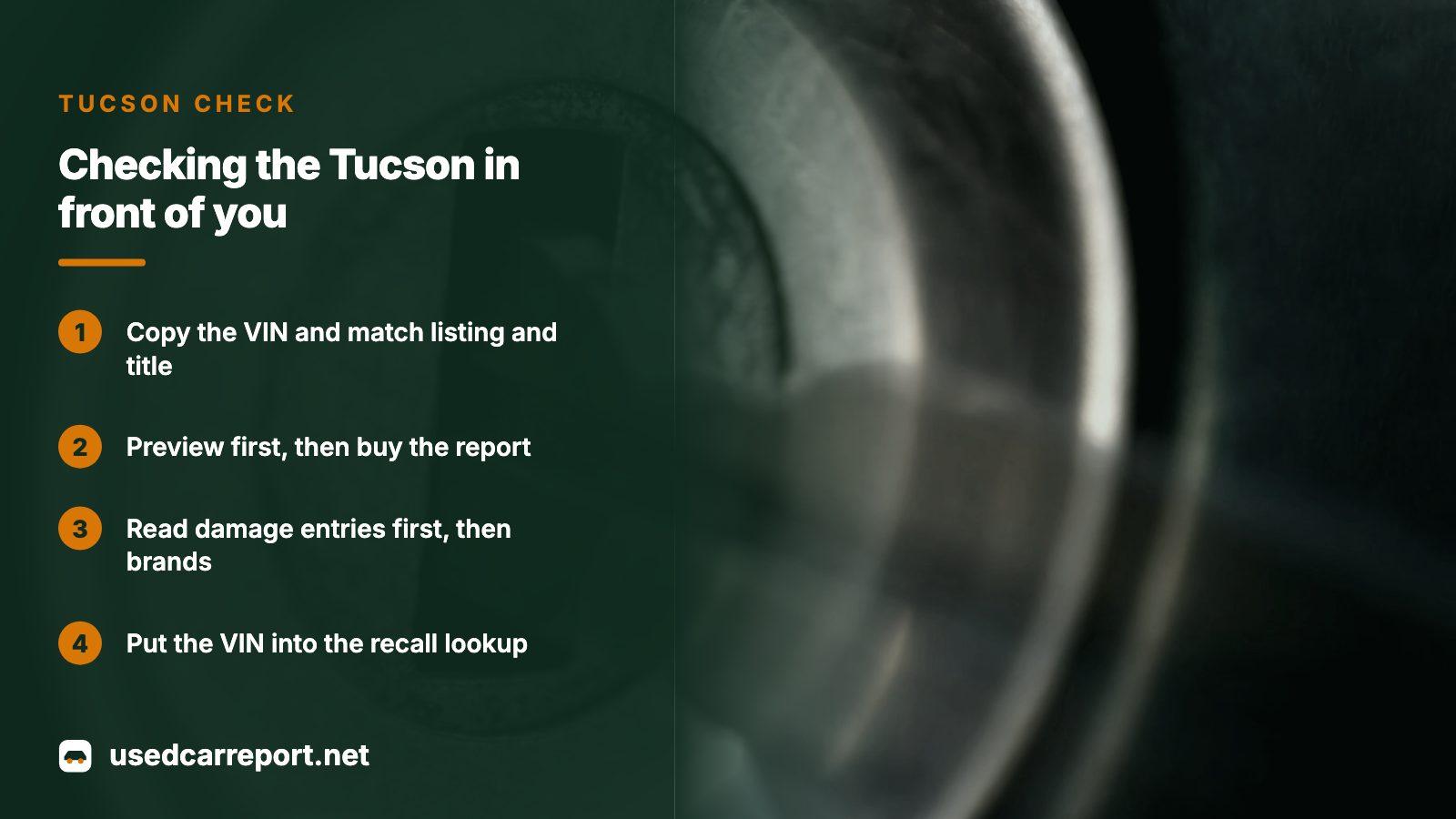
- Copy the VIN from the SUV itself and match it to the listing and the title.
- Run the preview first; it costs nothing. If the Tucson still looks good, buy the report once (the pricing page has the options) and read it before anything else.
- Read accident and damage entries first, then title brands, salvage or total-loss records and the odometer sequence.
- Put the VIN into NHTSA's recall lookup, then ask for repair orders covering the gearbox update, the engine inspection or the brake fuse, whichever fits the year.
- Hand the car to a mechanic, who should start with the gearbox on a 2016, the engine on a 2017 to 2019 and the fuel injectors on a 2022.
A flagged year means more questions for the seller and a keener price. It says little about the particular SUV waiting at the curb.
Where this information comes from
- NHTSA owner complaint 11515354 — owner experience, paraphrased
- NHTSA owner complaint 11564650 — owner experience, paraphrased
- NHTSA owner complaint 11324657 — owner experience, paraphrased
- NHTSA: recalls by vehicle — Where each campaign named above can be checked against one VIN.
- 49 U.S.C. 30120: remedy without charge — The 15-year limit on no-charge recall repairs.
- NMVTIS: for consumers — What the federal title system collects, and why a search can miss a written-off car.
Sources and photos: Facts checked against the sources above in November 2026. Photos by Rafał Karoń, Derek Nelson and Victor Hughes on Unsplash; diagrams by UsedCarReport.
Keep reading
- VIN accident check: read the damage records before you buyWhat accident and damage entries show about one car, and where they stop.
- Buying a car with an open recall: read the damage record firstWhat an unrepaired campaign means for the price and your first week of ownership.
- Hyundai Santa Fe years to avoid, and the damage record to read firstThe maker's other SUV, and a brake-fuse campaign that names both models.
- Pre-purchase inspection: read the damage records, then hire the mechanicWhat a mechanic checks on a lift before you commit to the car.
Frequently asked questions
Which Hyundai Tucson years are the ones to avoid?
Going by NHTSA complaints, 2016 and 2017 stand out, then 2022, 2018 and 2019, against a yearly median of 226. A busy year means inspecting harder and asking for paperwork; it does not prove that a given SUV is bad, because well-kept cars turn up in all of those years.
Is the 2016 Hyundai Tucson a bad year?
It draws the most complaints, 1,615, and carries 5 recalls. The power train is the leading area, and the build-range gearbox campaign is fixed with software. Whether a given 2016 is a problem depends on its repair orders, test drive and crash history, so judge that car, not the year.
What problem do Hyundai Tucson owners report most?
The engine, with 2,292 reports over the 2008 to 2022 span, ahead of the power train at 1,124. Write-ups mention oil use, knocking and stalls that come with little warning. Begin any inspection there, and ask the seller for oil-change records.
Which Tucson years are the most reliable?
NHTSA does not rate reliability; it records complaints and recalls. By that count 2009, 2008, 2010 and 2021 carry the thinnest records, and 2020 sits near the median at 175. Each has a recall on file, and the oldest cars are at or past the 15-year mark that can end free repairs on new recalls.
Will a VIN check show whether a used Tucson was in a crash?
It lists accident and damage entries, plus salvage and total-loss records, where they were reported. States report differently, so a clean result narrows the doubt rather than closing it. Get a mechanic's opinion before paying.
Now check the car itself
The guide explains what to look for. The report shows what this VIN has on record.