THE SHORT ANSWER
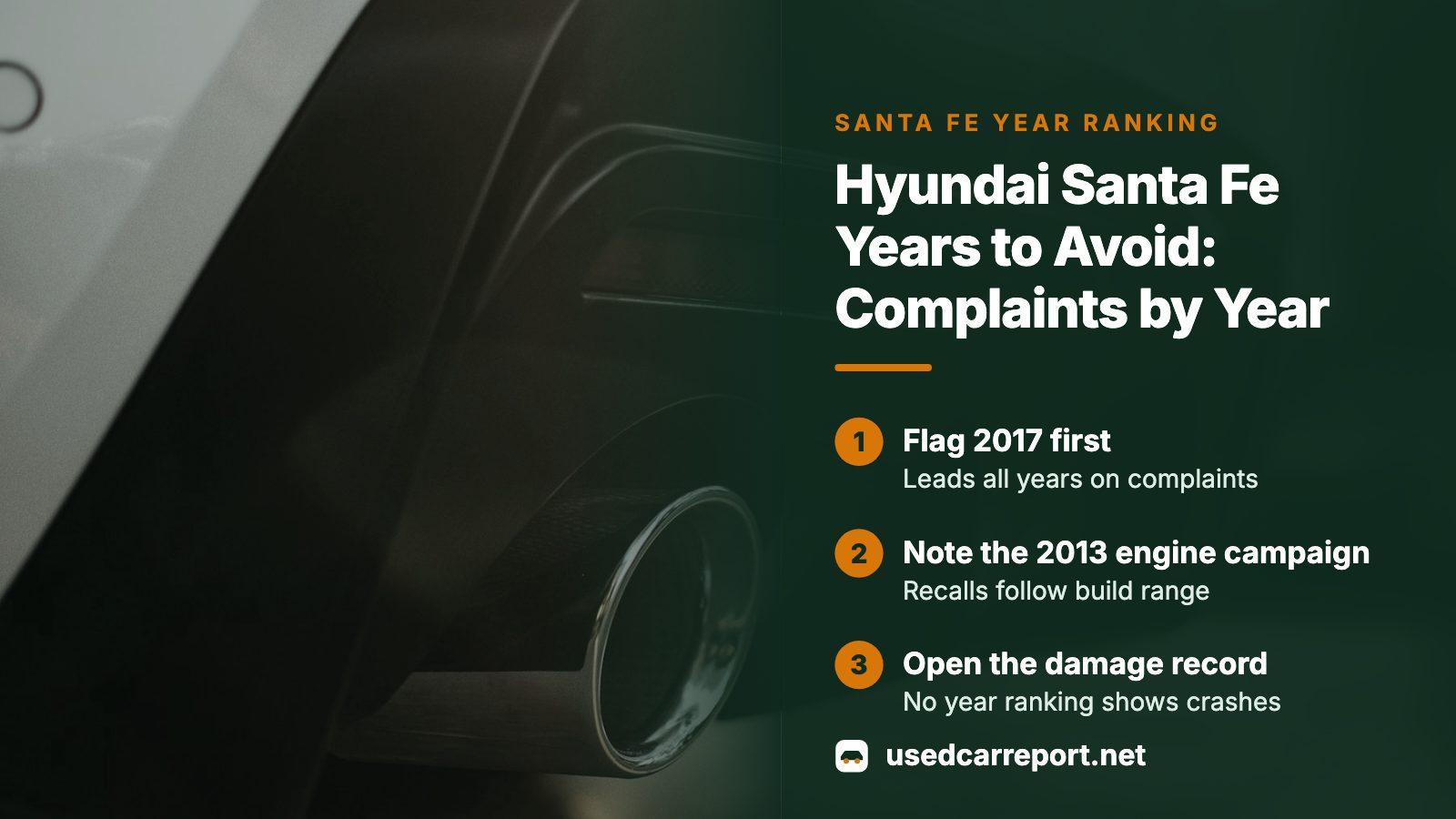
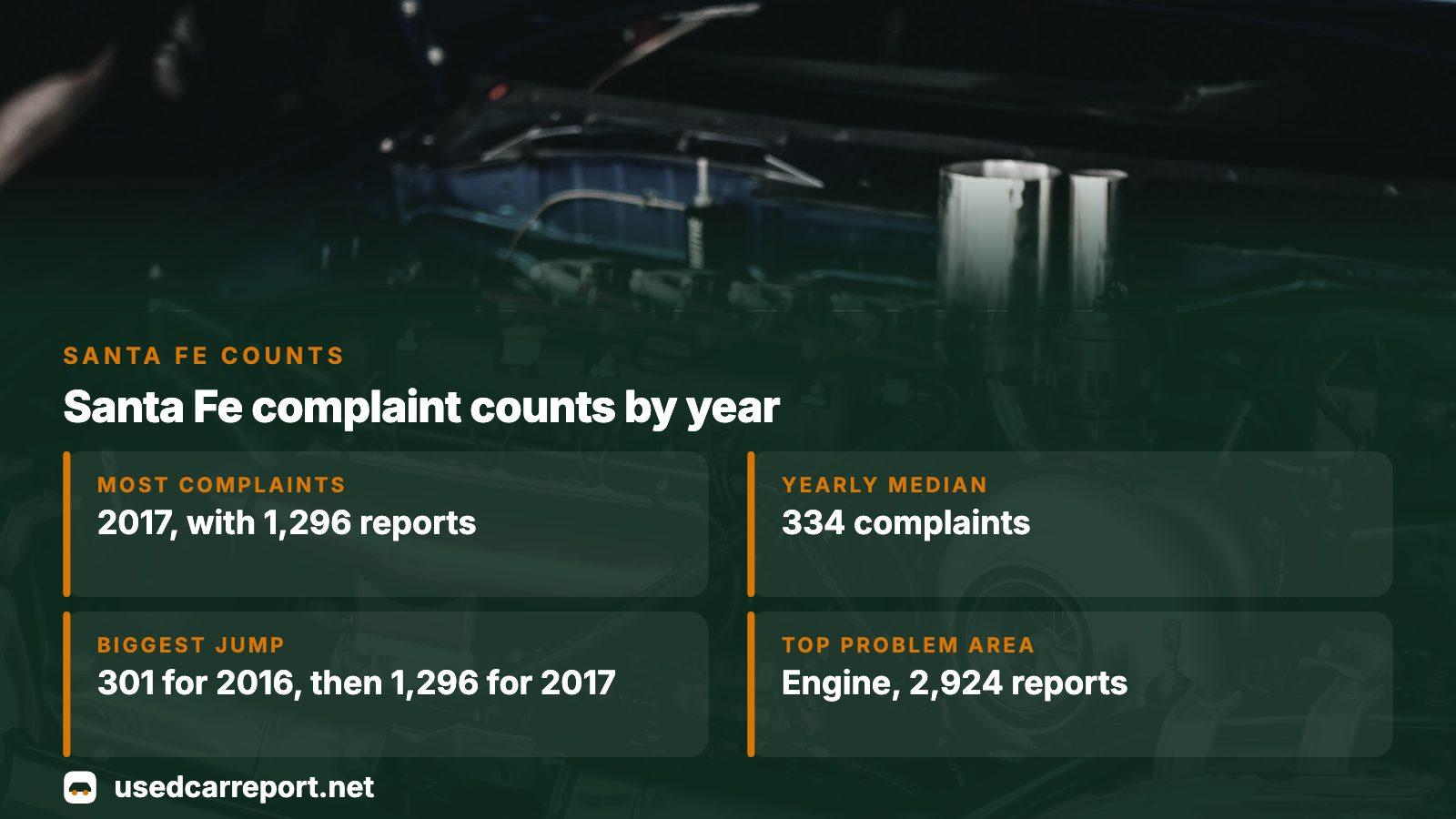
The Santa Fe has drawn 6,353 owner complaints at NHTSA over 2008 to 2022, with a median year of 334. The 2017 model leads at 1,296, then 2013 at 799, 2014 at 653 and 2008 at 541. Engine trouble tops every flagged year but 2008. No year is quiet enough to buy on its label, so read the VIN's accident, damage and mileage records before you trust the year.
- Most complaints
- 2017, with 1,296 reports
- Yearly median
- 334 complaints
- Biggest jump
- 301 for 2016, then 1,296 for 2017
- Top problem area
- Engine, 2,924 reports
The four Santa Fe years that draw the most complaints
The record spans 15 model years, 2008 to 2022. Dividing each year's complaints by the middle figure of 334 gives a multiple, so 3.88 for 2017 means nearly four ordinary years of filings packed into one. Counts were pulled in August 2026.
| Year | Complaints | Versus the median | Top area | Recalls |
|---|---|---|---|---|
| 2017 | 1,296 | 3.88 | Engine | 6 |
| 2013 | 799 | 2.39 | Engine | 3 |
| 2014 | 653 | 1.96 | Engine | 3 |
| 2008 | 541 | 1.62 | Fuel and propulsion system | 6 |
Recall counts are listed too, though they work differently: a recall is a flaw the maker has accepted and fixes for nothing, while a complaint is an unchecked report from one owner.
The jump from 2016 to 2017
Owners filed 301 complaints about the 2016 Santa Fe, then 1,296 about the 2017. A leap of more than fourfold usually points to a change on the vehicle itself rather than gradual wear, so shop 2016 and 2017 as two separate populations.
NHTSA's recall data offers one candidate. Santa Fes from 2017 with the 3.3 liter engine fall under a crankshaft campaign that began in November 2017: rough spots on a crankshaft pin can wear the bearings and stall the vehicle, and dealers inspect the engine and replace it if needed, at the maker's cost.
2013 and 2014: the engine campaign behind the count
For both of these years, NHTSA lists an engine campaign naming the Santa Fe Sport. Machining errors at the factory can cause early bearing wear, a seized engine can follow, and dealers inspect it, replacing the short block when needed. A later campaign, opened in late 2018, covers Sport engines already repaired once, because the swap itself may have left a fuel pipe damaged or badly fastened, with a leak as the risk. NHTSA's complaint lookup files the Sport under a separate model name, so search both.
From an NHTSA owner complaint
In a complaint filed in August 2024, an owner described buying a used 2013 Santa Fe from a dealer in January, only to have the engine lock up by July. Hyundai's website showed the VIN as affected by the engine recall, yet the dealer's service department wanted earlier maintenance records the new owner did not hold. A history report supplied them, but Hyundai's corporate office, the owner says, kept "giving me the run-around".
Service history stays with the paperwork, not with whoever bought the car last week. Ask the seller for the records and run the VIN before any money changes hands, since a claim after an engine failure may hinge on both.
The quieter years, and why none is a green light
The thinnest records are 2011 at 181, 2021 at 184, 2020 at 202 and 2019 at 217, all far below the median of 334. Still, no year stands clearly apart from the rest, so none can be named the safe pick.
Recent years have had less time in owners' hands, so a low count flatters them. The 2021 model stands out the other way: 7 recalls, more than any other year, set against just 184 complaints, which may mean problems were caught early.
Where owners say the trouble starts
Over all 15 years, complaints cluster in a few areas, and the engine is far in front.
- Engine: 2,924 complaints
- Power train: 585
- Service brakes: 568
- Electrical system: 534
- Fuel and propulsion system: 481
The write-ups behind those counts return again and again to knocking, oil use and stalls with little warning. A mechanic should start there on any Santa Fe, whatever its year. Brakes matter to a buyer as well, since two ABS campaigns appear in the recall table below.
Recalls follow a build range, not the model year
Each campaign names the production range it covers, so two Santa Fes of one year can differ. Four matter most here, and NHTSA's search by VIN shows which apply to a particular car.
| Campaign | Vehicles named | What can happen | Dealer remedy |
|---|---|---|---|
| 17V226000 | 2013-2014 Santa Fe Sport | Bearing wear, engine seizes | Inspect, replace short block as needed |
| 17V578000 | 2017 Santa Fe, 3.3 liter | Crankshaft wear, stalling | Inspect, replace engine as needed |
| 22V056000 | 2016-2018 Santa Fe, 2017-2018 Sport | ABS short, engine fire | Replace multi-fuse as needed |
| 23V651000 | 2013-2015 Santa Fe, 2013 Sport | Brake fluid leaks in ABS, fire | Replace ABS fuse |
Both ABS campaigns advise keeping the SUV in the open, well clear of homes and garages, until repaired. Find out from the seller if the repair was ever made.
What the damage record shows that no year ranking can
A complaint total describes thousands of SUVs and cannot say whether this one was hit. Accident and damage entries, total-loss and salvage records, title brands and auction photos belong to one VIN, and they can turn an ordinary-looking Santa Fe into a car worth less, or not worth buying.
From an NHTSA owner complaint
A 2014 Santa Fe owner told NHTSA the SUV hit a deer at 72 mph in 2018. Every airbag went off, the passenger seat belt pulled free of the floor, and an ambulance took both occupants to hospital. The SUV went to a salvage yard as a total loss.
The complaint does not say what became of that SUV. A later buyer of a car like it learns the story only from records tied to the VIN: state-applied brands, insurer salvage and total-loss findings, and transfers to salvage yards, all gathered by the federal title system.
That coverage has holes. Some states do not feed the national system, and each applies its own standards when branding a title, so an empty search does not prove a car was never written off. That is why this site's report leads with accident and damage.
Mileage and owner counts that do not match
Odometer readings from inspections, sales and title events form a sequence, and a rollback breaks it.
From an NHTSA owner complaint
A March 2026 complaint came from an owner who had bought a 2017 Santa Fe two years earlier showing about 46,000 miles, with a seller's claim of a single leasing owner. When the engine failed, an independent mechanic ran a history report: five earlier owners, several mileage discrepancies, and a last reliable reading of 113,000.
The routine that follows is simple: compare the dash with the readings in the report, and the owner count in the ad with the one on the record.
Checking the Santa Fe you are about to buy
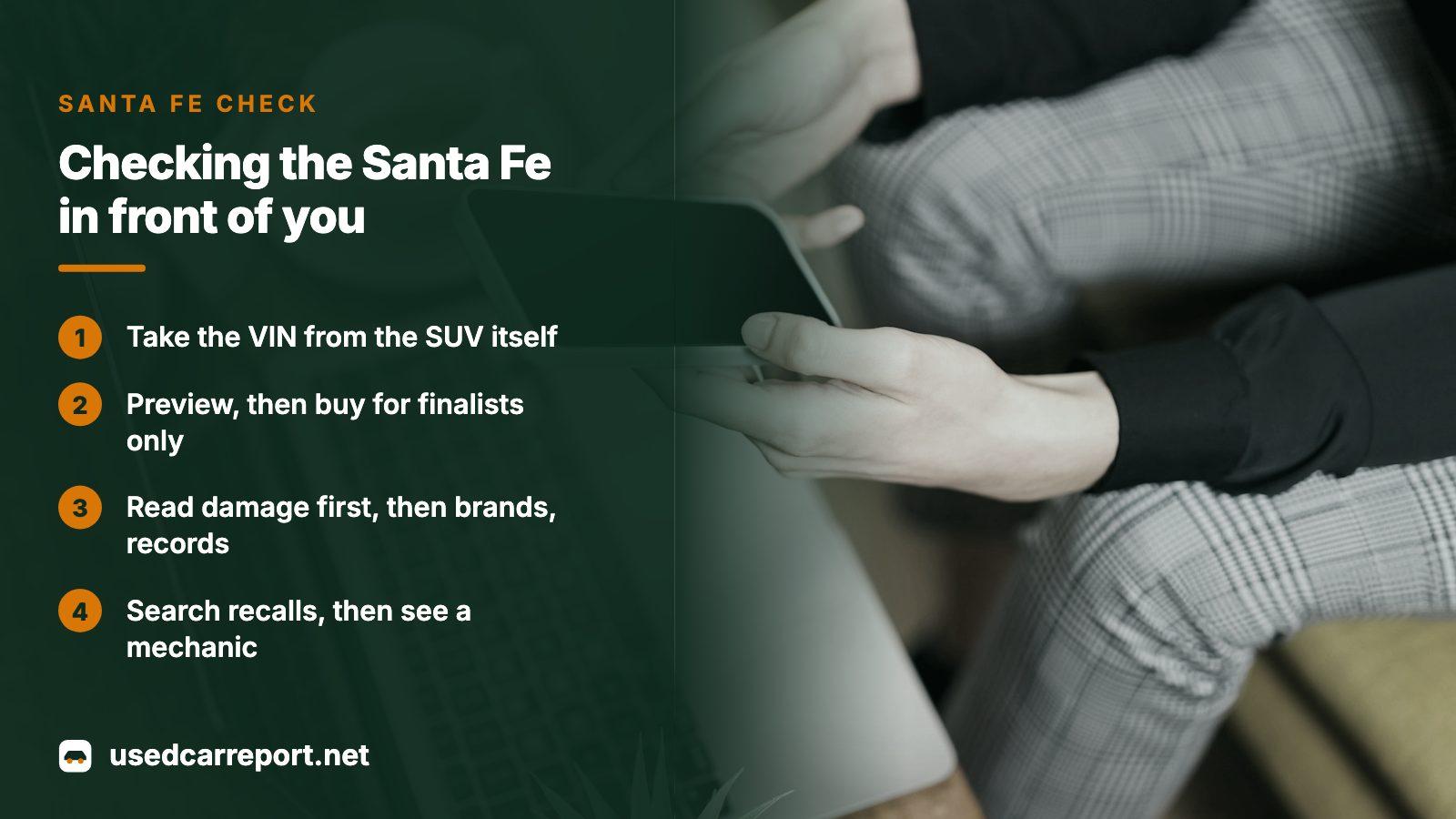
- Take the VIN from the SUV itself and check it against the title or listing.
- Run that VIN through the preview, which is free. Buy the report only for a car that survives that look; it is paid once, with no recurring charge, and the pricing page has the options.
- Read accident and damage entries first, then title brands, total-loss or salvage records and the odometer sequence.
- Search the VIN in NHTSA's recall lookup, then ask for proof of any engine or ABS repair.
- Hand the findings to a mechanic for a pre-purchase inspection, beginning with the engine.
A flagged year calls for more records and a lower first offer. It is no verdict on a particular SUV you have yet to see.
Where this information comes from
- NHTSA owner complaint 11608948 — owner experience, paraphrased
- NHTSA owner complaint 11098004 — owner experience, paraphrased
- NHTSA owner complaint 11724587 — owner experience, paraphrased
- NHTSA: recalls by vehicle — Where open campaigns can be looked up for one car by its VIN.
- NMVTIS: what a vehicle history report covers — The federal title-record program behind brand, salvage and total-loss data, and where it falls short.
- NICB: VINCheck — A theft and total-loss screen for one VIN.
Sources and photos: Facts checked against the sources above in November 2026. Photos by Farhan Abid, Jakub Żerdzicki and Willian Cittadin on Unsplash; diagrams by UsedCarReport.
Keep reading
- VIN accident check: read the damage records before you buyWhat accident and damage entries show about a car, and what they leave out.
- Buying a car with an open recall: read the damage record firstHow an unrepaired recall affects the price and your first week of ownership.
- Check mileage history by VIN: six steps, damage records firstHow an odometer sequence is built and how a rollback shows up in it.
- Hyundai Tucson years to avoid, and the accident record to check firstAnother Hyundai SUV that shares an ABS fire recall with the Santa Fe.
Frequently asked questions
What are the worst Hyundai Santa Fe years?
On owner complaints filed with NHTSA, 2017 tops the list at 1,296, 2013 follows at 799, then 2014 at 653 and 2008 at 541; the median year is 334. A flagged year means asking for service records and inspecting the engine closely, then checking that SUV's own VIN history.
Is the 2017 Santa Fe a bad year?
It draws the most complaints, up from 301 for 2016, and 3.3 liter cars fall under a crankshaft recall. A busy year is not automatically a bad car, though: documented recall work and a clean record make a very different purchase from unexplained mileage.
What is the most common Santa Fe problem?
The engine, at 2,924 complaints, well ahead of power train at 585 and service brakes at 568. Owners describe knocking, oil use and stalls. Begin any pre-purchase inspection there, and be wary of a seller who has no oil-change records.
Will a VIN check show whether a Santa Fe was in a crash?
It lists accident and damage entries plus salvage or total-loss records where they were reported. Some states do not report to the national title system, so a clean report lowers the risk but cannot remove it. NICB's VINCheck adds a theft and total-loss screen.
Where can I see whether this Santa Fe has an open recall?
Type the VIN into NHTSA's recall lookup. Campaigns cover production ranges rather than whole years, so only the VIN settles it. Dealers repair listed defects without charge, but ask the seller for proof the work was done before you pay.
Now check the car itself
The guide explains what to look for. The report shows what this VIN has on record.