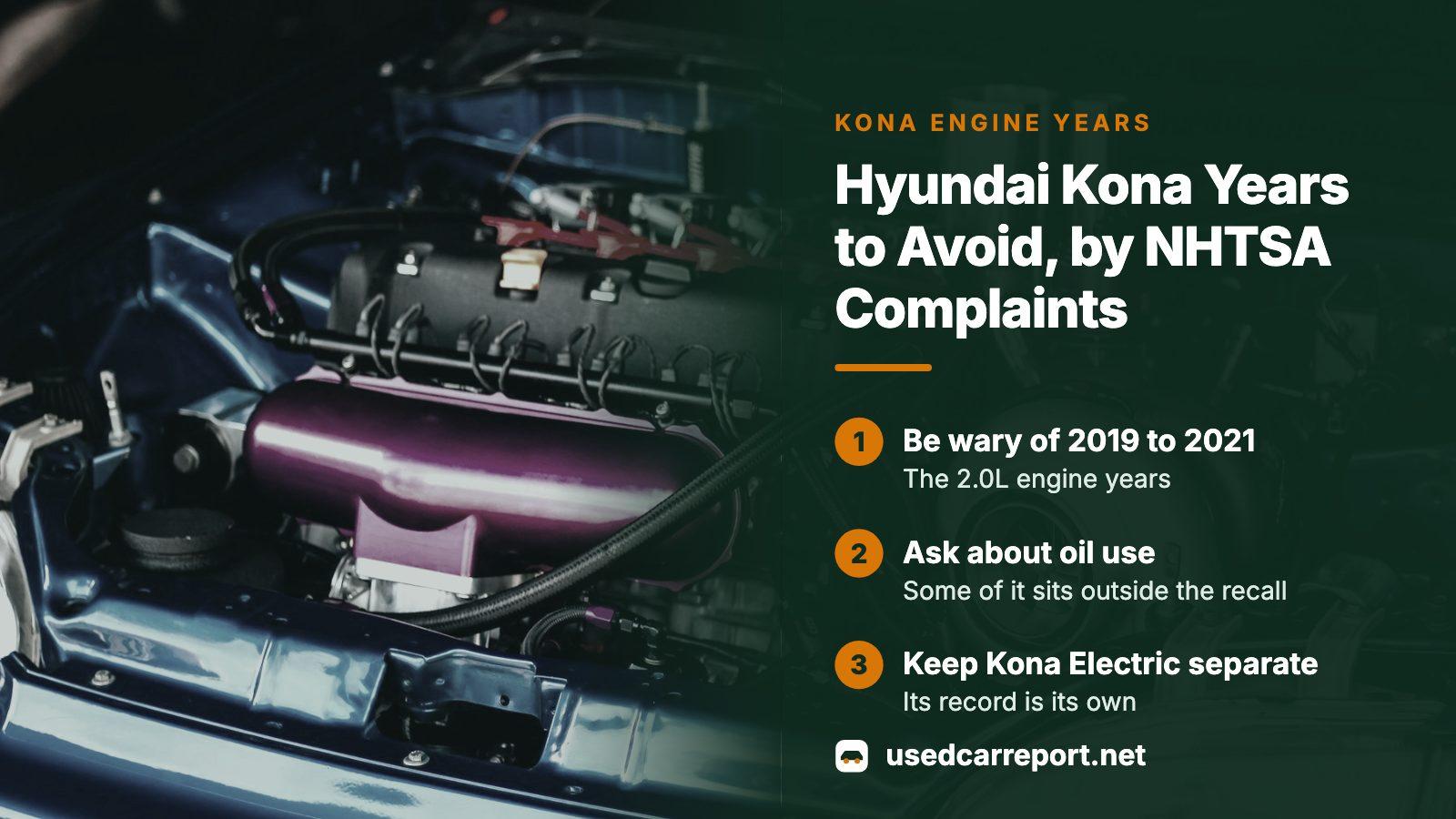
THE SHORT ANSWER
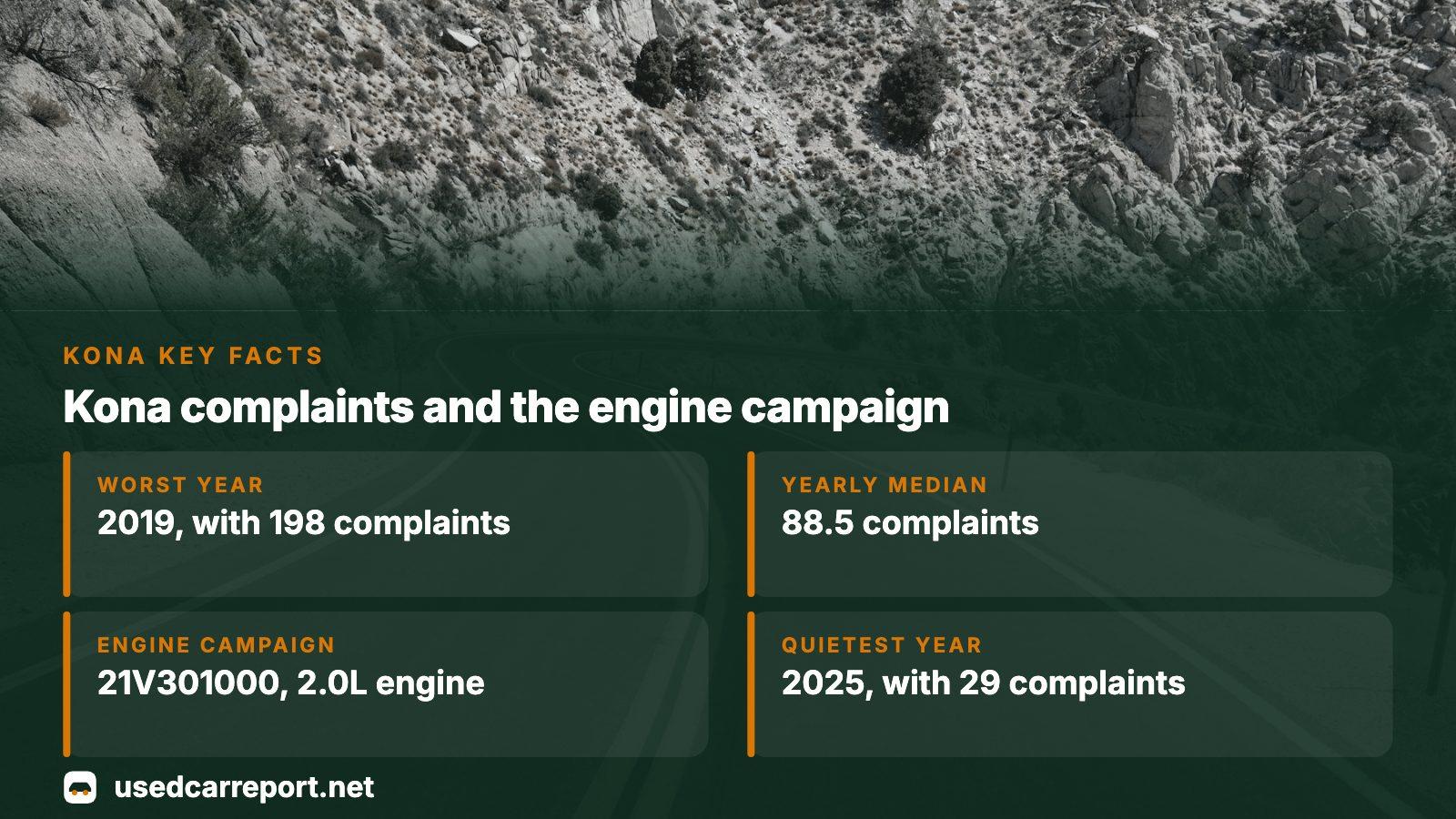
Owners have filed 805 NHTSA complaints about the gasoline Kona for 2018 to 2025, with a median year of 88.5. The 2019 model leads with 198, then 2020 with 162 and 2021 with 120. Engine trouble drives all three, and one recall covers the 2.0L engine in those years. The 2023 to 2025 models are the quietest. Before buying any year, read the VIN's accident and damage entries.
- Worst year
- 2019, with 198 complaints
- Yearly median
- 88.5 complaints
- Engine campaign
- 21V301000, 2019 to 2021 with the 2.0L engine
- Quietest year
- 2025, with 29 complaints
What the complaint counts say, year by year
The table uses the gasoline Kona's entries in NHTSA's complaint and recall databases, which were queried for this page. Dividing each year by the 88.5 median shows how far it sits from an ordinary year. A 2025 has simply been on the road for fewer owner-years, so its low figure partly reflects age.
| Model year | Complaints | Versus median | Engine share | Recalls |
|---|---|---|---|---|
| 2019 | 198 | 2.24 | 138 | 1 |
| 2020 | 162 | 1.83 | 109 | 2 |
| 2021 | 120 | 1.36 | 80 | 1 |
| 2022 | 102 | 1.15 | 33 | 0 |
| 2018 | 75 | 0.85 | 42 | 0 |
| 2023 | 66 | 0.75 | not the lead | 1 |
| 2024 | 53 | 0.60 | 9 | 4 |
| 2025 | 29 | 0.33 | not the lead | 1 |
The recall column counts campaigns NHTSA lists against each year. A campaign means the maker has accepted a defect exists and owes the fix. Any single complaint reflects what one owner reported, and nobody has verified it.
2019 to 2021: the 2.0L engine years
Across 2018 to 2021, owners filed 369 engine complaints, and 2019 alone holds 138 of them. Campaign 21V301000, filed in April 2021, names certain 2019 and 2020 Elantras, 2019 to 2021 Konas and Velosters with the 2.0L Nu MPI engine. Piston oil rings may have been heat-treated badly, which can damage the engine.
NHTSA states the consequence plainly: a damaged engine may stall, and oil may reach hot exhaust parts, which raises fire risk. Hyundai's remedy is an inspection with a new engine where the inspection calls for one, plus software that listens for piston ring noise.
From an NHTSA owner complaint
The owner of a 2020 Kona took it in for this campaign, but the dealer said it could not do the repair because no matching failure or fault codes showed up. An independent mechanic had already advised replacing the engine and the check engine light was on. The owner says Hyundai sided with the dealer and the car stayed unrepaired.
Take from it that a campaign is not a guarantee. Ask the seller for the dealer's paperwork showing what was inspected, and treat a missing record on a 2019 or 2020 as a reason to bargain or walk.
Oil use that sits outside the recall
Not every engine complaint maps to the campaign. Some owners say their car burned oil yet fell outside it, or that a dealer's consumption test passed it as acceptable.
From an NHTSA owner complaint
A parent with a 2020 Kona found the oil nearly empty soon after a change, with no leak on the driveway. The dealer's test put consumption at 1 quart per 1,000 miles and called that acceptable. The car was not on the recall list, and both the dealer and Hyundai declined to pay because the warranty had ended.
- Check the dipstick on the lot, cold, and ask when oil was last topped up.
- Ask for service records showing oil changes and any consumption test.
- Learn whether factory or extended coverage is still running, and who stands behind it.
- Have a shop read stored engine codes before you sign.
2018: fewer complaints, harder ones
The first model year files 75 complaints, below the median, and has no recall at all. Yet it stands out in other ways: 10 of its complaints flag a fire and 12 injuries are logged, more than 2019 despite far fewer filings. Engine problems still lead, with 42 reports.
From an NHTSA owner complaint
A leased 2018 Kona developed an engine knock at 110,000 miles. A repair shop suspected a failed rod and said the whole engine needed replacing, and the car would no longer run while the owner waited for the dealer.
With no campaign to lean on, a 2018's engine health is simply unknown until someone checks. A pre-purchase inspection earns its fee here more than on a newer car.
2022 to 2025: quieter, with their own recalls
The 2022 model sits just above the median at 102, with electrical complaints (22) joining engine ones. The 2023 to 2025 cars lean toward electrical trouble. For 2024, electrical reports lead with 31 and engine ones follow with 9.
- 2023: campaign 23V526000, an overheating oil pump controller tied to idle stop and go, with a fire risk. Owners are told to park outside until it is fixed.
- 2024: four campaigns, covering a rear seat belt retractor, a short at the battery cables, the EGR valve and a rear seat belt buckle.
- 2025: the rear seat belt buckle campaign, 26V452000, filed in July 2026.
These are fixes dealers perform free, so they matter mainly if the seller never had them done. Enter the VIN at NHTSA's recall search to learn which items remain open.
The Kona Electric is a separate record
NHTSA files the battery car under its own name, so the gasoline counts above leave it out. Its 2019 model drew 54 complaints, 42 of them about the electrical system. Two battery campaigns, 20V630000 and 21V127000, cover 2019 and 2020 cars for a possible short circuit in the lithium-ion pack and a fire risk.
Remedies include a battery software update and a pack inspection, with replacement where needed. Owners are advised to park outside until the work is done. A newer air bag software campaign, 26V728000, filed in November 2026, reaches electric cars from 2019 to 2023. NHTSA's 2020 figure for the electric name also repeats the gasoline filings, so treat its raw total with care.
Why a car's damage record can outweigh its year
A year ranking describes thousands of cars. A particular Kona may have been rear-ended, hit a curb hard enough to bend a wheel, or been written off and rebuilt. None of that shows up in a complaint count, and a cheap-looking 2022 with a hidden crash is a worse buy than a documented 2021.
That is where the report earns its place. Read accident and damage entries first, then title brands, salvage or auction records, and the odometer sequence. NMVTIS, the federal title database, was set up to curb title fraud and keep stolen cars off the market, though its records can have gaps. Only the preview costs nothing here; the full report is a single payment.
How to check a Kona before you pay
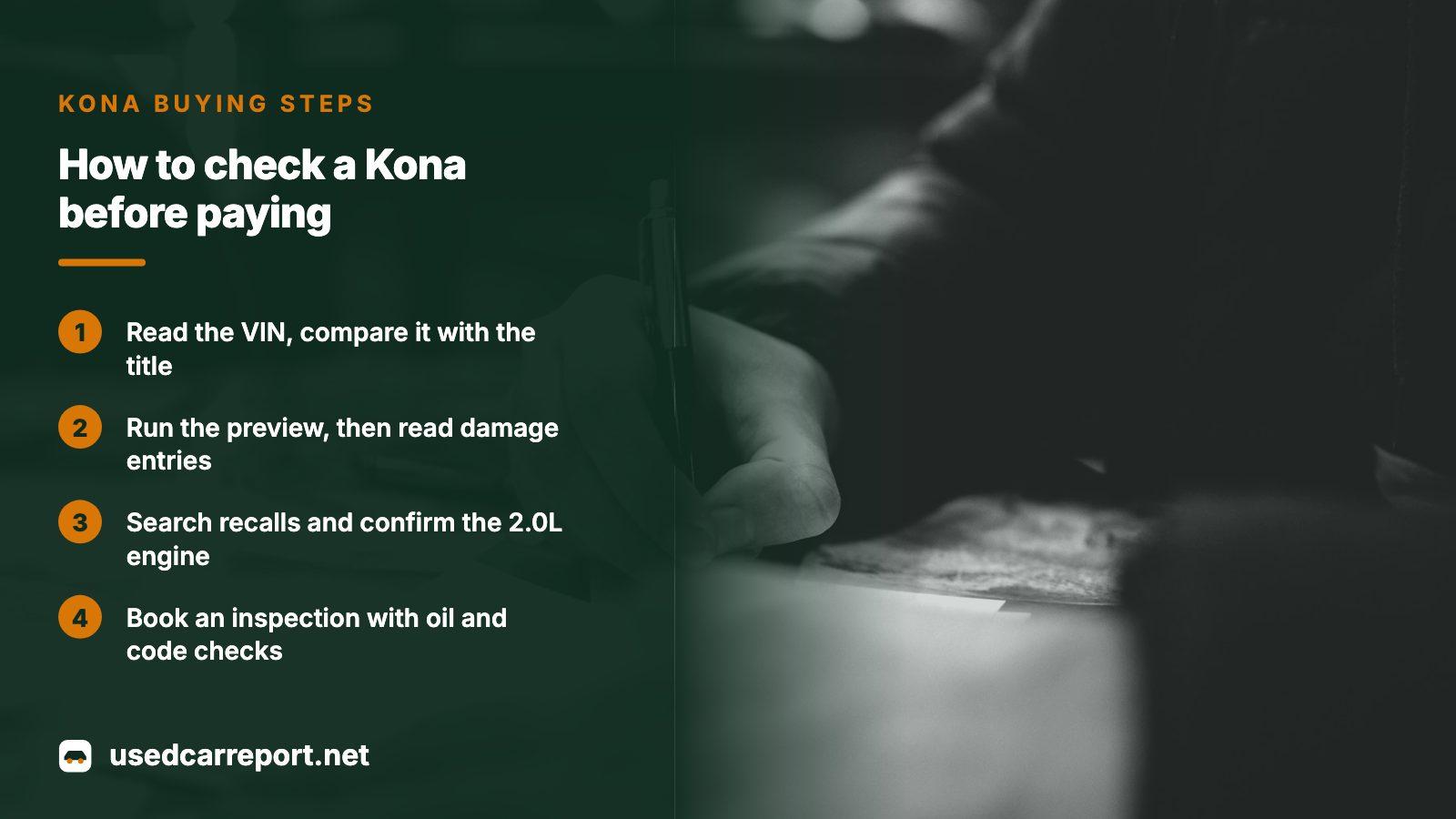
- Take the VIN from the dashboard plate where the windshield meets the dash, and check it against the registration and the ad.
- Run the preview, then read the full report's damage and title entries.
- Use NHTSA's recall search on that VIN. It lists unrepaired recalls only, so ask for proof of any that were done.
- For a 2019 to 2021 gasoline model, ask which engine it has and request the dealer's record for campaign 21V301000.
- Book an independent inspection and have the oil level and stored codes checked.
A year on this list is a prompt for questions and a lower offer. It is not a ban. A well-documented Kona from any year can be a sound buy.
Where this information comes from
- NHTSA owner complaint 11763068 — owner experience, paraphrased
- NHTSA owner complaint 11767214 — owner experience, paraphrased
- NHTSA owner complaint 11765508 — owner experience, paraphrased
- NHTSA: check for recalls — The VIN lookup, and what it leaves out.
- NMVTIS: vehicle history — The federal title system's stated purpose.
Sources and photos: Facts checked against the sources above in November 2026. Photos by Willian Cittadin, Owen Michael Grech and Will Truettner on Unsplash; diagrams by UsedCarReport.
Keep reading
- VIN accident check: read the damage records before you buyWhat accident and damage entries show about one car, and where they stop.
- Buying a car with an open recall: read the damage record firstWhat an unrepaired campaign means for price and your first week.
- Hyundai Tucson years to avoid, and the accident record to check firstThe maker's compact SUV, ranked the same way.
- Pre-purchase inspection: read the damage records, then hire the mechanicWhat a mechanic checks before you commit.
Frequently asked questions
Which Kona model years are the riskiest?
Begin with 2019 and 2020, which have the most complaints and the 2.0L engine campaign. The 2021 is next. A 2018 deserves an inspection because it has no recall to rely on. The 2023 to 2025 models have the lowest counts, though each has its own campaigns.
What is the Hyundai Kona engine recall?
Campaign 21V301000 covers certain 2019 to 2021 Konas with the 2.0L engine. Piston oil rings may be improperly heat-treated, which can damage the engine and cause stalling. A dealer will examine the Kona's engine and replace it if required, with nothing charged to the owner.
Is the Kona Electric included in these years?
No. NHTSA lists it under a separate model name, so its record is different. It has its own battery campaigns for 2019 and 2020 cars, and a newer air bag software campaign for 2019 to 2023. Check the VIN for open ones.
Are the newest Konas safe to buy?
The 2023 to 2025 years show far fewer complaints, but newer cars simply have fewer owner-years behind them. Look for open recalls, such as the rear seat belt buckle campaign on 2024 and 2025, and read the damage record before buying.
Does a clean VIN check mean the engine is fine?
No. A history report covers title, damage and odometer records, not mechanical condition. Pair it with NHTSA's recall lookup, service records and an independent inspection, especially on a 2018 to 2021 car with the gasoline engine.
Now check the car itself
The guide explains what to look for. The report shows what this VIN has on record.