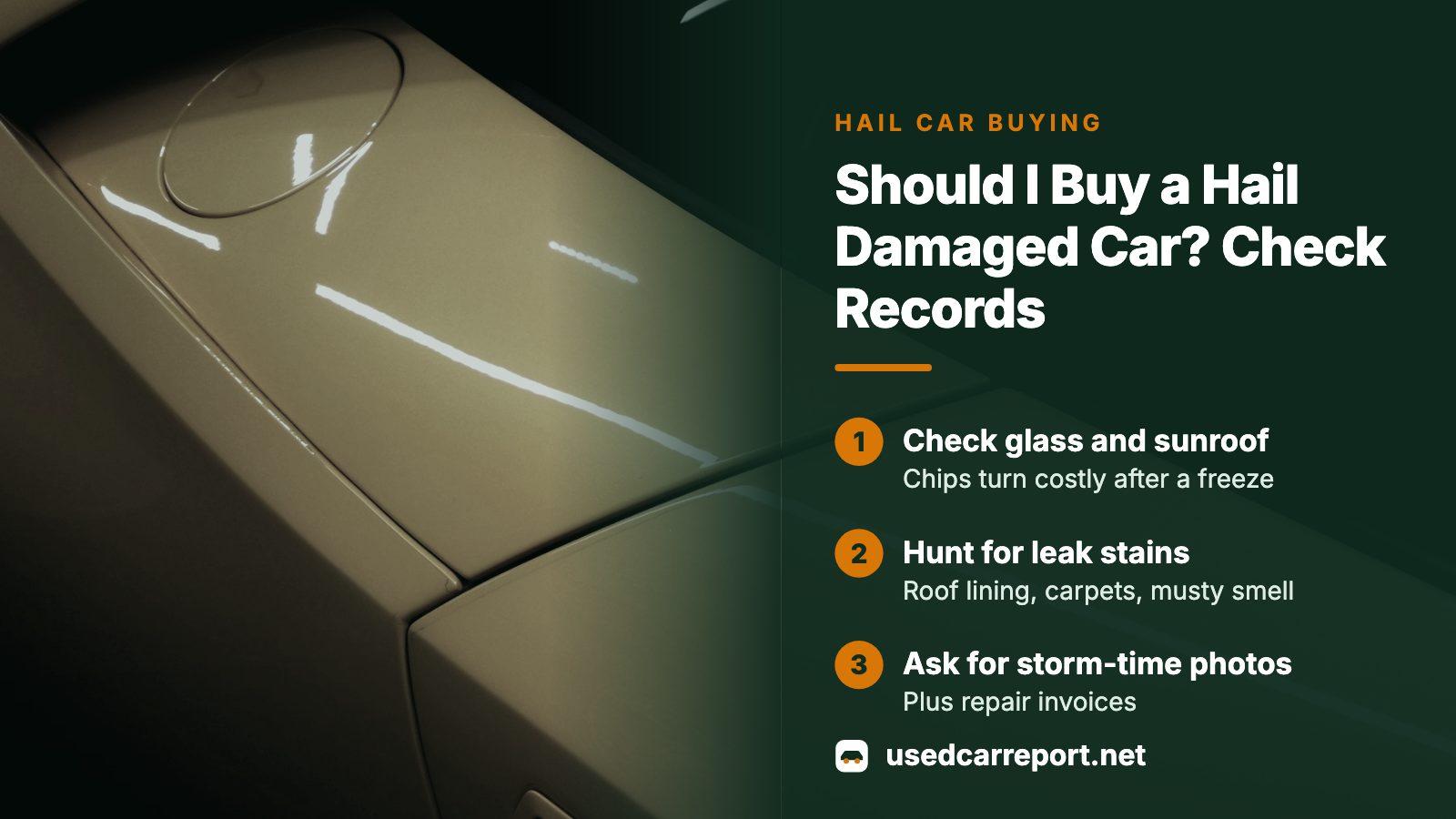
THE SHORT ANSWER
Yes, you can buy a hail-damaged car if the damage is cosmetic, the price is clearly lower, and the paperwork backs up the seller's story. Run the VIN, read the title brand, and have a shop check the roof, glass and electronics. Walk away if the seller cannot show how it was repaired or if the records show a total loss.
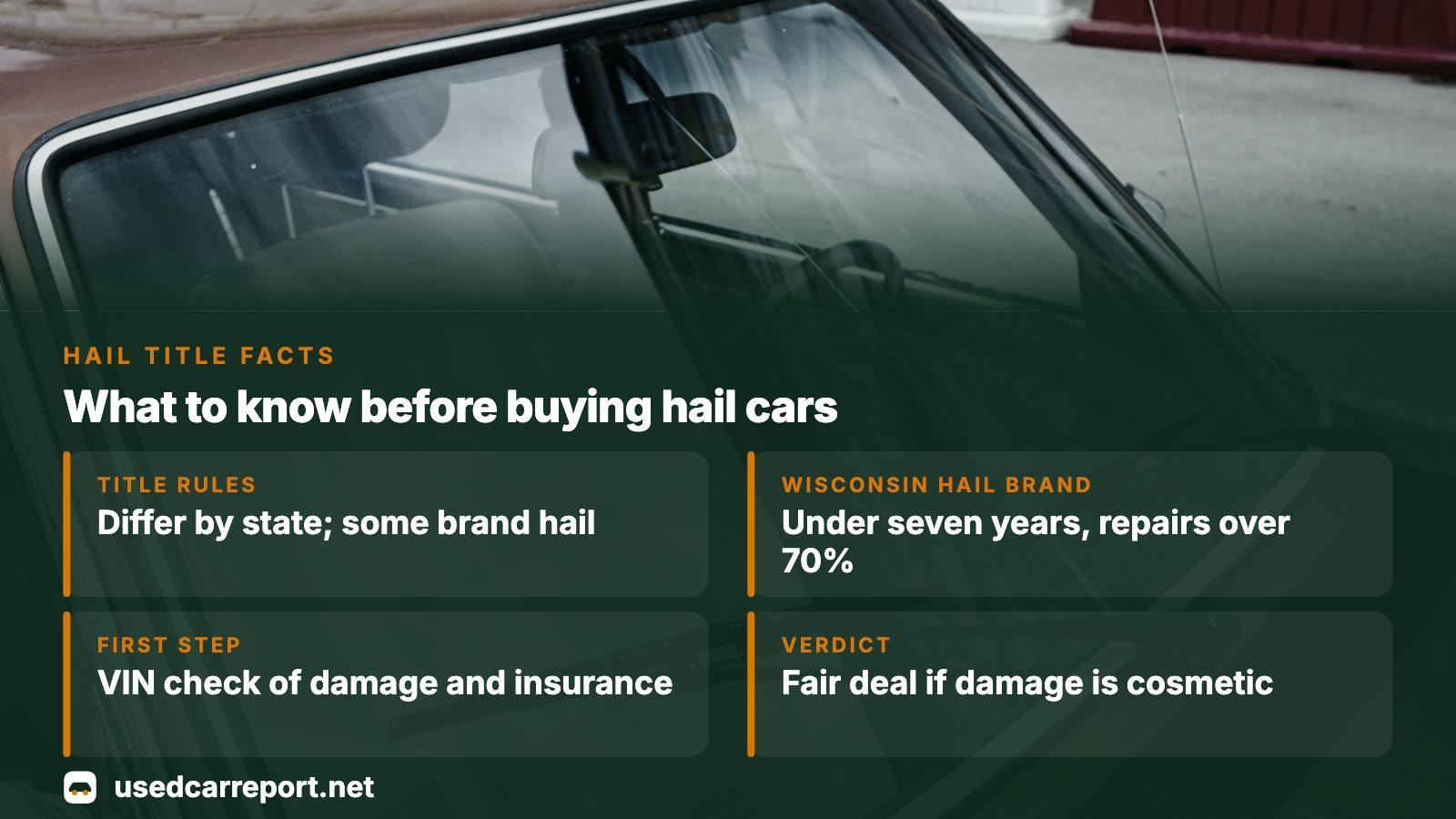
- Title rules
- Differ by state, and some brand hail separately
- Wisconsin hail brand
- Car under seven years, repairs over 70% of value
- Best first step
- VIN check of damage and insurance records
- Preview
- Free, then one payment for the full report
When a hail-damaged car is a fair deal
Hail mostly dents what faces the sky: hood, roof, trunk lid and the tops of the fenders. A car like that still drives the same. If the glass is intact, the lights work and the seller takes a real amount off the price, you are trading looks for money, which some buyers happily do.
The trouble is that a dented roof tells you the weather, not the whole story. A car that sat in a storm may also have been in a parking-lot bump, or may have been repaired badly after the hail. The deal is only fair when you know which of those you are buying.
What the title may or may not say
There is no national rule that says hail damage must appear on a title. Each state decides. Wisconsin, for example, brands hail separately: the car must be younger than seven years, hail must be the only cause, repairs must top 70% of fair market value, and no exterior panels may have been replaced. If panels were swapped, Wisconsin treats the car as salvage instead.
Nevada uses a plain repair-cost test of 65% of pre-damage value, with paint left out of the count, and its salvage page does not single out hail. So the same storm can produce a branded title in one state and a clean one in another.
Read the front of the title
Wisconsin's DOT advises buyers to look for brands on the title itself and to ask the seller about them. Hiding a brand on the sale paperwork can cost a Wisconsin seller as much as 5,000 dollars in fines. Ask the question out loud and write down the answer.
What a VIN check can and cannot show
Hail rarely produces a police report, so do not expect a neat line reading hail. What you can find is the paper trail around it: an insurance claim, a total-loss record, a salvage or auction listing with photos, a title brand from another state, and odometer readings that show whether the car moved around between sales.
| Record | What it tells a hail buyer |
|---|---|
| Insurance claim or total loss | An insurer paid out or wrote the car off, so ask what was repaired |
| Auction or salvage photos | The car right after the storm, before any bodywork |
| Title brand | Salvage or rebuilt status, possibly from a different state |
| Accident or damage entries | Whether anything other than hail is on file |
A clean result is not proof the car is untouched. Hail repairs paid by the owner out of pocket can leave no record at all. That is why the history comes first and the inspection second.
Damage hiding behind the dents
Walk the car in daylight, ideally on a cloudy day so reflections show every dimple. Then look past the paint.
- Windshield and rear glass: chips and star cracks that are cheap now and costly after a freeze.
- Sunroof or panoramic glass: replacement can be expensive, so ask whether it was touched.
- Lights, mirrors and trim: cracked lenses and loose moldings let water in.
- Roof lining and carpets: stains or a musty smell point to a leak, which can also point to water in the electronics.
- Paint: stretched or flaking finish where a repair shop worked the dents out.
If a paint-depth gauge shows wildly different readings between neighboring panels, someone refinished them. That is not automatically bad, but it means you should ask for the shop's invoice.
What owners report after hail repairs
Owners who file complaints with NHTSA sometimes mention hail, and the stories are less about dents than about what came after. Three are worth reading.
From an NHTSA owner complaint
The owner of a 2023 Ford Explorer wrote that a body shop, while repairing hail damage, found a second-row seat belt that was never installed properly at the factory, with loose bolts. A dealer confirmed it, and no warning light had ever shown. Take from this that a repair visit is a chance to have a shop look at the safety hardware too.
From an NHTSA owner complaint
An owner of a 2021 Subaru Outback described a long stay at a body shop for hail repair. After pickup the electronic door locks failed, the dealer found a faulty body control module, and the dealer declined to cover it under warranty because of the outside repair. Take from this that electrical faults after a hail job can become a dispute over who pays, so ask a dealer service desk how they treat outside repairs.
From an NHTSA owner complaint
The owner of a 2019 Toyota RAV4 said the vehicle was declared a total loss from hail and that Toyota would not help with a separate drivetrain defect because of that status. Take from this that a total-loss history can change what a maker is willing to do, long after the storm.
Total loss, salvage and rebuilt status
Some hail cars are written off by the insurer because repair costs pass a state's threshold. Those can come back as salvage, then as rebuilt after a state inspection. Wisconsin, for instance, requires a salvage inspection before plates are issued and changes the brand to rebuilt salvage once the car passes.
A rebuilt hail car can be a good value, but it is a different purchase from a car with a few dents. Insurers may price it differently, resale is harder, and some lenders are cautious. Treat a rebuilt brand as a separate decision and read what the repairs consisted of.
Title data from many states is pooled in NMVTIS, a Justice Department program aimed at fraud and unsafe cars, so a brand from one state can follow the car into another.
Pricing and negotiating
Do not take the seller's discount at face value. Get a written estimate from a paintless dent repair shop or body shop for the panels you can see, then compare that number with the gap between this car and a similar undamaged one. If the discount is smaller than the estimate, you are paying for the repair twice.
Also consider your own insurance. Ask your agent whether pre-existing hail damage will be noted, since a later hail claim on a car that is already dented can turn into an argument about which dents are new.
A sensible order of checks
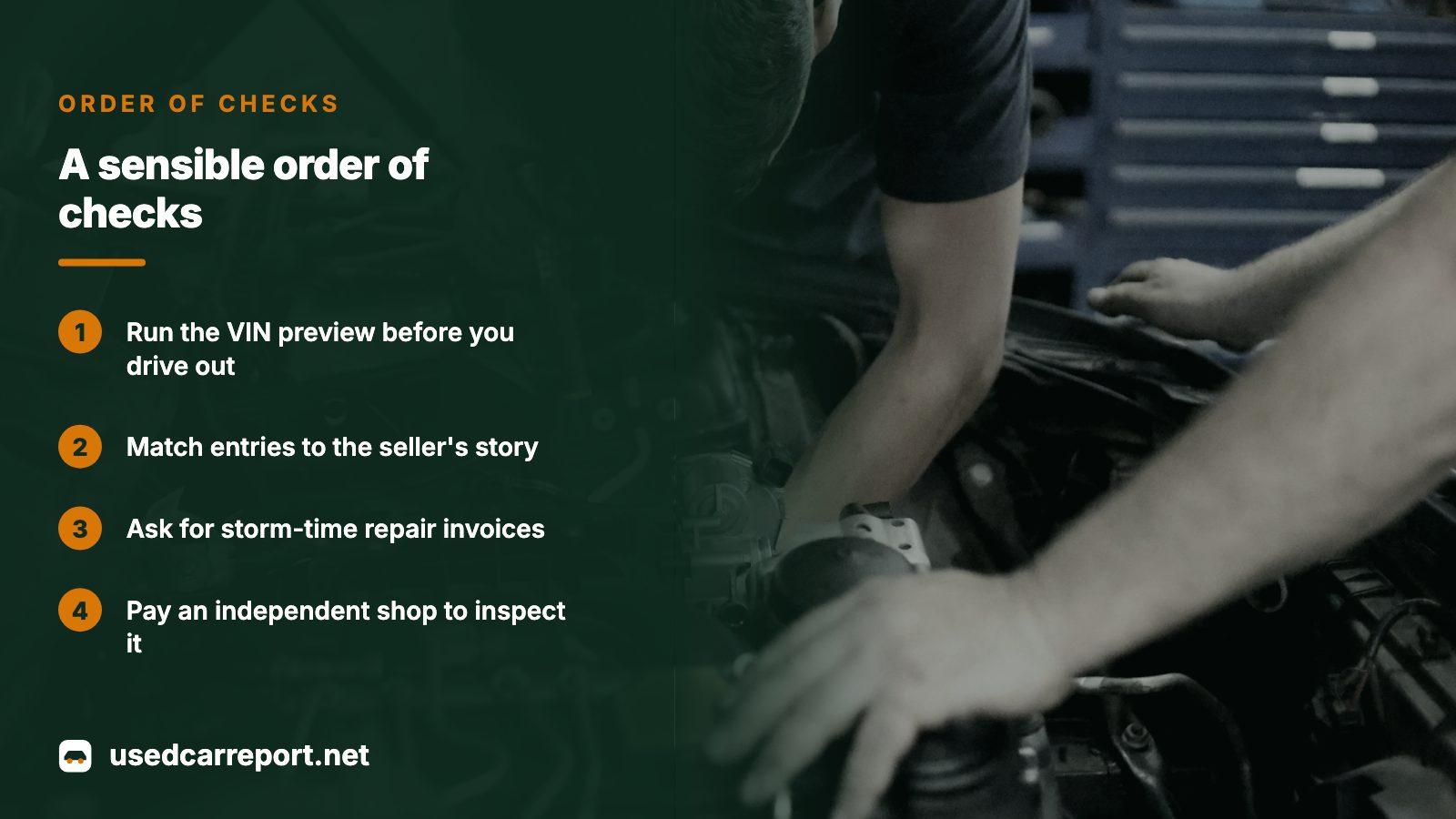
- Get the VIN from the dash or door jamb and run the preview before you drive out to see the car.
- Read any damage, insurance, auction and title entries, and match them to what the seller told you.
- Ask for repair invoices and photos from the time of the storm.
- View the car in daylight and check glass, seals, roof lining and electronics.
- Pay an independent shop to inspect it, then negotiate with the estimate in hand.
If step two turns up a total loss or a brand the seller did not mention, stop and ask why. A good seller will have an answer and the paperwork to match.
Where this information comes from
- Wisconsin DOT: flood damaged vehicles and other title brands — supports the hail brand, salvage, rebuilt and disclosure points
- Nevada DMV: salvage vehicles — supports the repair-cost threshold that leaves paint out
- VehicleHistory.gov: NMVTIS — supports the purpose of the federal title system
- NHTSA owner complaint 11602949 — owner experience, paraphrased
- NHTSA owner complaint 11484811 — owner experience, paraphrased
- NHTSA owner complaint 11606143 — owner experience, paraphrased
Sources and photos: Facts checked against the sources above in November 2026. Photos by Franck V., Mustafa Sheikhmouss and Max Tokarev on Unsplash; diagrams by UsedCarReport.
Keep reading
- Salvage title check: five steps, damage records firstRead how salvage and rebuilt brands show up before you buy.
- Structural vs cosmetic damage: what the damage record means for a used carLearn which damage is only skin deep and which is not.
- Car accident depreciation check: what a crash does to a car's valueSee how damage history changes what a car is worth.
- Pre-purchase inspection: read the damage records, then hire the mechanicPlan the shop visit that comes after the records check.
Frequently asked questions
Is a hail-damaged car worth buying?
It can be, when the damage is limited to dents, the glass and electronics are sound, and the price drop is bigger than a shop's repair estimate. It is a poor buy if the car was a total loss, if repairs were hidden, or if the seller cannot explain the paperwork.
Does hail damage show up on a vehicle history report?
Only indirectly. Hail seldom creates a police report, so look for insurance claims, total-loss records, auction photos and title brands. A repair the owner paid for privately may leave no record, which is why an inspection still matters.
Will a hail-damaged car have a salvage title?
It depends on the state and the repair cost. Some states have a separate hail brand, some count hail inside their usual total-loss rule, and a car with only mild dents may have no brand at all. Check the title and your state agency's rules.
Can a hail-damaged car cause problems with insurance?
It can. Ask your insurer how pre-existing dents are documented, and photograph the car at purchase. If a new storm hits later, clear photos help show which dents were there when you bought it.
What should I check on a car with hail dents?
Look at the windshield, sunroof, lights, seals and roof lining for leaks and cracks, then compare paint on each panel for signs of refinishing. Run the VIN to see claim and damage entries, and pay an independent shop to inspect the car.
Now check the car itself
The guide explains what to look for. The report shows what this VIN has on record.