THE SHORT ANSWER
Owners filed 4,441 NHTSA complaints about the Mustang for 2008 through 2022. The peak is 2012 at 469, against a yearly median of 271, followed by 2011 and 2015, then 2021 and 2016. Among years with settled records, only 2020 sits clearly below the median. A flagged year means a closer inspection and a lower opening bid, while the VIN's accident and damage record outweighs the year itself.
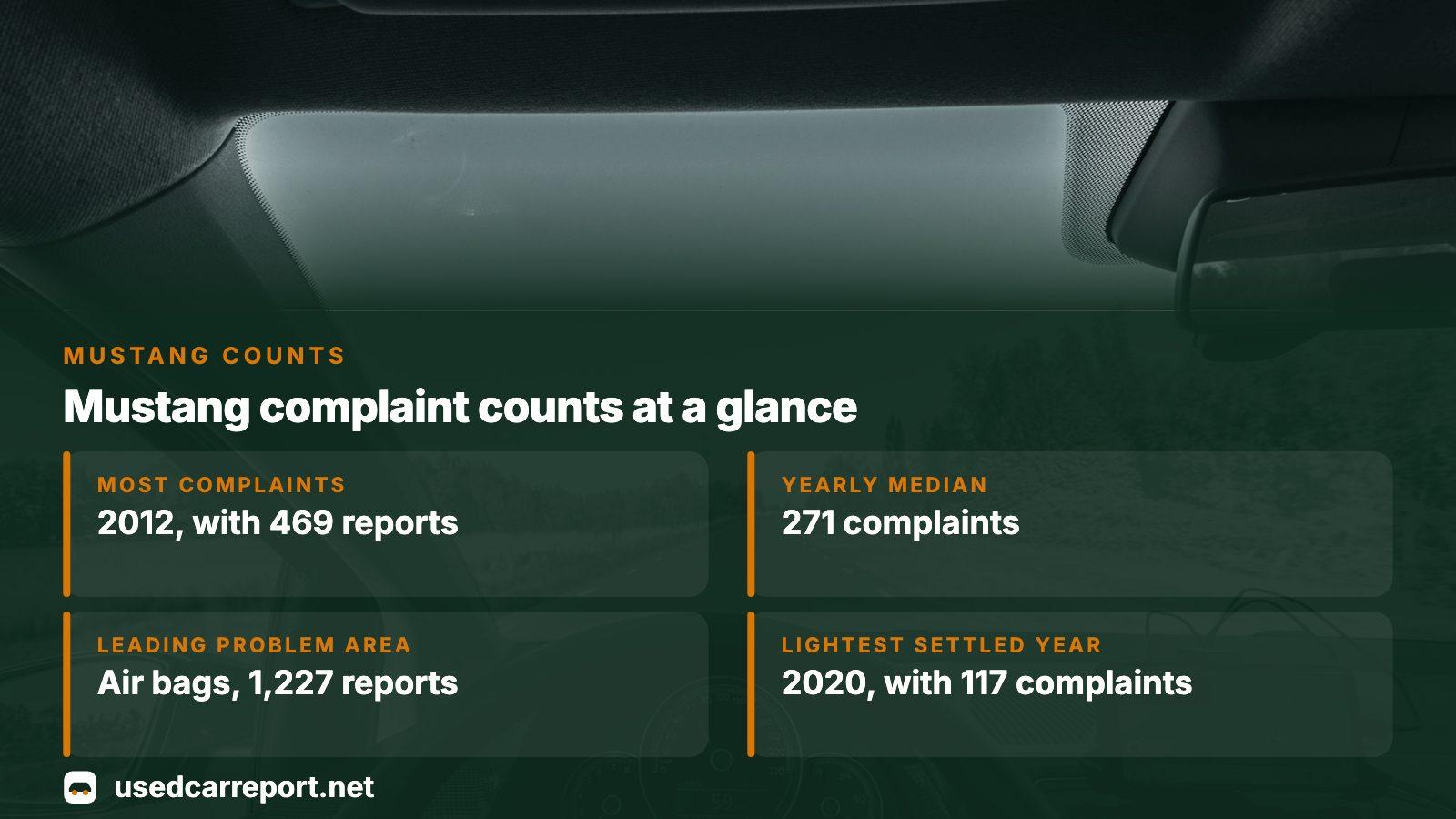
- Most complaints
- 2012, with 469 reports
- Yearly median
- 271 complaints
- Leading problem area
- Air bags, 1,227 reports
- Lightest settled year
- 2020, with 117 complaints
The five Mustang years furthest above the median
NHTSA holds 4,441 owner complaints for 2008 through 2022 Mustangs. The middle year of those 15 carries 271, so each count below is divided by that figure: 1.73 means roughly three-quarters more than a typical year.
| Model year | Top complaint area | Ratio to median | Complaints |
|---|---|---|---|
| 2011 | Power train | 1.72 | 466 |
| 2012 | Power train | 1.73 | 469 |
| 2015 | Unknown or other | 1.61 | 436 |
| 2016 | Engine | 1.37 | 371 |
| 2021 | Electrical system | 1.46 | 395 |
The ratio tells you how hard to look, not what you will find. Good and tired coupes turn up in every row.
A sudden jump between 2020 and 2021
Reports go from 117 for 2020 to 395 for 2021, more than triple in a single model year. A step that sharp looks like a change to the car itself, not a slow drift in owner mood, and the leading area for 2021 is the electrical system. Used 2020 cars sit on the quiet side of that break and 2021 cars on the noisy side, so confirm the production year on the paperwork, then ask about warning lights, screens and anything a dealer has reset.
Air bags top the list, and much of it is recall paperwork
Sorted by component, air bags lead across 2008 to 2022 with 1,227 reports. Power train follows with 717, then electrical system with 541 and engine with 365. In NHTSA's lists, 78 of the 125 air bag complaints for 2011 and 95 of the 158 for 2012 mention Takata, and some describe owners waiting on parts. A big air bag number is partly a to-do list that a VIN lookup can settle.
From an NHTSA owner complaint
An owner who bought a 2012 Mustang in late 2024 says the dealership mentioned a recall and switched off the passenger air bag. Two weeks later the service center sent the car away unrepaired, saying the air bag "didn't exist". The owner heard nothing more.
A disabled or missing air bag is a question to settle before you pay. Ask why, then hold the seller's answer against the car's accident and damage entries.
Power train trouble marks 2011 and 2012
Both of the top two years name power train first. NHTSA's lists show 200 such reports for 2011 and 177 for 2012, out of 717 across the whole run, and they range from a manual box that grinds between gears to a gearbox that drops into first without warning.
From an NHTSA owner complaint
A 2012 Mustang owner reports cruising at 55 mph when the transmission dropped to first gear unprompted. The speedometer quit, three warning lights glowed, and roughly 67,000 miles in, nobody had diagnosed or repaired the fault when the complaint was filed.
On a 2011 or 2012 car, transmission service records matter more than a clean interior. Drive it cold, run every gear and watch for lights that stay on.
What a model year cannot show: whether this coupe was hit
A complaint count describes a population. It cannot say whether the Mustang in the driveway met a guard rail or lost a front corner in a parking lot. UsedCarReport puts accident and damage entries first in its report for that reason: fresh paint hides a repair from the eye, though not from a reported record.
| Question | Where the answer sits |
|---|---|
| Do owners complain about this model year? | The NHTSA counts above |
| Was this car in a collision, and how bad? | Accident and damage records, with a damage map |
| Was it ever a total loss or flood car? | Title brands and salvage history |
| Did it pass through an auction? | Auction records and photos |
| Do mileage readings climb the way they should? | Odometer readings by date |
| Is a recall waiting on this exact car? | Open recalls by VIN |
A record holds only what was reported, so an unreported fender-bender will not appear. A shop's lift inspection covers that gap.
When the odometer story falls apart on a private sale
From an NHTSA owner complaint
A buyer who picked up a 2011 Mustang from a private seller told NHTSA that a service visit exposed a mileage mismatch: 174,000 miles at the time of purchase, 298,000 at registration. The complaint opens with the words odometer fraud.
One account is not proof, but the lesson is old. Until you see mileage logged on different dates, a private seller's word is the only record you have. Those readings should climb steadily, and a drop or a flat stretch is your cue to stop and renegotiate or walk away.
The quieter years, and why the newest cars sit out
Among years with time to settle, 2020 is the only one clearly under the median, at 117 complaints or 0.43 times the typical year. Very new model years are left out on purpose: owners have had little time to file, so a short list says more about age than quality.
| Model year | Complaints | Recalls |
|---|---|---|
| 2018 | 186 | 4 |
| 2019 | 142 | 6 |
| 2020 | 117 | 8 |
| 2015 | 436 | 11 |
Read recalls beside complaints; the 2015 row is there for contrast. A recall means Ford owes a free fix, so 2015 carrying the most recalls is not automatically bad news. Federal law ends that free duty 15 years after a car's first sale, and NHTSA's VIN lookup omits older campaigns, so an early Mustang needs extra homework.
Running the check on the Mustang you are considering
- Copy the VIN from the car and check every character against the seller's paperwork. One mismatch is a stop sign.
- Enter it on UsedCarReport for the free preview, which shows which record types exist before you pay anything.
- If the preview lists collision, title or auction records, open the full report and read the accident and damage entries first, then title brands and odometer readings.
- Run NHTSA's recall lookup for the same VIN. Its results cover recalls still waiting for a repair, so a clean answer does not rule out earlier ones.
- Try NICB VINCheck too: five searches a day per IP address, drawn from theft, salvage and flood reports by participating insurers. A clean result is no guarantee.
- Book an independent inspection aimed at the gearbox, the air bag system and any sign of an old repair.
Paying for the report is one purchase, not a plan. The pricing page has the options.

Where this information comes from
- NHTSA: Check for recalls — The free VIN recall search, with its limits: unrepaired campaigns only, and nothing older than 15 years unless the maker extends coverage.
- NHTSA: Vehicle safety and owner complaints — The public complaint database behind the per-year counts and the component rankings on this page.
- NICB: VINCheck — A no-charge screen of insurer theft, salvage and flood reports, with the insurer's own warning that a clean result guarantees nothing.
- NMVTIS: National title record — The federal title-record system built to protect buyers from fraud and unsafe vehicles.
- NHTSA owner complaint 11648635 — owner experience, paraphrased
- NHTSA owner complaint 11513987 — owner experience, paraphrased
- NHTSA owner complaint 11669174 — owner experience, paraphrased
Sources and photos: Facts checked against the sources above in November 2026. Photos by Jacob McGowin, Michal Biernat and Sander Jeurissen on Unsplash; diagrams by UsedCarReport.
Keep reading
- VIN accident check: read the damage records before you buyWhat collision and damage records show for a single car, and where they stop.
- Check mileage history by VIN: six steps, damage records firstHow odometer readings across dates expose a mileage story that does not add up.
- Buying a car with an open recall: read the damage record firstHow to handle a recall that has not been repaired on the car you are eyeing.
- Dodge Charger years to avoid, and what the damage record addsThe same year-by-year complaint comparison for a rival performance car.
Frequently asked questions
Which Ford Mustang years should I avoid?
Owner complaints at NHTSA point to 2012, 2011 and 2015 first, then 2021 and 2016. All five sit well over the yearly median of 271. That is a signal to inspect and bargain, not a ban, because each count covers thousands of cars and says nothing about the one for sale.
Is a 2011 or 2012 Mustang worth buying?
It can be, at the right price and with proof. Both years draw many power train reports, so ask for transmission service records, drive the car cold through every gear and have a shop inspect it. Then check the VIN for collision history and open recalls before you agree to a number.
What is the most common Mustang problem?
Air bags, with 1,227 reports across 2008 to 2022, then power train with 717 and electrical system with 541. A large share of the air bag entries on 2011 and 2012 cars mention Takata, and a VIN lookup can show whether that recall work is done or still open.
What is the best Mustang year to buy used?
By complaint counts alone, 2020 is the lightest settled year at 117, with 2019 next at 142. Fewer complaints is not the same as better built, though, and 2021 jumps to 395. In any year, a crash or flood entry on the VIN can outweigh a quiet complaint record.
How do I check a used Mustang for accident damage?
Run the VIN. The free preview on UsedCarReport shows which records exist, and the paid report opens with accident and damage entries and any auction photos. Match photos to the panels on the car, and have an independent shop judge old repairs, since unreported damage appears in no record.
Now check the car itself
The guide explains what to look for. The report shows what this VIN has on record.