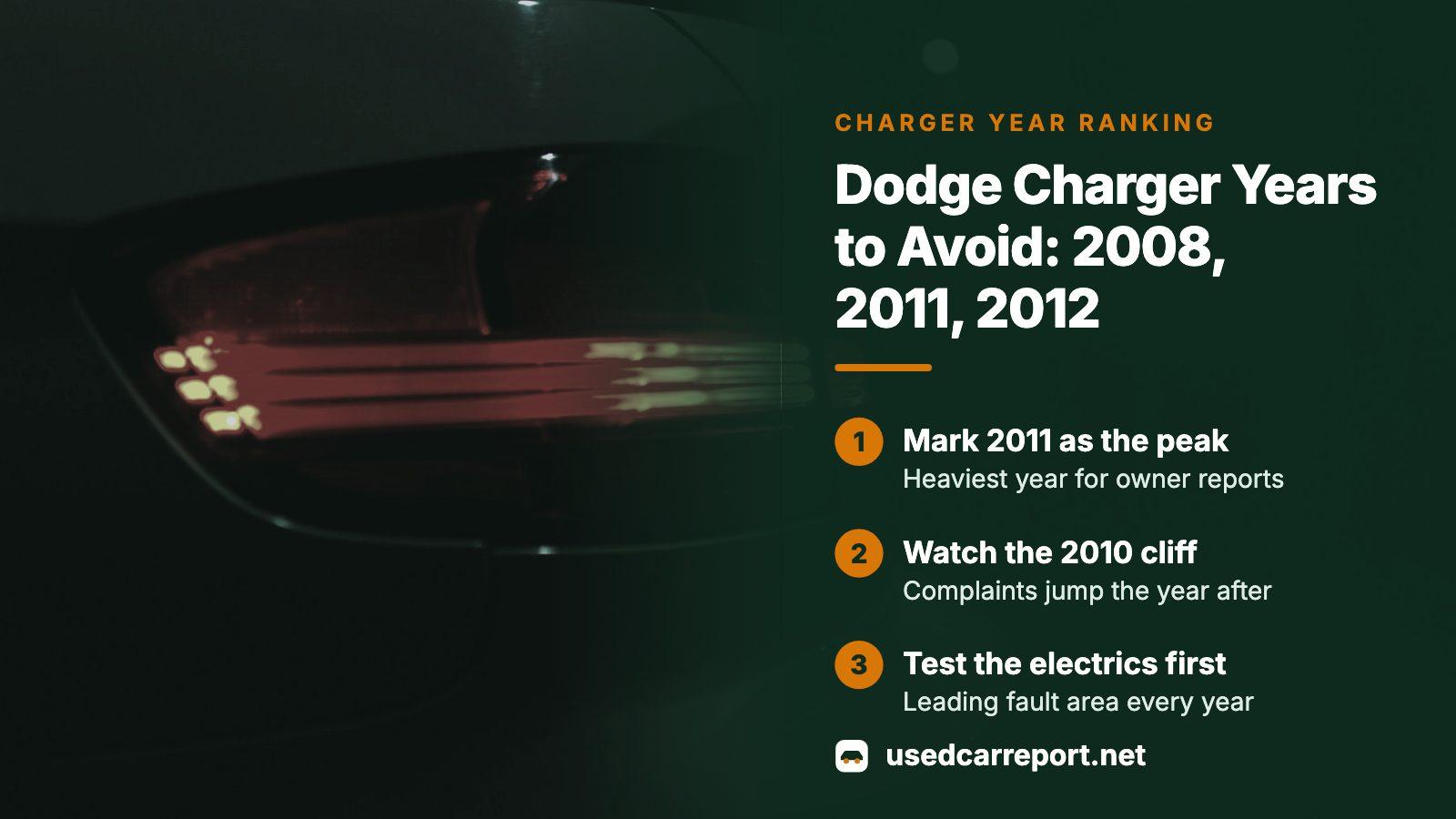
THE SHORT ANSWER
NHTSA holds 3,897 owner complaints on 2008 to 2022 Chargers, and the middle year has 175. Complaints peak at 698 for 2011, then 661 for 2012 and 624 for 2008, with 2013 and 2014 trailing behind. Electrical faults top every list. The thinnest records belong to 2020, 2021 and 2022, but those cars are young. A bad year earns a closer look and some bargaining room, but the car's own accident and damage entries settle the question.
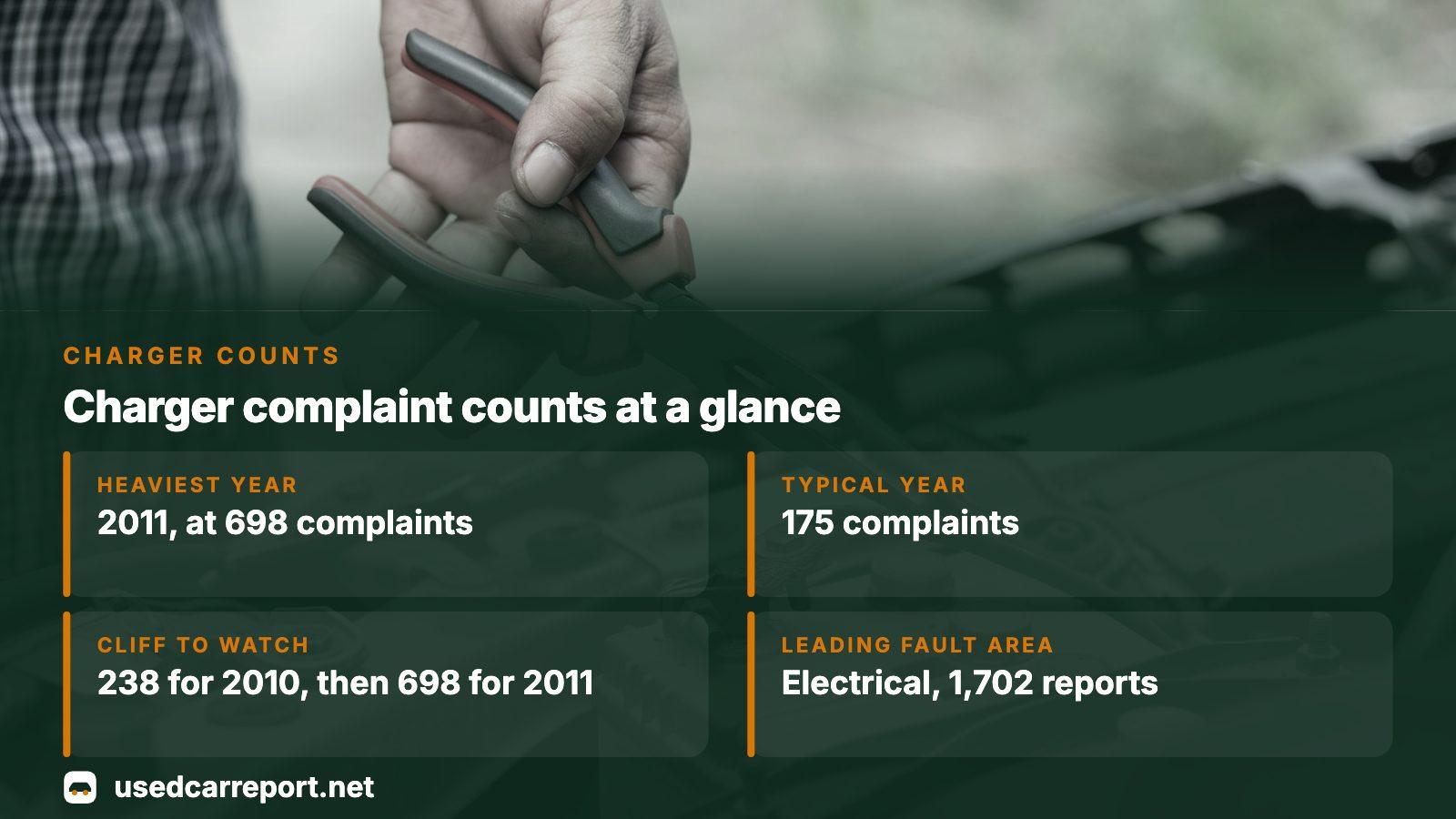
- Heaviest year
- 2011, at 698 complaints
- Typical year
- 175 complaints
- Cliff to watch
- 238 for 2010, then 698 for 2011
- Leading fault area
- Electrical, 1,702 reports
The three Charger years owners complain about most
NHTSA's Charger file covers fifteen model years, 2008 to 2022, and 3,897 complaints. Divide each year by the 175 of the middle year and three stand apart. A multiple of four means about four ordinary years of grievances packed into one.
- 2011: 698 complaints, roughly four times the median, with 11 recalls on file.
- 2012: 661 complaints and 14 recalls, the most recalls of any year.
- 2008: 624 complaints, about three and a half times the median, with 5 recalls.
- 2013 and 2014: 366 and 346, still about double the median, and the end of the elevated stretch.
Electrical system is the most reported area in all five of those years. Anyone shopping one of them should plan the test drive around it.
Where the climb starts: 2010 to 2011
Complaints for 2010 stand at 238. For 2011 they reach 698, nearly three times as many. A cliff like that suggests something changed on the car rather than a slow slide in quality, so treat 2010 and 2011 as two different sedans.
Inside 2011, electrical system leads and exterior lighting stands out beside it. Dead headlamps hide in daylight, so ask for a look after dark.
From an NHTSA owner complaint
A 2011 Charger owner told NHTSA the starter burned out within a week of purchase. A replacement alternator part followed, the fault returned, and the car sat idle for months. The seller, the owner said, had never mentioned three recalls on that VIN, covering air bags, structure and electrical.
The lesson is timing. A recall lookup is quick, and it only helps if it happens before the sale.
The quieter years, and why a low count proves little
From 2015 to 2019 the yearly counts sit in a narrow band: 135, 182, 128, 122 and 120. All but 2016 fall under the 175 median, and 2016 is barely over it. The 2009 cars land exactly on the median.
The lowest counts come last: 2020 with 57, 2021 with 32 and 2022 with 13, backed by 3, 2 and 3 recalls. Those cars have spent the least time with owners, so small numbers partly reflect youth. They show a quiet record so far, and say nothing about whether one particular car was ever crashed.
Where Charger owners report faults, in test-drive order
Add all fifteen years together and five areas lead the file. Work down the list in this order.
- Electrical system, 1,702 reports: operate every window, lamp and screen, and note any dash warning that appears and fades.
- Engine, 554 reports: ask for service records and listen to a cold start.
- Air bags, 482 reports: check that the air bag lamp glows at ignition and then fades, and look up recall status by VIN.
- Power train, 320 reports: shift through the gears at low speed and on the highway, feeling for slips.
- Exterior lighting, 171 reports: test low beams, high beams and signals, preferably at dusk.
Totals blend every year. They point a mechanic at a place to look, not at a verdict on one car.
A model year is a population; a crash belongs to one car
Picture two 2012 Chargers on one lot. One had a single owner and a quiet commute. The other was hit, repaired, auctioned and hit again. The complaint ranking cannot tell them apart, and the price tag often cannot either.
That is why accident and damage entries come ahead of the year on a used-car report. Note each entry's severity, whether air bags fired and whether auction photos exist. Check the use type too, since a rental, fleet or patrol sedan lives harder than one kept by a single owner.
From an NHTSA owner complaint
A 2008 Charger owner wrote that two air bag recalls were waiting on a dealer visit when a minor accident happened. By the owner's account, a hit to the left fender at under 30 miles an hour set off the driver and passenger bags, and only the recalled ones fired. The owner said the accident was still in dispute.
A past deployment and an air bag recall never done are separate things to look for. One points to an earlier impact, the other to a repair still owed.
Mileage entries and auction stops tell their own story
Damage is half the paper trail. Dated odometer readings and any auction appearance let you test whether the mileage in the ad can be right. Six figures is normal on a Charger this age; a reading that runs backward is not.
From an NHTSA owner complaint
A buyer of a 2008 V8 Charger told NHTSA the sales contract listed 113,440 miles. The inspection sticker, dated November 2018, read 114,000, and a history report showed the car at auction later that month with 113,437. The buyer did not say how the gap arose.
Line up every figure: the ad, the contract, the sticker and each dated entry in the report. A small gap may be harmless, such as a rounded sticker, but a number that falls between dates calls for questions before you pay.
Recalls follow the VIN, and age can end the free repair
Recall counts measure a different thing. A recall means the maker accepted that a defect exists, and the repair is free to the owner. So a long list is not always bad news: 2012 carries 14, the most of any year, while 2022 carries 3.
A campaign covers a band of build dates, not a model year, so a year's tally cannot say whether your sedan is included or whether the work was done. NHTSA's recall search answers both from one VIN.
Age adds a wrinkle. Section 30120(g) of Title 49 lets a maker charge for recall work on a car whose first owner bought it more than fifteen calendar years before the recall notice. A late campaign on an older Charger may leave you paying, so ask the dealer what it will still cover.
Run the VIN on the Charger before you drive it
Start at the driver's door. One copy of the VIN is on a tag you can see from outside, low in the windshield; the other is on a label by the door latch. Both should match each other, the title and the listing. The tenth character encodes the model year, so it checks the ad's year.
- Photograph every place the VIN appears and compare it with the seller's paperwork.
- Enter it in the free preview, then open the full report on each Charger still in the running.
- Read the accident and damage entries first, then title brands, auction photos and odometer readings.
- Add a recall search at NHTSA and a VINCheck at NICB, both free.
- Pay an independent mechanic to check the electrical system and a cold start.
Previewing costs nothing. The full report is bought once, with nothing to cancel later, and a shopper weighing several sedans can buy 3, 5 or 10 together. Prices are on the pricing page.

Where this information comes from
- NHTSA owner complaint 11184883 — owner experience, paraphrased
- NHTSA owner complaint 11268790 — owner experience, paraphrased
- NHTSA owner complaint 11320354 — owner experience, paraphrased
- NHTSA: recalls by vehicle — Looks up open recall campaigns for one car from its VIN.
- NMVTIS: national motor vehicle title information system — The federal title-record program behind brand and total-loss data on a single vehicle.
- NICB: VINCheck — A theft and total-loss screen for one VIN.
- 49 U.S.C. 30120: remedies for defects and noncompliance — The statute that makes recall repairs free and sets the 15-year limit.
Sources and photos: Facts checked against the sources above in November 2026. Photos by Johnathan Kaufman, Jakub Żerdzicki and Towfiqu barbhuiya on Unsplash; diagrams by UsedCarReport.
Keep reading
- VIN accident check: read the damage records before you buyWhat an accident and damage record shows about a car, and where it falls short.
- Buying a car with an open recall: read the damage record firstHow to handle a sedan whose recall repair was never done.
- Ford Mustang years to avoid, and why this car's crash record comes firstThe same complaint ranking for the Charger's muscle-car rival.
- Pre-purchase inspection: read the damage records, then hire the mechanicWhat to ask a mechanic to look at once the record checks out.
Frequently asked questions
Which Charger model years are the worst?
By NHTSA complaints, 2011, 2012 and 2008 lead with 698, 661 and 624 reports, and 2013 and 2014 follow. A bad year justifies a longer inspection and a lower first offer, not an automatic no, since sound cars exist in every year.
Which Charger years have the fewest complaints?
The lightest files belong to 2022, 2021 and 2020, at 13, 32 and 57, though a young car has barely had time to draw complaints. For a longer record, 2015 to 2019 stays between 120 and 182 a year, near or under the median. Upkeep still decides how any single car behaves.
What goes wrong most often on a Charger?
Electrical faults, with 1,702 reports from 2008 to 2022, far ahead of the engine at 554 and air bags at 482. Owners describe headlamps that cut out and warning lights that come and go, so use every switch on the test drive and ask a mechanic to read the fault codes.
Should I walk away from a Charger with an accident on its record?
Not automatically. A light collision that was repaired well can leave a sound sedan, while a deployed air bag or a severe entry justifies an independent inspection and a lower price. Check the severity, any auction photos and the title status, then have a mechanic study panel gaps and the underbody.
How do I check one particular Charger before buying?
Start with the VIN. Run the free preview, read the accident and damage entries, title brands and odometer readings in the full report, then add a recall search and a VINCheck. Finish with a mechanic's inspection. A complaint ranking describes a production run, never the car in the driveway.
Now check the car itself
The guide explains what to look for. The report shows what this VIN has on record.