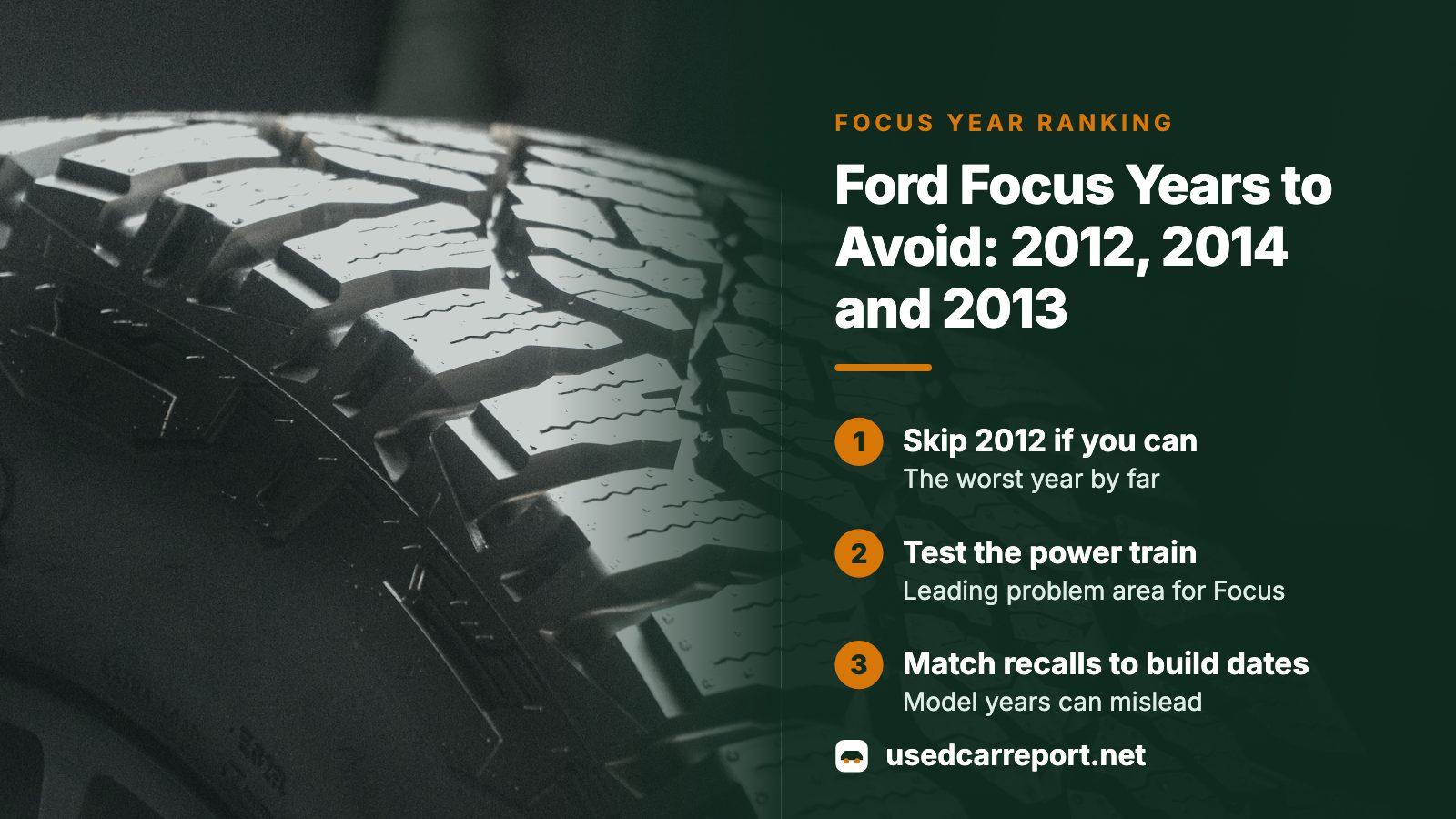
THE SHORT ANSWER
NHTSA holds 13,432 owner complaints on the Focus for 2008 through 2018, with a yearly median of 896. The worst year is 2012 at 3,793, followed by 2014 at 2,651 and 2013 at 2,174, while 2011, 2009 and 2008 are the lightest settled years. Power train is the leading complaint area. Treat a flagged year as a cue to inspect closely and offer less, and read the car's crash and damage record first.
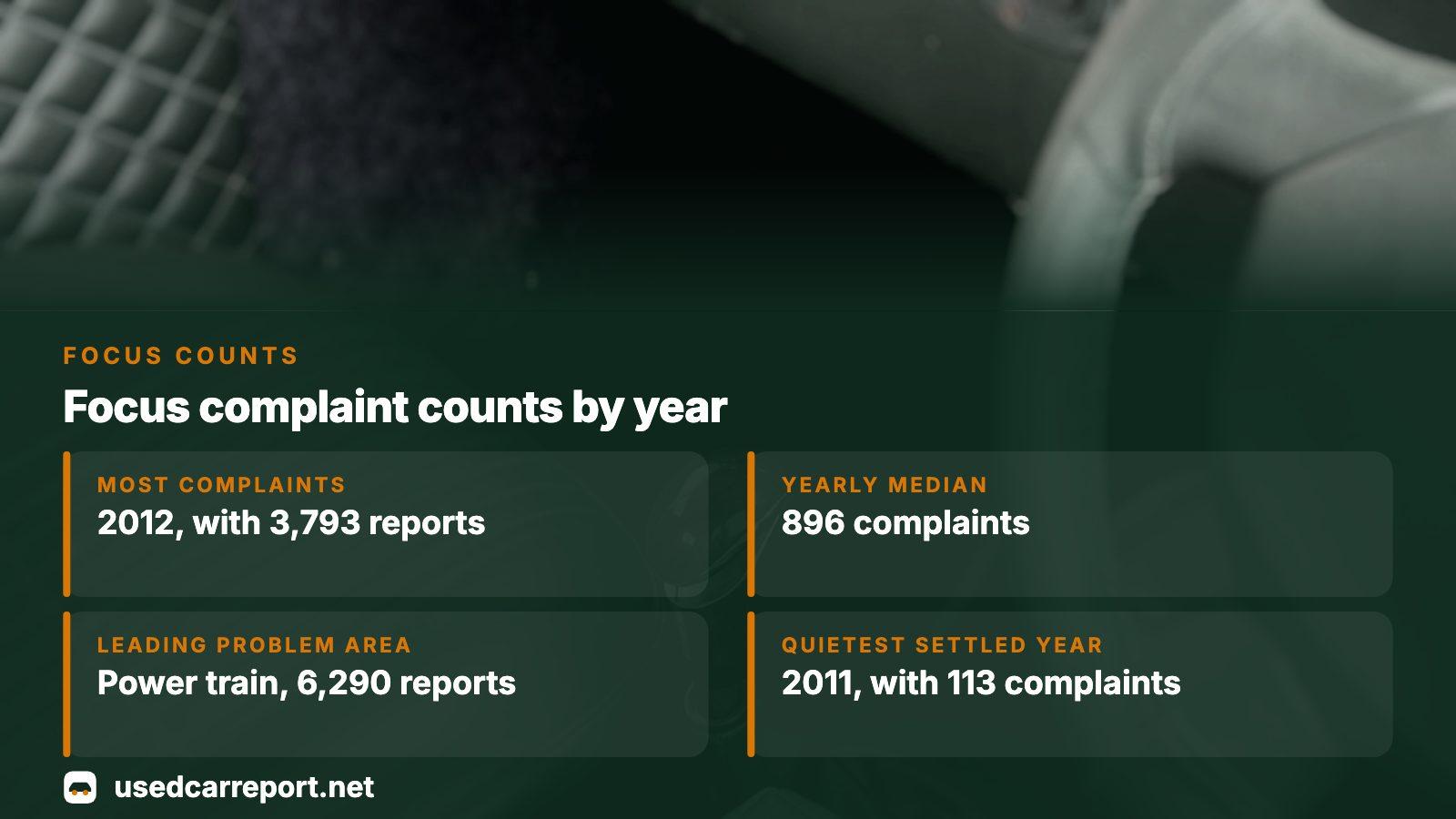
- Most complaints
- 2012, with 3,793 reports
- Yearly median
- 896 complaints
- Leading problem area
- Power train, 6,290 reports
- Quietest settled year
- 2011, with 113 complaints
Every Focus year against its own median
NHTSA has 13,432 Focus complaints for 2008 to 2018, and the middle year holds 896. The last column divides each year by that figure, so 2.43 means about two and a half times a typical year. Recalls are shown too: a recall is a defect the maker admits and fixes at its own cost, unlike one owner's unverified complaint.
| Model year | Complaints | Recalls | Ratio to median |
|---|---|---|---|
| 2012 | 3,793 | 8 | 4.23 |
| 2014 | 2,651 | 12 | 2.96 |
| 2013 | 2,174 | 12 | 2.43 |
| 2016 | 1,187 | 10 | 1.32 |
| 2015 | 1,027 | 9 | 1.15 |
| 2017 | 896 | 10 | 1 |
| 2018 | 825 | 7 | 0.92 |
| 2010 | 287 | 0 | 0.32 |
| 2008 | 250 | 2 | 0.28 |
| 2009 | 229 | 0 | 0.26 |
| 2011 | 113 | 0 | 0.13 |
Three years tower over the rest, while 2008 to 2011 sit far below.
The jump from 113 to 3,793 between 2011 and 2012
A leap that size points to a change in the car, and EPA's fuel economy site shows one. Its 2011 Focus automatic has four speeds; the 2012 automatics are labeled AM6 and AM-S6, with six. One 2014 owner's complaint calls the gearbox a dual-clutch automatic, and another names it DPS6.
Power train tops the list in all three flagged years. NHTSA's live list, read on November 5, 2026, tags 1,462 complaints on the 2012 car as power train, 1,102 on the 2013 and 1,597 on the 2014. A word search finds the clutch named in 413, 377 and 645 of them, so the 2014 car may be worst for that fault even though 2012 draws more overall. Steering is the second large mark on 2012, at 933.
When a stall turns into an accident record
Filers answer the crash question themselves. In NHTSA's list it is marked yes on 108 of the 2012 complaints, 49 of the 2013 and 69 of the 2014. Those are owners' accounts, not police findings, yet they show how a hesitating gearbox can become a collision entry on a car that is later sold.
From an NHTSA owner complaint
A 2012 Focus owner describes turning left at 15 mph when the transmission warning light came on and the car stalled into the side of another vehicle. The owner was not hurt, but the car was destroyed. The clutch and control module had been replaced months earlier, and the mileage was about 76,000.
On these years, open the crash and damage entries first. Note when a collision was logged and whether drivetrain work appears near the same date. Badly repaired damage and a gearbox fault nobody settled are what you are screening for.
Recalls attach to build dates, not model years
NHTSA lists 8 recalls for the 2012 Focus and 12 each for 2013 and 2014, but few cover a whole year. Match the VIN against campaigns like these, since an earlier repair can also have been done wrongly.
| Recall | Cars covered | The risk |
|---|---|---|
| Purge valve, 18V735000 | 2012 to 2018, 2.0L engine | A stall with no warning, no restart |
| Same valve fixed wrongly, 26V369000 | 2012 to 2018, already repaired once | Stall risk, software update at a dealer |
| Door latches, 16V643000 | 2012 to 2015 | A latch can fail while the door looks closed |
| Steering gear, 14V514000 | 2014, built August 8 to 15 | Loss of steering control |
| Fuel delivery module, 14V525000 | 2014, built May 1 to 24 | Low fuel pressure and a stall |
| Block heater, 26V011000 | 2013 to 2018, 2.0L engine | Shorting when plugged in, with fire risk |
Until the valve work is done, NHTSA advises keeping the tank at least half full. No gearbox campaign appears among the eight on the 2012 list, so a clean recall search says little about the transmission trouble owners describe.
What to read, in order, on a Focus report
UsedCarReport opens its report with accident and damage, an order that suits a 2012 to 2014 Focus. A free preview lists the kinds of records held on that VIN before any payment, and the full report is a single purchase, with options on the pricing page.
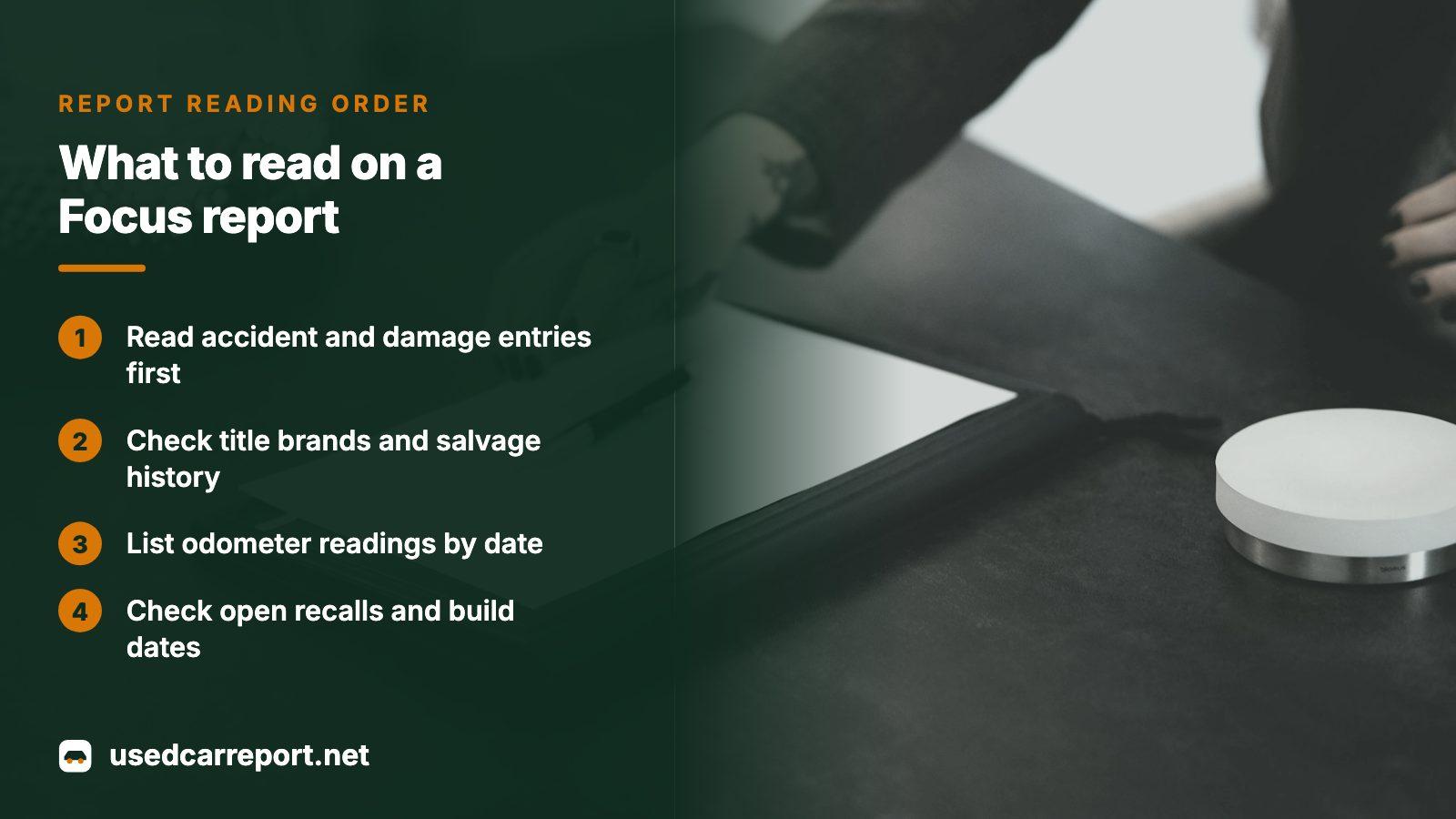
- Accident and damage entries: dates, the damage map and any auction photos, held up against the panels on the car.
- Title brands and salvage history. A total-loss or flood brand outweighs any year ranking.
- Odometer readings by date, which should climb steadily. A flat stretch or a drop needs an explanation.
- Open recalls, then the build-date campaigns above.
- Ownership and use type. Years as a rental or fleet car mean a different life from one owner's commute.
- NICB's VINCheck as a cross-check, a free theft and total-loss screen.
Reports hold only what someone reported, so a quiet parking-lot dent can be missing. An independent mechanic's inspection fills that gap.
A used buyer, a clutch fault and the end of covered repairs
Free recall repairs do not last forever. Federal law lets the obligation lapse 15 years after a car's first sale, and the 2012 cars are approaching that line. Programs and warranties can carry mileage caps too.
From an NHTSA owner complaint
A buyer who picked up a 2013 Focus used, at 70,000 miles, was handed a history report listing a transmission clutch issue. Within a month the car lost power, and a recall repair covered it. Nearly a year later a part outside the recall cost $125. On the third visit a $2,300 repair came with word that recall coverage ended at 100,000 miles. The owner could not afford it and collected the car as it was.
A known fault on the history is a reason to price the repair in, not to trust the past fix. Ask what was replaced, when, at what mileage, and whether any coverage remains.
A test drive built around the Focus's known trouble
- Start the car cold and pull away from a full stop. Hesitation, shudder or a lurch is the headline complaint on these years.
- Climb a grade, then merge at highway speed. Lost power with a warning light is a reason to stop, not to haggle.
- Scan for stored codes before driving. A cleared clutch or transmission fault is worth a question.
- Ask for repair orders naming the clutch, control module or fuel tank, and compare their dates with any collision on the report.
From an NHTSA owner complaint
A parent who bought a 2014 Focus from a used dealer as a teenager's first car saw hesitation pulling out from a stop within a week, and one slip and jerk at an intersection nearly caused a collision. A clutch actuator code showed on the dash. The part was replaced, yet the hesitation and the light kept returning.
A fault that shows up in week one and survives a part swap is the pattern to screen for. Treat 'it only needed a part' with caution.
The quieter years, and what they leave out
By complaint volume the lightest settled years are 2011 at 113, 2009 at 229, 2008 at 250 and 2010 at 287, all far under the median of 896. Only 2008 carries recalls, two of them. The 2015 to 2018 cars hover near the median instead.
A quiet year is still a statistic about a crowd. An older car has had longer to collect owners and incidents, so its VIN record can matter more than its year.
Where this information comes from
- NHTSA: Check for recalls — The recall search by VIN, and the public campaign data behind the recall counts and the build-date table.
- NHTSA: Vehicle safety and owner complaints — The complaint database behind the yearly counts, the component tags and the crash flags.
- Fuel Economy.gov: 2012 Ford Focus — EPA and Energy Department listing used for the automatic transmission designations.
- NICB: VINCheck — A no-charge theft and total-loss screen for a single VIN.
- NHTSA owner complaint 11073262 — owner experience, paraphrased
- NHTSA owner complaint 11252137 — owner experience, paraphrased
- NHTSA owner complaint 11544438 — owner experience, paraphrased
Sources and photos: Facts checked against the sources above in November 2026. Photos by Rob Wingate, Annika Wischnewsky and Thakur Jaideep Singh on Unsplash; diagrams by UsedCarReport.
Keep reading
- VIN accident check: read the damage records before you buyWhat collision and damage records show for a single car, and where they stop.
- Buying a car with an open recall: read the damage record firstHow to handle a campaign that is still open on the Focus you are eyeing.
- Pre-purchase inspection: read the damage records, then hire the mechanicWhat a shop checks on a lift, including drivetrain faults no record can show.
- Ford Escape years to avoid, and the accident record to read firstFord's crossover shares the door latch and block heater recalls covered above.
Frequently asked questions
Which Ford Focus years should I avoid?
Start with 2012 at 3,793 complaints, then 2014 at 2,651 and 2013 at 2,174, against a yearly median of 896. Those totals justify a harder look and a lower price, not a blanket ban. A collision entry on any of them raises the stakes.
Is a 2012 Ford Focus worth buying?
Sometimes, at the right price and with paperwork behind it. The year draws the most complaints, led by power train and steering, so ask for repair orders on the clutch and control module, drive it cold, and read the VIN's crash and damage entries before naming a figure.
What is the best Ford Focus year to buy used?
By complaints alone, 2011 is lightest at 113, then 2009 at 229 and 2008 at 250. A low count says nothing about one car's crash, title or mileage history, so run the VIN whichever year you pick.
What goes wrong most often on a Ford Focus?
Power train, with 6,290 reports across 2008 to 2018, then engine at 2,202, steering at 1,311, electrical at 1,195 and fuel or propulsion at 1,081. Owner text on the 2012 to 2014 cars leans toward hesitation, shudder and clutch faults.
How do I check a Focus for accident damage?
Run the VIN. UsedCarReport's free preview signals which records exist for the car, and the report opens with accident and damage, then title, odometer and recall data. Add NHTSA's recall lookup and NICB's theft screen, and have a shop inspect for repairs nobody reported.
Now check the car itself
The guide explains what to look for. The report shows what this VIN has on record.