THE SHORT ANSWER
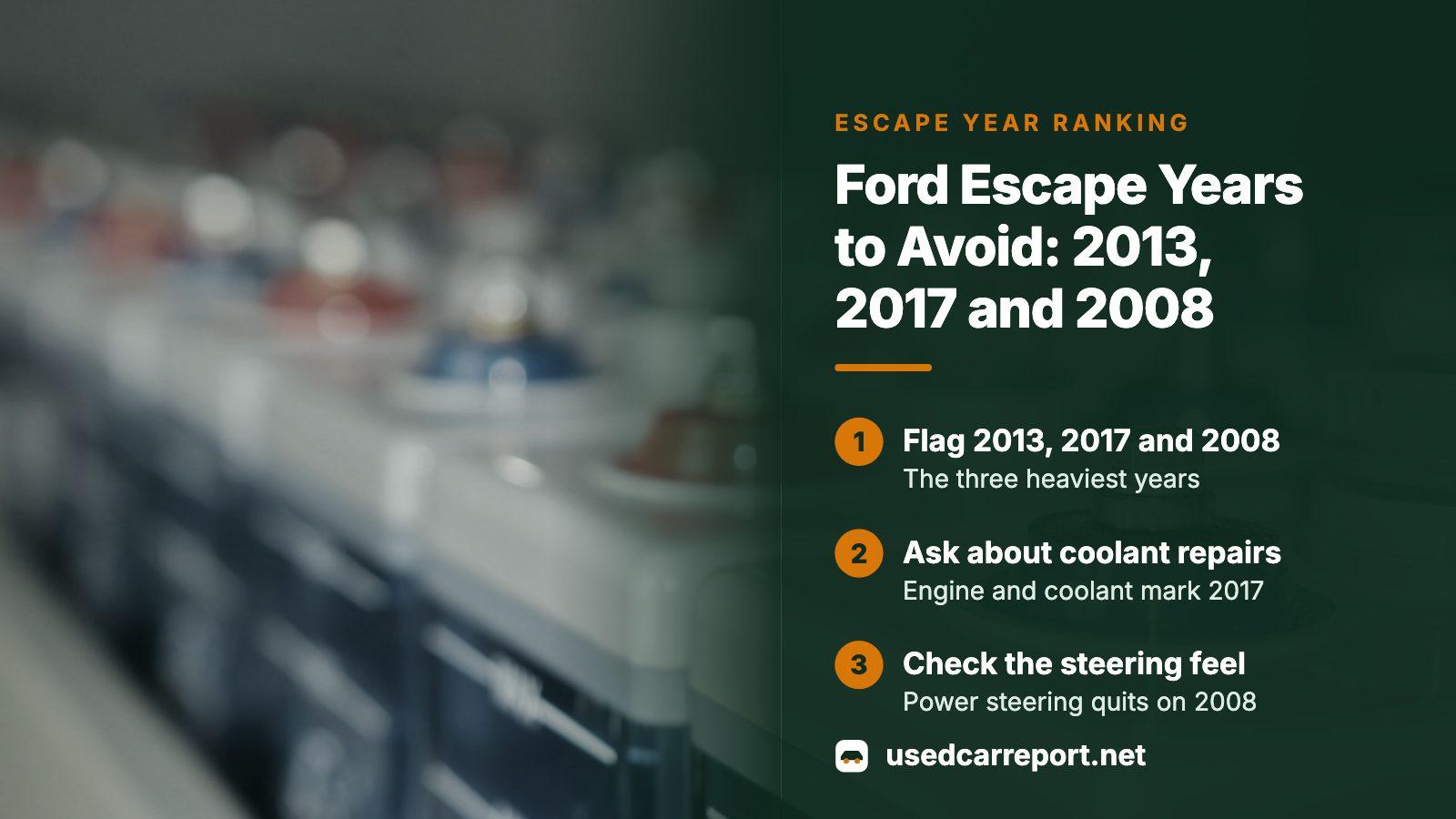
NHTSA holds 22,600 owner complaints for the 2008 to 2022 Escape, with a median of 1,550 per year. The 2013 model leads at 2,757, then 2017 at 2,702 and 2008 at 2,417. Engine and coolant reports mark the first two, lost power steering marks 2008. A flagged year means a slower inspection and a lower first offer, not a ban. Read that SUV's own accident and damage record first.
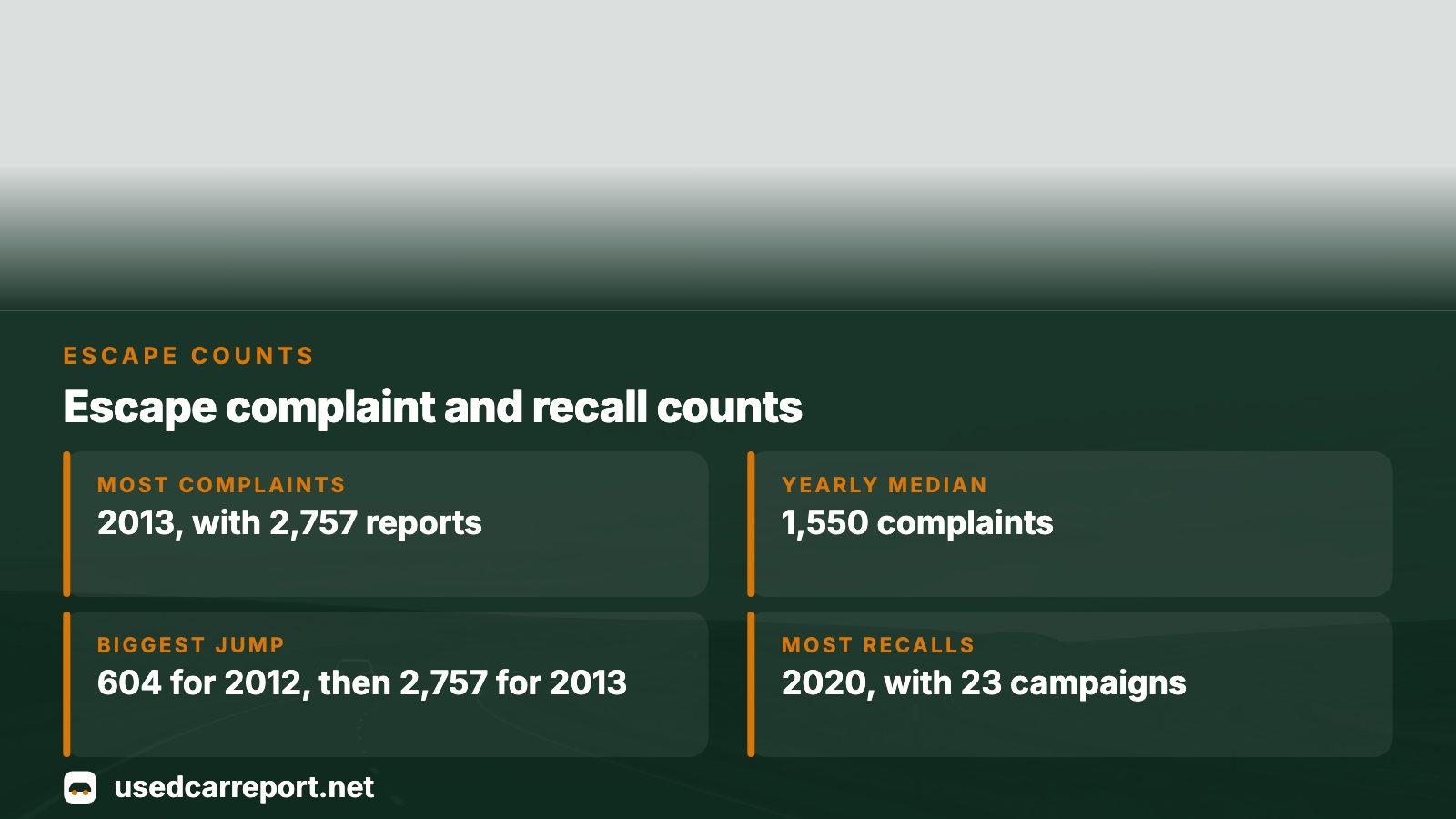
- Most complaints
- 2013, with 2,757 reports
- Yearly median
- 1,550 complaints
- Biggest jump
- 604 for 2012, then 2,757 for 2013
- Most recalls
- 2020, with 23 campaigns
How the Escape model years rank by owner complaints
These counts cover the 2008 to 2022 Escape as NHTSA's file stood on 5 November 2026. Each multiple divides a year's total by the 1,550 median, so 1.78 means nearly two ordinary years of complaints rolled into one.
| Model year | Complaints on file | Versus the median | Main complaint area | Recalls |
|---|---|---|---|---|
| 2013 | 2,757 | 1.78 | Engine | 18 |
| 2017 | 2,702 | 1.74 | Engine | 4 |
| 2008 | 2,417 | 1.56 | Steering | 5 |
| 2010 | 2,130 | 1.37 | Vehicle speed control | 5 |
| 2014 | 2,090 | 1.35 | Engine | 16 |
Mark two jumps: 604 complaints for 2012 against 2,757 for 2013, over four times as many, and 1,184 for 2016 against 2,702 for 2017. Steps that big tend to signal a redesign or a mechanical change, so neighboring years are not interchangeable.
2013: the biggest complaint count and 18 recalls
Engine tops the 2013 file at 1,269 reports, ahead of power train at 402 and electrical at 340. Buyers could pick a 2.5 L, a turbocharged 2.0 L or a turbocharged 1.6 L, and the recall list leans on the last. Five campaigns name it: a fuel line that may split, a cylinder head that may overheat and crack, a freeze plug that may loosen, and coolant leaks. They reach only cars built between October 2011 and mid-2013, so build date matters as much as the badge.
From an NHTSA owner complaint
A shopper bought a used 2013 SE. Roughly eighteen months later, the owner says, coolant was leaking into the engine and had ruined it. The owner ties the car to the old 1.6 L recall and says nobody flagged that at purchase: "I wasn't made aware of this."
Which engine a car carries, and whether those repairs were done, are VIN questions. Answer both before talking price.
2017: coolant, misfires and engine replacements
Engine tags sit on 1,584 of the 2,702 complaints for 2017, and 510 carry the engine and engine cooling tag. A word search of the summaries finds coolant or antifreeze in 1,555. The pattern repeats: a check-engine light, a misfire code on one cylinder, overheating, then a dealer blaming coolant that has reached the engine. Owners of the 1.5 L and the 2.0 L turbo both describe it.
Only four recalls exist for 2017, none about coolant reaching the cylinders: two cover power windows, one a shifter cable bushing, one a cracking 2.0 L block heater. Owners instead cite a Ford service program, 21N12, said to have paid for replacement engines until November 2022. NHTSA's recall file does not list it, so treat those details as owner accounts.
From an NHTSA owner complaint
A buyer got a used 2017 Escape showing 14,000 miles. The engine light came on with misfire codes, and the dealer pinned it on coolant entering the engine, adding that the program had ended. A new engine was quoted at $9,275.50. The owner heard of the issue only after passing 60,000 miles and says Ford never sent a letter.
Check a 2017's coolant reservoir cold and ask how often it needed topping up. Request invoices for engine work, and have a mechanic test the cooling system before agreeing a price.
2008: power steering that quits
Steering is tagged on 1,237 of the 2,417 complaints for 2008, far ahead of power train at 372 and service brakes at 292. Recall 14V284000 covers 2008 to 2011 Escapes built through September 2010. Its torque sensor may stop reading the driver's input, the electric assist drops out, and the wheel goes heavy at low speed. Dealers update software and swap parts when the car has a fault history.
From an NHTSA owner complaint
An owner who bought a 2008 from a used-car lot lost power steering eight months on, and the torque sensor was blamed. Learning of the 2014 recall, the owner phoned a Ford dealer and then Ford's customer line. Both said the recall repair predated the sale. The failure had returned, and nobody offered to pay.
A finished recall proves work was done, not that the part lasts. There is a federal cutoff too: once a recall notice arrives over 15 calendar years after a car was first bought, the maker no longer owes the free repair, so a new campaign on a 2008 could land on the owner.
The quieter years, and what the quiet can hide
The lightest counts belong to 2022 at 238, 2021 at 355, 2019 at 600 and 2012 at 604. The first two are young, so owners have had little time to file. Their recall tallies are not light: 19 each, and 23 for 2020. Several concern the 1.5 L engine, such as a cracking oil separator housing and a fuel injector that may crack and leak.
A 2012 or 2019 makes a friendlier shortlist than a flagged year, but that is a lean, not a guarantee.
Four reasons a complaint count can mislead
A raw count is a rough instrument, and four things bend it.
- Sales volume: a popular SUV collects more reports than a rare one built just as well.
- Age: old years have had far longer to gather reports, and new ones have barely begun.
- Source: each complaint is one owner's unchecked account, a pattern in bulk and thin proof alone.
- Recalls: a campaign means the maker accepted a defect and pays for the fix, so a long list can show problems being caught.
Why this SUV's accident and damage record comes before its year
Every complaint above describes how a part behaved. None says whether this Escape was hit, repaired, written off or wound back on the odometer. A quiet 2012 with a hidden structural repair is a worse buy than a flagged year with a spotless past.
| Question about the SUV | Where the answer sits |
|---|---|
| Was it in a crash, and which corner took the hit? | Collision and damage entries, plus salvage auction photos if it was sold at one |
| Was it ever branded salvage, rebuilt or flood? | Title records and brands tied to the VIN |
| Do the mileage readings climb believably? | Odometer readings from across its life |
| Which engine does it have? | Factory specs decoded from the VIN, since a 2013 or 2017 came with three engines |
| Is any recall still open? | NHTSA's own search, run on the same VIN |
A short order of checks before you pay for an Escape
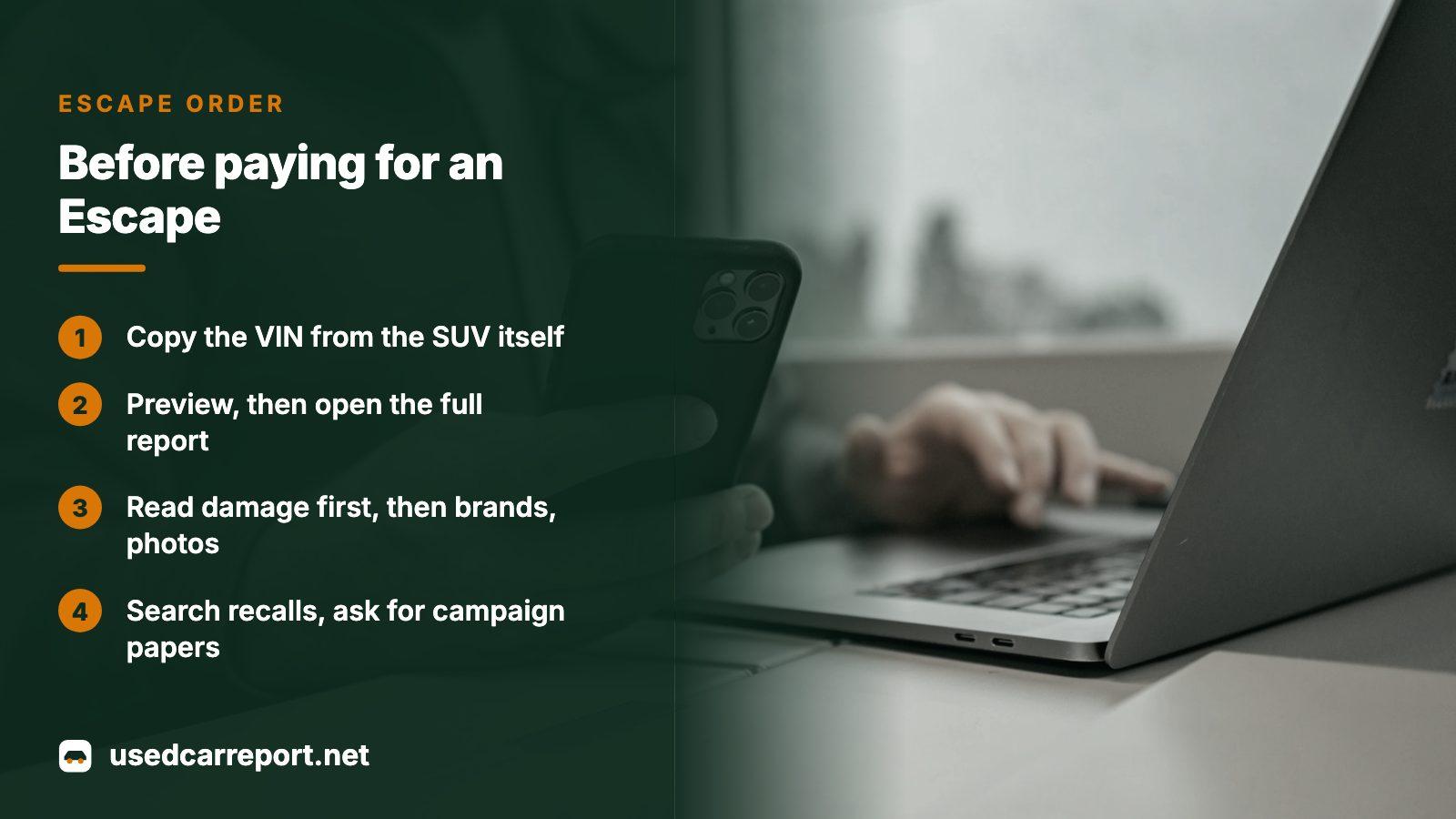
- Copy the VIN from the SUV itself, not the listing, and check it against the title paperwork.
- Preview that VIN at no cost, then open the full report on any Escape still in the running.
- Read the accident and damage section first, then title brands, auction photos and odometer readings.
- Search NHTSA's recall tool with that VIN, and ask for dealer paperwork on every campaign said to be finished.
- Ask for invoices that fit the year, such as coolant work on a 2013 or 2017 and steering work on a 2008, and have an independent mechanic test those systems.
A preview costs you nothing. The full report is paid once, with nothing recurring, and anyone comparing several Escapes can bundle 3, 5 or 10 reports into one purchase. Amounts are set out on the pricing page.
Where this information comes from
- NHTSA: vehicle safety and the complaint database — Where owners file complaints and where Escape filings by model year can be searched.
- NHTSA: recalls by vehicle — The search that shows open recall campaigns for one car by its VIN.
- US Code: 49 U.S.C. 30120 — The statute behind the 15-year limit on free recall repairs.
- fueleconomy.gov: find a car — Lists the engines offered on the 2008, 2013 and 2017 Escape.
- NHTSA owner complaint 11508005 — owner experience, paraphrased
- NHTSA owner complaint 11685029 — owner experience, paraphrased
- NHTSA owner complaint 11072784 — owner experience, paraphrased
Sources and photos: Facts checked against the sources above in November 2026. Photos by Vanya Smythe, Anastasiia Nelen and John Kakuk on Unsplash; diagrams by UsedCarReport.
Keep reading
- VIN accident check: read the damage records before you buyWhat accident and damage entries show about a single car, and where they fall short.
- Buying a car with an open recall: read the damage record firstHow an unfinished campaign should shape your offer, and what to do after the sale.
- Pre-purchase inspection: read the damage records, then hire the mechanicThe questions to bring to an independent mechanic once the records pass.
- Used car red flags: start with the crash and damage recordsOther warning signs to weigh next to a model year's complaint record.
Frequently asked questions
Which Ford Escape years should I avoid?
By NHTSA owner complaints, 2013 leads with 2,757, then 2017 with 2,702 and 2008 with 2,417, against a median of 1,550. None is a ban. Each calls for a slower inspection, a question about the engine and a lower first offer than a quieter year would get.
Is any Escape year a safe bet?
No year is guaranteed. The lowest counts are 238 for 2022 and 355 for 2021, yet those cars are young and carry 19 recalls apiece. Among older years, 2019 at 600 and 2012 at 604 look lightest. Upkeep records and the car's own history outweigh the year.
What is the most common Escape problem?
Across the fifteen model years, engine is tagged most, 6,953 times, then power train at 4,126 and steering at 3,787. One complaint can carry several tags, so totals overlap. Treat them as a test-drive plan, weighting steering for a 2008 and coolant for a 2013 or 2017.
If a recall was already done, is the problem solved?
Not necessarily. A completed recall shows the repair happened, not that the part will never fail again. Some 2008 owners report the steering torque sensor failing after the 2014 repair and hearing that nothing more was owed. A VIN search shows recall status; a mechanic judges the part.
How do I check one particular Escape before buying?
Begin with the VIN. Preview it at no cost, then read the accident and damage records in the full report, plus title brands and odometer readings. Check recalls on NHTSA's site with that VIN, and hire an independent mechanic, since no record shows how the engine and steering feel today.
Now check the car itself
The guide explains what to look for. The report shows what this VIN has on record.