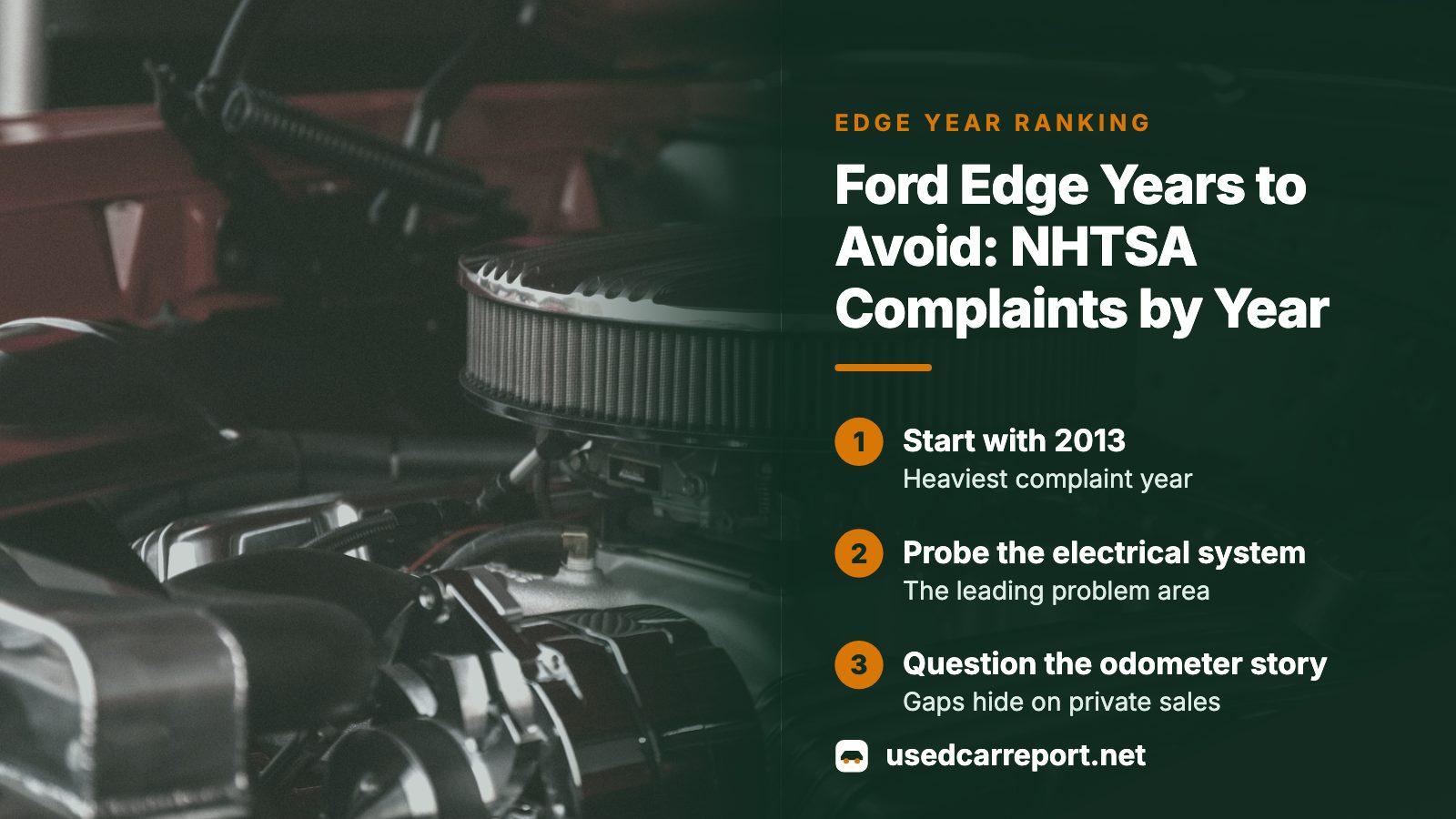
THE SHORT ANSWER
Owners filed 12,783 complaints with NHTSA about Edges built from 2008 to 2022, and the middle year holds 743. 2013 is heaviest at 2,437, then 2011 at 1,801 and 2017 at 1,308, with 2012 and 2008 close behind. Among older years 2009 and 2014 are quietest. Treat a flagged year as grounds to look harder and open low; the VIN's accident, damage and odometer record decides whether one Edge deserves your money.
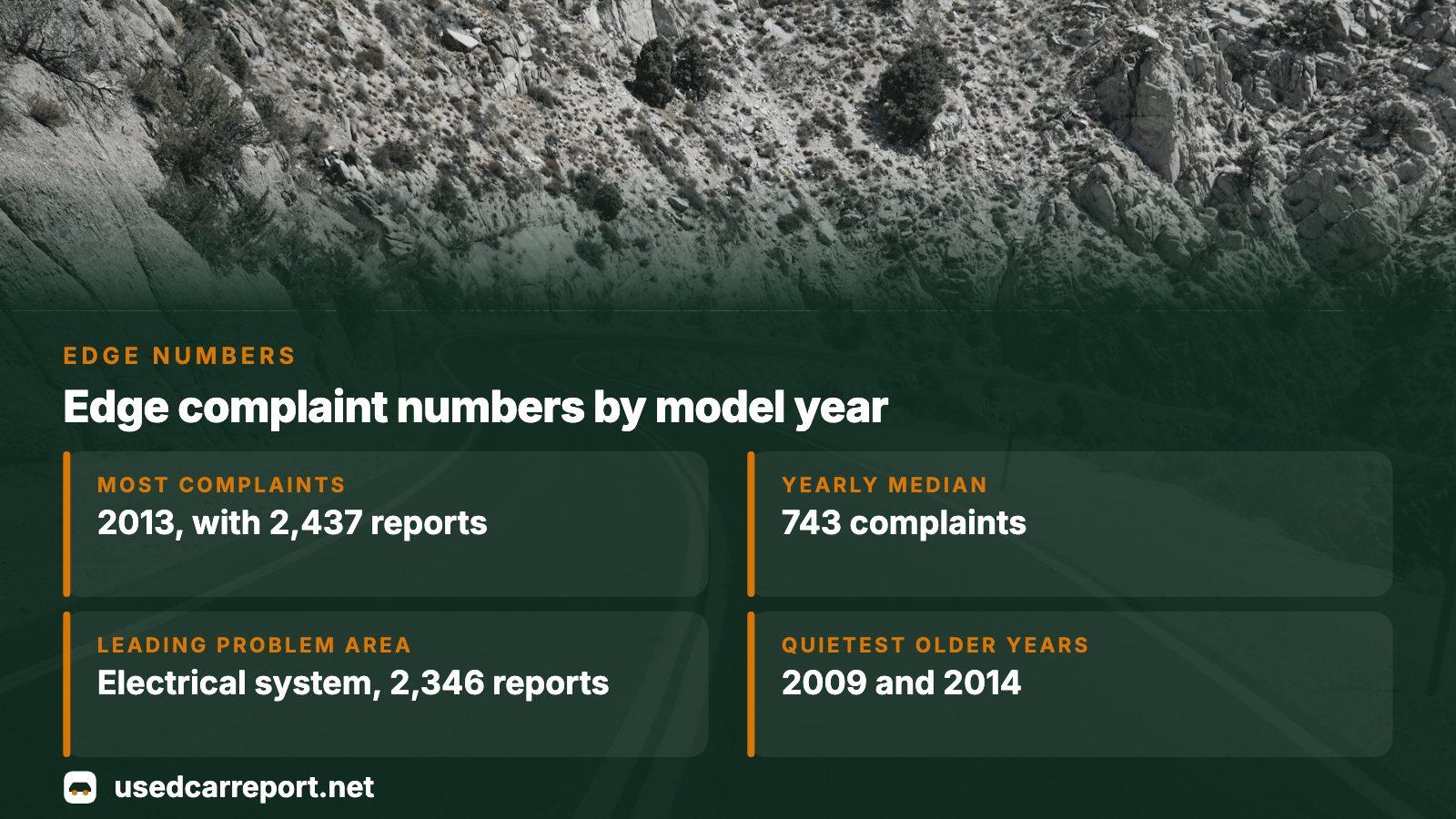
- Most complaints
- 2013, with 2,437 reports
- Yearly median
- 743 complaints
- Leading problem area
- Electrical system, 2,346 reports
- Quietest older years
- 2009 and 2014
The five Edge years that sit above the middle
NHTSA's records, as pulled in mid-August 2026, hold 12,783 owner complaints for 2008 through 2022 Edges. The middle year carries 743, so that is the yardstick; a ratio of 3.28 means a little over three typical years in one.
| Year | Top problem area | Complaints | Ratio to median |
|---|---|---|---|
| 2008 | Air bags | 1,119 | 1.51 |
| 2011 | Electrical system | 1,801 | 2.42 |
| 2012 | Electrical system | 1,131 | 1.52 |
| 2013 | Electrical system | 2,437 | 3.28 |
| 2017 | Engine | 1,308 | 1.76 |
The full table has two sharp jumps, from 673 for 2010 to 1,801 for 2011 and from 1,131 for 2012 to 2,437 for 2013, then a fall to 379 for 2014. Swings like that usually follow a change to the car itself, so ask which side of a break your shortlist Edge sits on. A November look at the live records nudged each count up; the ranking held.
What the 2011 to 2013 owners keep describing
Electrical system leads for 2011, 2012 and 2013.
- Door-ajar warning: roughly four in ten narratives for 2011 and for 2013 mention a light that stays on after the door is shut, with cabin lights burning, locks misbehaving and a flat battery.
- Brakes: about a quarter of the 2013 complaints are filed under service brakes, many describing a pedal that sinks or turns hard, and some owners say a shop blamed the brake booster.
- 2008 air bags: the year's leading area, tied to inflator recalls reaching 2007 to 2010 Edges.
Each is a five-minute test: shut every door with the ignition on, press the brake pedal firmly at a stop, and look up the VIN's open recalls.
2017: an engine fault a clean history will not show
2017 is flagged for its engine, and the narratives lean one way. More than half mention coolant, many describing it entering a cylinder on the 2.0-liter turbo, followed by misfire codes and a quote for a new engine.
From an NHTSA owner complaint
A buyer who took home a 2017 Edge from a Ford dealer in October 2024 says it had a clean history report, good service records and just under 40,000 miles. By January 2025 the heater had quit and coolant kept vanishing, and the dealer's shop found coolant in the cylinders and called for a new engine. Ford customer service, the owner says, would not share the cost because of the car's age.
The report was accurate and still could not warn of a flaw inside the engine. On a 2017, ask for proof of coolant top-ups, have a mechanic scan for misfire codes, and treat unexplained coolant loss as a reason to renegotiate or walk.
The quieter years, and why the youngest flatter themselves
2021 and 2022 post the lowest counts, but those cars are too new to have gathered many reports, so the figures prove little.
| Year | Complaints | Ratio to median | Recalls |
|---|---|---|---|
| 2009 | 261 | 0.35 | 7 |
| 2014 | 379 | 0.51 | 3 |
| 2020 | 305 | 0.41 | 4 |
| 2021 | 103 | 0.14 | 7 |
| 2022 | 126 | 0.17 | 5 |
Few complaints beside several recalls, as with 2009, can mean the maker caught faults early and paid for the repairs. Few of both, as with 2014, means that year drew less trouble.
Why a recall lookup cannot clear a flagged year
A recall means the maker has admitted a defect and repairs it at no charge, though under federal law that duty lapses once a car reaches 15 years from its first sale. A complaint is only what one owner believes happened. Campaigns cover build ranges, not whole years.
- 2013 has just two campaigns, a fuel-line part on 2.0-liter cars and halfshaft retention. Neither touches the brakes, so a clean result says nothing about the pedal complaints.
- 2017 has eight, including a roof-structure fix for panoramic-roof cars, a driver air bag module and front brake hoses.
- 2008 has seven, among them air bag inflator replacements.
Search each car by VIN in NHTSA's recall tool. One Edge can have a campaign open while its twin on the next lot does not.
What no model year shows: whether this Edge has been in a crash
Complaint data covers factory and wear problems and is silent on collisions, so an Edge that was hit and repaired can sit in any row. UsedCarReport puts accident and damage entries first in its report because repair quality matters as much as the crash.
From an NHTSA owner complaint
Buyers of a 2013 Edge from a dealer that sells repaired wrecks had been told about an earlier crash. Their own Ford mechanic later judged the passenger air bag work substandard, with a floor mat plugging the hole in the dash. The dealer called it a "custom made air bag cover". Repairs were promised for months and never came, the owners say, and the car now sits undriven, unable to pass Nebraska's safety inspection.
The crash was disclosed; the quality of the repair was not. Read the damage entries and auction photos first, then have an independent shop check what was fixed.
When the odometer story falls apart
Readings taken on different dates should only climb. A drop from one year to the next is the clearest warning, and it shows only when several sources sit side by side.
From an NHTSA owner complaint
A buyer of a 2008 Edge in November 2021 told NHTSA that a history report, seen only after the sale, showed an earlier accident the seller never mentioned. The owner cites readings of 192,195 miles in 2020 and 164,208 in 2021 and calls it a rolled-back odometer. The car, the owner says, cannot be registered or pass an emissions test, and a full refund is the demand.
Whatever the outcome, a report sets such readings out in date order before money changes hands. Ask the seller for the history up front.
Buying an Edge from a flagged year, step by step
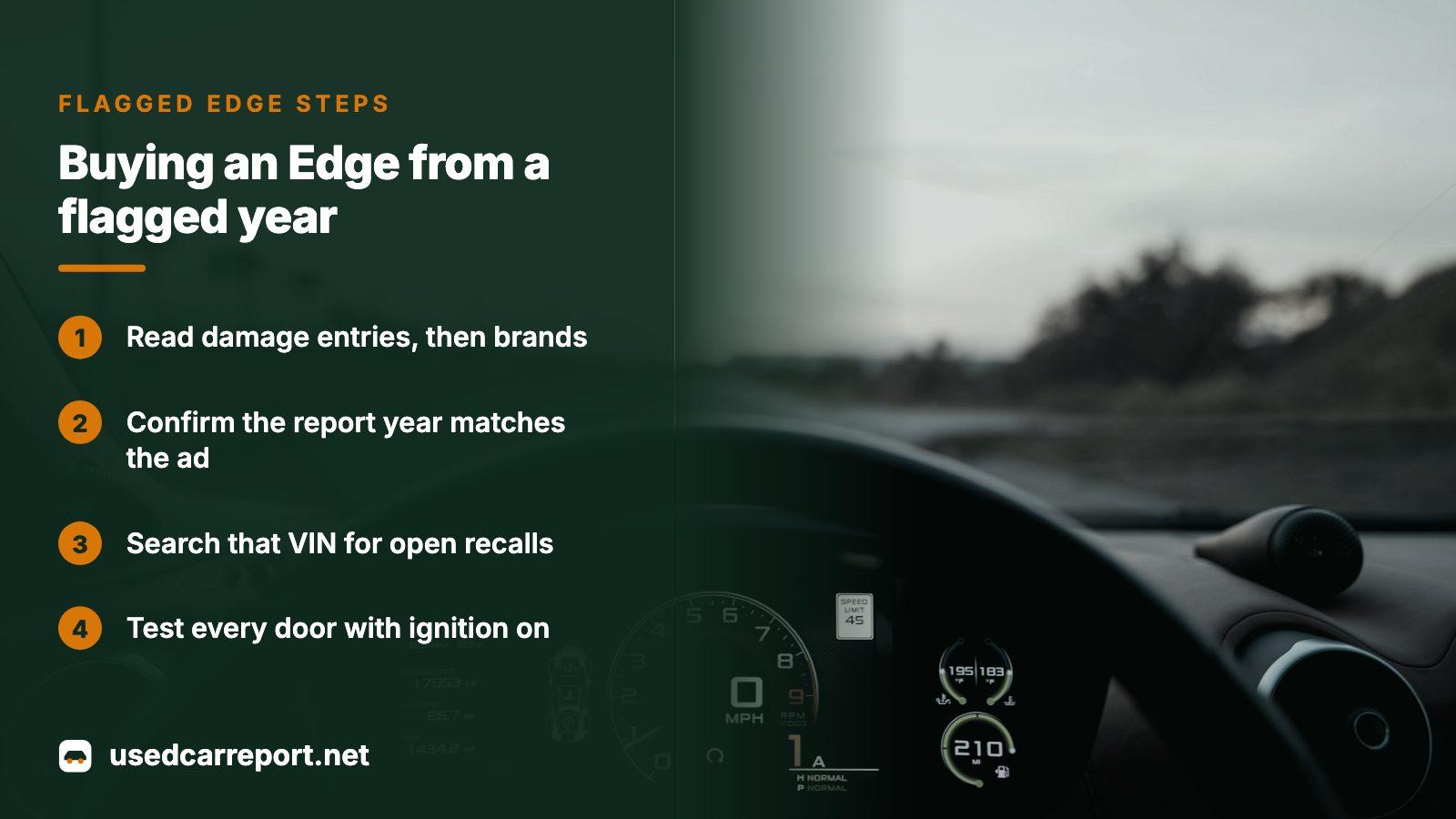
- Run the VIN and read the accident and damage entries first, then title brands and mileage readings.
- Confirm the model year on the report matches the ad, since flagged years sit right beside quiet ones.
- Search that VIN for open recalls, because campaigns reach only certain build ranges.
- Shut each door with the ignition on and watch the dash, then press the brake pedal hard at a stop.
- On a 2017, ask for coolant top-up records and have a mechanic scan for misfire codes.
- Set the offer from what turned up. A flagged year is a fair reason to open lower.
Running the check on the Edge you found
Enter the 17-character VIN and the preview, which costs nothing, lists the record types found for that car. The full report is bought once per Edge, or three, five or ten at a time if you are weighing several. No subscription is involved, and rates are on the pricing page. A report covers the car's past; only a mechanic judges its present condition.
Two no-charge tools exist outside this site: NHTSA's recall search lists open campaigns, and NICB's VINCheck flags theft and total-loss claims. Neither reports collisions. For title history on one specific vehicle there is the federal NMVTIS system.
Where this information comes from
- NHTSA: Vehicle safety and owner complaints — The federal complaint database behind the yearly counts and the component rankings.
- NHTSA: Recalls by vehicle — Where the recall campaigns for each model year are listed and where a VIN can be searched.
- NMVTIS: National title record — The federal title system, which covers the history of one car, something a model-year ranking cannot.
- NICB: VINCheck — A no-charge screen for theft and total-loss reports on a specific VIN.
- NHTSA owner complaint 11641958 — owner experience, paraphrased
- NHTSA owner complaint 10691084 — owner experience, paraphrased
- NHTSA owner complaint 11666932 — owner experience, paraphrased
Sources and photos: Facts checked against the sources above in November 2026. Photos by Victor Hughes, Dennis Eusebio and Will Truettner on Unsplash; diagrams by UsedCarReport.
Keep reading
- VIN accident check: read the damage records before you buyWhat a collision record shows about an Edge, and what it misses.
- Check mileage history by VIN: six steps, damage records firstHow readings from different dates expose a rolled-back odometer.
- Buying a car with an open recall: read the damage record firstWhat to do when a campaign is still open on the SUV you want.
- Pre-purchase inspection: read the damage records, then hire the mechanicThe hands-on look that judges the engine and brakes a report cannot.
Frequently asked questions
Which Ford Edge model years are the worst?
Going by NHTSA owner complaints, 2013 is worst, then 2011 and 2017, with 2012 and 2008 also above the yearly median of 743. That does not condemn any single car. It says to scrutinize the electrical system, the brakes and, on 2017, the engine, and to price the risk into your offer.
Which Ford Edge years have the fewest complaints?
2021 and 2022 are lowest at 103 and 126, but they are young, with little time to attract reports. Among older cars the quiet ones are 2009 at 261 and 2014 at 379. A low count says nothing about whether this particular Edge has been in a crash.
Is a 2013 Ford Edge a bad buy?
Not automatically. It tops the table at 2,437, yet much of that sits in areas a shop can check: door-ajar warnings, brake pedal feel and electrical faults. Test those, ask what has been replaced, and run the VIN. A clean 2013 with documented brake work at a fair price can be sensible.
What goes wrong most often on a Ford Edge?
Electrical leads with 2,346 reports, then service brakes at 2,093 and the engine at 1,966; power train and air bags follow. On 2011 to 2013 cars a door-ajar warning explains many electrical reports, while on 2017 the engine dominates.
How do I check an Edge for accident damage before buying?
Run its VIN first. The preview shows which records exist; the full report leads with accident and damage entries, plus auction photos where they exist. Compare those photos with the body panels, then have an independent shop examine the frame, dash and air bag covers.
Now check the car itself
The guide explains what to look for. The report shows what this VIN has on record.