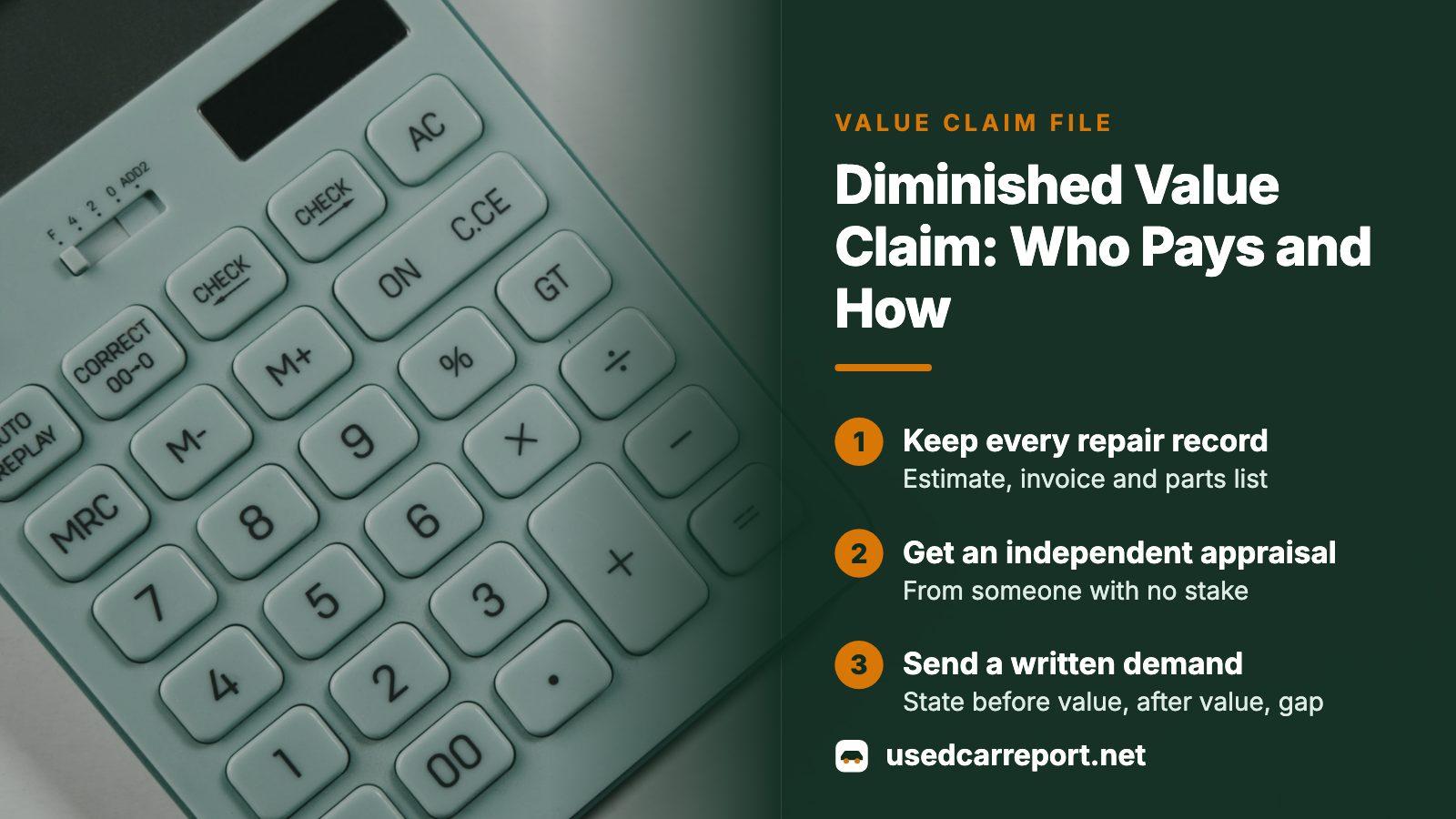
THE SHORT ANSWER
A diminished value claim is a request for the gap between what your car was worth just before a crash and what it is worth once repaired. You usually file it against the at-fault driver's liability insurer, since many first-party policies do not promise it. Gather repair invoices, an independent appraisal and the vehicle's record, then send a written demand soon after the repair is complete.
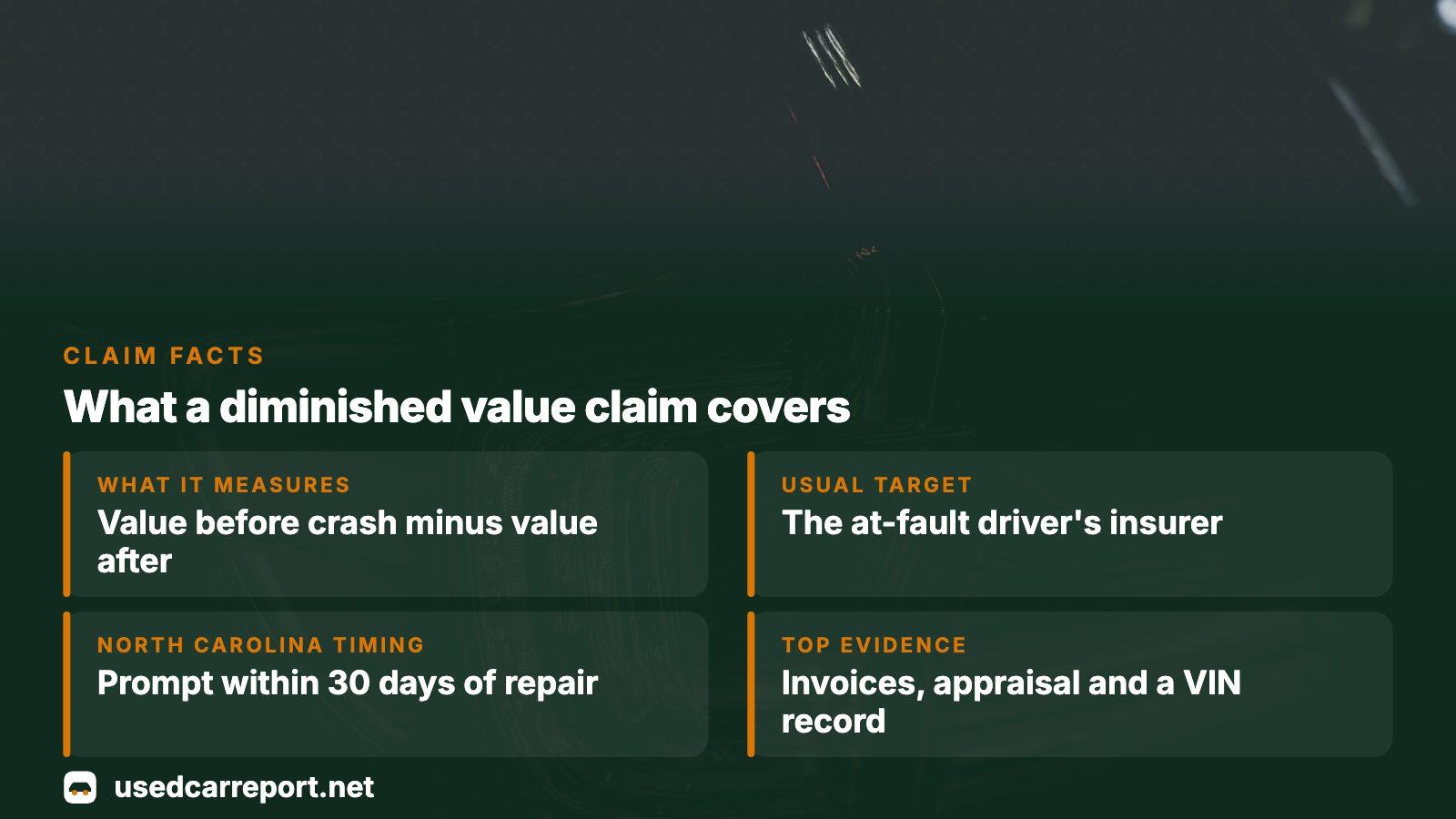
- What it measures
- Value before the crash minus value after repair
- Usual target
- The at-fault driver's liability insurer
- North Carolina timing
- Third-party claims count as prompt within 30 days of repair
- Best evidence
- Repair invoices, appraisal and a VIN record
The loss a repair does not erase
Picture a three-year-old sedan with a clean record. A driver runs a light and hits it. The shop replaces two panels, refinishes the paint and signs off. If you listed it tomorrow, the buyers who run its VIN would see a collision that the identical sedan down the street never had, and they would offer less.
That shortfall is diminished value. North Carolina's insurance rules put it plainly: the difference in the car's fair market value right before the accident and after the repairs are completed. The loss lives in the market, not the body shop.
Owners often meet the term only after the file is closed, so learn it before you sign anything.
Whose policy you file against changes everything
Two routes exist. In a first-party claim you ask your own company to pay under your own policy. In a third-party claim you ask the at-fault driver's liability insurer to pay for damage that driver caused. North Carolina's department describes both kinds of claimant and says in either case the insurer answers for the repair cost.
Repair cost and lost value are different line items, though. A third-party claim rests on the idea that someone owes you for harming your property, and a perfectly repaired car can still be worth less. A first-party claim rests on your contract, and the policy wording decides whether lost value is covered at all.
- At fault, with a clean repair: expect to claim on your own policy only if its wording covers lost value.
- Hit by an insured driver: a liability claim for lost market value is the usual path.
- Hit by an uninsured driver: ask your agent which coverages respond, and what they pay for.
States differ, so confirm your own state's position with its insurance department before building a demand.
How insurers put a number on it
Many adjusters run a worksheet, not an appraisal. A federal court order in a Georgia case, Tiller v. State Farm, quotes one insurer's letter. It cites a formula referenced in Section 10 of a March 6, 2002 order from a Georgia county court. It lists a retail value of $14,755 for the car, then applies a 30% damage modifier and an 11% mileage modifier, for a payment of $48.76.
That car had about $6,000 of damage, and the lost-value payment came to under fifty dollars. A second owner, with a smaller repair bill, got a check for $634.73. A third owner alleged that high mileage zeroed one modifier. Those are the plaintiffs' allegations, and the court never ruled on the formula.
What the court did and did not decide
The judge granted the insurer's motion to dismiss because the owners went straight at the other driver's insurer, skipping a judgment against the driver. The order says nothing approving or rejecting the formula. Treat the numbers as an example of one insurer's math, not a rule.
Building the file before you ask
Strong files share the same parts.
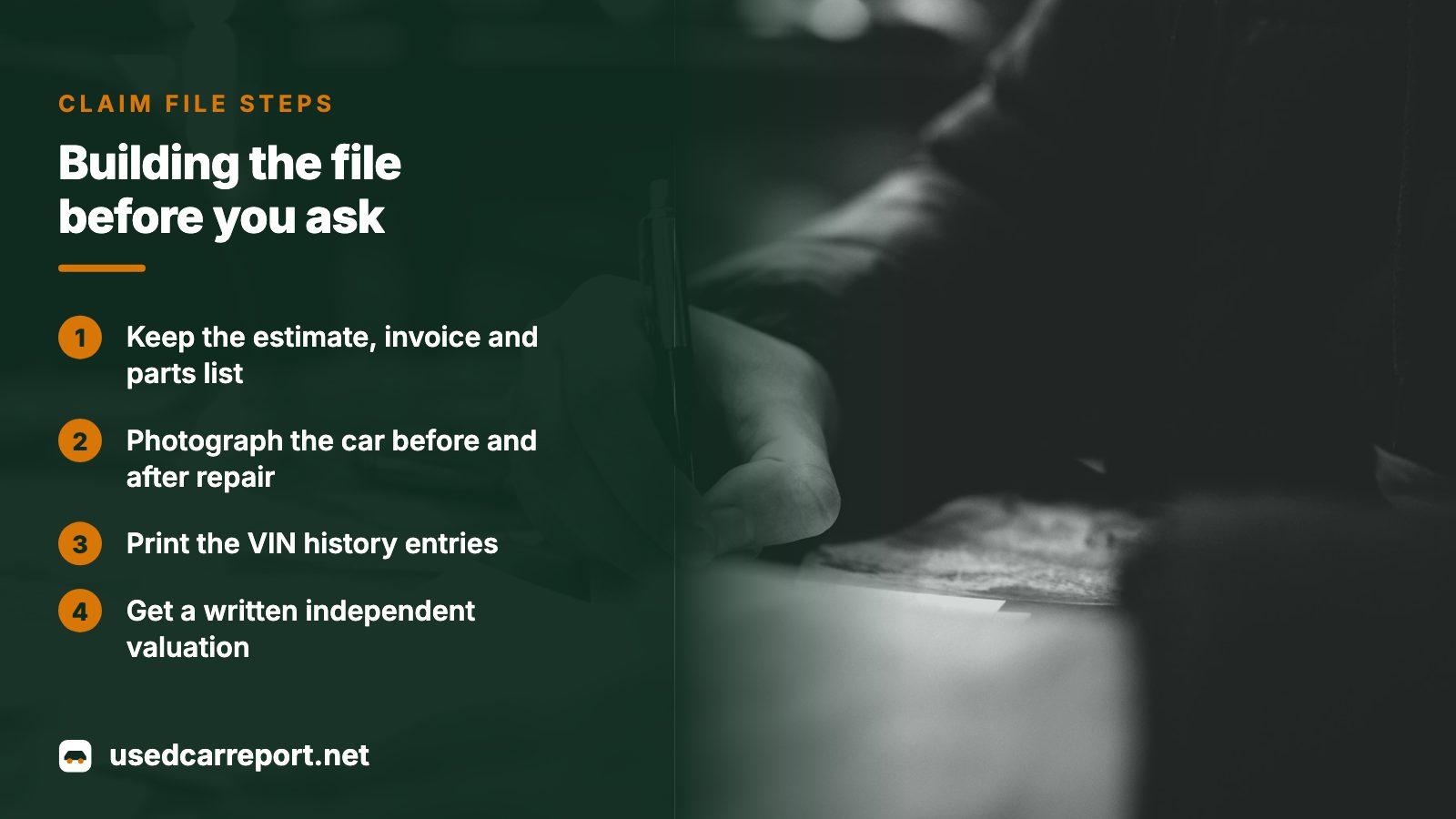
- Keep the repair estimate, final invoice and parts list, including whether any parts were aftermarket.
- Photograph the car before and after the repair, and save the shop's frame or measurement printout if it gave one.
- Pull the vehicle's history by VIN and print the accident and damage entries as they now appear.
- Get a written valuation from an independent appraiser who has no stake in the outcome.
- Write a demand letter stating the before value, the after value and the gap, with attachments listed.
North Carolina's department notes that your insurer may recommend a shop but you pick your own, and that aftermarket parts may be required only when they equal the originals on fit, quality, performance and warranty terms.
What the VIN record adds to a claim
The record answers a question the adjuster will ask: what does a buyer see? A report that lists only a minor damage entry argues for a modest loss. One that shows auction photos, an insurer total-loss entry or a title brand argues for a bigger one. The federal title system run by the Department of Justice says a total-loss or salvage history generally signals severe damage, which is exactly how buyers read it.
Run it twice if you can: once now, and again after the claim closes, since records post on different schedules.
| What the record shows | How a buyer reads it | What it means for your claim |
|---|---|---|
| Damage note, no brand | Repaired and likely fine | Smaller loss, document the repair quality |
| Auction photos of the damage | Seen before repair | Stronger argument for a real gap |
| Total-loss entry | Severe damage | Strong evidence, expect heavy discounting |
| Salvage or junk brand | Hard to resell | Check whether the car is eligible for this claim path at all |
Timing, releases and the clause people sign too fast
Lost value usually cannot be measured until the car is fixed, so the timing rules matter. A North Carolina rulemaking notice from the department treats a third-party diminished value claim as prompt when it is made within 30 days after repair, and says a release signed after repair does not bar such a claim. It also says the claim must still fit inside the state's limitations period.
That is not a national deadline, since other states set their own windows. Before endorsing a payment, read the paper that came with it. If it says the amount settles all property damage, ask in writing whether lost value is included.
Pause before you sign
A payment letter that mentions only repair costs is not the same as one that settles lost value. Ask the adjuster to state in writing what the check covers, and keep a copy.
If the offer is too low
Start with the appraisal you commissioned and answer the insurer's worksheet line by line: the valuation source, the modifiers, and why each applies to your car. Ask for the calculation in writing.
If you claim on your own policy, the appraisal clause lets each side name an appraiser, the two choose an umpire, and a decision by any two binds both. Each side pays its own appraiser and shares the umpire's cost equally, so weigh that expense against the gap. In a third-party claim, North Carolina's department says you can claim on your own collision coverage and let your company pursue the other insurer, or keep working with the insurer's appraiser. A lasting dispute may end in court, and the department suggests talking with an attorney.
Small gaps rarely justify a lawsuit.
If you are the buyer, not the owner
Everything above works in reverse when you shop. A seller who says the car was crashed but fixed is describing a car whose market value already fell, and the price should show it.
So run the VIN before you talk money. The UsedCarReport preview costs nothing and shows which accident and damage records exist. The full report is one payment, no subscription, priced on the pricing page. Compare the entries to the asking price, then ask for the repair invoices behind any damage.
Where this information comes from
- Federal court order: Tiller v. State Farm (govinfo) — quoted insurer letter, the worked payment figures and why the case was dismissed
- North Carolina Department of Insurance: after an accident — first-party and third-party claimants, appraisal, repair shop and parts rules
- North Carolina Department of Insurance: rule notice on diminution in value — how the rule defines the loss and treats timing after repair
- NMVTIS: understanding a vehicle history report — what brands, salvage and total-loss history signal to buyers
Sources and photos: Facts checked against the sources above in November 2026. Photos by Sasun Bughdaryan, Owen Michael Grech and A n v e s h on Unsplash; diagrams by UsedCarReport.
Keep reading
- Car accident depreciation check: what a crash does to a car's valueHow crash records weigh on price when you are the one buying.
- Car accident claim check: has an insurer ever paid on this car?Reading the insurance entries on a vehicle's record.
- VIN accident check: read the damage records before you buyThe accident and damage section read entry by entry.
- Salvage title check: five steps, damage records firstWhat a total-loss decision does to a title.
Frequently asked questions
Can I file a diminished value claim against my own insurer?
Only if your policy language or your state's law supports it. Many policies pay repair costs and stop there, so the wording decides. Read the physical damage section, then ask your insurer in writing whether lost value is covered. If the answer is no, a claim against the at-fault driver's insurer is often the better route.
Does a perfect repair cancel the claim?
No. The claim concerns market value, not workmanship. North Carolina defines the loss as the gap between the car's value just before the accident and its value after repairs are complete. A flawless repair still leaves a record that buyers find and price in.
What evidence helps most?
A written valuation from an independent appraiser carries the most weight, backed by repair invoices, before and after photos and the vehicle history record. Together they show the before value, the after value and why the difference is real. A bare claim with no paperwork tends to meet the insurer's own worksheet.
How long do I have to file?
It varies by state. North Carolina's rule notice treats a third-party claim as prompt within 30 days after repair and ties it to a statute of limitations. Other states differ, so ask your state insurance department for its window and file as soon as repairs are finished.
Does a VIN check prove diminished value?
It does not set a dollar figure. It shows what accident, damage, salvage and total-loss records are attached to the car, which is the history a buyer sees. Use it as supporting evidence next to an appraisal, not as a replacement for one.
Now check the car itself
The guide explains what to look for. The report shows what this VIN has on record.