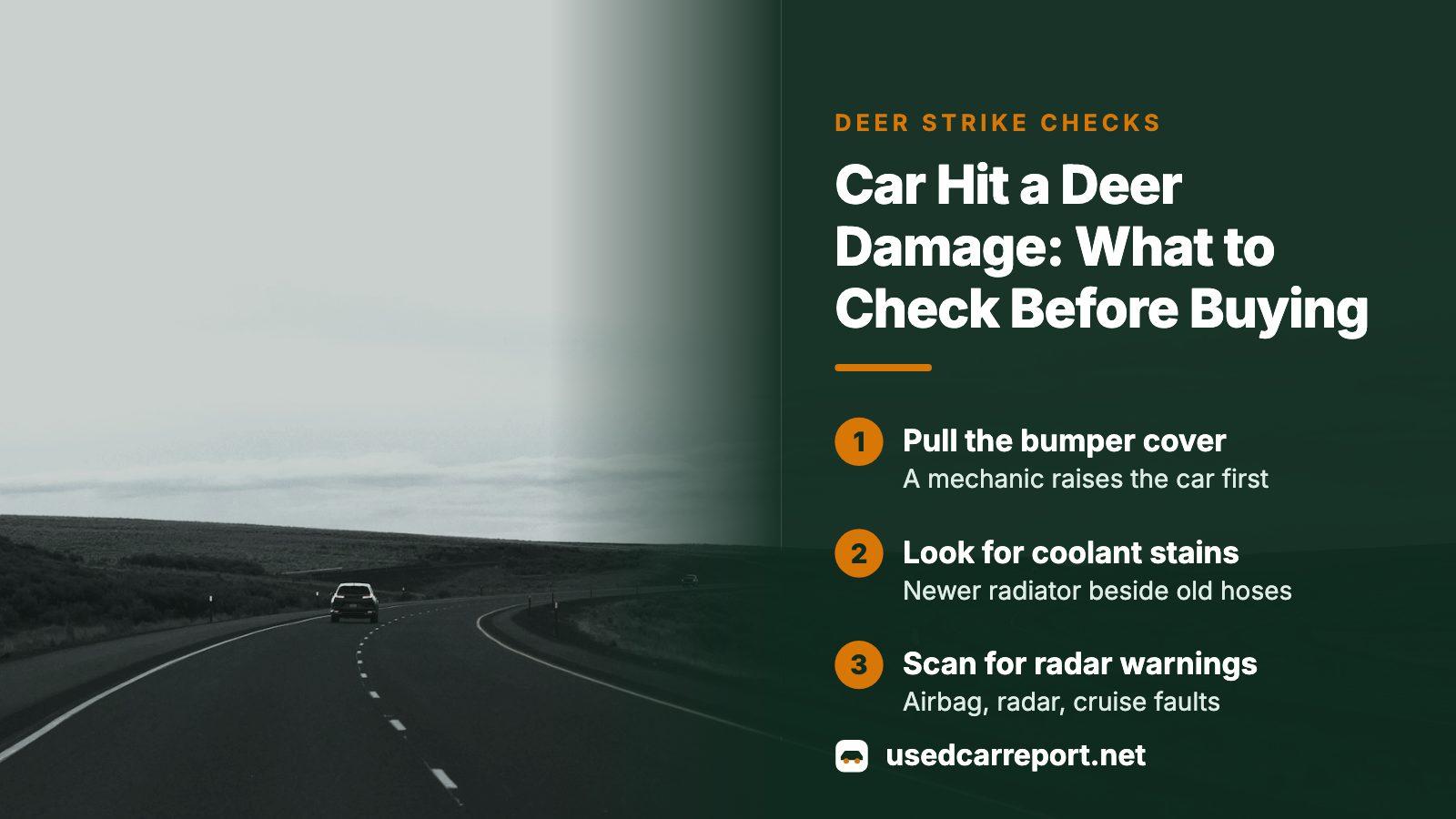
THE SHORT ANSWER
Deer damage typically starts at the bumper, grille, hood, headlights and radiator, and can reach the frame, suspension and airbag sensors. A cheap-looking repair can hide more. Before you buy, run the VIN for damage and insurance records, request the shop invoice, then have a mechanic raise the car and pull off the bumper cover.
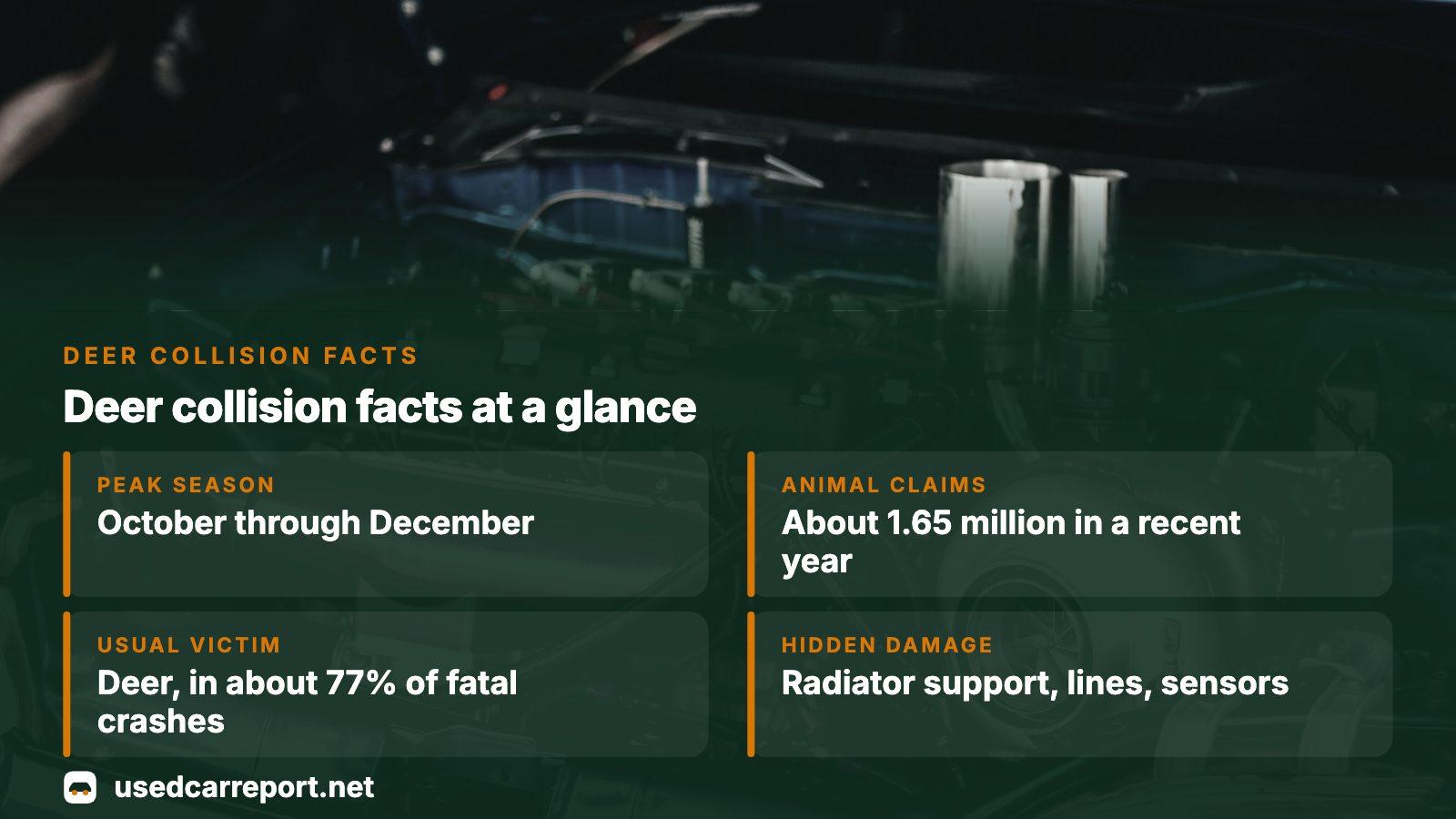
- Peak season
- October through December, per Triple-I
- Insurance claims
- About 1.65 million animal claims in a recent year
- Usual victim
- Deer, in about 77% of fatal animal crashes sampled
- Preview
- Free to start; the full report is a single payment
Where a deer strike does its damage
A deer is heavy, and it arrives at highway speed. The first things to give are the ones that sit furthest forward: the bumper cover, the grille, the headlight housings and the hood. Behind them sit the radiator, the condenser for the air conditioning and the cooling fans, all packed close together and all easy to crack.
Larger animals, or a hit at speed, can push on into the front rails, the suspension mounts and the windshield base. Sometimes the animal rides up over the hood and lands on the roof line. What you see in a parking lot is the outer layer. The repair bill, and the safety question, live underneath.
- Visible: crumpled hood, cracked lamps, torn bumper cover, missing grille
- Hidden: bent radiator support, leaking coolant lines, damaged sensors and wiring behind the bumper
- Serious: pushed front rails, shifted subframe, a windshield that was reset
Why a small dent can hide a big bill
Modern fronts carry radar, cameras and crash sensors. A bumper that looks nearly whole can still have a bracket knocked loose or a sensor aimed a few degrees off. Those faults seldom show up on a short test drive, and a seller who bought the car at a discount after the hit may not even know.
Cooling damage is the other sleeper. A radiator cracked in the strike may be patched or swapped, but if the car ran warm before the repair, the engine can carry that stress for years. Ask whether the cooling system was replaced and whether the fans and condenser were checked, not just whether the bumper was painted.
What owners say about airbags after a deer hit
Airbags are where deer strikes get confusing. Many owners expect a big front hit to fire them, and some report that it did not. Others report the opposite: a modest hit that set everything off. NHTSA keeps these reports public, and the pattern is worth knowing as a buyer, because an airbag that fired once means parts and wiring were replaced.
From an NHTSA owner complaint
The driver of a 2015 Ford Escape described hitting a deer with the front of the car at roughly 40 to 45 miles an hour. The grille, bumper and hood needed replacing, yet the airbags stayed shut, and the owner said they did not understand why. Another owner, with a 2016 Subaru Outback, reported a minor clip to the right front fender, sheet metal damage only, and airbags that went off hard enough to harm their hearing.
Take from this that the size of the dent does not predict what the safety systems did. If a car has been hit by a deer, find out whether the airbag module and sensors were inspected, and whether any bag was replaced with a proper part.
What the records can reveal about a deer hit
A VIN check will not say the word deer. It looks for the paper trail a deer hit leaves behind: an accident or damage entry, an insurance claim, a total-loss record, a salvage title or an auction listing with photos. The federal NMVTIS database was set up to shield consumers from title fraud and unsafe cars, so a report drawing on it can bring up a brand the seller left out.
Animal collisions are a special case. Many are paid as own-damage insurance claims and fixed at a body shop, and some never reach any database at all. So a spotless report is encouraging but proves nothing. It lowers the odds, and the inspection closes the gap.
| Record on the report | What it can mean for a deer hit |
|---|---|
| Damage or accident entry | A front-end event was logged; request the shop invoice |
| Insurance claim record | The car may have been repaired through a claim |
| Total loss or salvage title | Repair cost passed the insurer's limit; check the brand |
| Auction record with photos | You may see the damage as it sat before repair |
Running the VIN before you commit
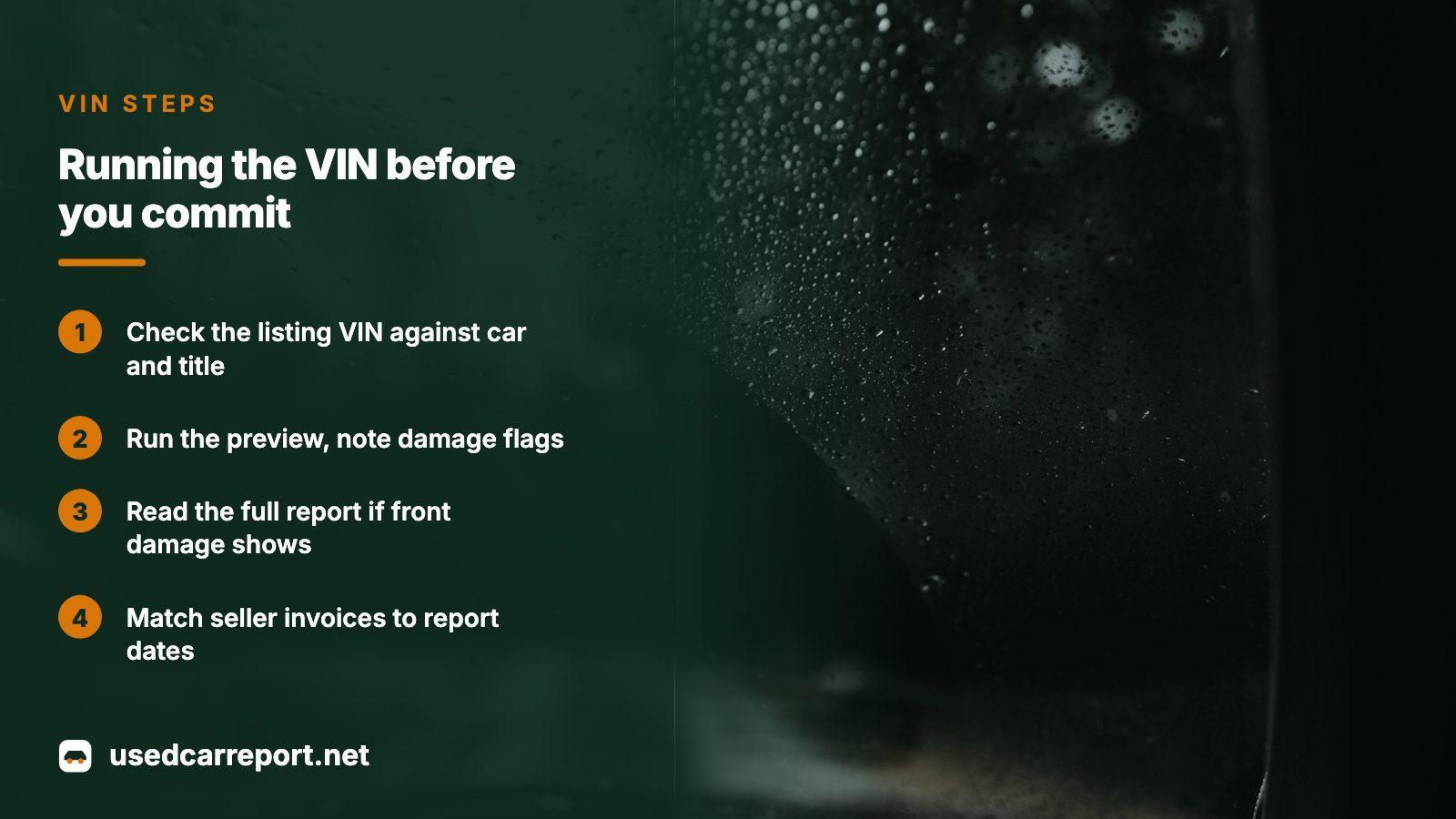
Ask the seller to text or email the VIN, and compare it with the plate on the dash and the line on the title paperwork. Put it into UsedCarReport and the free preview tells you whether damage or insurance records exist. When they do, one payment opens the full report with details and photos. See the pricing page for the options.
- Take the VIN from the listing and check it against the car and title
- Run the preview and note any damage, claim or brand flags
- Read the full report if a front-end event shows up
- Match any invoices the seller hands over against the dates in the report
Do this before an inspection, so the mechanic knows where to look. A shop that is told about a front-end repair will check the radiator support, the rails and the sensors first.
Season and region change the odds
Triple-I says deer season generally runs from October through December, and that more deer collisions happen in those months than at any other time of year. Cars sold in winter and spring in deer country are more likely to have a hit in their past than the same model sold elsewhere.
Citing State Farm, Triple-I reports about 1.65 million animal-collision claims between July 2025 and June 2026. Pennsylvania had the most claims, while West Virginia drivers had the highest odds of a claim, at 1 in 46. If the car came from West Virginia, Montana, Wisconsin, Pennsylvania or Michigan, the top five states for odds, ask more questions about the front end.
Reading the repair work on the car itself
Even with paper in hand, look at the car. Uneven gaps between hood and fenders suggest a panel was hung or the front shifted. Paint that does not quite match from fender to door, or overspray on rubber and trim, points to a quick respray.
- Check the hood and fender gaps for even width on both sides
- Look for fresh coolant stains or a newer radiator beside old hoses
- Scan for dash warnings, especially airbag, radar or cruise faults
- Check headlights for mismatched age, clarity or aim
Ask for the photos
Before-repair photos from an auction or insurer let you compare what was damaged with what was fixed. If the report has them, match the photos to the car in front of you.
When to walk away and when to negotiate
A well-documented repair at a shop with invoices, matching dates and a post-repair inspection can be a fair purchase, especially if the price reflects the history. Many buyers pass on any car with a front-end event, which is also reasonable.
Walk away if the seller cannot say who fixed it, if the report shows a total loss and the title brand is missing from the paperwork, if airbag or sensor warnings appear, or if the VIN plate and the title show different numbers. Negotiate when records are clear, the shop is named and the inspection finds nothing structural.
Where this information comes from
- IIHS: Collisions with fixed objects and animals — death totals and the share of deer among animals struck
- Triple-I: Deer vehicle collisions — season timing, claim counts and state odds
- NMVTIS: VehicleHistory.gov — the purpose of the federal title database
- NHTSA owner complaint 11301552 — owner experience, paraphrased
- NHTSA owner complaint 10971465 — owner experience, paraphrased
Sources and photos: Facts checked against the sources above in November 2026. Photos by John Kakuk, Justin Cron and Willian Cittadin on Unsplash; diagrams by UsedCarReport.
Keep reading
- Front end damage on a used car: how to spot it and check itDeer strikes land on the front, so read how front-end repairs are judged
- Buying a car with airbags deployed: what the record must proveCovers what a fired airbag means for the car you are inspecting
- Structural vs cosmetic damage: what the damage record means for a used carHelps you tell a bumper job from a frame problem
- VIN accident check: read the damage records before you buyShows how a VIN accident search works step by step
Frequently asked questions
Does hitting a deer show up on a vehicle history report?
It can, as an accident or damage entry, an insurance claim or a total-loss record. The report will not name the animal. Some deer hits are fixed privately and never reach any database, so a clean report lowers the risk without removing it. Pair the check with an inspection.
Is a car that hit a deer safe to buy?
It can be, when the repair was done properly and documented. Look for invoices, a named shop and a post-repair inspection that covered the cooling system, sensors and structure. If the seller cannot show any of that, treat the car as unrepaired and price it that way.
Do airbags always deploy when you hit a deer?
No. NHTSA owner complaints include both cases: airbags that stayed shut after a hard front hit, and airbags that fired after a minor fender strike. Deployment depends on how the sensors read the impact, not on the animal. Ask whether any airbag parts were replaced.
What is the hidden damage after a deer collision?
Radiators, condensers, fan assemblies, wiring, sensors, and the radiator support behind the bumper cover are the usual hidden items. In harder hits the rails and suspension mounts can shift. A lift inspection finds most of it; a bumper-off look finds the rest.
Can I check a used car for deer damage before buying?
Yes. Run the VIN for the free preview, read damage and insurance records in the full report if flags appear, then collect the invoices and book a pre-purchase inspection. The records tell you where to look; the inspection tells you what is actually there.
Now check the car itself
The guide explains what to look for. The report shows what this VIN has on record.