THE SHORT ANSWER
Treat front end damage as a question of what was repaired and how, not a yes or no. Run the VIN and read the accident, damage and insurance entries, look at the nose for uneven gaps, paint and loose fasteners, ask for the repair invoice, and have an independent shop lift the car. A repaired hit is not automatically a bad car, but the price should reflect it.
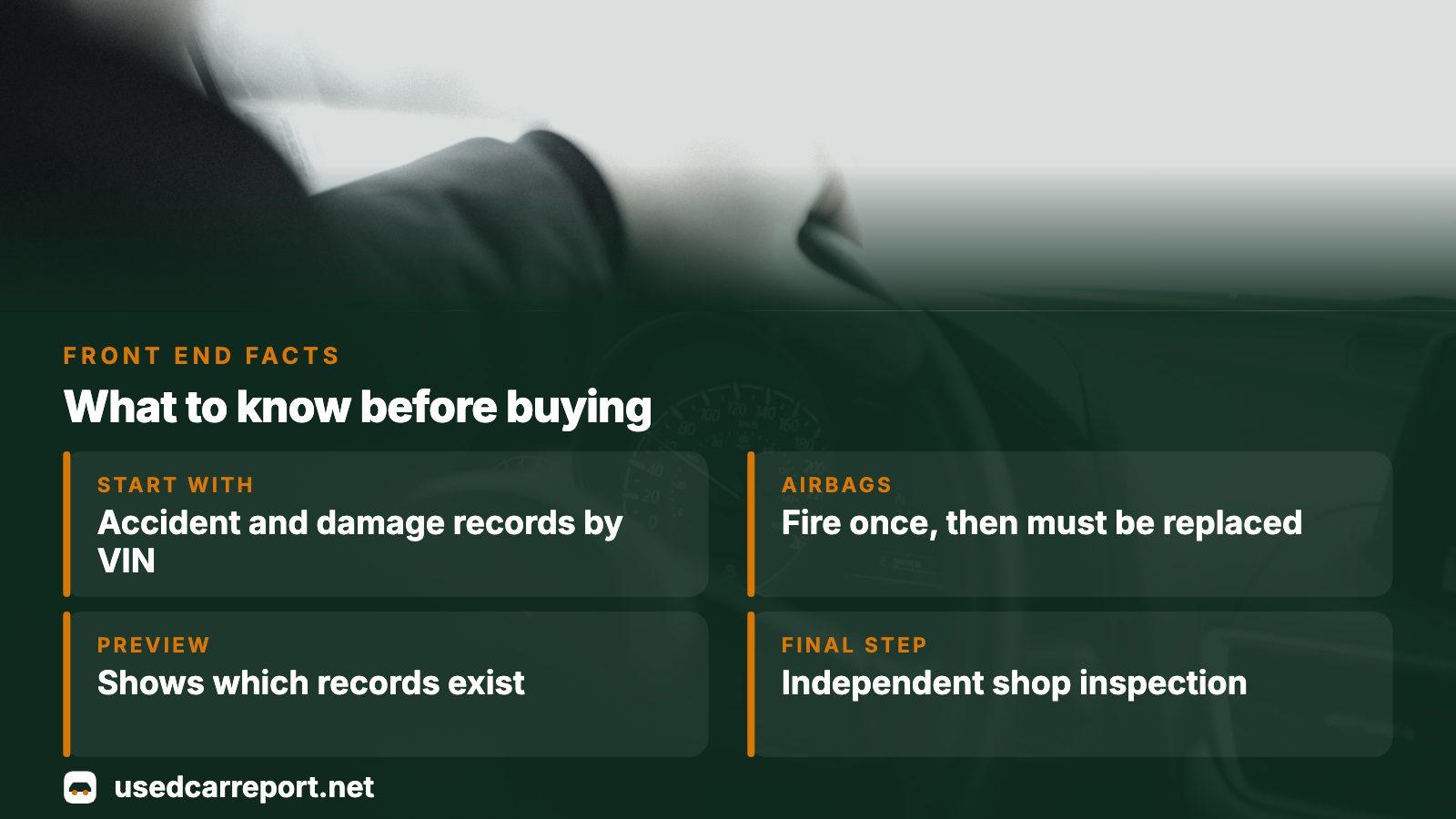
- Start with
- Accident and damage records by VIN
- Airbags
- Fire once, then must be replaced
- Preview
- Free, shows which records exist
- Final step
- Independent shop inspection
Why the nose of the car matters more than the paint
Bumper covers, headlights and fenders are the cheap part of a front end repair. Behind them sit the radiator support, the crash structure that is meant to crumple, the sensors that decide when an airbag fires, and on newer cars the camera or radar behind the grille. A seller who says it was only a bumper job may be telling the truth, or may be describing the visible fraction of a larger bill.
That is why a front hit deserves a closer look than a scratched door. You are not judging how the car looks today. You are judging whether the parts built to protect you in the next crash were put back the way the maker intended.
What the records can and cannot say
Run the VIN and go straight to the accident and damage entries. It can show a reported collision, the area of impact where one was recorded, an insurance payout, and auction or salvage photos taken before repair. Those photos are the nearest thing to seeing the damage as it was.
The limit is real, though. A hit paid for in cash at a body shop may never reach any database. Records show only what somebody reported, so an empty section shrinks the chance of a hidden nose repair without ending it.
| Record | What it can tell you |
|---|---|
| Accident entry | A collision was reported, sometimes with the impact area |
| Insurance record | A claim was paid, or the car was written off |
| Auction or salvage photos | The car before repair, the clearest view of the nose |
| Title brand | The state labeled the car salvage, rebuilt or similar |
The free checks you can run first, and their gaps
NICB, the insurers' crime bureau, offers VINCheck. Type in all 17 characters and it flags a car that member insurers listed as stolen and never recovered, or as a salvage or flood loss. It costs nothing, allows five lookups a day per connection, and the bureau itself says it cannot stand in for a full report.
The gap matters for this topic. A car repaired after a front collision, with the insurer paying the shop and not declaring a total loss, produces nothing for VINCheck to return. Use it as a quick screen for the worst outcomes, then pull a full report for the accident detail.
- NICB VINCheck: flags for theft, salvage and flood from member insurers
- NHTSA recall lookup: unfixed safety recalls on that exact car
- Federal NMVTIS reports: title, odometer and certain damage history from approved providers
A walk-around that finds a repaired front end
Look at the car in daylight, on level ground, and stand a few feet off the corner so you can sight along the body. Repairs show up as differences between left and right.
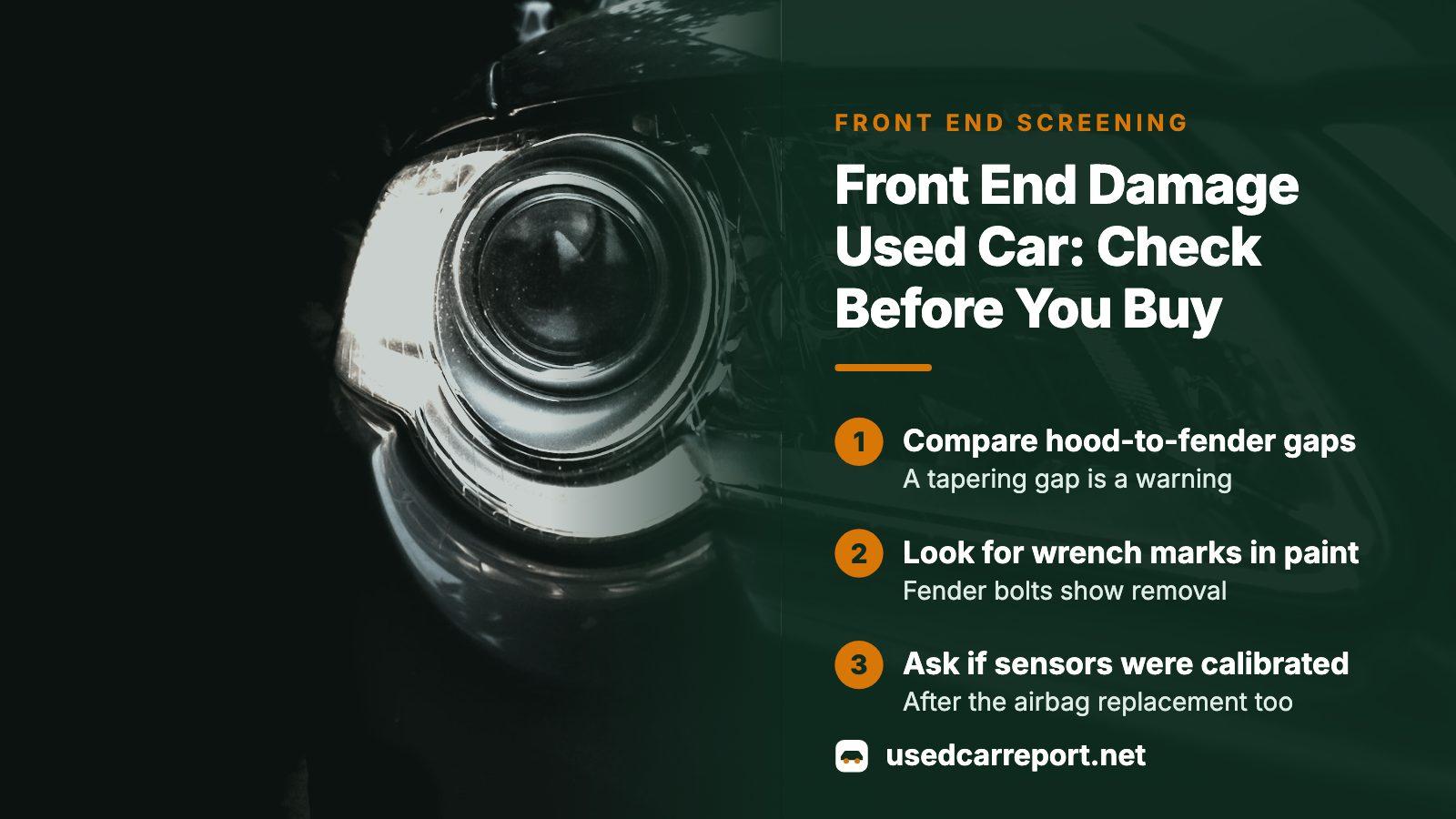
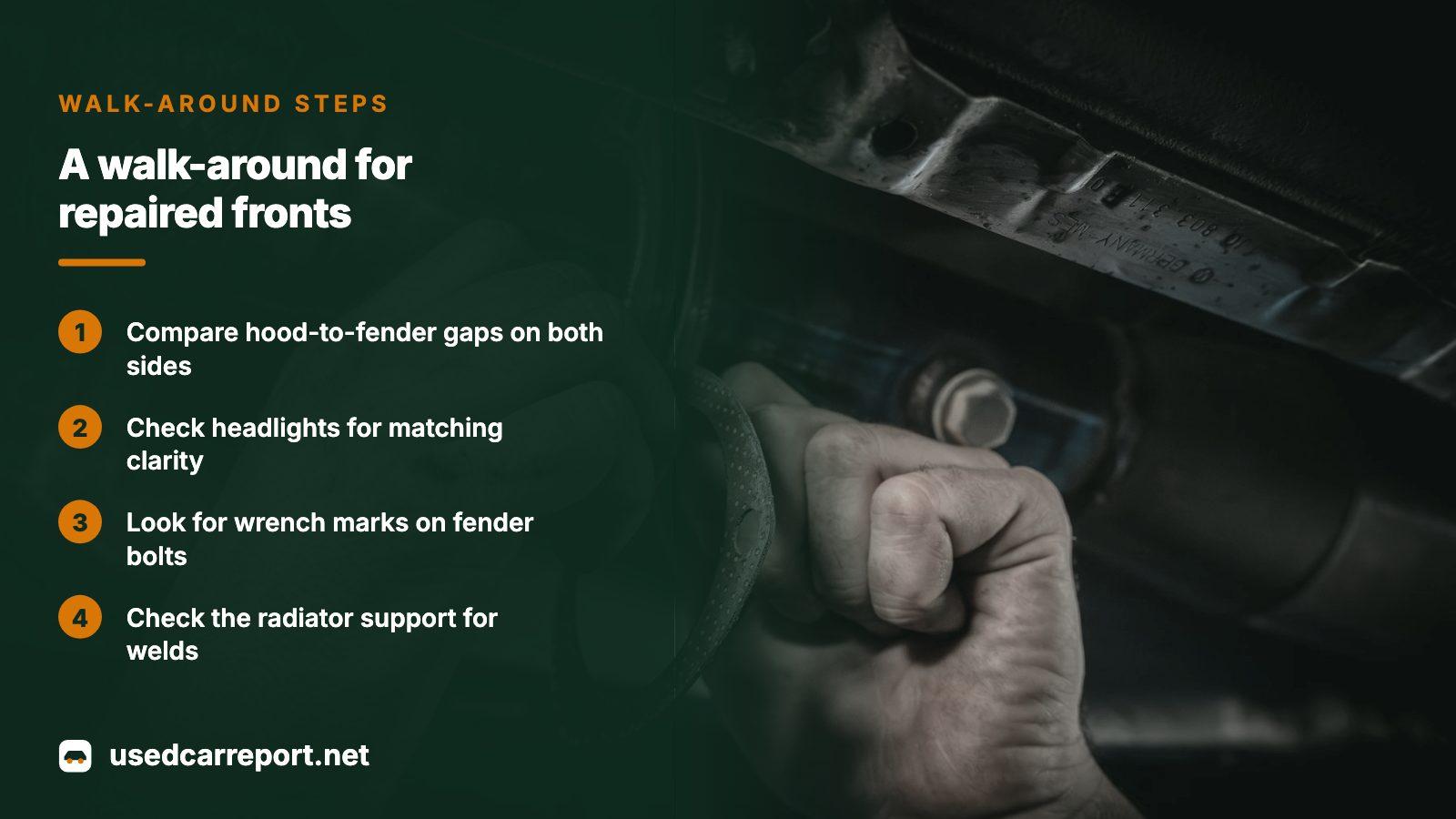
- Compare the gap between hood and fenders on both sides. A gap that tapers is a warning.
- Check that both headlights match in clarity, color and age.
- Look along the hood and fenders for a change in paint texture or shade.
- Open the hood and look at the bolts on the fenders. Wrench marks in the paint mean they were removed.
- Check the radiator support and the frame rails for kinks, fresh sealer or welds.
- Look for overspray on rubber seals, wiring and under-hood labels.
None of these proves a bad repair. Several of them together, on one side only, is a strong reason to ask for paperwork and a lift inspection.
Airbags and sensors after a front hit
NHTSA credits frontal airbags with more than 50,000 lives saved across 30 years, yet each bag works once. Its guidance after a crash: replace spent bags promptly, through an authorized shop, and keep the car parked until then.
NHTSA has also issued a consumer alert about cheap replacement inflators from overseas that have killed and hurt people here. Ask whether the airbags in a repaired car were new factory parts, and who installed them. A dash warning light that stays on, or one that comes on and goes out during your test drive, belongs in the notes for your inspector.
Ask for the airbag line item
On a repair invoice, look for the airbag modules, the crash sensors and the steering wheel airbag. A front repair that lists a bumper and two fenders but no airbag work on a car with a deployment record needs an explanation.
Cameras, radar and driver assist systems
NHTSA describes forward collision warning as a system that watches your speed, the speed of the car ahead and the gap between you. Automatic emergency braking goes further and applies the brakes. These systems rely on sensors mounted in or behind the bumper and windshield, the exact area a front hit disturbs.
NHTSA's advice is to read the owner's manual to see what a car's technology does. On a repaired car, test the features that the manual says it has. A warning light, a disabled feature message or a system that never seems to react is worth raising with the seller. A shop that repaired the nose should be able to tell you what was done to those sensors afterward.
Questions for the seller and what the answers mean
Ask plainly whether the car has been hit, where, and who fixed it. Then ask for the invoice. A shop that did the work will have a record, and a seller proud of a proper repair will usually hand it over.
- Who owned the car at the time, and is that person reachable?
- Did an insurer pay, and was an estimate or photo set made?
- Which shop repaired it, and were factory parts used?
- Were the airbags replaced, and by whom?
- Was the car aligned and the sensors calibrated afterward?
Vague answers, no invoice, and a sudden unwillingness to let an outside shop look at the car are each information. Compare what you hear to the records, and walk away if the two do not agree.
The inspection that settles it
The federal NMVTIS buying-tips page, which summarizes advice from the FTC, strongly encourages an independent inspection before purchase, plus a varied test drive and a mechanic with nothing riding on the sale. For a front end repair, tell the shop where the damage was, so the car goes up on a hoist and the structure gets measured, the suspension mounts and the tire wear.
On the drive, watch for pull to one side on a flat road, steering wheel that sits off center, a hood that vibrates, and tires worn on one edge. Any of these can point to alignment problems or bent parts left over from the hit.
Pricing the car and deciding
A well documented, properly repaired front end hit can be a fair purchase at a lower price. A hit with no paperwork, a repair that fails the inspection, or a mismatch between the seller's story and the records should end the deal.
To see what has been reported on a specific car, run its VIN through UsedCarReport. The free preview lists which accident, damage and insurance records exist, and the full report is one payment. Details are on the pricing page. Take whatever the damage entries show to your inspector.
Where this information comes from
- NHTSA: Air Bags — airbag replacement after a crash and the warning on substandard inflators
- NHTSA: Driver Assistance Technologies — what forward collision warning and emergency braking do
- NHTSA: 5-Star Safety Ratings — how the frontal crash test is run
- NICB: VINCheck — free theft and salvage screen and its stated limits
- NMVTIS: Used Car Buying Tips — independent inspection and test drive advice
Sources and photos: Facts checked against the sources above in November 2026. Photos by Alexandru Goman, Martin Fennema and Miles Loewen on Unsplash; diagrams by UsedCarReport.
Keep reading
- VIN accident check: read the damage records before you buyHow to read the accident section of a VIN report
- Frame damage check: start with the accident and damage recordsWhat to do when the damage may reach the structure
- Pre-purchase inspection: read the damage records, then hire the mechanicWhat an independent shop should check on the lift
- Buying a used car with accident history: what to check firstHow to weigh a car whose records show a past hit
Frequently asked questions
Is front end damage a deal breaker on a used car?
Not by itself. What matters is how severe the hit was, whether the repair is documented, and whether an independent shop finds the structure and safety systems sound. A properly repaired car can be reasonable at a lower price, while an undocumented repair on a car with airbag work is worth walking away from.
Will a VIN check always show a front end collision?
No. Records show what an insurer, auction, state or shop reported. A hit repaired privately and paid for out of pocket may leave no trace, which is why the walk-around and the shop inspection still matter after the report comes back clean.
How can I tell if a bumper was replaced?
Look for mismatched paint, uneven gaps to the fenders, new clips next to old ones and overspray on nearby rubber. A replaced cover is cosmetic. The question is what sits behind it, so ask for the invoice and have the radiator support and sensors checked.
Do airbags have to be replaced after a front crash?
A bag fires once, NHTSA notes, so a deployed one has to be replaced at an authorized repair center before the car is driven. Ask which parts were installed and by whom, because NHTSA has warned about substandard inflators sold as replacements.
Is the free NICB check enough before buying?
It is a useful screen for theft, salvage and flood flags from participating insurers, but the bureau says it should not be your only check. A front hit that never became a total loss will not appear, so pair it with a full accident and damage report.
Now check the car itself
The guide explains what to look for. The report shows what this VIN has on record.