THE SHORT ANSWER
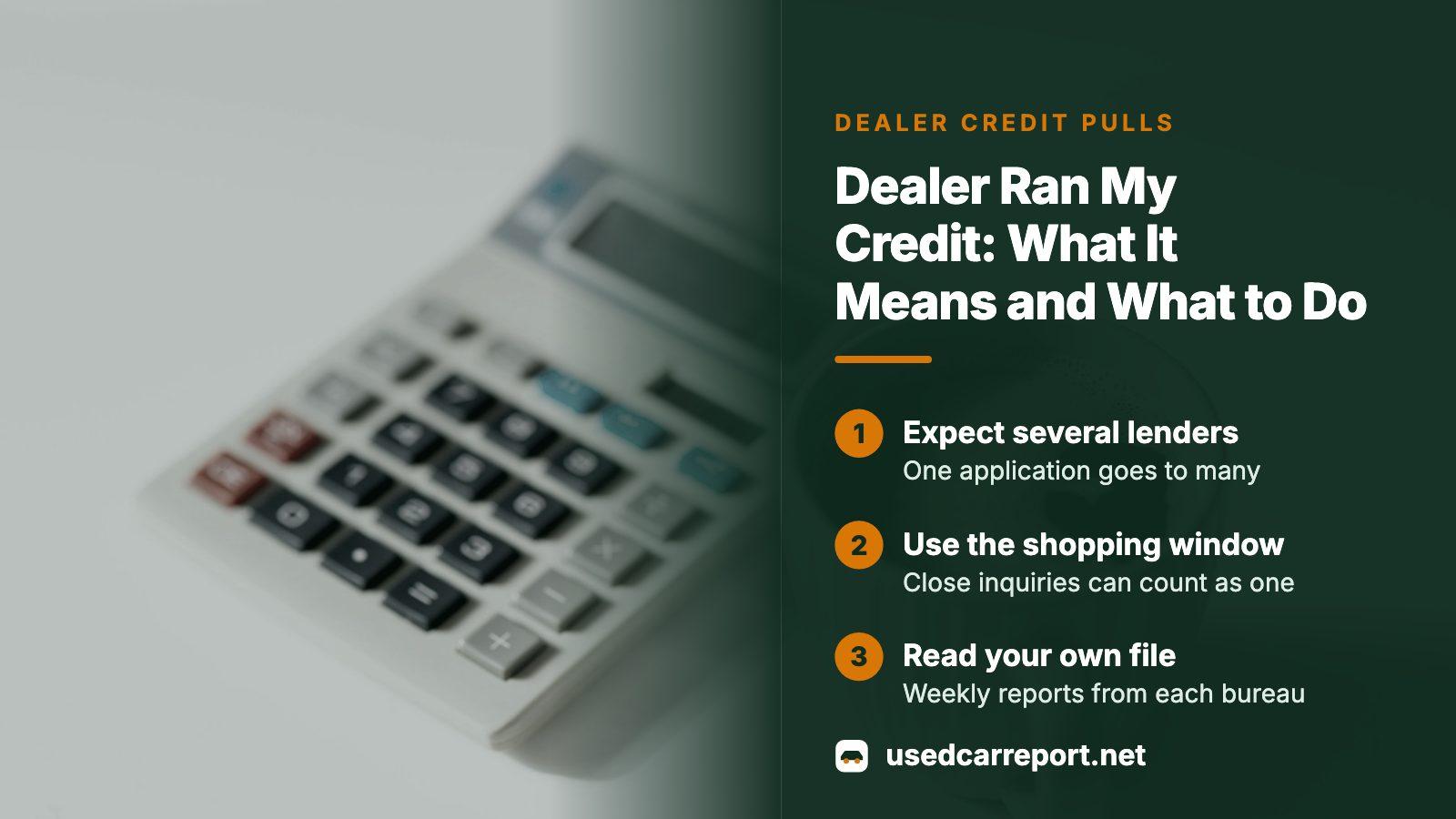
A dealer that arranges your loan usually sends one application to several lenders, and each can pull your credit report. Federal law permits that for a credit transaction you started. The Consumer Financial Protection Bureau advises keeping loan inquiries within 14 to 45 days of each other so they count as one. Expect a score disclosure or a risk-based pricing notice. If you never applied, dispute the inquiry in writing.
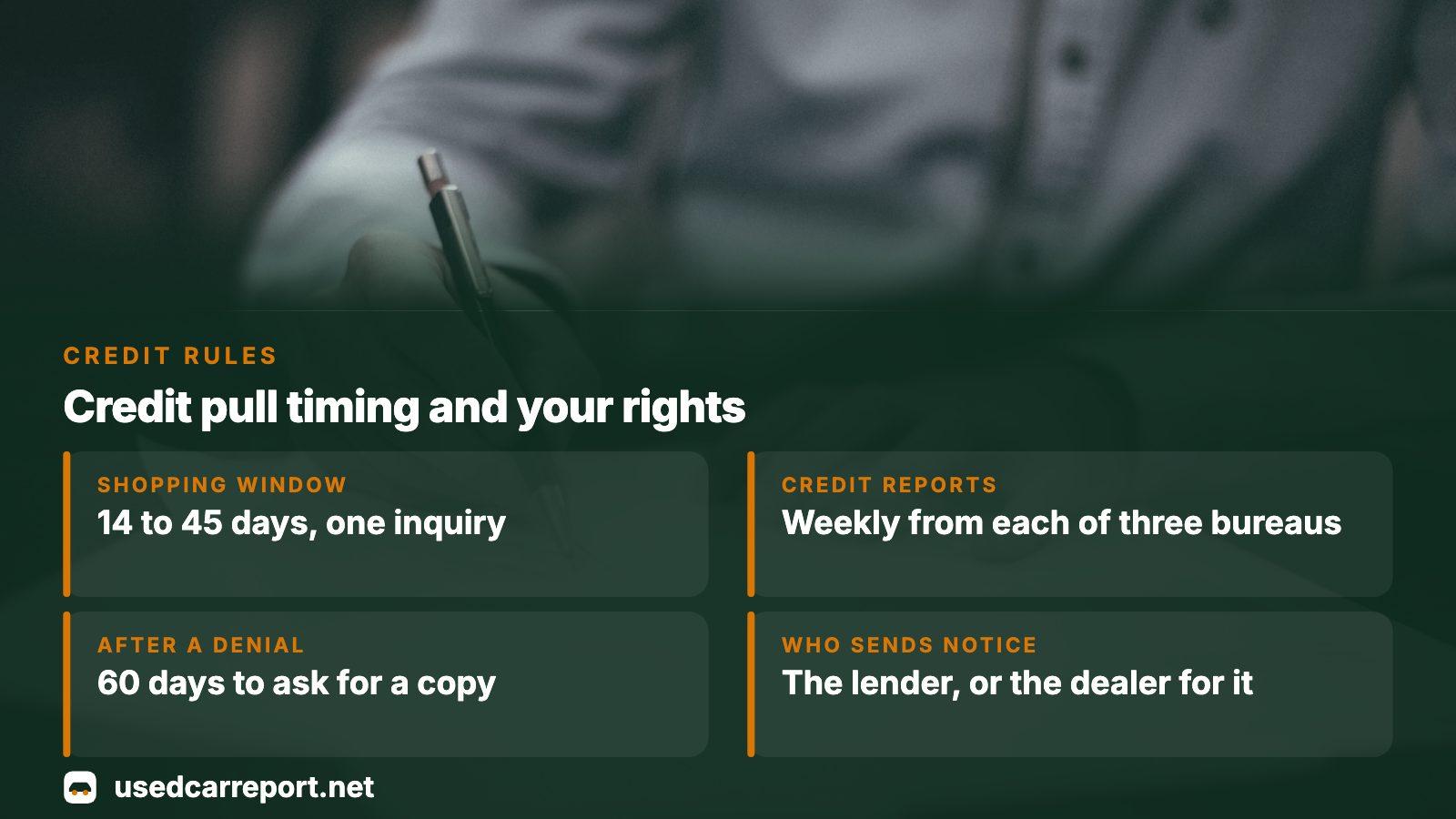
- Shopping window
- 14 to 45 days can count as one inquiry (CFPB)
- Free reports
- Weekly from each of the three bureaus
- After a denial
- 60 days to ask for a free copy
- Who sends the notice
- The lender, or the dealer on its behalf
What the finance desk does with your application
When a dealership arranges your financing, it commonly takes your application, passes it along to lenders and waits for their answers. Each lender that considers you checks your credit, which is how one afternoon of paperwork can leave several inquiries behind. The CFPB says a dealer may reach out to roughly five lenders for a single buyer.
The offers lean heavily on that report. According to the CFPB, a lower score generally means a higher interest rate, which is why the pull deserves attention.
Whether the dealer was allowed to run it
The Fair Credit Reporting Act lets a reporting agency release your file for a list of purposes and no others. Two of them fit a car lot: you gave written instructions, or the party asking is dealing with you in a credit transaction that involves extending credit to you. Handing over a finance application is the ordinary way that second purpose arises.
Browsing, test driving and chatting with a salesperson are not on that list. If an inquiry shows up and you never applied for financing anywhere, ask the dealer in writing what it was for. A wrong entry can be disputed.
What it does to your score, and the shopping window
A lender's inquiry can lower a score. The CFPB tells loan shoppers to keep comparison inquiries within 14 to 45 days of each other so they are counted as one, and to keep the whole purchase to a few weeks when a dealer is sending applications out for you. Because the guidance is a range, plan around the short end.
| What you do | What the CFPB guidance implies |
|---|---|
| Several auto-loan applications inside one short stretch | They can be counted together as a single inquiry |
| Applications that drift across months while you keep looking | The one-inquiry treatment is not promised, so each pull may count |
| Pulling your own reports | Not an inquiry about new credit, no effect on the score |
The paper trail a credit pull should produce
Federal rules give a lender two ways to comply. It can send a risk-based pricing notice to borrowers whose terms are materially worse than what many of its customers get. Or it can give every applicant a score sheet instead, showing the score, the range of possible scores, how you compare and where to claim free reports.
| Paper | When it applies | Timing and extras |
|---|---|---|
| Credit score disclosure | Given to every applicant as the alternative | Soon after the score is pulled, and no later than completion |
| Risk-based pricing notice | Terms materially worse than many of the lender's customers get | Before completion, but not before approval is communicated |
| Adverse action notice | Turned down, or given worse terms, because of your report | Names the reporting company, includes the score used, opens 60 days to request a free copy |
In dealer-arranged financing the lender can meet its duty by having the dealer hand you the notice, so the sheet may come from the showroom rather than the bank. Keep every page you are given.
Read your own file before the next application
Looking at your own report costs you nothing in score terms. At AnnualCreditReport.com the three bureaus, Equifax, Experian and TransUnion, will each show you a report weekly, according to the CFPB, and the law adds one report per company every 12 months. A full file disclosure also lists who pulled your report for anything other than a job check during the last year.
Look for inquiries from lenders you never applied to and for accounts that are not yours, since errors feed the score. Then collect a preapproved offer from a bank or credit union if you can. The CFPB suggests showing the dealership a rate you already hold, which invites competing offers.
If the pull was not yours to make
Treat an inquiry from an application you never made as an error on your file, and work through it in order.
- Request your file and write down which company made the inquiry and on what date.
- Ask the dealership in writing which application the pull belongs to, and keep the reply.
- Dispute the entry in writing with each credit reporting company that shows it. Explain what is wrong, attach copies of supporting papers and keep copies of everything.
- Write to the company behind the entry too. The CFPB says such a company generally has to investigate and answer within 30 days.
- If the entry stays, ask the reporting company to attach a statement of your dispute and file a CFPB complaint. If you suspect identity theft, start at IdentityTheft.gov.
A pull that matches an application you signed is not an error, so a dispute only works when the facts are on your side.
Check the car before anyone checks you
For a careful buyer, most dealerships run the order backward. You fall for a car, the finance desk collects your details, and only afterward does anyone ask what the car has been through. By then the inquiries sit on your file, whether or not the car earned them.
The damage record can be read earlier. The federal NMVTIS site tracks title brands, odometer readings, total loss and salvage history, with reporting required from title agencies, insurers and the businesses that recycle or scrap wrecks. It urges an independent inspection plus a history report before any decision.
From an NHTSA owner complaint
In January 2026 a 2015 Chevrolet Equinox owner filed an NHTSA complaint after buying a vehicle as is from a small dealership. The owner reported a shifted passenger door, said the title carried no accident and no one had mentioned one, and added, "I have a loan against it."
The lesson is the order of events. Damage found after the paperwork is harder to act on than damage found before it.
A buying order that limits the pulls
UsedCarReport begins at the VIN. Type it in and read the free preview. A car that survives it earns one purchase of the full report: accident and damage entries, brands on the title, mileage readings and photos from salvage or auction sales. Nothing renews, and the pricing page spells out what one report or a pack costs.
- Run the VIN and drop any car with a crash, damage or title problem you would not price in.
- Book an independent inspection for the cars that pass, because a record cannot replace a mechanic.
- Pull your own reports, fix errors and line up a preapproved offer.
- Only then hand over an application, and ask how many lenders will receive it.
- Ask for the score sheet, keep copies of every document and refuse any blank form.

Where this information comes from
- CFPB: What should I know before I shop for a car or auto loan? — The inquiry span, the roughly five lenders a dealer may contact, and how scores affect rates
- eCFR: 12 CFR 1022.74, credit score disclosure — What the score sheet must contain and when it is due, with the neighboring risk-based pricing rules
- 15 U.S.C. 1681b: permissible purposes of consumer reports — The list of reasons a reporting agency may release your file
- CFPB: How do I get a free copy of my credit reports? — Weekly access, the yearly right, and the extra copy after an adverse action notice
- CFPB: How do I dispute an error on my credit report? — Written disputes, the company behind the entry, and the next steps if it stays
- VehicleHistory.gov: Understanding an NMVTIS Vehicle History Report — Which damage-related records the federal title system tracks and who must report them
- NHTSA owner complaint 11708317 — owner experience, paraphrased
Sources and photos: Facts checked against the sources above in November 2026. Photos by Ben Wicks, Richard R and Scott Graham on Unsplash; diagrams by UsedCarReport.
Keep reading
- VIN accident check: read the damage records before you buyHow to read the accident and damage entries you want in hand before any application.
- Used car private seller vs dealer: what each owes you and what neither doesWhich papers a dealer must give you and which a private seller never will.
- Pre-purchase inspection: read the damage records, then hire the mechanicThe mechanic's half of the job, which no record and no credit file can do.
- Paying cash for a car: what the dealer reports and what to check firstThe route that skips the lender pull altogether, and what it changes about the deal.
Frequently asked questions
Is it legal for a dealer to pull my credit without asking me?
The law lists the reasons a reporting agency may release your file, and a credit transaction you started or your written instructions are among them. A pull with neither behind it is a problem. Ask the dealer in writing what it was for, request your file to see who made it, and dispute it if it matches nothing you signed.
Do I have to buy the car if the dealer ran my credit?
The federal credit rules covered here are disclosure rules, and none turns an application into a purchase. The CFPB tells buyers to read the loan paperwork before signing and to walk away if any part of it feels wrong. States may add rules, so ask your state's consumer protection office if a dealer claims you are committed.
Will the dealer show me my credit score?
Often, but not always. A risk-based pricing notice is required only when your terms are materially worse than the lender's best, and it carries a score only if a score set them. The score sheet goes to every applicant of a lender that chooses it. A buyer on top terms from a lender using the notice route may see no score.
What if the dealer ran my credit and then turned me down?
A denial, or worse terms based on your report, is an adverse action. The notice names the reporting company, includes the score used and starts a 60-day period for asking that company for a free copy. Request it, look for errors and dispute what is wrong.
Should I run a VIN check before the dealer runs my credit?
That is the safer order. Inquiries land when the application goes out, and you cannot take one back because the car proved to be a bad one. The free preview on UsedCarReport shows what the VIN turns up first, and the full report is one purchase. Keep the independent inspection too.
Now check the car itself
The guide explains what to look for. The report shows what this VIN has on record.