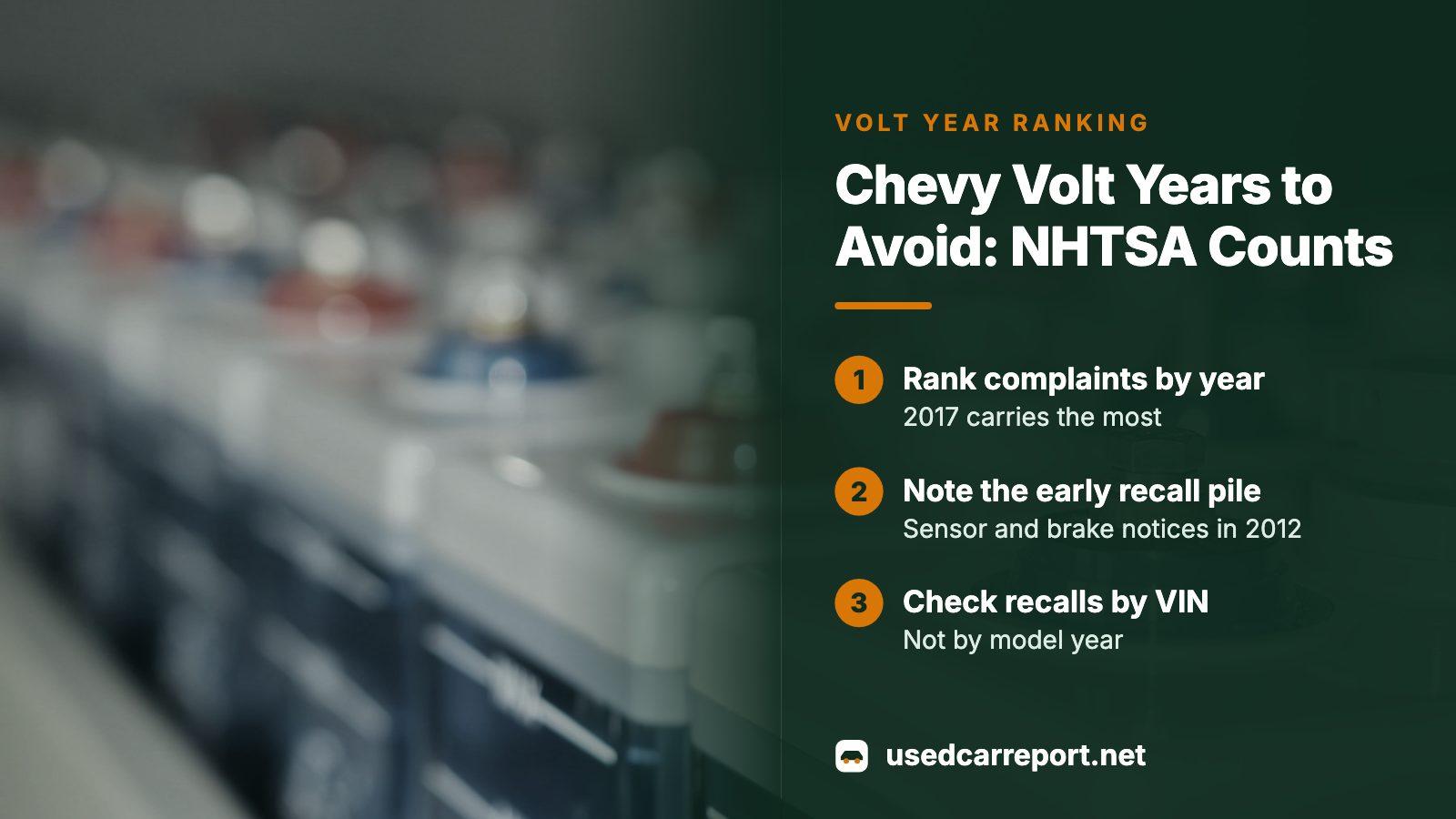
THE SHORT ANSWER
Skip 2012 and 2013 unless the recall work is documented and the passenger sensor behaves. Treat 2017 with caution: its complaints center on lost power and the battery control module. The 2014 and 2015 first-generation cars, and the final 2019 model, drew the fewest complaints, though every Volt still needs a recall lookup by VIN.
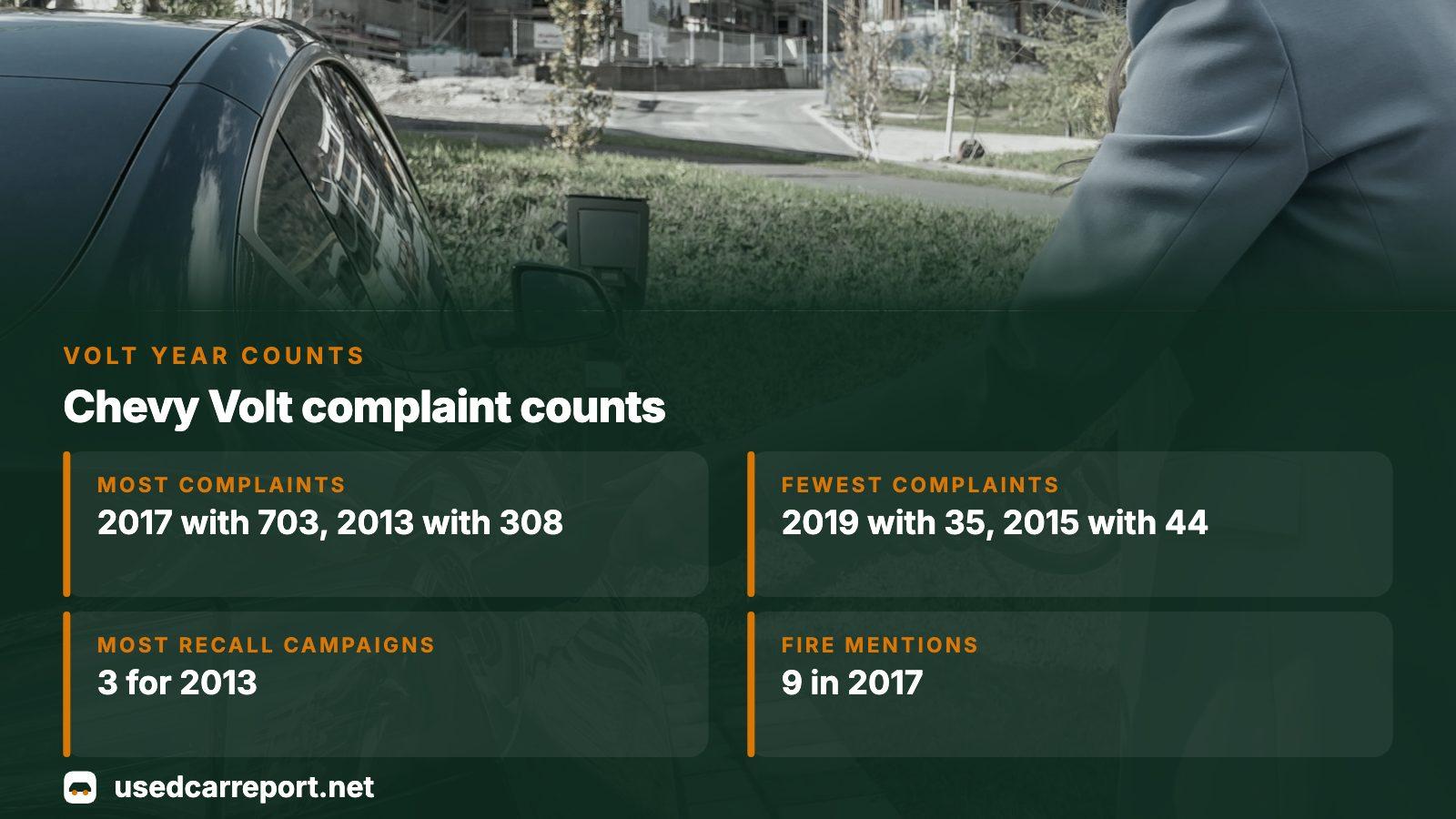
- Most complaints
- 2017 with 703, then 2013 with 308
- Fewest complaints
- 2019 with 35, then 2015 with 44
- Most recall campaigns
- 3 for 2013
- Fire mentions
- 9 in 2017, 2 each in 2012 and 2013
How these years were ranked
Both counts below come straight from NHTSA's public complaint and recall lookups for the Chevrolet Volt, one query per model year from 2011 through 2019. A complaint is an owner's own report, filed to the agency, so the totals measure how often people bothered to write in, not how many cars failed.
One limit matters. We did not read sales figures, so these counts are not rates. A year with a big production run will collect more complaints even if its failure rate is ordinary. Older cars have also had more time to collect reports. Read the numbers as a pointer toward what to inspect, then verify the specific car.
Complaints and recalls for every Volt year
| Model year | Complaints | Fire mentions | Recall campaigns |
|---|---|---|---|
| 2011 | 49 | 0 | 1 |
| 2012 | 245 | 2 | 2 |
| 2013 | 308 | 2 | 3 |
| 2014 | 93 | 1 | 0 |
| 2015 | 44 | 1 | 1 |
| 2016 | 170 | 1 | 1 |
| 2017 | 703 | 9 | 0 |
| 2018 | 228 | 0 | 2 |
| 2019 | 35 | 0 | 2 |
Zero recalls for 2014 and 2017 does not mean a clean car. Those years simply had no campaign filed under that exact model year in NHTSA's data, and 2017 still carries the heaviest owner complaint load.
2012 and 2013: the sensor, the brakes and the recall pile
These two years share the most worrying mix. In 2012 and 2013, air bag complaints are the top category, 86 in 2012 and 161 in 2013, and owner summaries keep describing the same fault: the front passenger seat sensor drops out and the dash shows a Service Airbag message. One complaint from a 2012 owner says NHTSA opened a probe into that sensing system in 2019 and closed it in 2021 after GM began a cost-reduction repair program. That is the owner's account, so ask for paperwork.
Recalls add to it. A 2012 Volt built in a narrow window of March and April 2012 was recalled for a brake pressure valve that can leave a front brake locked during a stability event. The 2013 Volt also has a 2018 recall for a software update that disabled battery cell balancing, and a 2023 recall for a driver air bag inflator that can rupture.
From an NHTSA owner complaint
A 2013 Volt owner reported that the passenger-side air bag light drops to OFF and a Service Airbag warning appears, mostly past 25 mph, for anywhere between 5 seconds and a minute. The pattern came and went: near-daily one week, absent the next. Take from it that an intermittent fault can hide on a test drive, so ask the seller how often the message appears and whether the sensor was ever replaced.
2017: the most complaints of any year
The second-generation Volt arrived for 2016, with a bigger battery and a second motor. The 2016 cars drew 170 complaints. Then 2017 jumped to 703, with 9 mentioning fire and 11 injuries listed across the year's reports. The top components were electrical (313), fuel and propulsion (236), power train (221) and engine (184).
Reading the summaries, a recurring story is the car losing power at speed, a Reduced Propulsion message and the check engine light. Of the 703, 56 mention reduced propulsion by name and 127 mention the check engine light. Owners also name the battery energy control module, the unit that manages the high-voltage pack.
From an NHTSA owner complaint
A 2017 owner reported the car would not start or run properly at 97,758 miles. A dealer took several days to confirm the battery energy control module had failed and quoted about $2,500. The owner says GM runs a special coverage program for some Volts but excluded this VIN, so the bill was out of pocket. Take from it that you should ask a dealer whether a given VIN is covered before you buy.
The years with the lightest records
The 2019 car drew only 35 complaints and the 2015 car 44, the two lowest in the set. The 2011 Volt shows 49, though it shares the early car's recalls. The 2014 model has 93 complaints and no campaign under its own year.
- 2019: 35 complaints, no fires, two recalls for rear brake performance and rear seat belt retractors.
- 2015: 44 complaints, one recall for a steering tie rod on a single build date, April 11, 2014.
- 2014: 93 complaints, no recalls returned for the model year.
- 2018: 228 complaints and no fires, but check the same two recalls as 2019.
Fewer reports is a weaker warning than a clean bill of health. Newer cars are also younger, so a 2019 has had less time to generate complaints than a 2012.
Check open recalls by VIN, not by year
A year-level recall list says what existed, not what was fixed on your car. Several Volt campaigns covered only certain build dates, such as the 2012 brake valve or the 2015 steering gear, so the VIN decides whether your car was ever in scope. Enter the number at NHTSA's lookup, then request the dealer's repair paperwork from the seller.
The 2011 to 2013 ignition recall is a good example of a quirky one: a Volt left switched on can drain the battery until the gasoline engine starts by itself, which in a closed garage could build carbon monoxide. The remedy is a software update, free, so a missed update is easy to catch with the VIN.
Where a damage and accident check earns its fee
A Volt with a rough history can look fine from the driveway. Before paying, start with our VIN preview, where no payment is asked, and read the title brand, accident and damage entries and salvage auction records if any exist. A flood or collision brand on a car built around a high-voltage battery changes the risk, and a Volt that has hit something deserves a specialist's look at the pack and its mounts.
If you go on to the full report, it is one payment and not a subscription. Current options sit on the pricing page. Pair that with an inspection of the passenger sensor, the dash messages and a scan for stored battery codes.
What to check on a test drive
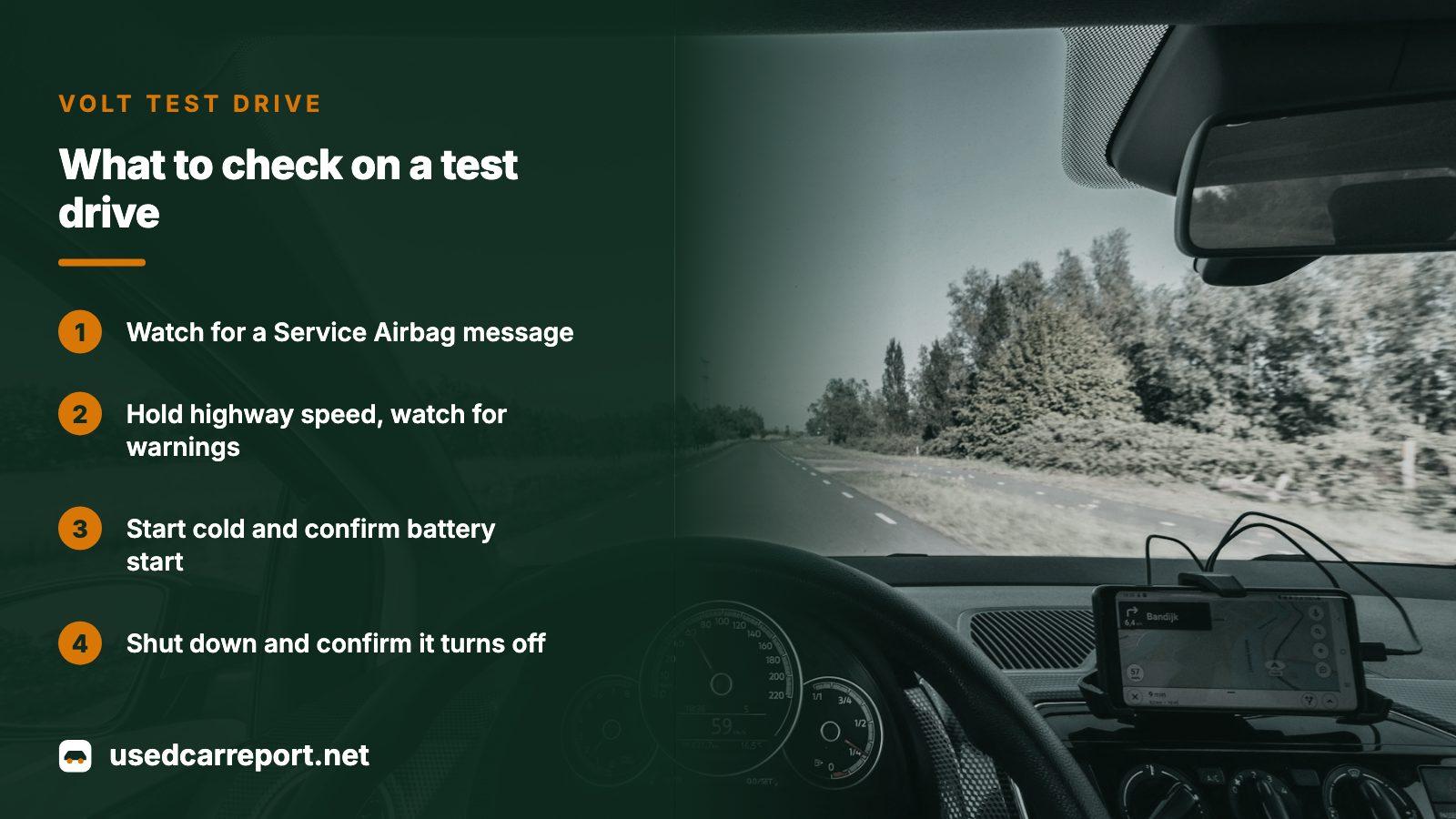
- Sit a passenger in the front seat and watch for a Service Airbag message or the passenger indicator flicking to OFF.
- Hold highway speed for a few miles and watch for a Reduced Propulsion message or a check engine light.
- Start from cold with a full charge and confirm the car begins on battery power as expected.
- Park, shut down, and confirm the car turns fully off without a Shift to Park message.
- Ask for dealer service records covering any recall and any battery module work.
Where this information comes from
- NHTSA recalls by vehicle: Chevrolet Volt — campaign numbers, build dates and remedies by model year
- NHTSA complaints by vehicle: Chevrolet Volt — owner complaint counts and components per model year
- NHTSA owner complaint 11770247 — owner experience, paraphrased
- NHTSA owner complaint 11676789 — owner experience, paraphrased
- EPA fuel economy: 2017 Chevrolet Volt — second-generation electric range and total range
Sources and photos: Facts checked against the sources above in November 2026. Photos by Vanya Smythe, Sander Jeurissen and smart-me AG on Unsplash; diagrams by UsedCarReport.
Keep reading
- Toyota Prius years to avoid: 2010, 2008 and 2012, plus the damage checkAnother hybrid with its own model-year trouble spots.
- Buying a car with an open recall: read the damage record firstWhat to do when the VIN shows an unfinished campaign.
- Buying an electric car after an accident: what to check firstHow collision history affects a car with a high-voltage battery.
- Pre-purchase inspection: read the damage records, then hire the mechanicWhat a shop should look at before you sign.
Frequently asked questions
What is the worst year for the Chevy Volt?
By complaint volume, 2017 is the worst, with 703 owner reports, many about lost power and the battery control module. By safety risk mix, 2012 and 2013 also rank poorly, with air bag sensor complaints and several recalls. Counts are not rates, since we did not read sales.
Are Chevy Volts reliable?
Reliability varies by year. The 2014, 2015 and 2019 cars drew the fewest complaints relative to the others in NHTSA's data. Even so, every Volt should get a recall lookup by VIN, a battery code scan and an inspection, because the numbers cannot speak for one specific car.
Which Chevy Volt year is best to buy?
The 2019 has the lowest complaint count at 35, with no fire mentions, and the 2015 follows with 44. Both have recalls to confirm. We cannot call any year best, only lightest on the record we pulled, so verify condition and history on the car itself.
Is the first or second generation Volt better?
The data does not crown a generation. The first (2011 to 2015) has the early air bag sensor and brake recalls; the second (2016 on) has the 2017 spike and battery module complaints. The second adds range: 53 electric miles against 35 on the 2012.
Can a VIN check tell me if a Volt was in a crash?
It can show reported title brands, accident and damage records and salvage auction entries tied to the VIN. It will not show unreported damage, so pair it with an inspection by a shop that can test the high-voltage battery.
Now check the car itself
The guide explains what to look for. The report shows what this VIN has on record.