THE SHORT ANSWER
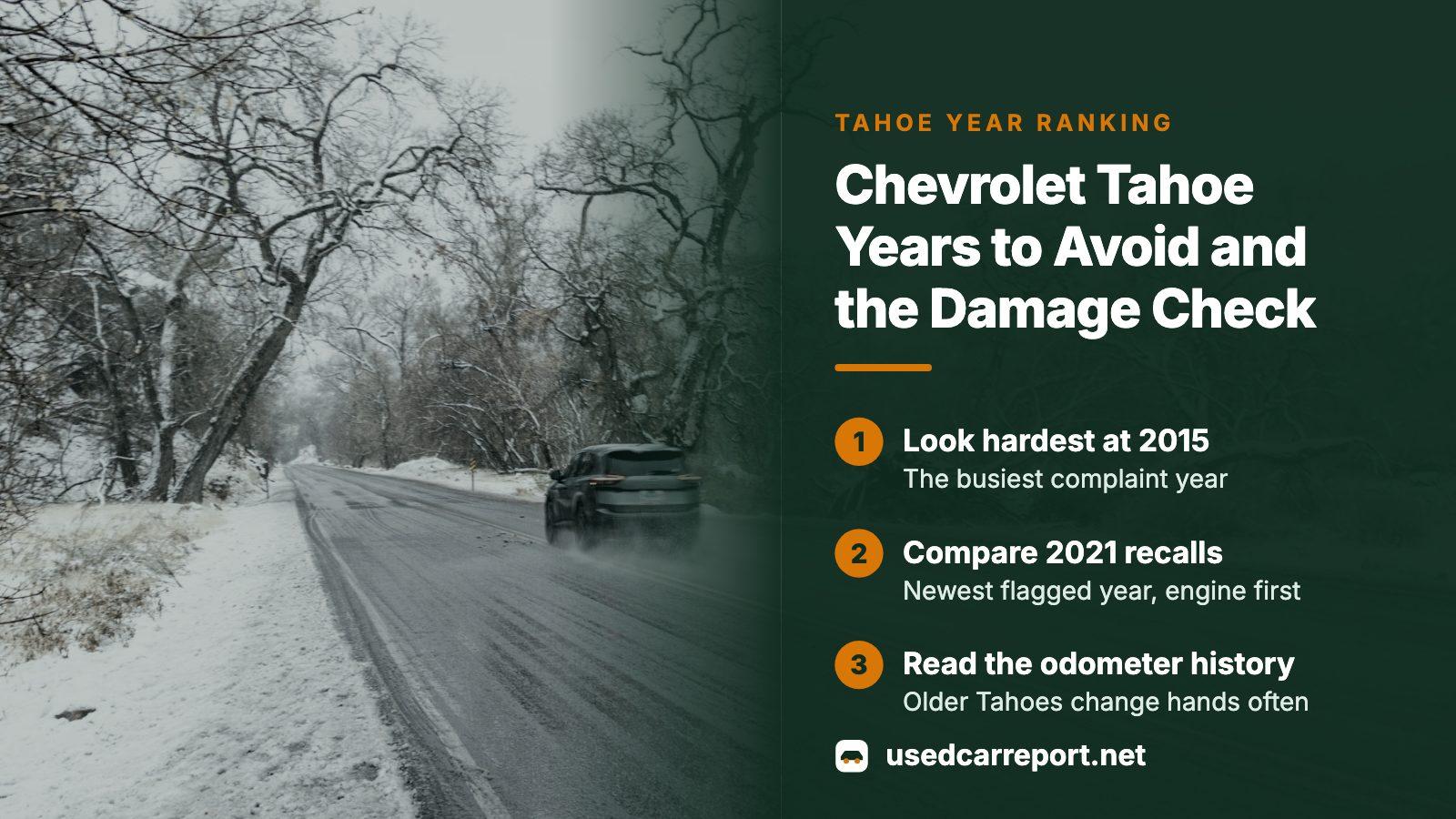
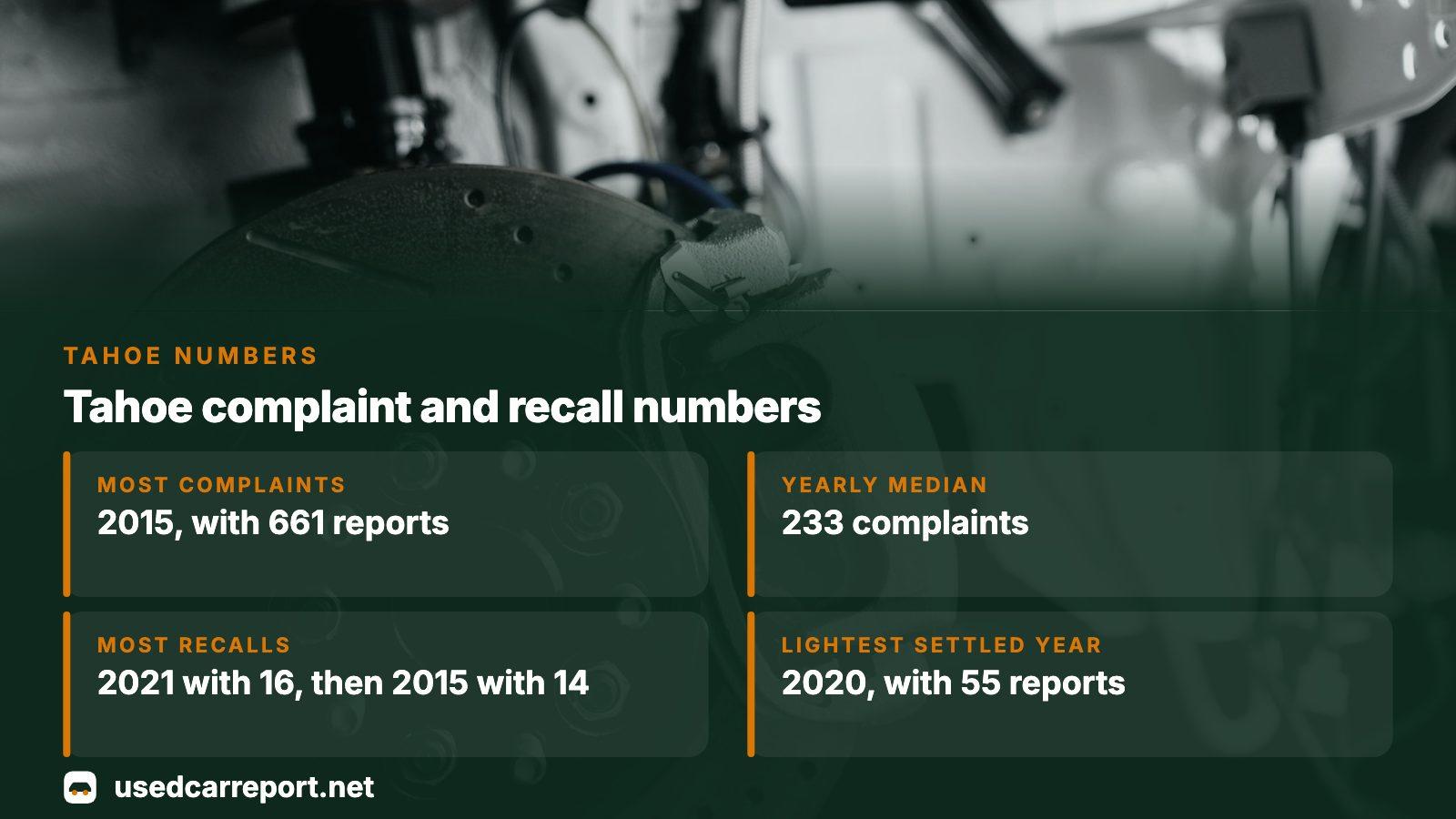
NHTSA holds 4,132 Tahoe complaints for 2008 to 2022, and the median year has 233. The heaviest are 2015 with 661, 2008 with 586, 2011 with 456 and 2021 with 432. The lightest settled years are 2020, 2014, 2018 and 2019. A flagged year earns a firmer inspection and a lower offer, but the accident and damage record of the exact SUV decides whether it deserves an inspection at all.
- Most complaints
- 2015, with 661 reports
- Yearly median
- 233 complaints
- Most recalls
- 2021 with 16, then 2015 with 14
- Lightest settled year
- 2020, with 55 reports
Which Tahoe years draw the most owner complaints
NHTSA's file for this SUV runs from 2008 to 2022 and, as pulled in August 2026, holds 4,132 owner complaints. The typical year has 233. The multiple in the table divides a year's count by that median, so 2.84 means nearly three typical years packed into one.
| Model year | NHTSA complaints | Versus the median | Recalls | Most reported area |
|---|---|---|---|---|
| 2015 | 661 | 2.84 | 14 | Service brakes |
| 2008 | 586 | 2.52 | 4 | Air bags |
| 2011 | 456 | 1.96 | 5 | Unknown or other |
| 2021 | 432 | 1.85 | 16 | Engine |
| 2010 | 319 | 1.37 | 4 | Unknown or other |
Every other year lands between 55 and 306 complaints. Note that 2014 has just 93, then 2015 jumps to 661. A step that size often means the truck itself changed, so a good year on one side says little about the year after it.
2015: the busiest year, and what brake owners describe
The 2015 Tahoe has the largest complaint file and a long recall list of 14 campaigns, with service brakes leading its categories. Campaign 19V645000 covers 2015 through 2018 Tahoes whose brake vacuum pump can wear down until it no longer supplies enough assist, so the pedal gets heavy and stopping takes longer.
From an NHTSA owner complaint
A 2015 owner filed in 2026 after the brake pedal turned hard and a Service Brake System warning light appeared. An independent mechanic blamed the vacuum assist pump and pointed to campaign 19V645000, yet a dealer said that recall was closed. The truck was still unrepaired at about 150,000 miles.
A campaign number shows a defect was acknowledged, not that this truck was fixed or is still covered. Type the VIN into the federal recall lookup and ask the seller for the repair order.
2021: the newest flagged year, with the engine on top
The 2021 trucks log 432 complaints, or 1.85 times the median, with engine as the biggest category. The climb from 55 for 2020 is steep. The year carries 16 recalls, yet only one is an engine campaign: campaign 25V274000, which covers 6.2-liter V8s in 2021 to 2024 models and concerns connecting rod and crankshaft parts.
From an NHTSA owner complaint
An owner picked up a 2021 High Country in April 2026, at roughly 84,700 miles. By August the 6.2-liter engine had quit on the highway with the owner's wife driving, and nothing had flashed on the dash beforehand. The complaint reports camshaft and lifter damage, and the truck was at a Chevrolet dealer for repair.
Camshafts and lifters are not the parts named in that recall, so an empty recall lookup does not clear an engine. Ask for the oil-service history and have a mechanic listen to the truck cold.
2008 and 2011: age, inflators and old paperwork
The 2008 Tahoe draws 586 complaints, led by air bags, and has 4 recalls on file. Two are passenger inflator campaigns, including 21V052000, where degraded propellant can make an inflator rupture and spray metal at the occupants. The fix is a dealer swap at no charge, but the campaign lists only certain states for trucks this old, so check the VIN and ask a dealer whether yours qualifies.
The 2011 trucks log 456 complaints, and the top category reads unknown or other, so the data names no single system to check. A mechanic's full inspection and the service papers carry more weight than the year.
The quiet years and what a thin file leaves out
- 2020: 55 complaints, 0.24 of the median, 3 recalls.
- 2014: 93 complaints, 0.4 of the median, 3 recalls.
- 2018: 101 complaints, 0.43 of the median, 3 recalls.
- 2019: 103 complaints, 0.44 of the median, 2 recalls.
These are the lightest settled records. The newest trucks are left off on purpose, since few owners have had time to report anything, and counts also move with sales, so a small number can mean a small year as easily as a good one.
Why the accident and damage record outranks the year
A ranking describes a production year. A collision, an insurance claim or a stop at a salvage auction happened to a single truck. Picture two Tahoes at one asking price: a 2014 with 93 complaints and a 2016 with 256, or 1.1 times the median. The 2014 wins on paper. If it came out of a serious front-end wreck and was patched cheaply, the 2016 with an unmarked record is the safer buy.
That is why this site puts the damage record first in a report. A hit means asking what was repaired and by whom; a blank record means the year notes above can point the mechanic.
Odometer readings on an older, high-mileage Tahoe
A Tahoe from 2015 or earlier has probably changed hands more than once, and mileage is the one figure a buyer cannot verify by looking at the truck.
From an NHTSA owner complaint
Buying a 2015 Tahoe from a private seller, an owner was given 116,485 as the mileage. At registration the reading came to about 150,237, and the complaint was filed as odometer fraud. The record gives no price, no seller and no outcome.
- Lay the readings out by date: the dash, the latest service invoice, any inspection record and each entry on the report.
- A number that drops, or a long gap with none, deserves an answer from the seller before money moves.
Recalls on older Tahoes and the 15-year limit
Many recalls on a model year can simply mean the maker found and fixed its faults. A complaint is an unchecked owner story, while a recall means the maker has conceded a fault and funds the repair. Campaigns follow production ranges, so only a VIN matches a truck to one.
The free repair expires. Section 30120(g) of Title 49 draws the line at 15 calendar years: count back from the earlier of the owner notice and the agency order, and a Tahoe first sold before that point loses the right to a free fix. A campaign announced today for a 2008 Tahoe could miss the window, so get the dealer's answer in writing before agreeing a price.
Check the VIN ahead of paying for the inspection
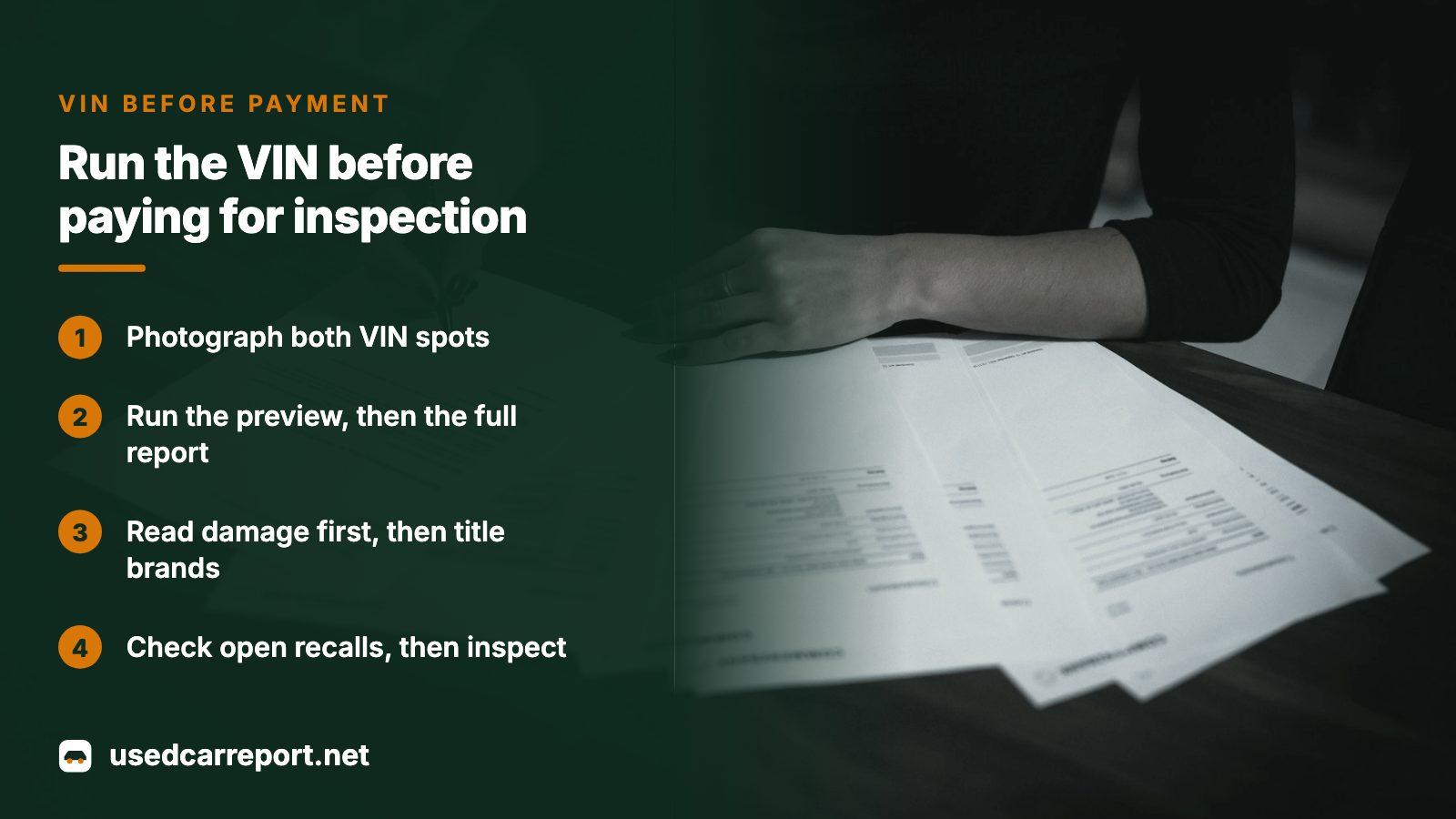
Reading a record on screen costs far less than finding a problem on a lift. Begin at the dash plate and the door-jamb label. The 17 characters on both must agree with each other, the title and the ad, and the tenth should fit the year in the listing.
- Photograph both VIN spots and compare them with the title.
- Run the preview, then open the full report on any Tahoe still in the running.
- Read accident and damage first, then title brands, salvage and auction photos, and mileage entries.
- Check the VIN against NHTSA's open recalls too.
- Book an independent inspection and hand the mechanic the brake and engine notes above.
Open the free Tahoe preview first. One payment covers a full report with nothing recurring, and packs of 3, 5 and 10 reports suit a buyer comparing several Tahoes. Rates sit on the pricing page.
Where this information comes from
- NHTSA owner complaint 11737536 — owner experience, paraphrased
- NHTSA owner complaint 11758758 — owner experience, paraphrased
- NHTSA owner complaint 11680438 — owner experience, paraphrased
- NHTSA: vehicle safety and the complaint database — Where the Tahoe owner complaints behind the yearly counts are filed.
- NHTSA: recalls by vehicle — Shows the open campaigns on one truck from its VIN.
- NHTSA: recall campaign 25V274000 — The record for the 6.2-liter engine campaign covering 2021 to 2024 models.
- 49 U.S.C. 30120: remedies for defects and noncompliance — The statute behind free recall repairs and the 15-year limit.
Sources and photos: Facts checked against the sources above in November 2026. Photos by Zoshua Colah, Dimitri Karastelev and Erik Mclean on Unsplash; diagrams by UsedCarReport.
Keep reading
- VIN accident check: read the damage records before you buyWhat accident and damage records show on a VIN, and where they fall short.
- Check mileage history by VIN: six steps, damage records firstHow to line up odometer readings before you trust the dash.
- Buying a car with an open recall: read the damage record firstWhat an unrepaired campaign means for the price and the paperwork.
- Honda Pilot years to avoid, and why a damage check comes before the yearThe same year-by-year complaint comparison for a rival three-row SUV.
Frequently asked questions
What are the worst years for a Chevrolet Tahoe?
On NHTSA complaints, 2015 leads at 661, then 2008 at 586, 2011 at 456, 2021 at 432 and 2010 at 319, against a median of 233. The trouble differs by year: brakes for 2015, air bags for 2008, the engine for 2021. Let the list steer the inspection.
Is the 2015 Chevrolet Tahoe a bad year?
It has the biggest complaint file and 14 recalls, with service brakes the top area, yet plenty of 2015 trucks drive fine. Ask whether each campaign was completed, judge the pedal on the test drive, and read the accident and damage record for that VIN first.
Which Tahoe years have the lightest complaint records?
Among settled years, 2020 has 55 complaints, 2014 has 93, 2018 has 101 and 2019 has 103. The newest trucks are excluded because owners have barely had time to file. No count reflects one truck's crashes or mileage, so a VIN record matters more than any table.
Can I skip the accident check if the year has few complaints?
No. Complaints capture what owners said about mechanical trouble. They cannot show whether one truck was wrecked, written off, sold at a salvage auction or had its mileage altered. Those facts sit in records tied to the VIN, so a quiet year still needs a damage check.
Can I still get recall repairs on an older Tahoe?
Often, but not always for free. The 15-year rule in Title 49 can end the no-charge repair for a truck first sold long before the notice. Check the VIN on NHTSA's recall site, then take any open campaign to a Chevrolet dealer and ask for the answer in writing.
Now check the car itself
The guide explains what to look for. The report shows what this VIN has on record.