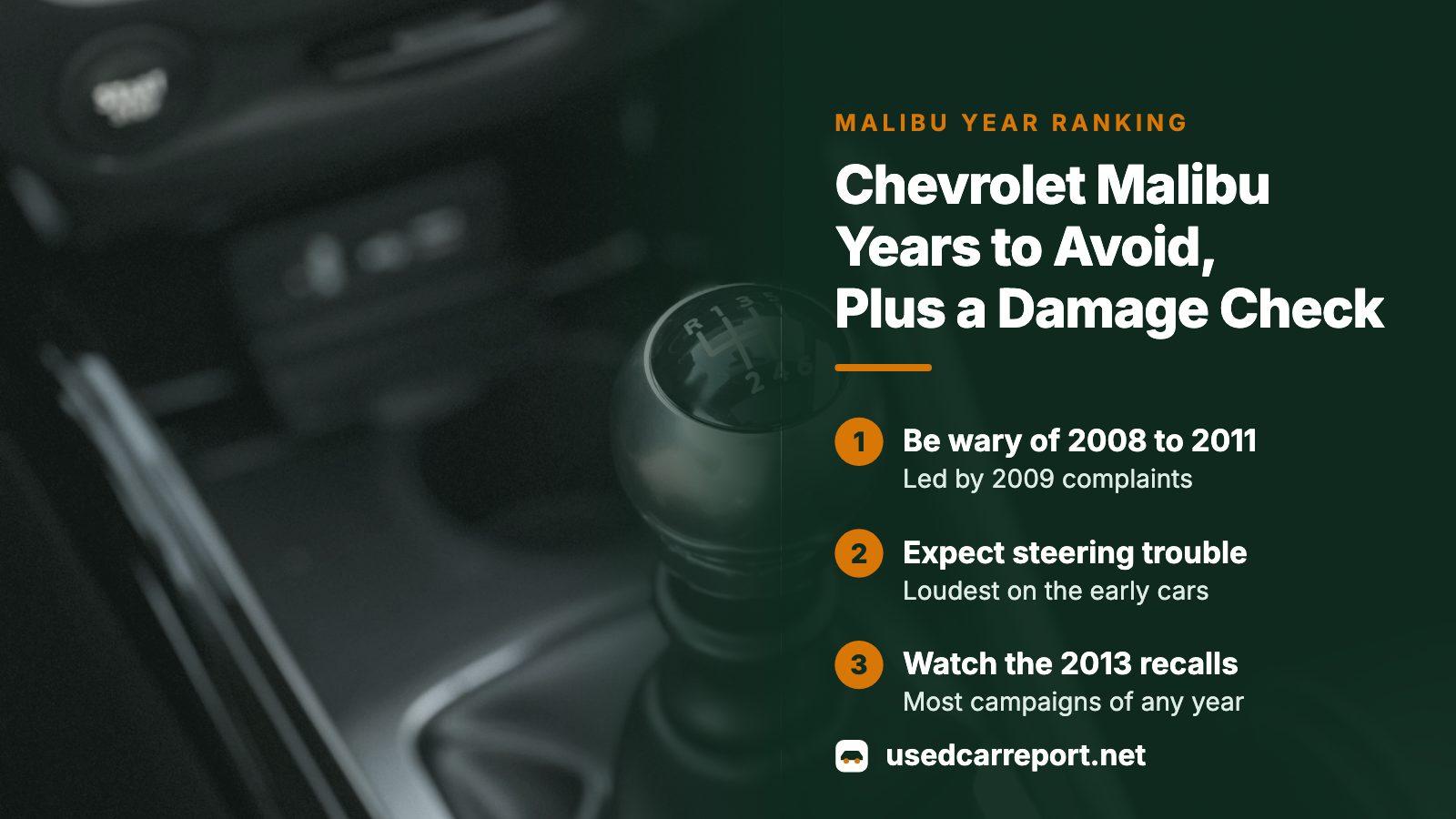
THE SHORT ANSWER
Be wariest of 2008 to 2011, led by 2009 with 1,511 NHTSA complaints against a yearly median of 727. Steering is the loudest complaint on the 2008 to 2010 cars, electrical trouble on 2011 and 2013, engine trouble on 2016 to 2018. The lightest years are 2021, 2022, 2019 and 2020, though the newest are partly quiet from youth. Run the VIN for damage, title brands and mileage before the year decides anything.
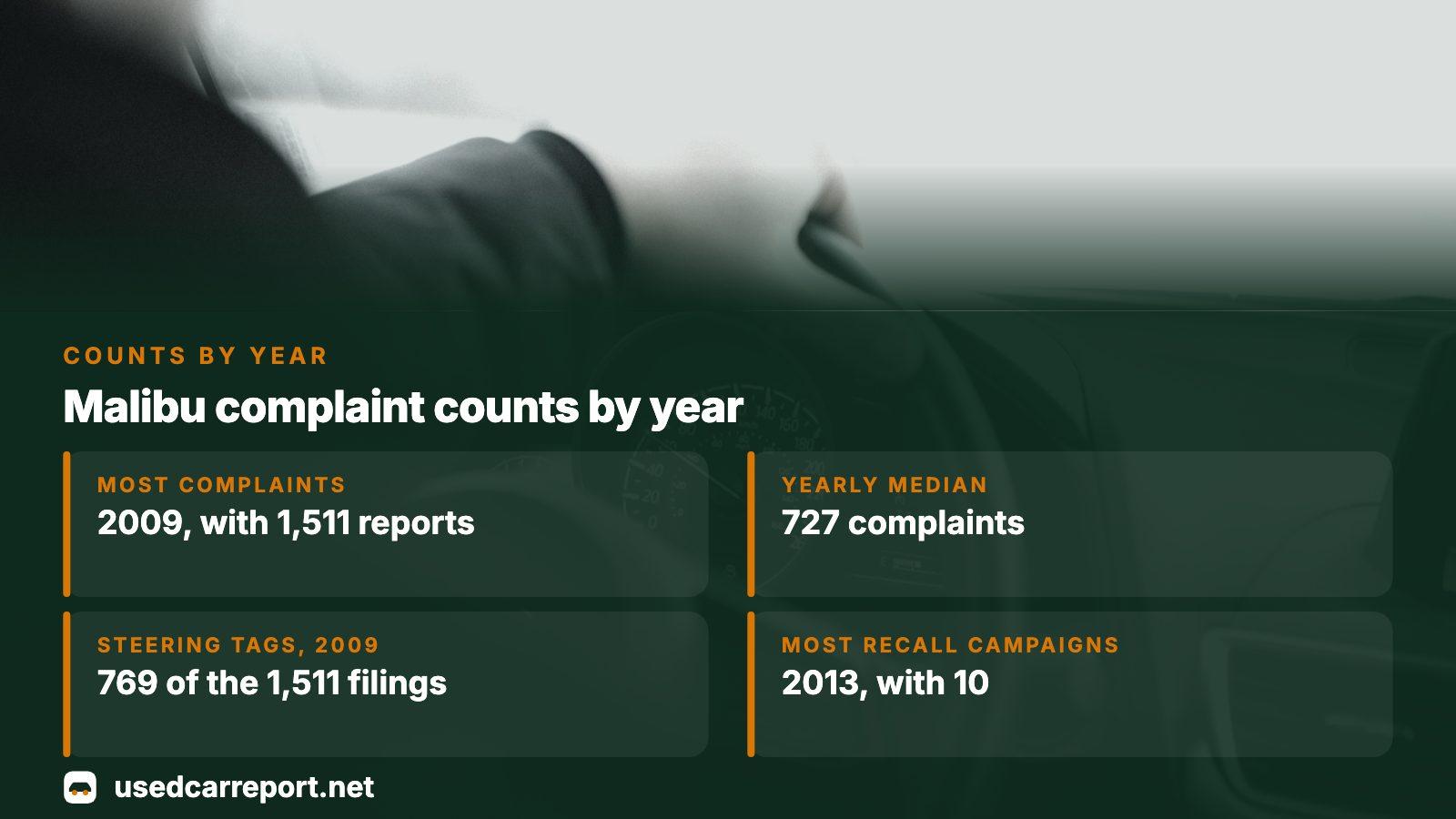
- Most complaints
- 2009, with 1,511 reports
- Yearly median
- 727 complaints
- Steering tags, 2009
- 769 of the 1,511 filings
- Most recall campaigns
- 2013, with 10
Where the complaints pile up, year by year
NHTSA's file for 2008 through 2022 held 10,211 Malibu complaints when pulled on November 5, 2026. The middle year, 2017, sits at 727. The ratio column divides each year by that figure, so 2 means twice a typical year.
| Year | NHTSA filings | Ratio to median | Campaigns | Top tag |
|---|---|---|---|---|
| 2009 | 1,511 | 2.08 | 6 | Steering |
| 2010 | 1,365 | 1.88 | 4 | Steering |
| 2008 | 1,017 | 1.40 | 5 | Steering |
| 2011 | 978 | 1.35 | 4 | Electrical |
| 2013 | 924 | 1.27 | 10 | Electrical |
| 2012 | 907 | 1.25 | 3 | Electrical |
| 2016 | 865 | 1.19 | 9 | Engine |
Read 2008 through 2013 as one heavy band, not a single villain. Sales volume and age push counts up too, so a high number alone proves little about any one Malibu.
Steering trouble on the 2008 to 2010 cars
Steering is the area owners name most on the three earliest years: 769 of the 1,511 filings for 2009, 468 of 1,017 for 2008 and 455 of 1,365 for 2010 carry that tag. Of the 2009 filings, 41 report a crash. NHTSA's recall record for certain 2008 and 2009 Malibus, campaign 14V153000, describes power steering assist that can vanish suddenly while driving, leaving the wheel much heavier at low speed.
From an NHTSA owner complaint
A 2009 Malibu owner was doing about 60 mph when the car began pulling right without warning. The power steering, stability and traction lights came on. After a tow to the dealer, the maker told the owner that its special coverage for lost power assist did not reach this car, because the car carried a salvage title. It had about 93,850 miles.
The lesson is narrow: this owner says the maker's coverage for a lost-assist fault stopped at a salvage brand, which makes the title record part of the price on any 2008 to 2010 car.
Recalls on these years, and the 2013 outlier
- 2008 and 2009: lost power steering assist (14V153000), plus a wiring fault that can light the brake lamps wrongly or switch off stability features on Malibus through 2012 (14V252000).
- 2008 to 2010, 4-speed automatic: a shift cable end that can break, so the lever and the real gear stop agreeing (12V460000).
- 2010 and 2011: a driver air bag inflator that may over-pressurize and burst in a crash (19V019000).
- 2013: rear suspension bolts left under-torqued (13V024000), then toe links that can corrode and fracture on cars sold or registered in a set of eastern and midwestern states (21V633000).
The 2013 cars carry 10 campaigns, the most of any year, against only 924 complaints. Open campaigns belong to a VIN, not a year, so enter the VIN at NHTSA's recall search rather than taking a seller's word. Federal law also puts an age cap on the free-repair duty, fifteen calendar years from first sale (49 U.S.C. 30120).
The 2016 jump and the quieter recent cars
Filings leap from 270 for 2015 to 865 for 2016, and the leading complaint changes with them. On the 2016 to 2018 cars the engine tag comes first, at 312, 256 and 281 reports. The 2017 Malibu sits right at the median, 727, and 2018 just under at 700.
| Year | NHTSA filings | Ratio to median | Campaigns |
|---|---|---|---|
| 2021 | 90 | 0.12 | 2 |
| 2022 | 99 | 0.14 | 1 |
| 2019 | 193 | 0.27 | 1 |
| 2020 | 202 | 0.28 | 1 |
| 2015 | 270 | 0.37 | 3 |
| 2014 | 363 | 0.50 | 6 |
The newest two years look light partly because they are young. Among older cars, 2014 and 2015 are the quiet picks, though 2014 still lists 6 recall campaigns.
Why the damage record comes before the year
Picture two Malibus at one asking price: a 2019 with 193 complaints and a 2012 with 907. On paper the 2019 wins. If it took a hard front hit and was patched cheaply, or passed through a salvage auction, that light count says nothing about its frame or air bags. A complaint count describes a crowd of cars. An accident and damage record describes the one in front of you.
From an NHTSA owner complaint
A buyer who bought a 2010 Malibu from a dealer was shown only a small slice of the history report on a phone. Roughly three weeks after the purchase, the buyer learned at a different dealership that the car had hail damage, past rental use and an open recall. The buyer asked to return it, and the seller replied that none of that had to be disclosed.
A partial view on someone's phone is not a report. Get the full record in hand before any money moves, and read the damage, use-type and recall lines before you talk price.
Mileage and title brands on cars with several owners
A Malibu from 2008 to 2013 has had time to pass through several owners, and the odometer is what a rushed seller counts on you not checking. Readings from different dates should climb in step. A drop, or a long gap followed by a much lower figure, is the cue to stop and ask. Salvage and rebuilt brands deserve the same suspicion, since auction photos capture the worst moment.
From an NHTSA owner complaint
A 2009 Malibu owner bought the car in a private sale with about 120,000 miles showing. A history report pulled afterward listed about 234,000. The car had piled up several problems, which is what made the owner suspect the odometer had been rolled back.
The reading on the dash is the seller's claim. Compare it with dated readings from outside the car, before the sale and not after.
A test-drive list built from what owners report
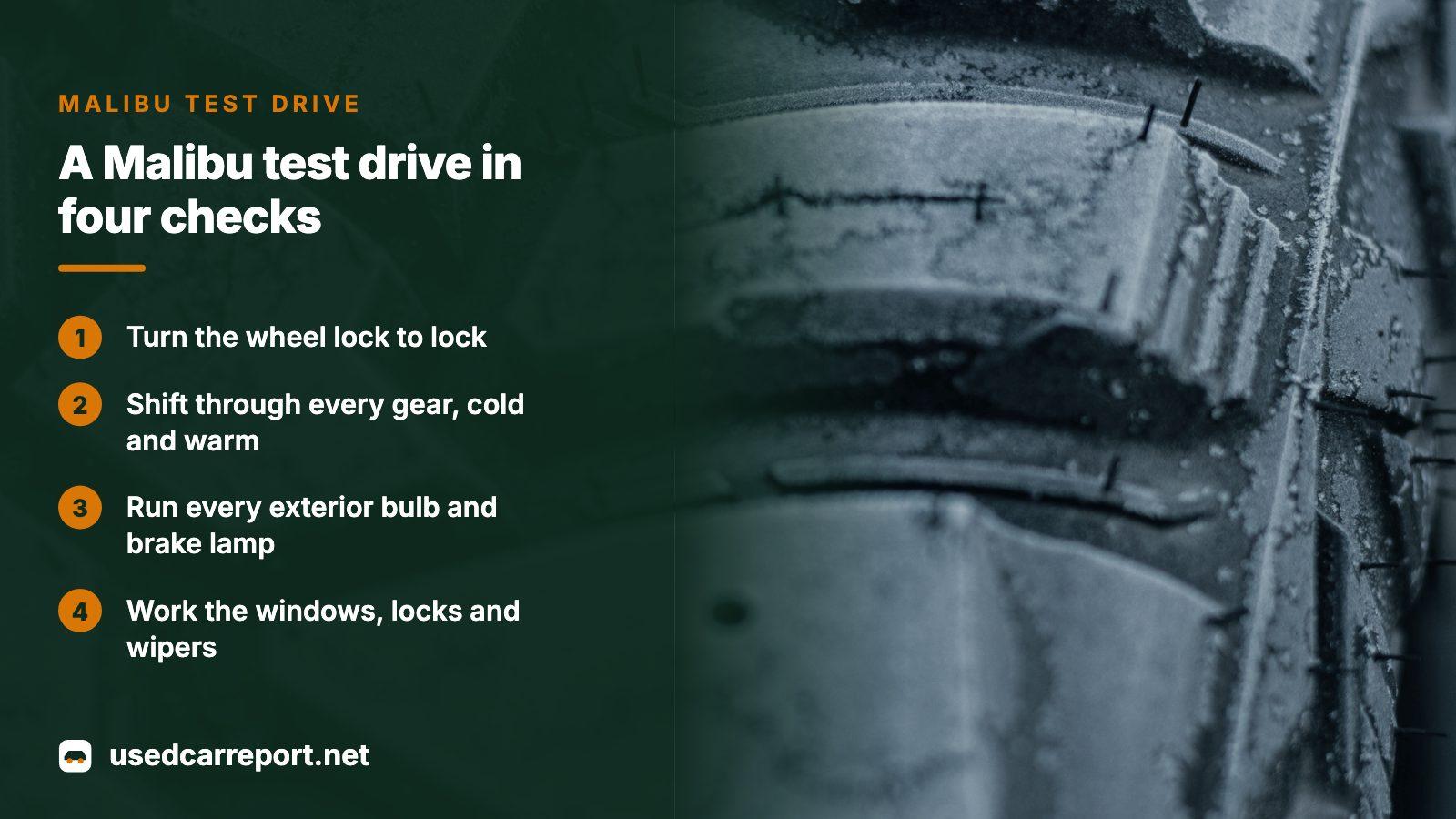
- Turn the wheel lock to lock, then drive at 30 mph and watch the dash for power steering, stability or traction warnings. Steering and stability control both rank among the top tags for 2009.
- Shift through every gear, reverse included, once cold and once warm. Power train draws 1,319 reports across the years.
- Run every exterior bulb and the brake lamps. Exterior lighting draws 901 reports, and one wiring recall covers brake-light faults through 2012.
- Work the windows, locks and wipers. Electrical is the largest tag overall, at 2,795.
- On 2016 to 2018 cars, ask for dated service records, since engine leads those years.
None of that replaces a lift inspection by an independent mechanic, but it tells you where to point theirs.
Run the VIN before the year decides anything
The year narrows the list and the VIN settles the purchase. Others offer free lookups to start with: NHTSA's recall search takes a VIN, and NICB's VINCheck compares one against theft and total-loss reports from member insurers. After that, pull up this site's preview, which is free. Buying a full report is a one-time payment, and packs hold 3, 5 or 10 of them, with no plan quietly renewing. For amounts, open the pricing page.
On a Malibu, read the accident and damage records first, then the title brand lines, odometer readings and any salvage auction photos. Open recalls come next. If the record is clean, a lift inspection finishes the job. If it is not, the year you picked no longer matters.
Where this information comes from
- NHTSA owner complaint 11005385 — owner experience, paraphrased
- NHTSA owner complaint 10914871 — owner experience, paraphrased
- NHTSA owner complaint 11717364 — owner experience, paraphrased
- NHTSA: vehicle safety and the complaint database — Where the Malibu owner complaints behind the yearly counts are filed.
- NHTSA: recalls by vehicle — Shows the open campaigns on one car from its VIN.
- 49 U.S.C. 30120: remedies for defects and noncompliance — The statute behind free recall repairs and its age cap.
- NMVTIS: national motor vehicle title information system — The federal title-record program meant to guard buyers against fraud.
Sources and photos: Facts checked against the sources above in November 2026. Photos by Nils Keesmekers, Joan and Miles Loewen on Unsplash; diagrams by UsedCarReport.
Keep reading
- VIN accident check: read the damage records before you buyWhat accident and damage records show on a VIN, and where they stop.
- Salvage title check: five steps, damage records firstHow to find a salvage brand before it affects repairs and resale.
- Check mileage history by VIN: six steps, damage records firstComparing dated odometer readings against what the dash claims.
- Buying a car with an open recall: read the damage record firstWhat an unrepaired campaign means for the price and the paperwork.
Frequently asked questions
Which Chevrolet Malibu years should I avoid?
Complaint volume puts 2009 first with 1,511, then 2010 with 1,365 and 2008 with 1,017, against a median year of 727. The 2011 to 2013 cars also sit above it. Complaints are unverified owner accounts, so inspect those years closely and price carefully rather than refusing them unseen.
Is a 2013 Malibu a bad year with so many recalls?
Ten campaigns is the highest recall count for any Malibu year, yet 924 complaints sits only a little above the median. A recall is a fault the maker agreed to fix, so a high count can mean problems were caught and repaired. What matters is whether one VIN's campaigns were completed.
Which Malibu model years hold up best?
By complaint volume, 2021, 2022, 2019 and 2020 are lightest, with 90, 99, 193 and 202 filings. The newest are light partly from youth. Among older cars, 2015 has 270 and 2014 has 363. A low count says nothing about one car's crash or title history.
Can a Malibu with few complaints still have a damaged past?
Yes. A complaint count reflects what owners of a model year reported, not what happened to a single car. A 2019 or 2021 Malibu can still have been in a collision, branded salvage, auctioned or rolled back. Those events live in the VIN's accident, title and odometer records.
Can older Malibus still get free recall repairs?
Not always. Federal law caps the free-repair duty at fifteen calendar years between a car's first sale and the maker's notice or the agency's order. On the oldest Malibus here, that cap may already apply to a campaign announced now. A dealer can check where a specific VIN stands.
Now check the car itself
The guide explains what to look for. The report shows what this VIN has on record.