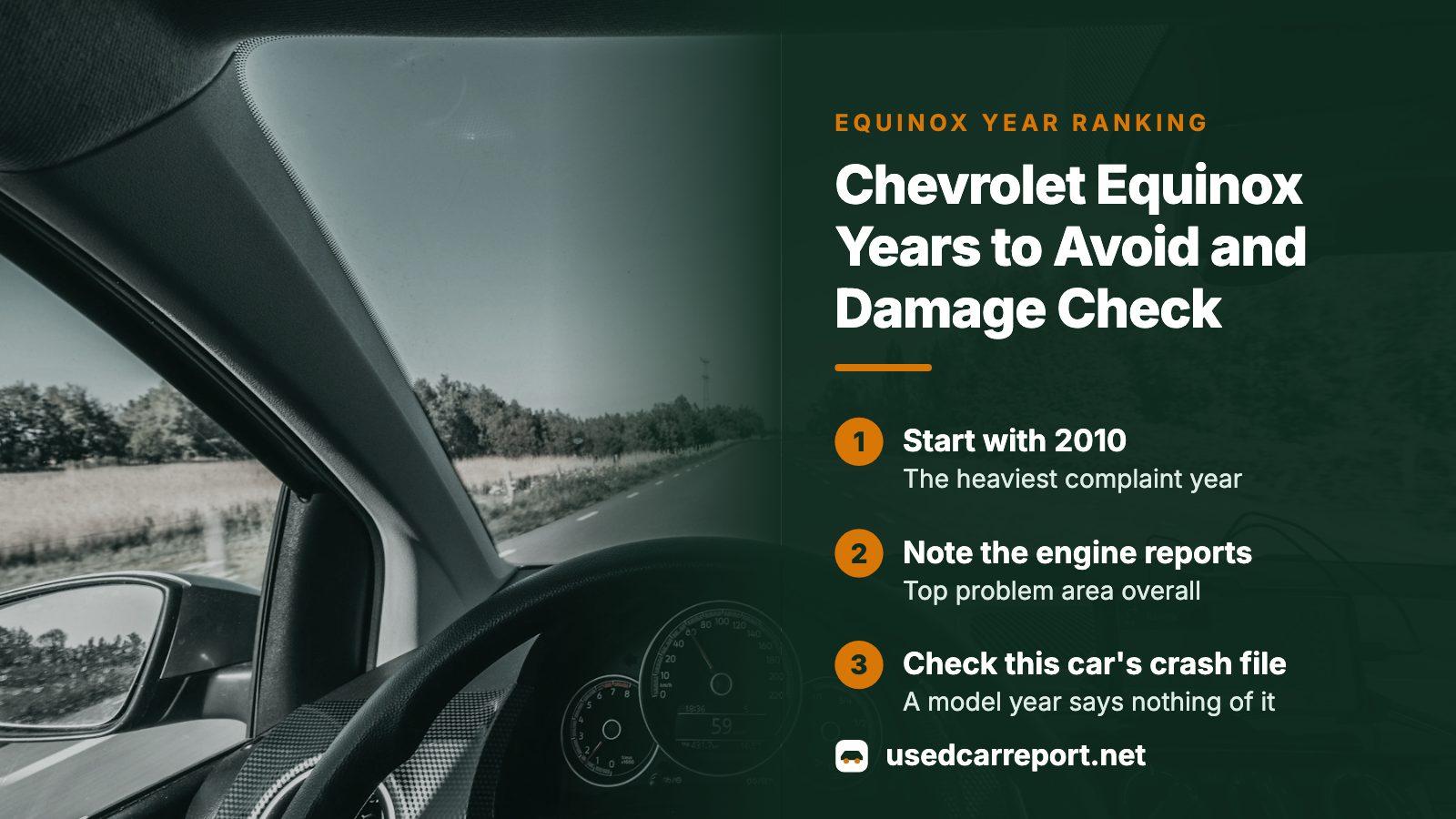
THE SHORT ANSWER
NHTSA holds 6,587 Equinox complaints for 2008 to 2022, and the median year has 392. The heaviest are 2010 with 784, 2011 with 781, 2013 with 749, 2012 with 682 and 2015 with 679, mostly about the engine. The lightest settled years are 2021, 2009 and 2022. A flagged year earns a firmer inspection and a lower offer, but an accident and damage record for the exact car decides whether to inspect at all.
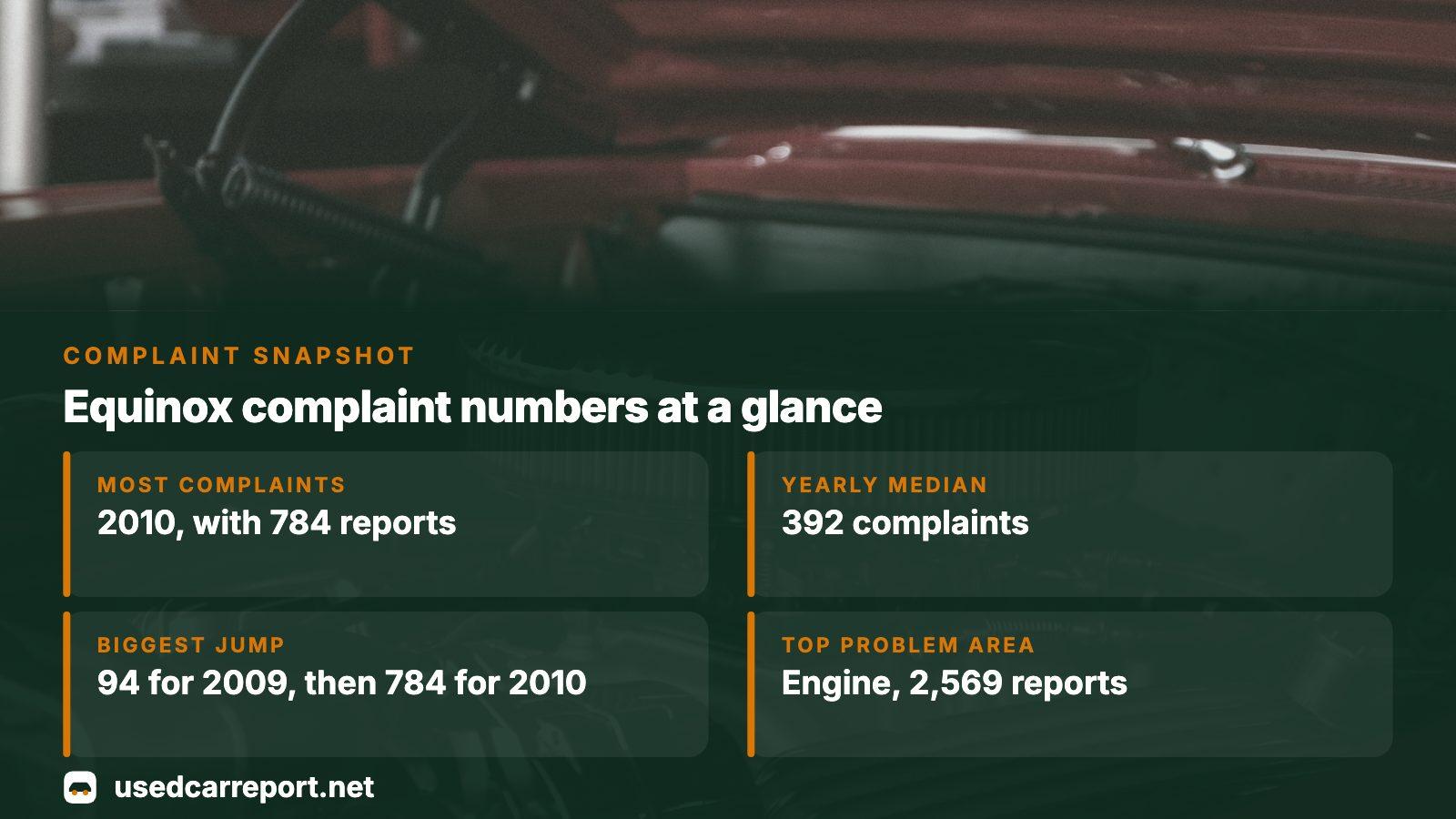
- Most complaints
- 2010, with 784 reports
- Yearly median
- 392 complaints
- Biggest jump
- 94 for 2009, then 784 for 2010
- Top problem area
- Engine, 2,569 reports
Which Equinox years draw the most complaints
NHTSA's file runs from 2008 to 2022 and holds 6,587 owner complaints, as pulled in August 2026. The middle year has 392. The multiple in the table divides a year's count by that median, so a 2 means twice a typical year.
| Year | NHTSA complaints | Versus the median | Recalls | Most reported area |
|---|---|---|---|---|
| 2010 | 784 | 2 | 3 | Engine |
| 2011 | 781 | 1.99 | 3 | Engine |
| 2013 | 749 | 1.91 | 2 | Engine |
| 2012 | 682 | 1.74 | 3 | Engine |
| 2015 | 679 | 1.73 | 2 | Visibility and wipers |
The 2014 cars follow at 546, or 1.39 times the median, so read 2010 through 2015 as one rough band. No count here condemns an individual SUV.
What owners report on the flagged years: mostly engine
Across every year, engine leads the categories with 2,569 reports, well ahead of every other area. Reading through the engine complaints for 2011 and 2013 cars, one theme repeats: oil that goes missing between changes, and later an engine that dies on the road, locks up or loses its timing chain.
From an NHTSA owner complaint
Bought used in early 2024, this 2013 Equinox passed a close look by mechanics at purchase and again before a long drive home, with "zero issues" found. Eleven months on, a low oil pressure light came on for the first time and the engine quit on the way to work. It has not started since, and money is still owed on the car.
The narrow lesson: passing an inspection and a tidy record do not settle an engine that owners so often describe as running low on oil. Ask for dated oil-change receipts and read the dipstick yourself on a cold engine. Complaints are unverified, so treat this as something to test for.
The quieter years, and what a thin file can hide
- 2021: 89 complaints, 0.23 of the median, 4 recalls.
- 2009: 94 complaints, 0.24 of the median, 0 recalls.
- 2022: 160 complaints, 0.41 of the median, 5 recalls.
Those are the lightest records, though the two newest cars are young enough that few owners have filed anything yet. The years from 2016 to 2020 sit near the middle, at 392, 271, 396, 295 and 299, or 0.69 to 1.01 of the median.
The cliff to remember sits between 2009 and 2010, from 94 complaints to 784. A jump that size often means the vehicle itself changed, so a good record on one side says little about the other.
Why the accident and damage record outranks the model year
A ranking describes thousands of SUVs. A collision, an insurance claim or a stop at a salvage auction happened to one of them. Picture two Equinoxes at the same asking price, a 2017 (271 complaints, 0.69 of the median) and a 2012 (682). The 2017 wins on paper, but if it took a hard hit and was repaired cheaply, the unmarked 2012 may be the safer purchase.
From an NHTSA owner complaint
Buying a 2015 Equinox "as is" from a small dealership, an owner filed a complaint after about a month of ownership. The passenger door had shifted, nobody had mentioned an accident according to the owner, and the owner has a loan against the car.
The complaint does not say what a history report would have shown. It does show how an as-is sale works: the question lands on the buyer. Read the crash history, any salvage or auction photos and any title brand before signing, while walking away still costs nothing.
Odometer readings on Equinoxes old enough for several owners
Equinoxes from 2010 to 2013 are well past ten years old, long enough for mileage to be misreported by a careless seller or a deliberate one.
From an NHTSA owner complaint
Paying a private seller for a 2011 Equinox that showed 119,000 miles, one buyer found a history report listing 175,000. The complaint was filed as odometer fraud. The record gives no explanation for the gap and does not say what the buyer did next.
- Line up every reading by date: the dash, the last service receipt, the inspection sticker and the odometer entries on the report.
- A reading that goes down, or a long stretch with none, needs an answer from the seller before money moves.
Recalls on older Equinoxes and the 15-year rule
Recalls attach to production ranges rather than whole years, so only the VIN matches a car to a campaign. NHTSA counts 3 campaigns each for 2010, 2011 and 2012, and 2 each for 2013 and 2015.
The repair promise also has an expiry date. Section 30120(g) of Title 49 in the U.S. Code drops the no-cost remedy for a car that was older than 15 years, counted from its first retail sale, when the recall notice went out. A campaign announced now on a 2010 Equinox may fall outside that window, although some dealers still do the work, so settle it before you buy. A VIN typed into NHTSA's recall search shows what is open on that car, at no cost.
A test-drive list built from the complaint categories
- Engine, 2,569 reports: check the dipstick cold, ask for oil-change receipts and listen at start-up for a rattle or tick.
- Visibility and wipers, 994: run the wipers at every speed, since several 2015 complaints describe them quitting in heavy rain.
- Power train, 734: feel for hesitation or harsh shifts as the car moves through its gears.
- Electrical, 671: work every switch and screen, and watch whether any warning light stays lit after the engine starts.
- Fuel and propulsion, 343: watch for stalling at idle or a loss of power under load.
Hand this list to the mechanic doing your inspection; it shows where owners say trouble starts.
Check the VIN first, then pay for the inspection
Ruling out a hit or rolled-back car on paper costs less than doing it on a lift. Read the 17 characters off the plate under the windshield on the driver's side, then check the label in the door frame. They should agree with each other, the title and the ad. The tenth position encodes the model year, a quick test of the year printed in the listing.
- Photograph both VIN locations and compare them with the title.
- Run the preview, then open the full report on any Equinox still in contention.
- Read the accident and damage records first, then title brands, salvage and auction photos, and odometer readings.
- Search the VIN on NHTSA's recall page too; that lookup costs nothing.
- Book an independent inspection with the list above.
The preview itself is free. Beyond it, a report is a one-time purchase with nothing to cancel later, and packs of 3, 5 or 10 are there for comparing several Equinoxes. Rates sit on the pricing page.

Where this information comes from
- NHTSA owner complaint 11670428 — owner experience, paraphrased
- NHTSA owner complaint 11708317 — owner experience, paraphrased
- NHTSA owner complaint 11746040 — owner experience, paraphrased
- NHTSA: vehicle safety and the complaint database — Where the Equinox owner complaints behind the yearly counts are filed.
- NHTSA: recalls by vehicle — Shows the open campaigns on one car from its VIN.
- 49 U.S.C. 30120: remedies for defects and noncompliance — The statute behind free recall repairs and the 15-year limit.
- NMVTIS: national motor vehicle title information system — The federal title-record program behind brand and total-loss data.
Sources and photos: Facts checked against the sources above in November 2026. Photos by Sander Jeurissen, Michal Biernat and Victor Hughes on Unsplash; diagrams by UsedCarReport.
Keep reading
- VIN accident check: read the damage records before you buyWhat accident and damage records show on a VIN, and where they fall short.
- Buying a car with an open recall: read the damage record firstWhat an unrepaired recall means for the price and the paperwork.
- Pre-purchase inspection: read the damage records, then hire the mechanicWhat an independent mechanic should look at once the records check out.
- Honda CR-V years to avoid, and the damage record to read firstThe same year-by-year complaint comparison for a close rival.
Frequently asked questions
What are the worst years for a Chevrolet Equinox?
By NHTSA owner complaints, 2010 is worst at 784, then 2011 at 781, 2013 at 749, 2012 at 682 and 2015 at 679, against a median of 392. Engine leads for the first four and wipers for 2015. Read it as a prompt to inspect harder and haggle, not as a verdict.
Is the 2010 Chevrolet Equinox a bad year?
It has the heaviest complaint file, 784 reports, right after a 2009 year with only 94, and 3 recalls on record. Plenty of 2010 cars run well, so judge the car. Ask for oil-change receipts, test the engine cold, and read the accident and odometer records for that VIN before making an offer.
Which Equinox years are the most reliable?
On complaint counts, 2021, 2009 and 2022 have the lightest records, at 89, 94 and 160. The 2016 to 2020 cars land near the median. The newest years flatter themselves a little, since fewer owners have lived with them long enough to file, and no count reflects a single car's crashes. Service records beat any ranking.
Can I skip the accident check if the year has few complaints?
No. Complaints record how owners reported mechanical trouble by model year. They cannot show whether one car was crashed, written off, sold at a salvage auction or had its mileage altered. Those facts live in records tied to the VIN, so a quiet year still needs a damage and title check.
Can I still get recall repairs on an older Equinox?
Often, but not always at no cost. Section 30120(g) of Title 49 lets the repair obligation lapse for a car that was older than 15 years, from first sale, when the notice issued. Before agreeing a price, put the VIN into NHTSA's recall page and take any open campaign to a dealer.
Now check the car itself
The guide explains what to look for. The report shows what this VIN has on record.