THE SHORT ANSWER
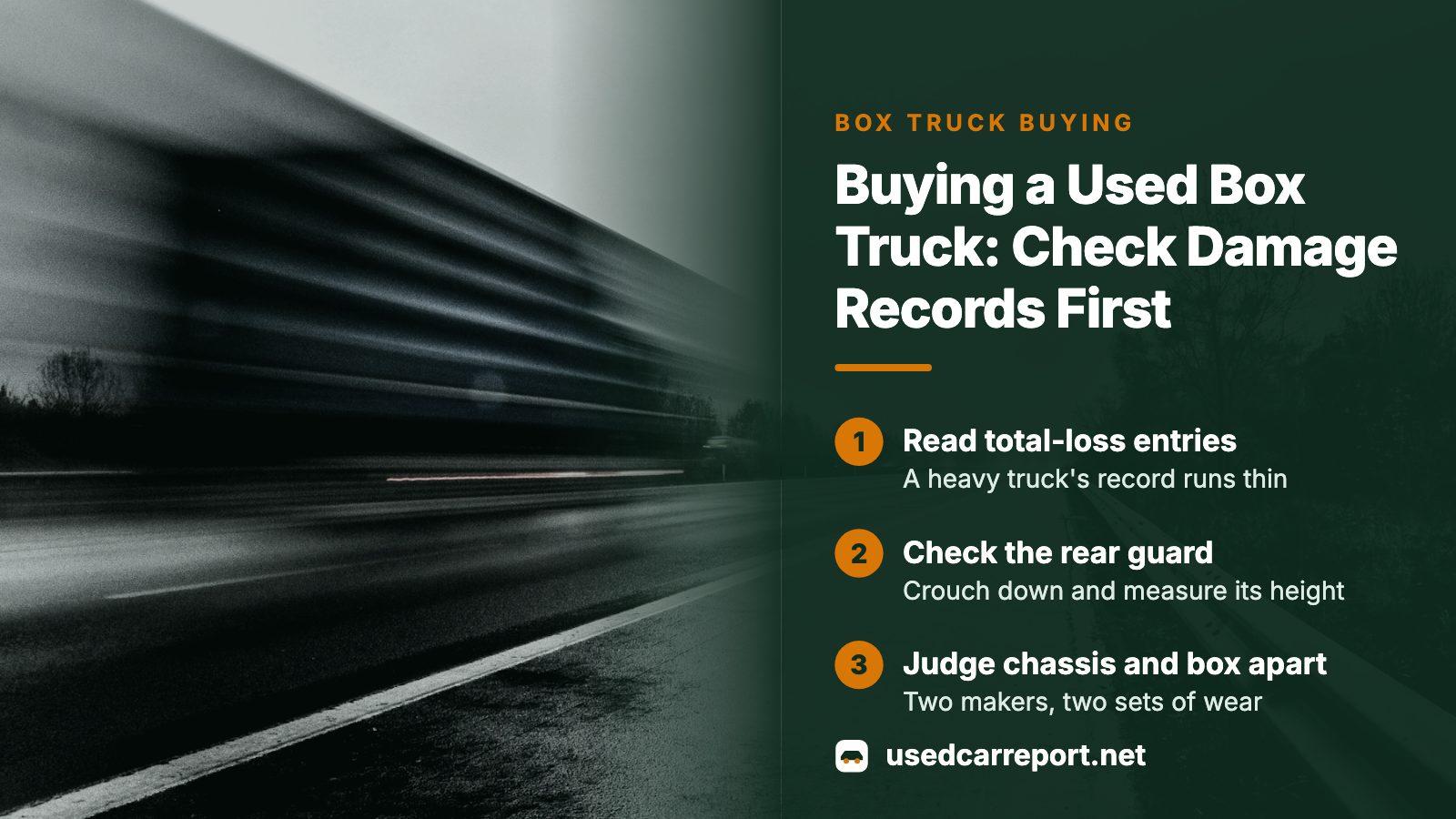
Before buying a used box truck, run its VIN and read the accident, total-loss and salvage entries, because a heavy truck's record may be thinner than a car's and a clean search proves less. Then look for repair evidence on the rear guard, frame rails and axle parts. If the truck weighs 10,001 pounds or more and works across state lines, ask for the annual inspection decal and the reports behind it.
- Read first
- Accident, total-loss and salvage entries
- Weight line
- 10,001 pounds, with interstate use
- Rear guard
- No more than 30 inches off the ground, empty
- Preview
- Free; full report is one payment
Why damage comes before everything else on a work truck
A box truck spends its days in loading yards, tight driveways and busy traffic, so it has more chances to be hit than a family car. The damage often sits where a quick walkaround never looks: the frame rails, the steel bar across the back, the underside of the box floor. A dented panel is cosmetic. A bent frame or a re-welded axle part rides along on every load, which is why the record comes first and the paint comes last.
What each damage entry tells you, and what to ask
Run the VIN before you drive anywhere, since the free preview costs nothing.
| Entry in the record | What it suggests | Ask the seller |
|---|---|---|
| Accident with an impact point | Which end took the hit, and roughly how hard | Who repaired it, and whether the frame was measured afterward |
| Insurer total-loss or salvage entry | An insurer decided the repair cost too much | The claim date, and who put the truck back on the road |
| Auction or salvage-yard photos | The truck as it looked before any repair | Which parts in the pictures have been replaced |
| Title brand | A state labeled the truck junk, salvage or flood | Which state issued it, and whether a clean title followed |
Why a clean search on a heavy truck proves less
NMVTIS, the federal title database, stores title brands, the newest mileage reading, insurer salvage determinations and transfers to junk or salvage yards. A Bureau of Justice Assistance page puts coverage near 87 percent of vehicles in the country, yet not every state reports, and the reporting requirement covers common automobiles only, so a heavy truck may be covered less fully than a car.
States also write their own branding rules, and a brand can fall away when a truck is retitled in a state that never checked the earlier one.
Treat a clean result as a lead
The same federal page calls a clean report good news and warns of false negatives. Ask for repair invoices, body-shop estimates and the names of shops that worked on the truck.
Crouch behind the truck and check the rear guard
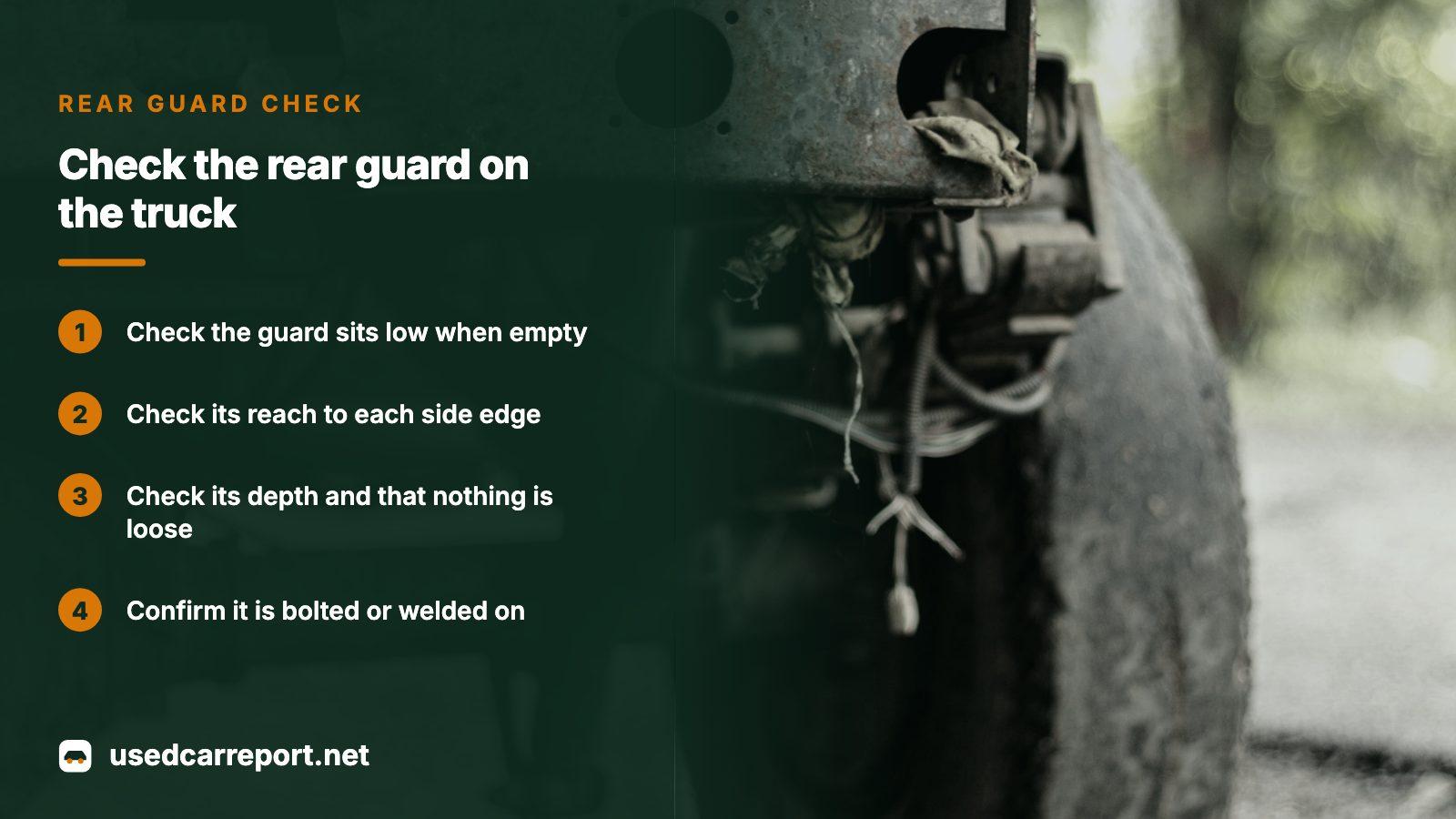
A rear impact guard is the horizontal bar at the back of the truck. Federal rules generally require one when the gap between the ground and the rearmost bottom edge of an empty truck, body or frame, whichever sticks out further, is over 30 inches.
- Height: the bottom of the guard no more than 30 inches off the ground when empty
- Reach: outer ends within 18 inches of each side edge of the truck
- Depth: no more than 24 inches in front of the rearmost point
- Mounting: bolted or welded on, with nothing loose
An inspector must fail a truck whose guard is missing, loose or outside those measurements. A guard that is bent, freshly welded or painted a different shade from the frame suggests the back end met something solid. Ask what, and ask for the invoice.
Frame, axle and weld repairs the inspection list treats as failures
The annual inspection list was written to reject unsafe trucks, which makes it a handy damage checklist. Take a flashlight and look for these first.
| Where to look | What fails an inspection |
|---|---|
| Frame rails | A member that is cracked, broken, loose or sagging |
| Body and engine mounts | Fasteners loose or missing from parts that should be bolted on |
| Spring hangers and U-bolts | Broken, cracked, loose or missing parts that let an axle shift |
| Front axle beam and steering parts | Any crack, or any obvious welded repair |
| Body beside the tires | Body or frame touching a tire or wheel part |
Fresh weld beads, odd bolts and an axle sitting off center in its wheel opening are the physical twin of an accident entry. If both agree, price the repair or leave. If the record is clean and the steel disagrees, believe the steel.
Two makers, one truck: judge the chassis and the box separately
Many box trucks are finished in stages: one company builds the cab and frame, another mounts the box. Under the federal rule for staged vehicles, the chassis maker labels the bare truck with its name, the month and year, the weight rating, the axle ratings and the VIN, and later makers add labels of their own. Each answers for its own work, so the labels show who stands behind what.
Photograph every label and compare its VIN with the title and your record. A repaired box can ride on a straight frame, and a clean box can sit on a frame that took a hit, so ask about each half.
The weight line that brings the annual inspection into play
Under 49 CFR 390.5, a truck used on a highway in interstate commerce counts as a commercial motor vehicle once either its rating or its real weight hits 10,001 pounds; the larger figure governs. Then 49 CFR 396.17 stops a carrier from using the truck unless every inspection component passed within 12 months and proof is aboard. The rule restricts use, not sale, so the problem arrives with the keys.
Proof can be the full report or a decal built from it. A decal should show:
- The inspection date
- Who holds the report, by name and address
- Something that identifies this truck, if it is not clearly marked on the vehicle
- A statement that the truck passed
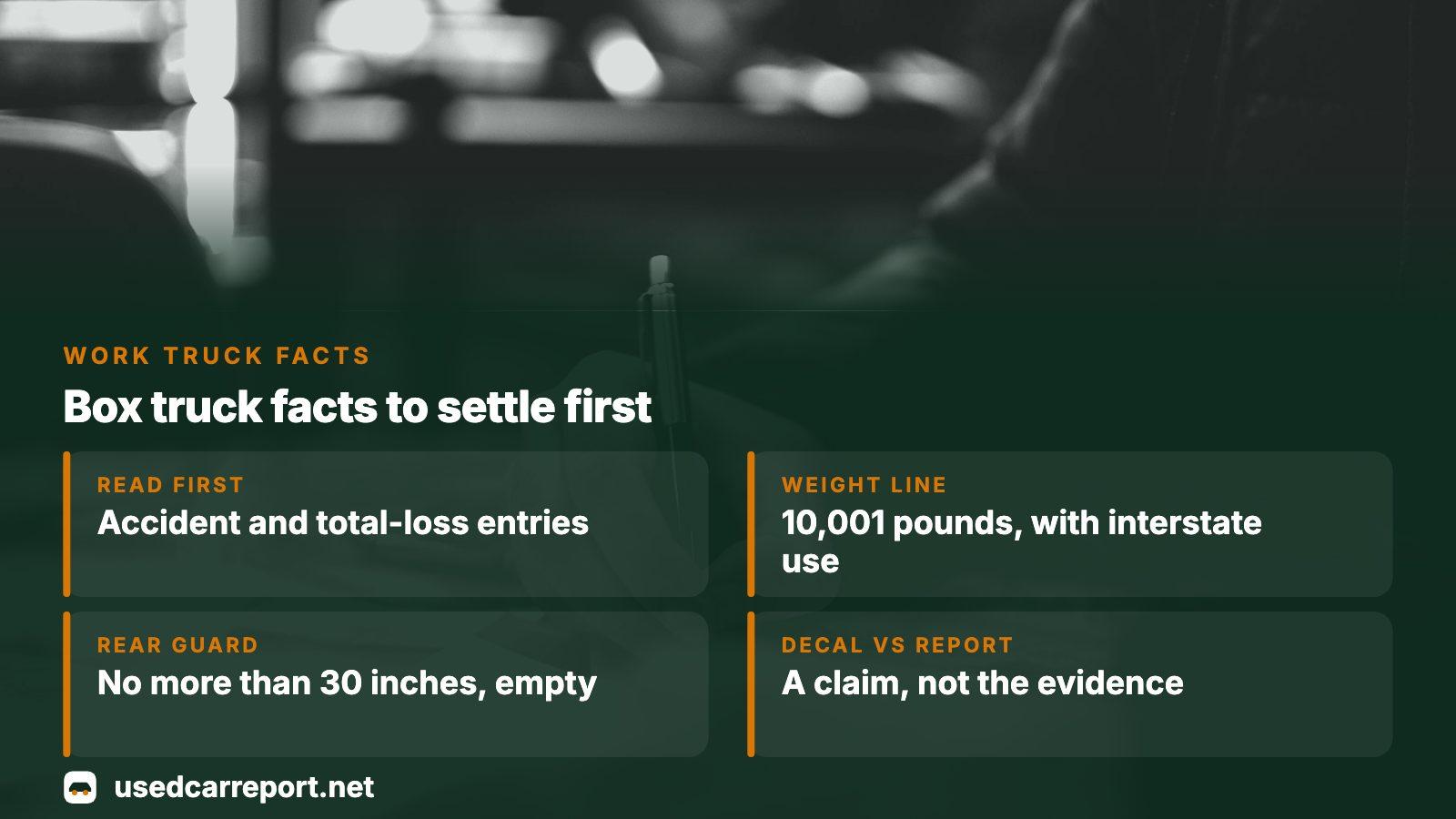
A decal is a claim; the inspection report is the evidence
A qualified inspector's report under 49 CFR 396.21 names the inspector, the carrier, the date, the vehicle and each component checked, including any that fell short. The carrier keeps it 14 months where the truck is housed or maintained, so ask early. Repeated flags on one part show where the next bill sits.
From an NHTSA owner complaint
A 2015 Isuzu NPR box truck owner told NHTSA the leasing dealer insisted on over $1000 of work, a tire among it, as the price of clearing federal inspection. When the truck came back, a sticker went on within five minutes, in the owner's telling, and a technician's drive afterward found a steering problem and a pull to the right.
A sticker shows a date someone filled in, not that anyone went over the frame and brakes. Ask for the report behind the decal and the earlier ones, and treat a truck with none as uninspected.
When to walk away, and the check to run first
- An accident or total-loss entry the seller cannot back with invoices
- Fresh welds on the frame, front axle beam or steering parts
- A rear guard that is missing, bent or outside the measurements above
- Labels that are missing, painted over or show a different VIN than the title
- No inspection report and no date for the last pass, on a truck past the weight line
UsedCarReport opens with a free preview of the accident and damage record for a VIN; the full report is one purchase and carries no subscription, and the pricing page has the choices. Preview each truck you are considering, buy the full report on those that pass a first look, then have a heavy-truck mechanic lift the finalist.
Where this information comes from
- 49 CFR 390.5: definitions — The 10,001 pound test and the interstate wording that make a truck a commercial motor vehicle
- 49 CFR 396.17: periodic inspection — The 12-month rule, what a decal must show and who may perform the inspection
- 49 CFR 396.21: inspection recordkeeping — What the inspector's report must name and how long the carrier keeps it
- Appendix A to part 396: minimum inspection standards — Frame, axle, steering and rear guard defects that fail an inspection
- 49 CFR 567.5: vehicles built in two or more stages — What each maker's label on a staged truck shows and who answers for what
- Bureau of Justice Assistance: NMVTIS for consumers — What the federal title database holds and where its coverage runs thin
- NHTSA owner complaint 11271094 — owner experience, paraphrased
Sources and photos: Facts checked against the sources above in November 2026. Photos by Ümit Yıldırım, Zoshua Colah and Owen Michael Grech on Unsplash; diagrams by UsedCarReport.
Keep reading
- Frame damage check: start with the accident and damage recordsHow frame damage shows up in records and what to ask when an entry mentions it
- VIN accident check: read the damage records before you buyWhat an accident entry on a VIN report does and does not tell you
- Pre-purchase inspection: read the damage records, then hire the mechanicWhy a mechanic's lift check belongs before you hand over payment
- Salvage title check: five steps, damage records firstWhat a salvage or total-loss entry means for a truck you are weighing
Frequently asked questions
Does a used box truck need a VIN history check if I only drive it locally?
Yes. The history describes what happened before you owned the truck. Whether the federal inspection rules apply to you turns on weight and interstate use, so get a definite answer for your own operation from your state's motor carrier office.
How can I tell if a used box truck was in a wreck?
Start with the VIN's accident, total-loss and auction-photo entries, then confirm on the truck: a bent or re-welded rear guard, fresh welds on frame rails or the front axle beam, a body touching a tire, or mismatched fasteners. A repaired truck should come with invoices, so ask.
What if the seller has no inspection decal?
The truck is not unusable, just not ready to work. A carrier can inspect its own vehicles, or use a commercial garage, a fleet lessor or a truck stop with qualified inspectors, and a passing state inspection that meets the federal minimums counts for 12 months. Price the inspection and likely repairs into your offer.
Does NHTSA's recall lookup work on box trucks?
NHTSA runs a no-cost recall lookup by VIN that covers trucks as well as cars. A box, liftgate or other body fitted by a second company may have its own notices, so ask that builder separately.
What should I ask the seller for besides the title?
Photos of the certification labels, the current inspection report and earlier ones, repair invoices for any accident entry, and the name of the company that built the box. Compare the VIN on each paper with the one on the truck.
Now check the car itself
The guide explains what to look for. The report shows what this VIN has on record.