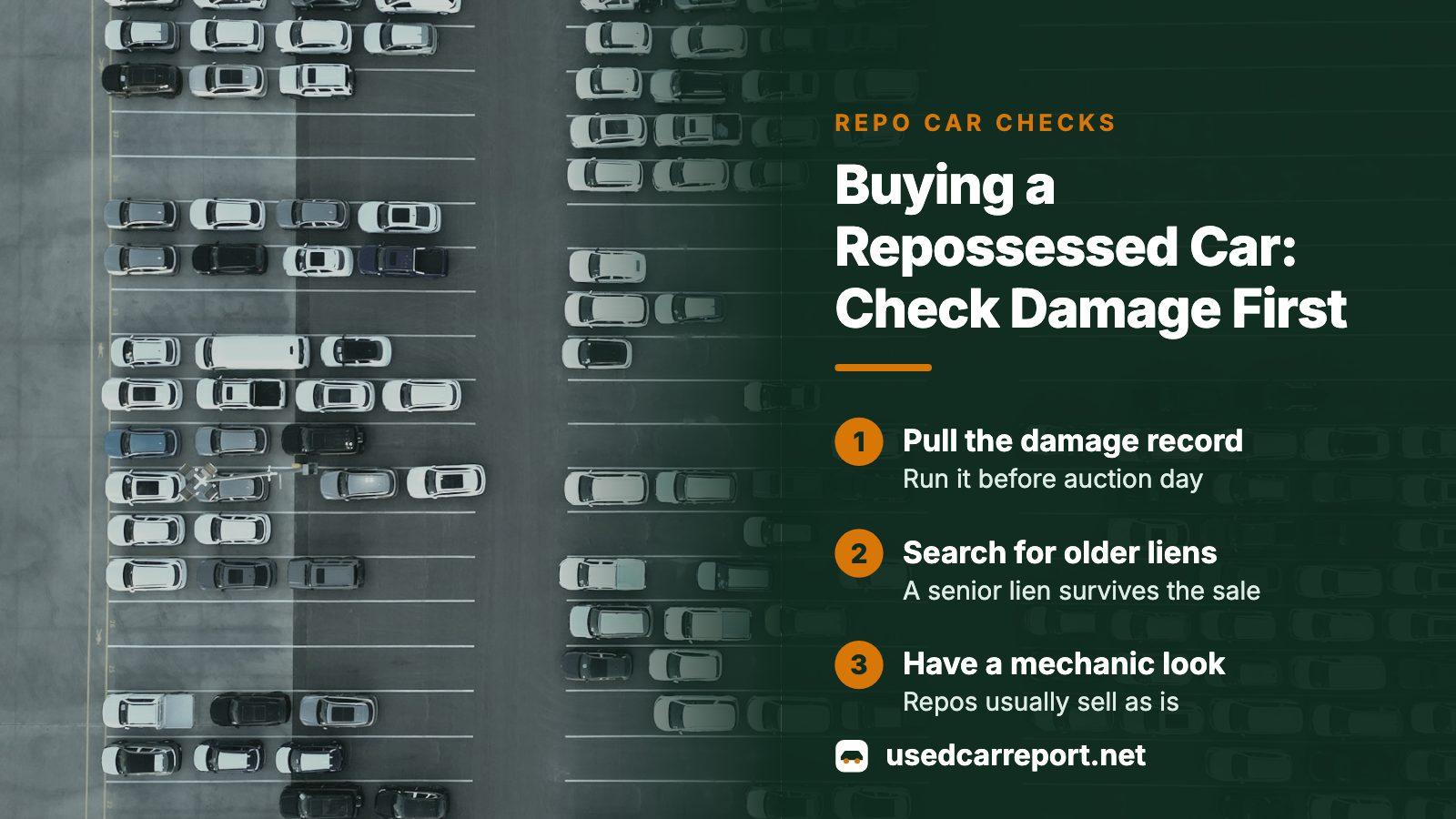
THE SHORT ANSWER
Buy a repossessed car only after three checks. The accident and damage record should show what the car went through before the lender took it, a lien search should show no older claim that outlives the sale, and a mechanic should inspect it, because lenders usually sell as is. The sale clears the loan it was made under and any junior lien. Flood history, frame repair or a brand nobody mentioned are reasons to walk.
- Read first
- Accident and damage record
- Cleared by the sale
- The foreclosing loan and any junior lien
- Not cleared
- A lien that ranks above that loan
- Preview
- Free; full report is one payment
A repossession is about the loan, not the car
A car is repossessed because the payments stopped. That fact says nothing about whether it was hit, flooded or written off, so a repo carries every unknown a used car does, plus a few of its own.
California's version of the commercial code lets a lender sell after default in the car's present condition, or after commercially reasonable preparation. Nothing in that section asks the seller to describe crash history. The sale rules are written with the borrower in mind, so they are not a promise to you about the car. Other states carry their own versions, so look up yours.
Run the damage record before the auction day
Ask for the VIN ahead of the viewing, or copy it from the listing, and run the preview before you travel. The full report is where the damage story sits, entry by entry:
| Record | What it says about a repo | What to do with it |
|---|---|---|
| Accident and damage entries | Whether the car was hit before the lender took it, and roughly where | Inspect those panels first and ask for repair paperwork |
| Auction and salvage photos | How the car looked at an earlier sale, before any repair | Hold the pictures up against the car on the lot |
| Title brand | Salvage, flood or junk status that a repossession does not erase | Price it as a branded car, not as a clean one |
| Odometer readings | Mileage that stalls, jumps or runs backward between records | Walk away if the figures do not line up |
| Liens and impounds | Claims against the car and any tow or storage history | Settle each one in writing before money moves |
NMVTIS, the federal title database, carries brand history, the newest odometer figure, and insurer salvage and total-loss calls. Its own consumer page warns that reporting is incomplete, so a clean result can still miss something. Compare it with the state title record.
A repo can be totaled and branded without any crash
A brand and a repossession can ride on one car, and neither proves an accident. The records let you ask the right question before you pay.
From an NHTSA owner complaint
An owner of a 2013 Honda Accord told NHTSA that the car had been repossessed from a previous owner whose damage to the cabin was bad enough to total it. After repair it carried a salvage title when the writer bought it, and the writer says it has "never been involved in any wreck". About eight years in, the steering began turning on its own at low speed. By this account, the Honda dealer said the steering recall did not apply to that VIN, tying it to the car's history, and asked roughly $4,600 for the repair.
This is a single owner's story, and the dealer has not been heard. Still, the lesson stands. The damage record and brand name what the car went through, and a recall search by VIN before purchase shows whether work is owed. Ask the maker in writing how a branded car is treated.
What the sale clears, and the lien it can leave
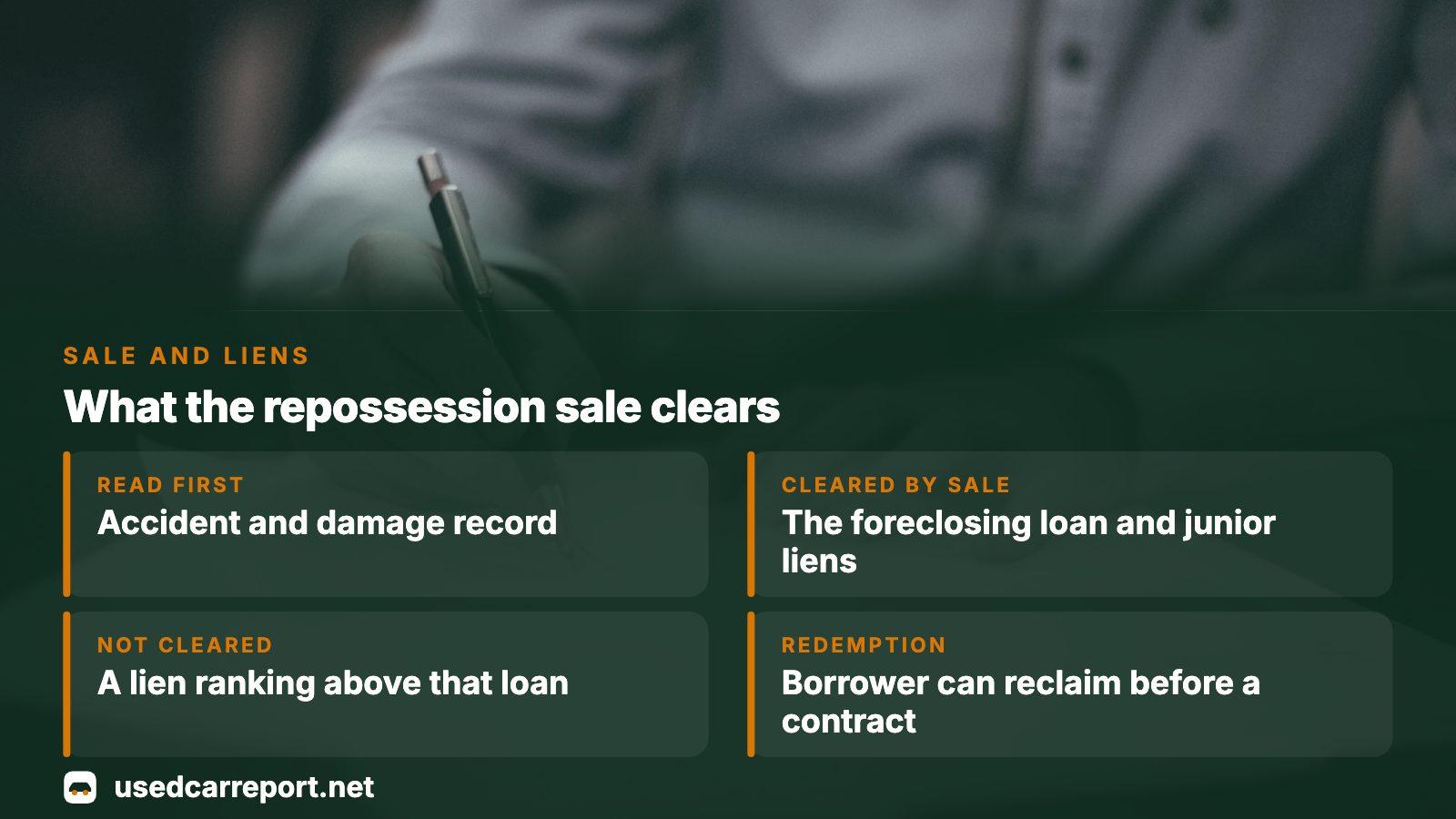
Under section 9617 of California's code, a lender's sale after default hands the buyer the borrower's rights, wipes out the loan the lender is selling the car to settle, and wipes out any lien ranked below it. A lien that ranked above that loan is not on the list.
A buyer acting in good faith keeps the car even if the lender broke the sale rules, and the borrower's complaint is with the lender. A buyer who does not take free gets the car still bound by the borrower's rights, the foreclosing loan and every other lien. Before you bid, get these on paper:
- Which loan the sale is made under, and who holds it.
- A lien search on the VIN, so an older claim shows up before you pay.
- Whether the sale paperwork disclaims title. Section 9610 lets a lender state that there is no warranty relating to title, which can leave you without recourse if a lien surfaces.
The borrower can reclaim the car until a sale contract exists
Under section 9623, the borrower, a co-signer or another lienholder may redeem the car by paying off what the loan secures and covering the lender's reasonable costs and fees. That right ends once the lender has disposed of the car, signed a contract to dispose of it or accepted it in satisfaction of the debt.
In practice, a winning bid may not close the door on the borrower. Ask the seller when the sale contract is signed, and hold off on transport, insurance and other non-refundable spending until it is.
Condition, recalls and the as-is risk
A lender selling in present condition is not vouching that the car runs. One taken over missed payments may have gone unserviced or stood outside for months, and the sale will not mention it. A history report is good at accidents and flood damage, yet it rarely covers worn brakes or a tired transmission, so it works beside an inspection, not instead of one.
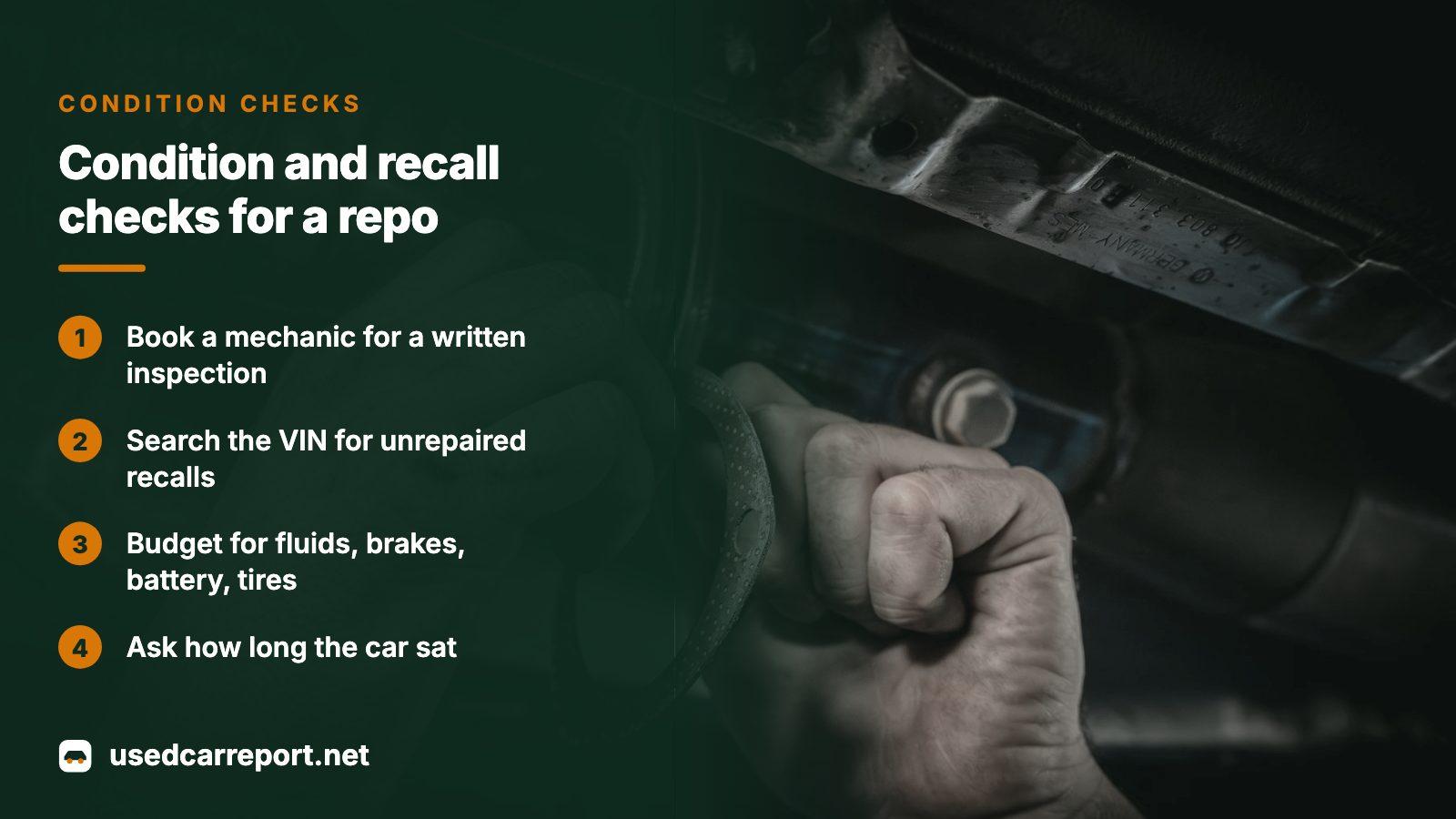
- Book an independent mechanic for a written inspection that lists repair costs. The FTC suggests buying elsewhere if a seller refuses.
- Search the VIN on NHTSA's recall page. It lists unrepaired recalls only, skips ones already fixed, and leaves out recalls more than 15 years old.
- Budget for fluids, brakes, a battery and tires as a starting point, not a surprise.
- Ask how long the car sat, and whether anyone started it recently.
Who is selling changes what you can ask for
| Seller | What tends to hold | Extra step |
|---|---|---|
| Lender or credit union | Holds the paperwork, and the car is often still titled to the lender | Ask which loan the sale falls under |
| Public auction | Short viewing time and as-is terms | Run the VIN before you arrive |
| Dealer with repo stock | Must post an FTC Buyers Guide showing as is or warranty | Get every promise written on the guide |
| Government or fleet disposal | Often a seizure or fleet sale, so the rules above may not apply | Read the sale terms in full |
Walk-away signs, and the next step
- A salvage, flood or odometer brand the listing never mentioned.
- Accident entries the seller cannot match to repair invoices.
- A lien the seller cannot name or document.
- No chance to start the engine or have a mechanic look at it.
- Pressure to pay before you have run the VIN.
If the car passes those, run the VIN preview now, which costs nothing. Should the car stay on your list, one payment buys the full report, nothing recurs, and the figures sit on the pricing page.
Where this information comes from
- California Commercial Code 9617: rights of a transferee — What a sale after default clears, and how good faith protects the buyer
- California Commercial Code 9610: disposition of collateral — Sale in present condition, and how a lender can disclaim title warranties
- California Commercial Code 9623: right to redeem — Who can redeem the car, and the moment that right ends
- NMVTIS: information for consumers — What the federal title system shows and where it falls short
- NHTSA: check for recalls — What a VIN recall search covers and what it leaves out
- FTC: buying a used car from a dealer — Buyers Guide, as-is sales and the case for an independent inspection
- NHTSA owner complaint 11696837 — owner experience, paraphrased
Sources and photos: Facts checked against the sources above in November 2026. Photos by Iain, Martin Fennema and Scott Graham on Unsplash; diagrams by UsedCarReport.
Keep reading
- Salvage title check: five steps, damage records firstA repossessed car can carry a salvage brand, and this page shows how to read it.
- VIN accident check: read the damage records before you buyStep through the accident entries before you go to see the car.
- Pre-purchase inspection: read the damage records, then hire the mechanicWhere a mechanic should focus on a car that sat unused.
- Buying a car with an open recall: read the damage record firstHow to handle recall work, which matters on a car with a murky history.
Frequently asked questions
Is the loan wiped out when you buy a repo?
The sale settles the loan it was run to repay, along with any lien ranked below that loan. A lien ranked above it is not among the things the statute discharges, so it can follow the car to you. Run a lien search on the VIN rather than trusting the seller's word.
Could the borrower get a repo back after I buy it?
Only before the lender signs a contract to sell, and only by paying off the debt and the lender's costs. After that, a buyer acting in good faith keeps the car even if the lender broke the sale rules. The borrower's complaint then runs against the lender.
Are repossessed cars sold as is?
Usually. A lender may sell in present condition and can disclaim title warranties in the sale record. A dealer must still post a Buyers Guide showing as is or a warranty. Treat any lender sale as as-is and pay for an inspection.
How do I check a repossessed car for damage before bidding?
Start with the VIN preview, then read accident entries, auction photos and the title brand in the full report. Cross-check the federal title record and the state's own record, then compare any photos with the car itself. A mechanic's written inspection covers what records cannot.
Can I check a repossessed car for recalls before I bid?
Yes. NHTSA's recall search by VIN shows unrepaired recalls. It does not show repairs already done, some newly announced recalls, or recalls more than 15 years old. If the car has a branded title, ask the maker how recall work is handled.
Now check the car itself
The guide explains what to look for. The report shows what this VIN has on record.