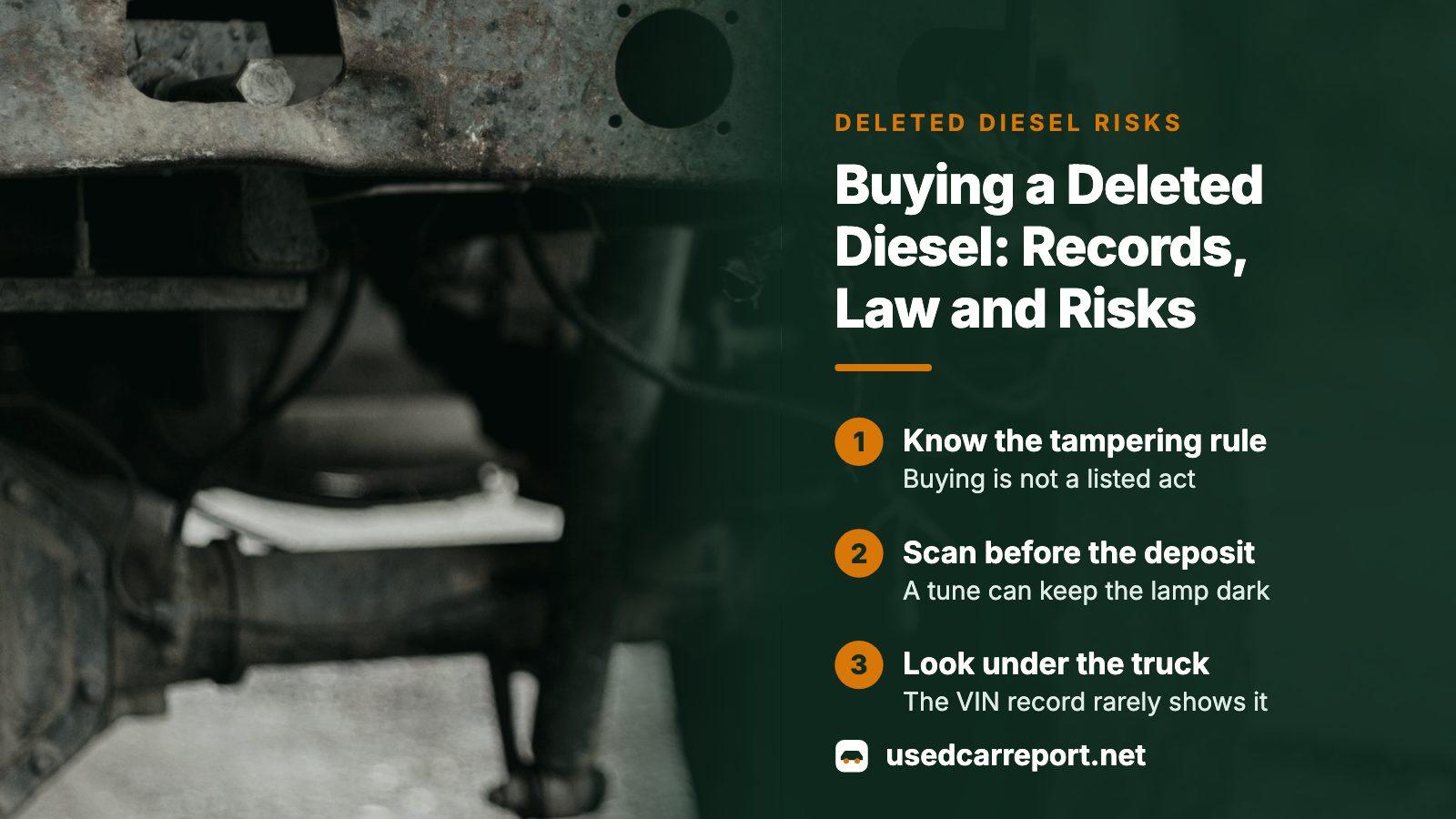
THE SHORT ANSWER
Federal law does not name buying a deleted diesel as a violation. It does bar anyone from removing or disabling emissions controls, and bars selling or fitting parts that defeat them. State rules on registering, testing and selling such a truck differ. No history report is built to record a delete, since the change happens after the truck is built. Read the damage, title and odometer records first, then scan the truck yourself.
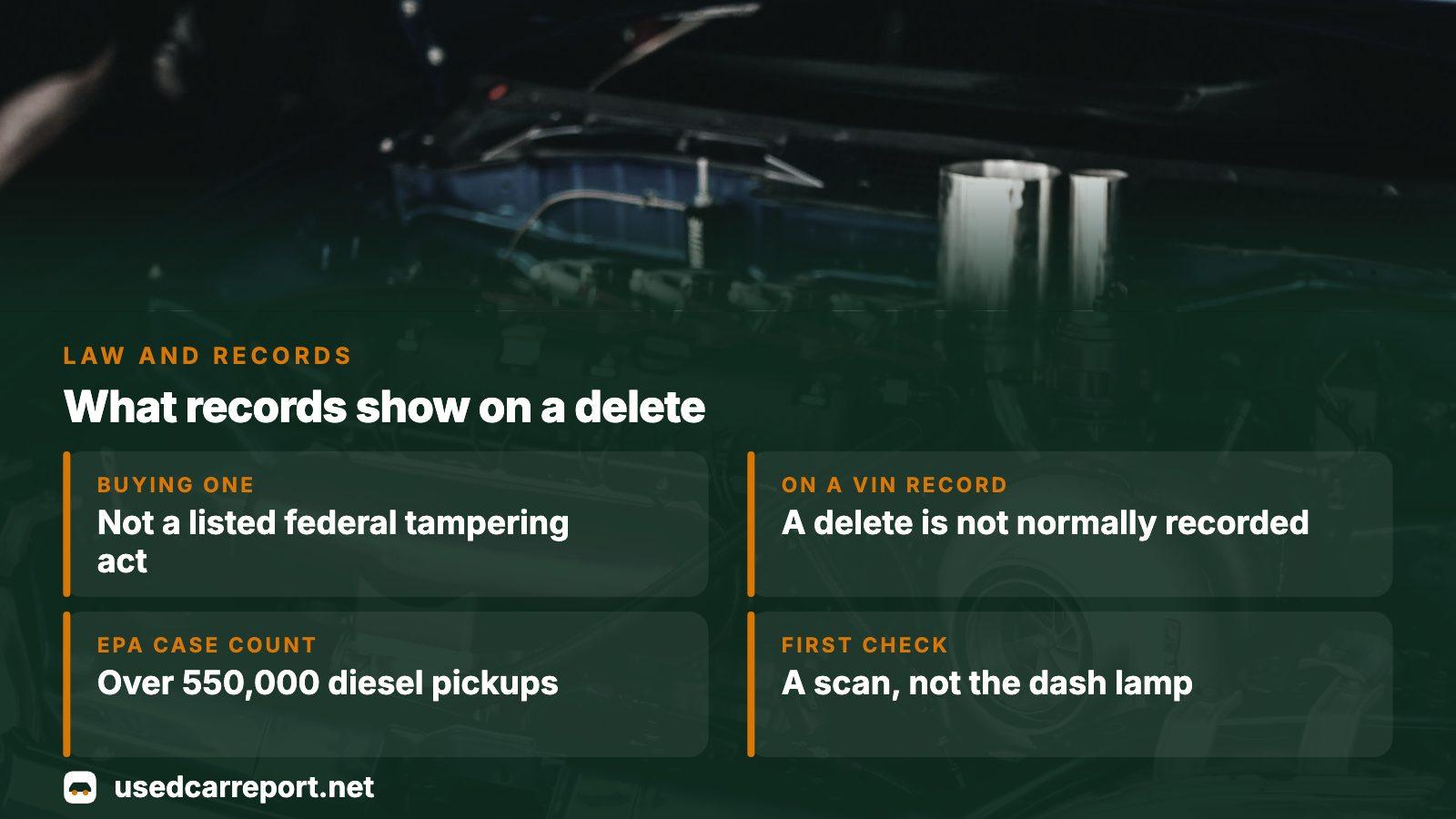
- Buying one
- Not a listed act under the federal tampering rule
- A delete on a VIN record
- Not normally recorded, so not listed
- EPA's own case count
- Over 550,000 diesel pickups lost their controls in about a decade
- First check
- A scan, since a delete tune can keep the dash lamp dark
What a delete changes, and why it hides so well
A delete strips or disables the exhaust-cleaning hardware on a modern diesel and nearly always adds new software. EPA's review of tampered diesel pickups describes a tune that reprograms the engine and overrides the onboard diagnostics, so the dash stays dark and the scanner finds no stored faults, even when the exhaust treatment is partly or fully gone.
That is why a walkaround proves little. EPA testing found that a tuner alone can triple nitrogen oxide output with the filters and catalysts still fitted. A truck can look stock and still be deleted in software. EPA names three motives: dodging upkeep costs, chasing economy or power, and customizing.
Is buying a deleted diesel against federal law?
The prohibited acts sit in 42 U.S.C. 7522(a)(3). One bars removing or disabling emissions equipment: flatly before the first retail sale, and only when done knowingly afterward. The other bars making, selling or fitting a part that has defeating that equipment as a principal effect. Purchasing a truck someone else deleted is on neither list.
| Act | Federal position |
|---|---|
| Buying a truck already deleted | Not among the listed prohibited acts |
| Removing or disabling the controls | Prohibited for any person, knowingly once the truck is sold |
| Making, selling or fitting a defeat part | Prohibited separately, counted per part |
| Driving, registering or reselling the truck | Depends on state law and local test rules |
Each vehicle and each part counts as its own offense. The statute's ceilings are $25,000 for a manufacturer or dealer that tampers and $2,500 for any other person who tampers or deals in defeat parts, and EPA adjusts them for inflation, so current maximums run higher. EPA says federal enforcement generally focuses on makers and suppliers of defeat parts, while many states ban tampering, driving a tampered truck, or selling one.
What the VIN records can and cannot tell you
A delete is made after the truck leaves the factory, and title offices, insurers and auction houses do not normally record it, so a history report will not say deleted. The records cover everything else that can go wrong with a hard-worked diesel, and those problems weigh more on a truck that may be hard to resell.
- Accident and damage entries, with salvage or auction photos: crash repairs on a heavy truck stack on top of the cost of reversing a delete.
- Title brands: a salvage or rebuilt brand on a deleted truck gives the next buyer two reasons to walk.
- Odometer readings: diesels pile up miles, so look for readings that climb steadily.
- Ownership and use type: time as a fleet or commercial truck is a reason to ask for the service file.
- Open recalls: the owner story below shows what happens when nobody looks.
When the delete is disclosed and the rest is not
From an NHTSA owner complaint
An owner of a 2014 Ram 3500 told NHTSA in 2023 that the truck was sold with paperwork, handed over on purchase day, saying its emissions equipment had been deleted. The owner then listed trouble unrelated to the delete: 27 open recalls by their count, a steering component that kept loosening and wipers that shorted out. They wrote that they were "never told this vehicle was unsafe" and that neither the maker nor a dealer would take responsibility. No outcome is given.
A seller who documents the delete has told you one fact, and it says nothing about steering, wipers or recalls. NHTSA returns open recalls by VIN at no charge.
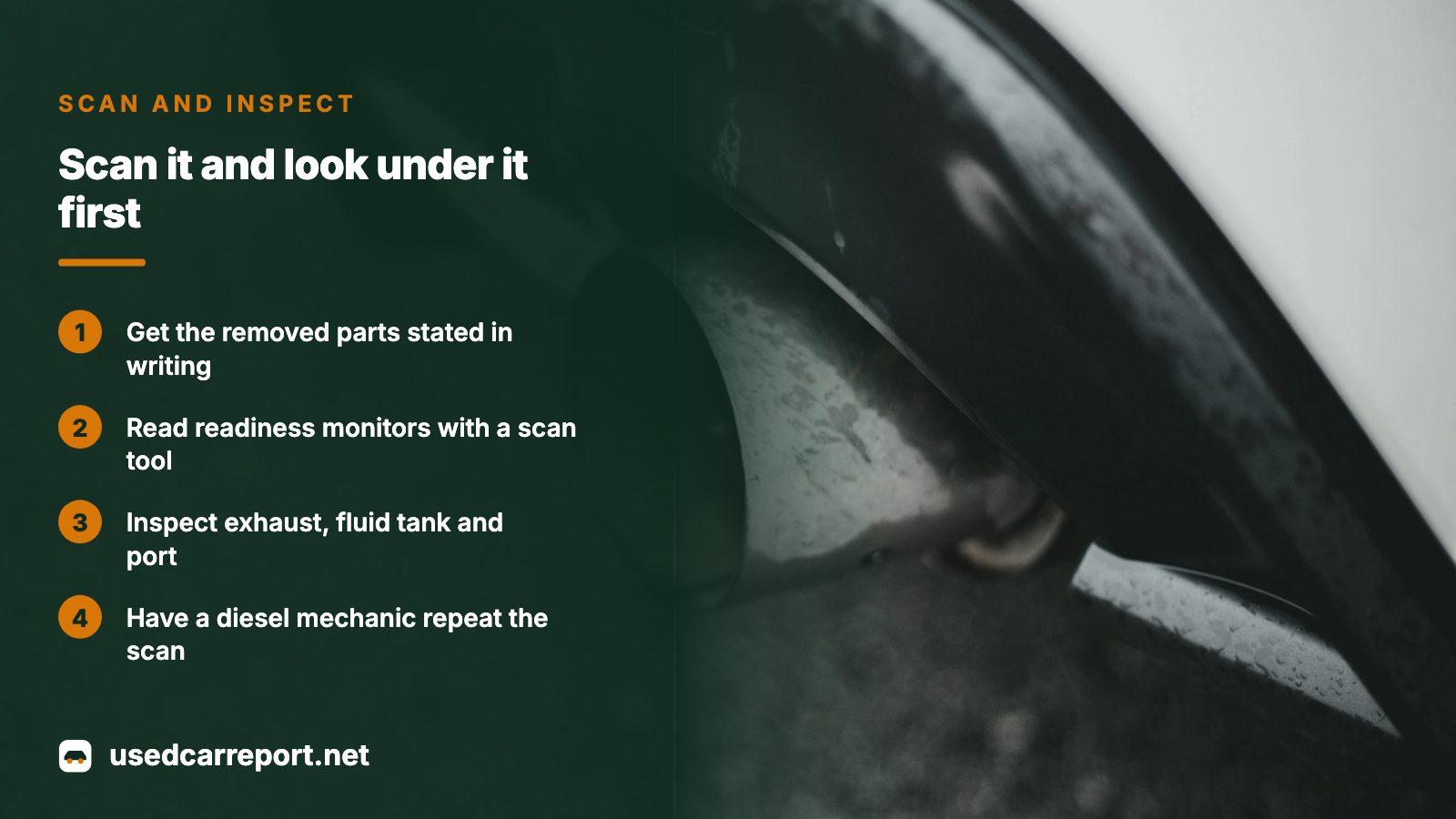
Scan it and look under it before a deposit
- Ask the seller to state in writing what was removed or disabled, which tune runs the engine, and whether the removed parts and original software come with the truck.
- Plug in a scan tool and read the readiness monitors yourself. A dark dash lamp is no evidence, because a delete tune is built to keep it dark.
- Look along the exhaust, at the diesel exhaust fluid tank and filler, and around the exhaust recirculation plumbing for plates, straight sections or missing pieces.
- Check the diagnostic port. A missing or altered connector is itself a failure under the federal inspection rule.
- Have a mechanic who knows that engine repeat the scan and road-test the truck under load.
Step one costs nothing. The last three are what a pre-purchase inspection exists for.
How an emissions test treats a deleted truck
Where a state runs an inspection program, the federal rule behind it, 40 CFR 51.357, is blunt. A 1996 or newer vehicle is rejected from testing when its diagnostic scan shows a not-ready code, though a state may reject 1996 through 2000 models only at three or more codes and 2001 and newer at two or more. The visual check fails any original device found missing, modified or disconnected.
Check the weight class
That rule's diagnostic inspection provision names light-duty vehicles and light-duty trucks, while EPA's tampered-pickup review puts Class 2b and 3 pickups between 8,500 and 14,000 pounds gross weight. How a state treats that class is its own call, so ask the registering agency about this exact truck.
Why trucks get deleted: the advice owners are given
From an NHTSA owner complaint
An owner of a 2011 Ram 2500 6.7 diesel, bought from relatives a year earlier, wrote to NHTSA in 2019 about two repair bills on just over 80,000 miles: about $1,500 for an oxygen sensor job and an estimated $5,000 for a turbocharger whose variable flaps misbehaved. Every mechanic consulted, the dealer included, called deleting the EGR and emissions parts the only true fix. The owner called that illegal, took the sensor work to the dealer instead, and saw the turbocharger warning return within minutes of driving off. No outcome is given.
A truck deleted after bills like these carries both histories. Ask which parts failed and what the shop said, then price it as one that may still need work.
Pricing the way back before you agree on a number
Federal law leaves a legal route home. Under 7522, work done to repair or replace an emissions device is not a prohibited act as long as the device ends up working properly.
Put numbers on that route before you bid. Ask a dealer or diesel shop for a written parts quote against the VIN, covering the exhaust treatment hardware, the sensors and a return to the original engine calibration. Subtract the total from the asking price, and weigh the narrower field of buyers at resale in states that restrict tampered trucks.
Run the VIN before you make the drive
UsedCarReport opens with a free preview of what is on file for a VIN, damage and accident entries first, then title brands and odometer readings. The full report is one payment, no subscription. It does not show a delete, and reports like it are not built to. What it settles is whether a truck earns a scan: a salvage brand or an odometer jump ends the search early. Run it on every deleted truck you consider, before the drive.
Where this information comes from
- U.S. Code: 42 U.S.C. 7522, prohibited acts — the tampering and defeat-part prohibitions, plus the repair exemption
- U.S. Code: 42 U.S.C. 7524, civil penalties — statutory ceilings and the per-vehicle, per-part counting
- eCFR: 40 CFR 51.357, inspection test procedures — rejection for not-ready codes and the visual device check
- EPA: Tampered diesel pickup trucks, aggregated evidence — what delete tunes do, EPA's case count, state laws, motives
- NHTSA owner complaint 11553257 — owner experience, paraphrased
- NHTSA owner complaint 11195487 — owner experience, paraphrased
Sources and photos: Facts checked against the sources above in November 2026. Photos by Zoshua Colah, Erik Mclean and Willian Cittadin on Unsplash; diagrams by UsedCarReport.
Keep reading
- Pre-purchase inspection: read the damage records, then hire the mechanicHire the mechanic who can scan the truck, after you have read the damage records.
- Buying a car with an open recall: read the damage record firstHow open recalls work for a used buyer, and what a clean lookup leaves out.
- Frame damage check: start with the accident and damage recordsHeavy trucks hide crash repairs, so read the damage entries and auction photos.
- Check mileage history by VIN: six steps, damage records firstHigh-mileage diesels need odometer readings that line up with the damage dates.
Frequently asked questions
Is it legal to buy a deleted diesel?
Federal law does not list buying one as a prohibited act. It lists removing or disabling the controls, and making, selling or fitting parts that defeat them. State law is separate, and many states restrict operating or selling a tampered truck, so ask the registering agency first.
Will a vehicle history report show a delete?
No. A delete is made after the truck is built, and title offices, insurers and auctions do not normally record it. A report still helps: accident and damage entries, title brands and odometer readings show whether the truck has other problems. A scan tool and an inspection establish the delete.
Can a deleted diesel pass an emissions test?
Where a state tests it, usually not. A not-ready scan result gets a 1996 or newer vehicle rejected, and a missing or modified original device fails the visual check. States decide how heavy pickups are handled, so the answer depends on the registration address.
Can the owner of a deleted truck be penalized?
Federally, removal is prohibited for any person, and after the first sale it applies to those acting knowingly, so whoever ordered the work carries that exposure. Buying the finished truck is not listed. EPA says enforcement generally targets makers and suppliers of defeat parts; many states prohibit operating a tampered truck.
How common are deleted diesel pickups?
EPA says it has no national prevalence estimate. Its investigated cases alone point to over 550,000 diesel pickups stripped of controls across about a decade, equal to roughly 15 percent of the diesel trucks first certified with controls. Any used diesel pickup deserves a scan.
Now check the car itself
The guide explains what to look for. The report shows what this VIN has on record.