THE SHORT ANSWER
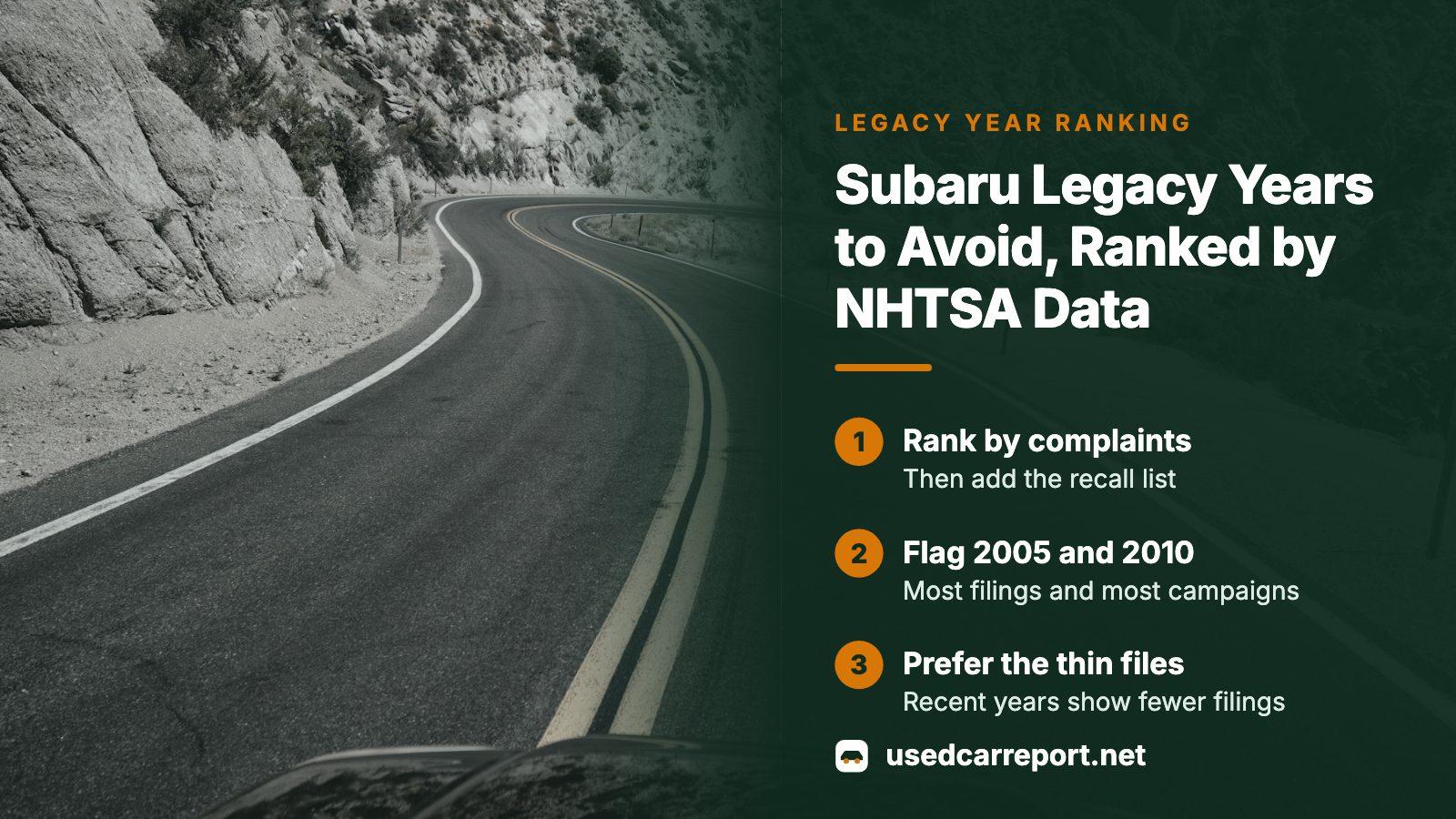
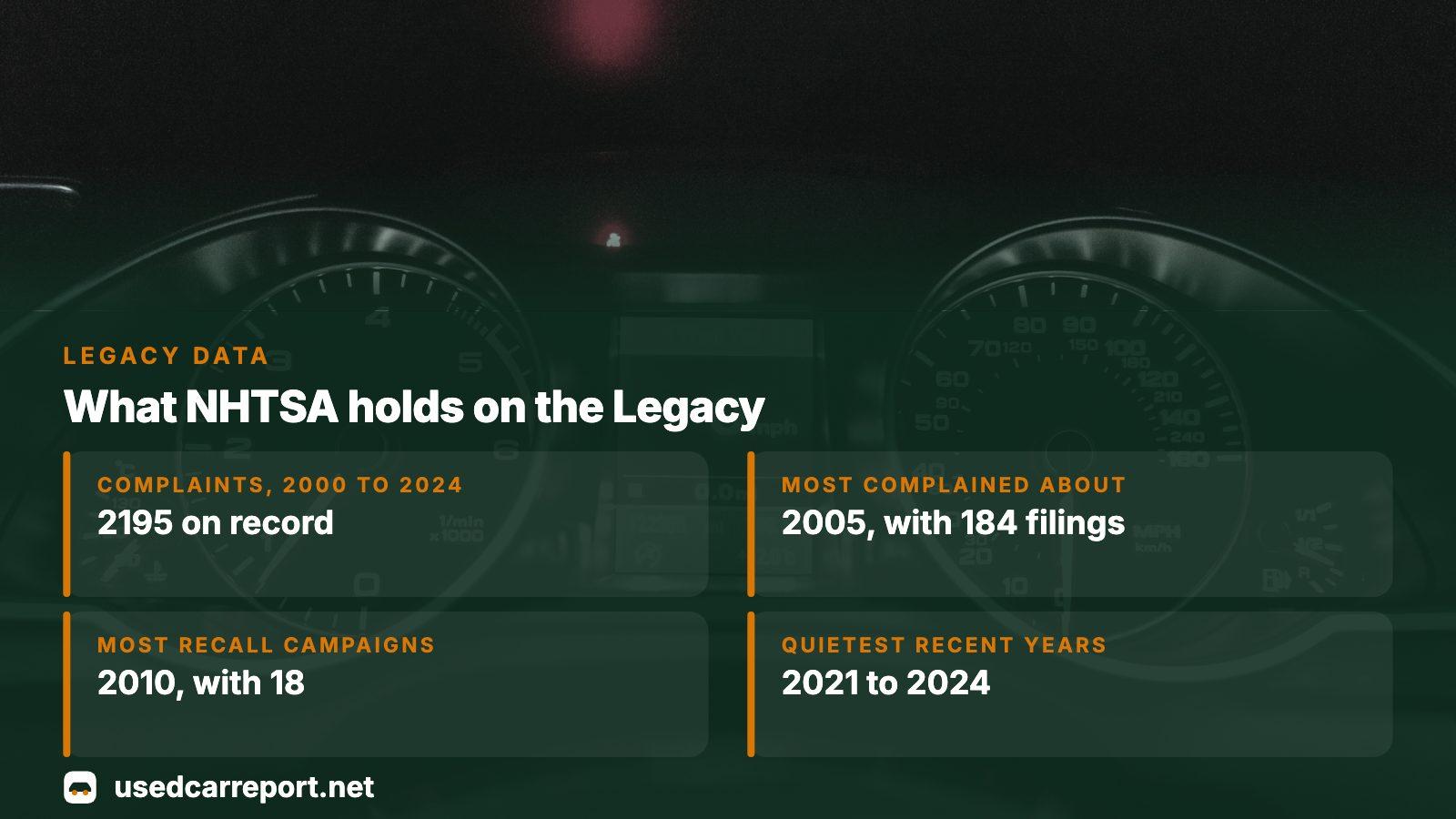
NHTSA holds 2195 owner complaints on the 2000 to 2024 Legacy. The 2005 model leads with 184, then 2011 with 167, 2015 with 160, 2010 with 151 and 2016 with 147. The 2010 also carries 18 recall campaigns, the most of any year. Treat those five years as the ones to inspect hardest, and read the car's accident and damage record before you negotiate.
- Complaints, 2000 to 2024
- 2195 on NHTSA's Legacy record
- Most complained about
- 2005, with 184 filings
- Most recall campaigns
- 2010, with 18
- Quietest recent years
- 2021 to 2024, between 10 and 34 complaints each
How these years were ranked
Opinions about the worst Legacy year tend to repeat each other, so this page counts instead. The numbers here come from NHTSA's records, queried for every model year from 2000 to 2024 on November 7, 2026. Complaints are filed by owners and are not proven defects, and a recall campaign shared with the Outback is listed under both cars. Even so, the same years rise to the top whichever way you cut the numbers.
Recent cars have had few years to gather filings, so a thin file for 2022 or 2023 says nothing about wear that comes with age. Read the table below as a ranking of reported trouble, not a guarantee of any single car's future.
Complaints and recalls, year by year
| Year | Owner complaints | Recall campaigns |
|---|---|---|
| 2003 | 62 | 15 |
| 2005 | 184 | 9 |
| 2010 | 151 | 18 |
| 2011 | 167 | 16 |
| 2012 | 90 | 16 |
| 2015 | 160 | 3 |
| 2016 | 147 | 3 |
| 2020 | 121 | 6 |
| 2023 | 10 | 2 |
Complaints and recalls do not move in lockstep. The 2010 and 2011 cars score high on both, while the 2015 and 2016 cars draw many complaints with few formal recalls.
2010 and 2011: stalling and a long recall list
These two years add up to 318 complaints, and power train is the biggest category in each, at 50 and 47. In the filings I read, owners describe a car that shudders and cuts out on a hard stop, with a failed torque converter given as the cause. The recall paperwork is just as busy: a cracked transmission cooler hose on early 2010 builds, a steering column connector that can break, a moonroof glass that may detach on the 2011, and a run of passenger airbag inflator campaigns.
From an NHTSA owner complaint
An owner of a used 2010 Legacy wrote in late 2021 that the car shakes and stalls when stopping fast and has to be shifted to park to restart. They were nearly hit on a busy highway. The as-is dealer that sold it refused to help, and the loan was still being paid.
What a buyer should take from this is the sale terms. An as-is sale leaves a stalling transmission with you, so test a hard stop on the road and ask for service records before signing.
2005: the most complaints of any year
The 2005 Legacy tops the list with 184 complaints, and the spread is wide: brakes lead with 31, then engine and cooling with 29, electrical with 25 and airbags with 21. NHTSA flags 11 of those filings as crashes and 4 as fires, though none involved a death. It has nine recall campaigns on file, so an open-recall search on the VIN is worth running.
At this age the bigger risk is an unknown past. A car that has changed hands several times can hide a branded title or an accident that was repaired cheaply, and brake or airbag complaints on a damaged car deserve extra suspicion.
2015 to 2020: electrical faults and glass
Six model years from 2015 to 2020 hold 787 complaints between them. Electrical faults dominate the 2015, 2016 and 2018 cars, with 51 filings on the 2016 alone, while visibility and wiper issues lead on the 2019 and 2020, at 49 and 57. Recalls are lighter here, only three a year until the 2020 reaches six, among them brake pedal mounting, fuel pump and automatic transmission programming.
- Test every warning light and driver-assist message on a long drive, not just the lot loop.
- Check the windshield for cracks and ask if the cameras behind it were recalibrated after a replacement.
- Ask whether the transmission programming and fuel pump campaigns were completed on a 2020.
The years with the thinnest complaint files
The 2007 Legacy shows only 33 complaints, the lowest of any model year before 2021, and the 2004, 2014, 2013 and 2008 cars each sit between 49 and 66. From 2021 on, counts fall to between 10 and 34 a year, with the 2024 at 17 and no recall campaigns at all.
A quiet record is a reason to start your search there, not to skip checks. Any Legacy this old can have been in a crash, and a short complaint list is silent on whether that happened.
Why this car's own history beats its model year
A UsedCarReport history report puts the accident and damage record up front, so you see whether a Legacy has been crashed before you worry about its transmission. Add the title brand, mileage readings and any total-loss or salvage entry, and a clean 2007 can look better than a repaired 2012.
From an NHTSA owner complaint
A buyer who bought a used 2010 Legacy from a private owner at about 114,852 miles reported the car stalling when braking hard, traced to the torque converter. The buyer felt a recall should exist. A seller's word about a stalling problem is thin protection, and the history record is where the earlier trouble would show.
Start with the VIN preview, which is free. The full report is one payment, and the choices are laid out on the pricing page.
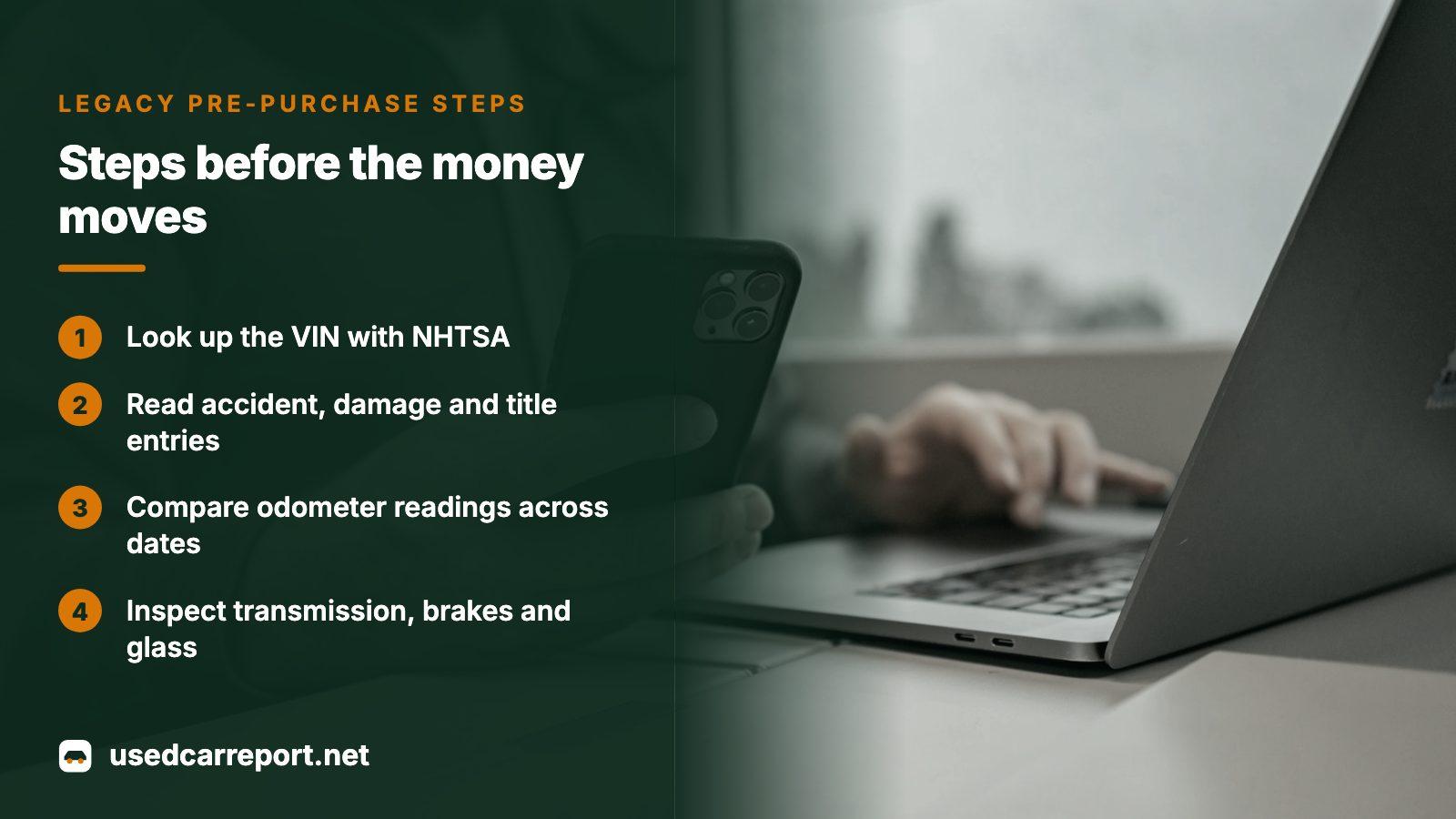
Six steps before the money moves
- Look the VIN up with NHTSA and write down any open campaign.
- Read the accident, damage and title entries on the history report.
- Compare odometer readings across dates for jumps or rollbacks.
- Drive a hard stop and a long highway stretch with the electronics on.
- Have an independent mechanic inspect the transmission, brakes and glass.
- Use anything you find to push the price down or walk away.
A flagged year is not a verdict. It is a prompt to inspect harder, and a good history lets you pay a fair price for a well-kept car.
Where this information comes from
- NHTSA: recalls by VIN — Where a specific car is checked for open safety campaigns.
- NHTSA: 2010 Subaru Legacy — Public record of complaints and recalls used for the 2010 and 2011 details.
- NHTSA: 2015 Subaru Legacy — Public record behind the 2015 and 2016 electrical counts.
- NHTSA owner complaint 11388138 — owner experience, paraphrased
- NHTSA owner complaint 11439992 — owner experience, paraphrased
- NMVTIS: understanding a vehicle history report — Federal explanation of title, brand, odometer and salvage indicators.
Sources and photos: Facts checked against the sources above in November 2026. Photos by Will Truettner, Anastasiia Nelen and Ambitious Studio* | Rick Barrett on Unsplash; diagrams by UsedCarReport.
Keep reading
- Subaru Outback years to avoid, and the damage record to read firstThe Legacy's wagon sibling, with its own complaint ranking.
- Subaru Impreza years to avoid, and what to check on the car itselfAnother Subaru sedan checked year by year.
- VIN accident check: read the damage records before you buyHow crash and repair entries describe a single car.
- Buying a car with an open recall: read the damage record firstWhat to do when the VIN search shows an unfixed campaign.
Frequently asked questions
Which Legacy year is the worst?
By raw complaints the 2005 leads with 184, but 2010 and 2011 are the stronger warning because they pair 151 and 167 complaints with 18 and 16 recall campaigns and many transmission stalling reports. Most complaints on the 2015 and 2016 are electrical instead.
Are newer Subaru Legacy years safe to buy?
The 2021 to 2024 cars show between 10 and 34 complaints each, and the 2024 has no recalls. That is encouraging, but those cars are young, so the record is short. Check the VIN for open recalls and any accident history regardless.
Do owner complaints prove a car is defective?
No. They are reports filed by owners, and NHTSA does not verify each one. Many complaints on one model year form a pattern worth inspecting for, but only recall campaigns mean the maker or regulator confirmed a defect.
How do I check a Legacy for open recalls?
Type the VIN into NHTSA's recall search. It returns unfinished safety campaigns for that exact car, and the dealer performs the repair at no charge. Run it before buying and again after, since new campaigns appear over time.
Is a cheap Legacy from a flagged year worth it?
Only with proof. Ask for service records, test a hard stop, and read the title and damage record. If the car is clean and the price reflects the risk, a flagged year can still be a fair purchase.
Now check the car itself
The guide explains what to look for. The report shows what this VIN has on record.