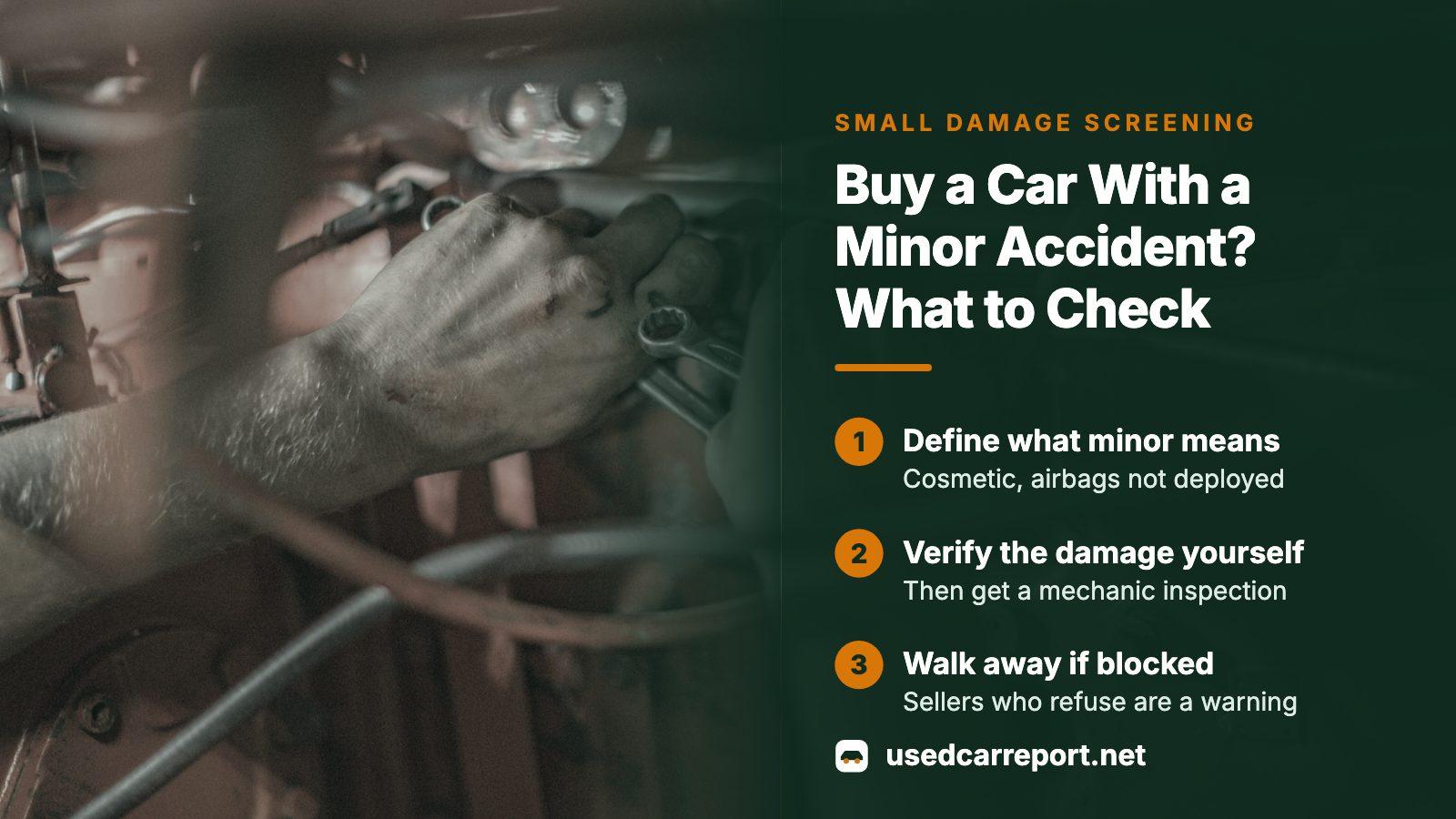
THE SHORT ANSWER
Yes, you can buy a car with a minor accident, provided the entry points to cosmetic damage, the airbags stayed closed, the repair is documented and an independent mechanic finds nothing structural. Ask for a lower price, since the car carries a history, and walk away if the seller dodges questions or refuses an inspection.
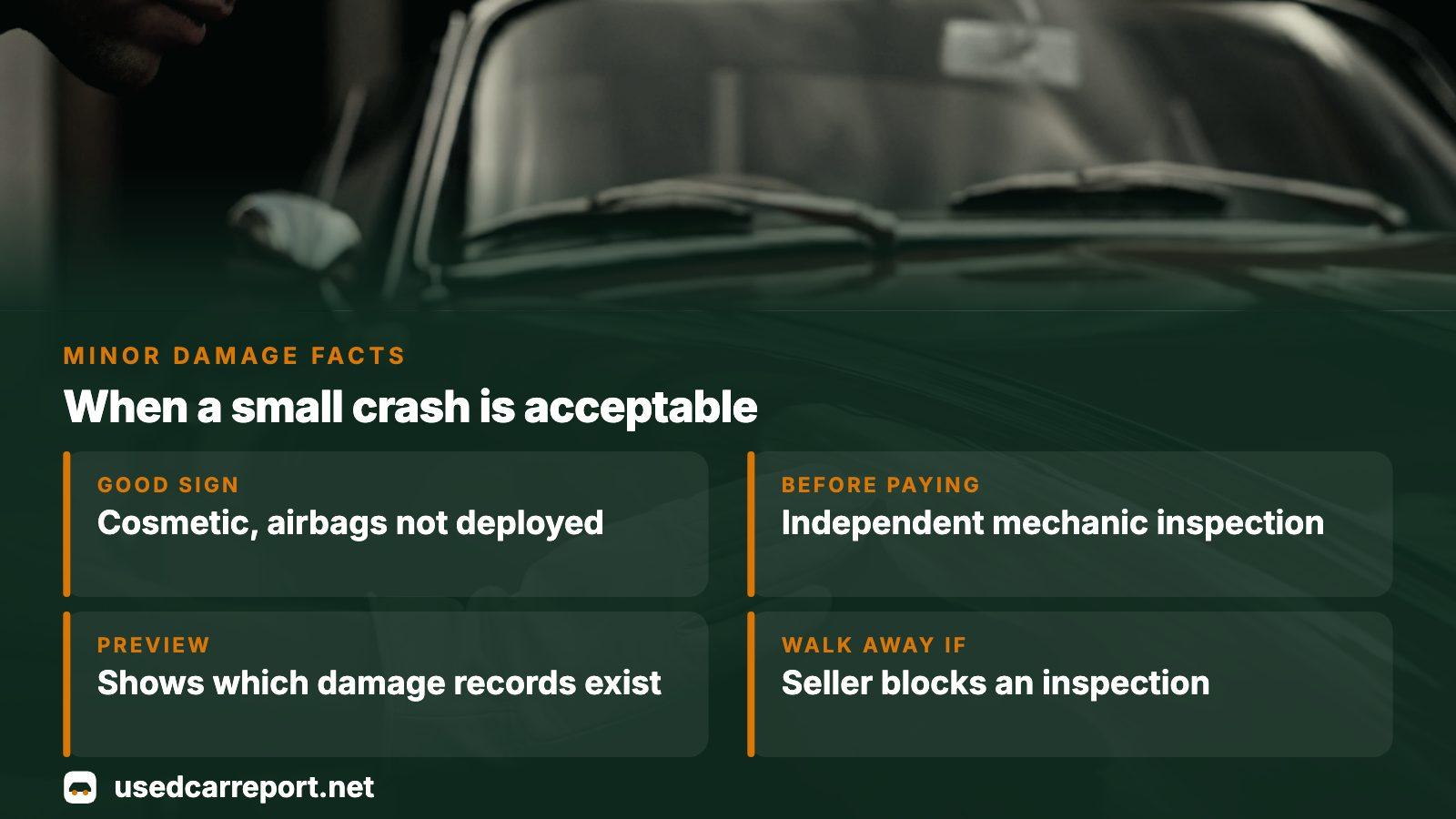
- Good sign
- Cosmetic damage, airbags not deployed
- Before paying
- Independent mechanic inspection
- Preview
- Free, shows which damage records exist
- Walk away if
- Seller blocks an inspection
What "minor" does and does not promise
Sellers love the word. A listing that says minor fender bender asks you to stop thinking, which is the moment to start. Nobody sets the definition: one seller means a scuffed bumper cover, another means a front corner that needed a new headlight, a hood and an afternoon on a frame machine.
What you want is the physical story under the label. Which panel was hit, whether anything bolted behind it was replaced, and whether the car's safety systems fired. A minor entry with no airbag deployment and a paint-only repair is a very different car from a minor entry that left a dash warning light glowing.
So treat the label as a lead, not a verdict. That is why UsedCarReport leads with its damage section: the entry, its date and any photos let you test the seller's description against something the seller did not write.
When buying one makes sense
Plenty of used cars have been bumped. A car that sat in a parking lot or took a low-speed hit and got a clean repair can drive for years afterward, and the history entry often lowers the asking price without lowering the car's usefulness. That discount is the real opportunity.
- The damage was to bolt-on or cosmetic parts such as a bumper cover, a fender or a mirror.
- The safety systems did not fire, and the dash shows no warning lights.
- The repair has paperwork: an invoice, photos or a shop name you can call.
- The panel gaps and paint look even in daylight.
- A garage with nothing riding on the sale lifted the car and saw no bent or re-welded structure.
When most of that list is true, the accident becomes a negotiating point instead of a danger sign.
When to pass, even if it was called small
Some patterns outweigh the word minor. An airbag deployment is the loudest: restraints are expensive, and a replaced module that was never cleared properly can leave a light on. Structural repair is next, because a bent or cut frame rail changes how the car absorbs the next impact.
Pass too when the repair has no paper trail and the seller changes the story between messages, when the car shows overspray on rubber seals or trim, or when a title brand appears that the listing never mentioned. A history that comes with a brand moves you out of minor accident territory and into a different decision.
A hard rule
When a seller refuses to give a neutral mechanic access to the car, the answer to the whole question is no. The FTC tells buyers to shop elsewhere when a dealer refuses an independent inspection, and a private seller's refusal deserves the same response.
Verify the damage yourself in four steps
- Enter the VIN, then go through each damage entry, including dates and any photos from an auction or insurance record.
- Ask the seller what was hit, who repaired it and whether they have the invoice, then compare the answers to the record.
- Walk the car in daylight: look along each side for wavy reflections, uneven gaps between panels and paint that does not match in texture.
- Hire a mechanic unconnected to the seller, and get a written list of needed repairs with the make, model and VIN on top.
Step one costs little and can end the search before you spend a Saturday. Steps three and four catch what a database cannot, since a fix settled privately may never have been logged anywhere.

A buyer who knew about the incident and still got a surprise
Drivers send NHTSA written complaints, and one of them reads like a warning about the airbag side of minor damage.
From an NHTSA owner complaint
A buyer of a 2016 Nissan Altima wrote that the history report had shown a minor incident at the front, with no airbag deployment. After the purchase, the airbag warning light stayed lit. A dealership service advisor said the whole module had to be replaced, at a quoted 2300 dollars, and the owner suspected the part was simply defective.
The lesson is not that the report was wrong. The report was accurate and the buyer read it. What was missing was a scan of the restraint system before the purchase. When an entry mentions the front of the car, ask for the warning light to be tested and the repair estimate in writing before you pay. Owner reports are one person's account, and the outcome here was not verified.
Pricing a car that has a history
A car with an accident entry is harder to resell, and the next buyer will ask for a discount too. That is a fair reason to ask for one now. The firmest way to do it is to let the inspection do the talking: the FTC notes that the mechanic's estimate of repair costs can be used to negotiate the price.
| What you find | How to handle the price |
|---|---|
| Clean repair, invoice in hand, nothing found on a lift | Ask for a discount for the history alone |
| Small repair needed, such as a misaligned panel or a dash light | Subtract the written estimate from your offer |
| Structural work or an unexplained airbag event | Pass, or only at a price you would accept for a car you may not resell |
| Seller will not show paperwork or allow inspection | Do not buy |
Keep it in writing. The FTC points out that verbal assurances are hard to enforce, so a promise to fix something after the sale means little unless it is on paper.
Dealer lots and private sales differ
On a dealer lot, the Buyers Guide posted in the window states if a warranty comes with the car or the buyer carries the risk, and the FTC says its terms beat conflicting contract language. Under an as-is sale, repairs after the sale are your cost, so any spoken promise about the accident repair should be written onto the guide before you sign.
In a private sale there is no guide, only a bill of sale and your own paperwork. That raises the value of the pre-purchase steps: the VIN check, the seller's repair invoices and the independent inspection all happen before money changes hands, because afterward you have few options.
What a history report can miss
A report is built from records, so it knows about what was reported. Insurance claims, police reports, auction listings and title records feed it. A scrape in a parking lot fixed at a cash-only body shop may appear nowhere, and a report also will not tell you about worn suspension or an old oil leak. The FTC says as much: reports seldom cover mechanical trouble, so they do not replace an inspection.
The reverse matters too. A record can exist that the seller never mentioned, which is exactly what the preview is for. Run the VIN, read what the damage entries say and bring them to the mechanic as a checklist. Only the preview costs nothing; the full report is one purchase, with the amount shown on the pricing page.
Where this information comes from
- FTC: Buying a used car from a dealer — inspection, Buyers Guide, as-is sales and using repair estimates to negotiate
- Justice Department: Research Vehicle History — approved title data providers that sell reports to the public
- NHTSA owner complaint 11269999 — owner experience, paraphrased
Sources and photos: Facts checked against the sources above in November 2026. Photos by Nina Mercado, Anastasiia Nelen and Mohamed Gado on Unsplash; diagrams by UsedCarReport.
Keep reading
- Buying a used car with accident history: what to check firstthe wider decision when the record shows more than a minor hit
- Pre-purchase inspection: read the damage records, then hire the mechanicwhat the independent mechanic should check on a car like this
- Car accident depreciation check: what a crash does to a car's valuehow much an accident entry should move the price
- Frame damage check: start with the accident and damage recordshow to tell whether a small hit reached the structure
Frequently asked questions
Is a car with a minor accident a risky purchase?
Not by itself. A cosmetic repair that is documented and inspected can leave a perfectly good car, often at a lower price. It becomes a bad idea when the airbags fired, the frame was touched, or the seller will not show repair paperwork or allow an independent inspection.
How do I find out how bad the accident really was?
Run the VIN and read the damage entries and any photos, then request the repair invoice from the seller. Set them side by side, and get a mechanic with no tie to the seller to examine it on a lift. The record gives dates and detail, while the lift shows what the repair actually did.
Should I ask for a discount if the damage was minor?
Yes. The accident entry follows the car and will make it harder to sell later. Use the mechanic's written estimate for anything that still needs work, and ask for a further reduction for the history itself. Keep every promise in writing.
Can a minor accident be missing from a vehicle history report?
It can. Reports draw on records such as insurance claims, police reports and auction data, so work paid for with cash may never be reported. That is why a clean record helps but does not replace a hands-on inspection.
Does a minor accident affect insurance or resale?
It can affect resale, since many buyers discount a car with an entry. For insurance, rules and pricing differ by insurer, so ask yours before you buy. Do not rely on a seller's guess about either one.
Now check the car itself
The guide explains what to look for. The report shows what this VIN has on record.