THE SHORT ANSWER
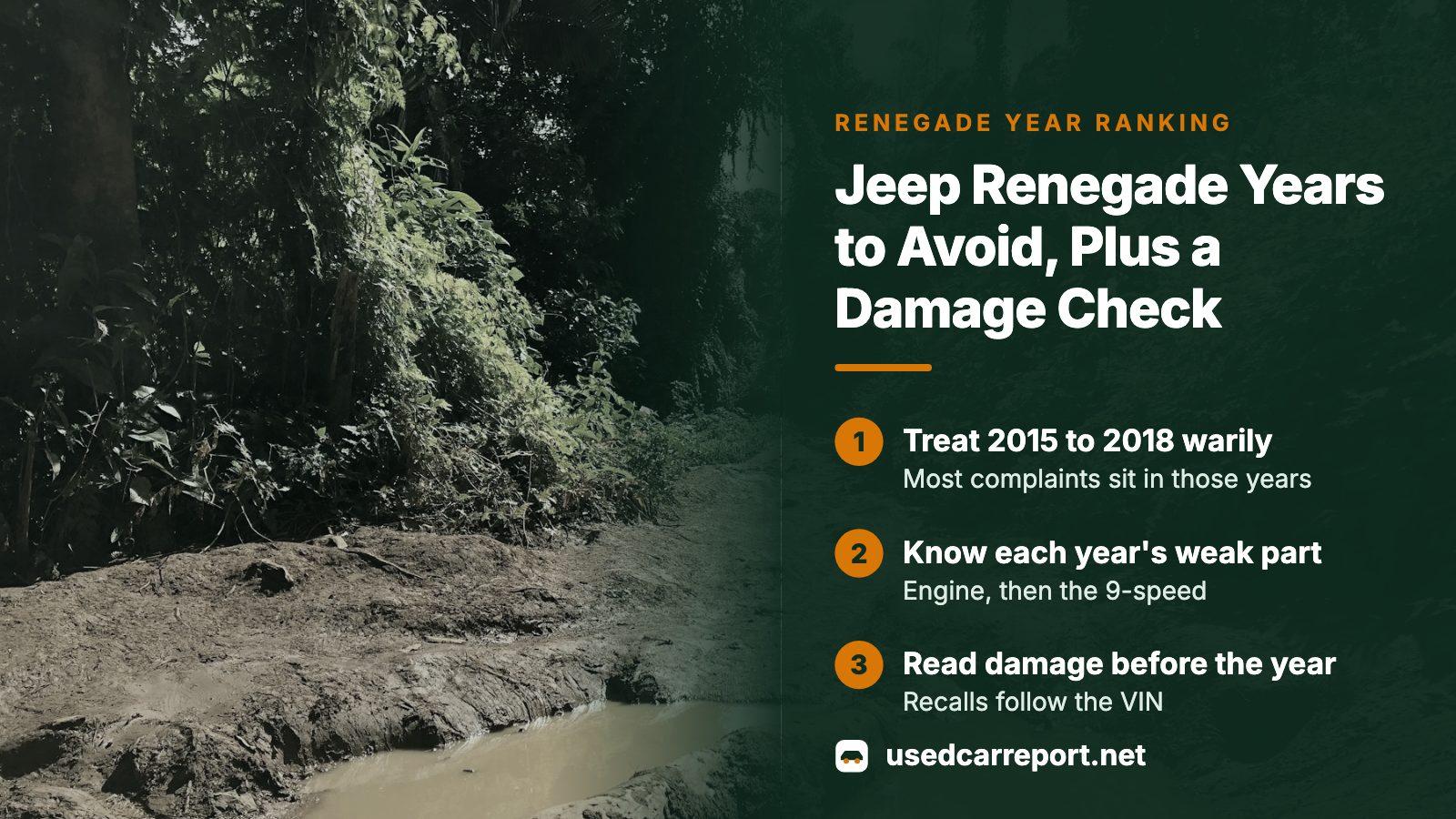
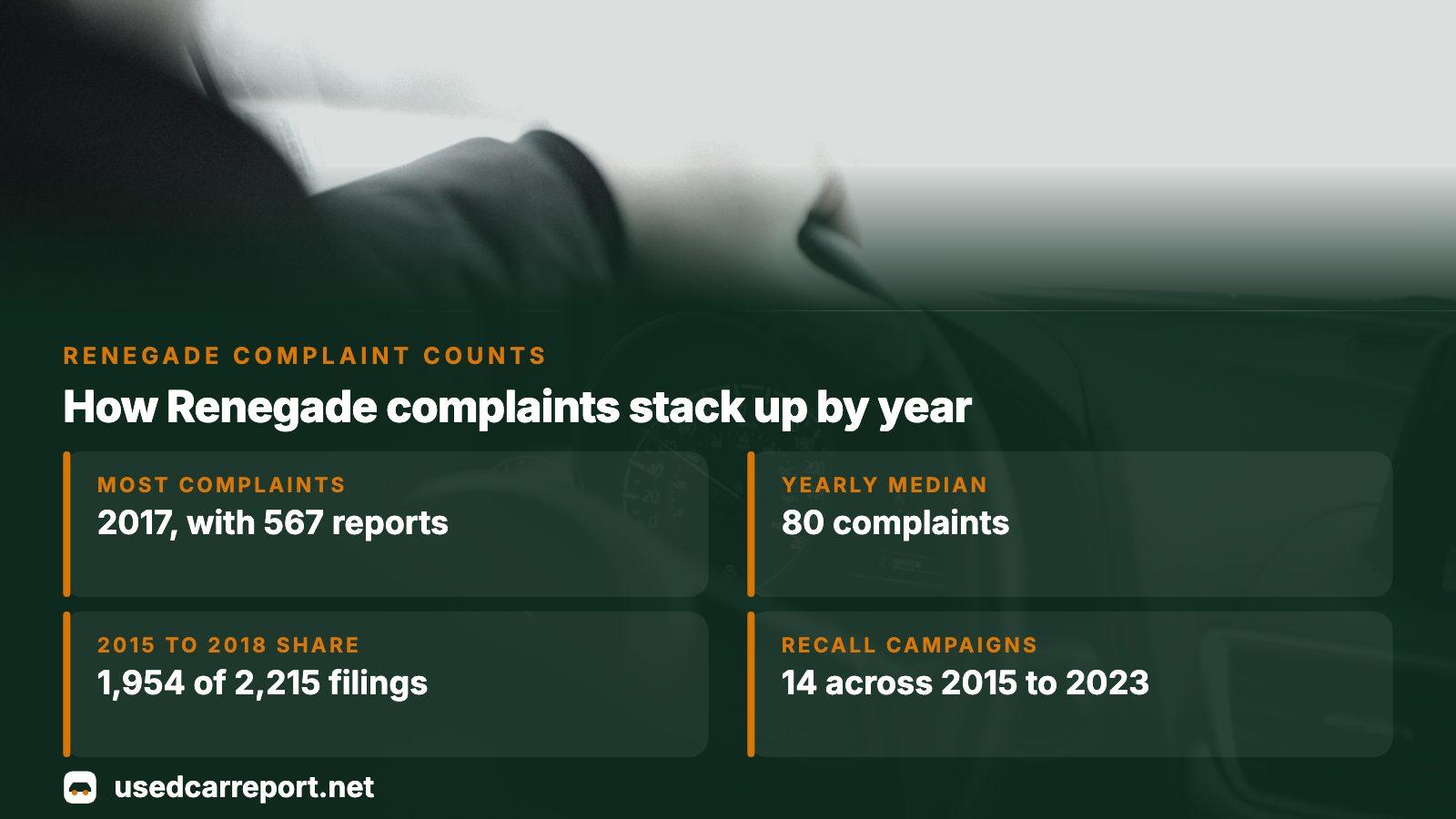
Avoid 2015 to 2018 unless the price is low and the car is proven. They hold 1,954 of the 2,215 complaints NHTSA lists for 2015 to 2023, against a yearly median of 80. Engine trouble leads 2016 to 2018, and the 9-speed automatic leads 2015. Model years 2019 to 2023 are far quieter, with 2022 and 2023 partly light from youth. Run the VIN for damage and open recalls first.
- Most complaints
- 2017, with 567 reports
- Yearly median
- 80 complaints
- 2015 to 2018 share
- 1,954 of 2,215 filings
- Distinct recall campaigns
- 14 across 2015 to 2023
What NHTSA's file shows for each Renegade year
I pulled the Renegade record from NHTSA's complaints and recalls feeds on November 7, 2026. It covers model years 2015 through 2023 and lists nothing for 2024 to 2026. The ratio column divides each year by the median year, 80, so a 7 means about seven times a typical year.
| Year | Complaints | Ratio to median | Recall listings | Leading tag |
|---|---|---|---|---|
| 2017 | 567 | 7.09 | 3 | Engine |
| 2015 | 512 | 6.4 | 4 | Power train |
| 2018 | 444 | 5.55 | 2 | Engine |
| 2016 | 431 | 5.39 | 2 | Engine |
| 2019 | 80 | 1 | 4 | Electrical |
| 2021 | 68 | 0.85 | 2 | Electrical |
| 2020 | 64 | 0.8 | 3 | Engine |
| 2022 | 28 | 0.35 | 2 | Electrical |
| 2023 | 21 | 0.26 | 2 | Electrical |
The drop after 2018 is steep, from 444 to 80. Fewer complaints on newer cars can simply mean fewer miles and fewer years on the road, so treat 2022 and 2023 as unproven rather than proven good.
2016 to 2018: the engine and the fuel pump
Owners of these three years name the engine more than anything else: 174 reports for 2016, 269 for 2017 and 189 for 2018. The 2017 cars also add 119 fuel and propulsion tags. That lines up with two recalls on the 2.4L engine. Campaign 18V131000 covers a cracked oil pump housing in the balance shaft module that can stall the engine, and 18V731000 covers a fuel pump flaw on 4X2 flex fuel cars that can drop fuel pressure and stall the car.
From an NHTSA owner complaint
The owner of a 2017 Renegade wrote that the car refused to start after repeated tries, got towed, and was diagnosed with coolant inside a cylinder and a failed engine. The dealer did not repair it. The owner added that the engine block had been worked on in 2020 under a recall nobody explained, with about 85,000 miles at failure.
Engine work in a car's past is worth raising with the seller, with the paperwork in hand.
2015: when the transmission drops into neutral
The first-year cars are different. Power train, at 171 reports, edges out engine at 161. Campaign 16V529000 applies to the 2015 Renegade with the 9-speed automatic: a weak crimp in the transmission wire harness sensor cluster can let the car shift to neutral without warning. NHTSA's own risk note is a higher chance of a crash. The free fix is a software reflash and, where needed, a new harness.
From an NHTSA owner complaint
A 2015 owner reported that the engine revs when pulling into traffic but the wheels get no power, as though the car were in neutral, and that it has happened several times. They found the gearbox campaign by searching the model and have no record that it was ever carried out on their car.
A seller saying the recall was done is not evidence. Ask for the dealer paperwork, or look the VIN up yourself.
Why I would read the damage record before the year
Picture a 2020 Renegade, one of the quiet years with 64 complaints, and a 2016 with 431. The 2020 looks like the safe choice. If it took a hard hit on the right rear and was repaired at the cheapest shop, though, the complaint count tells you nothing about its brakes, air bags or body. A complaint tally describes a model year. An accident and damage record describes one car.
That matters on the Renegade because several of its campaigns touch crash safety. The 2019 cars carry two restraint controller recalls, 19V287000 and 19V438000. Campaign 24V510000 warns of a miswired buckle sensor on the front seat belt, which could keep that air bag from firing in a crash. A car that has already been through a collision deserves a closer look at how those parts were put back.
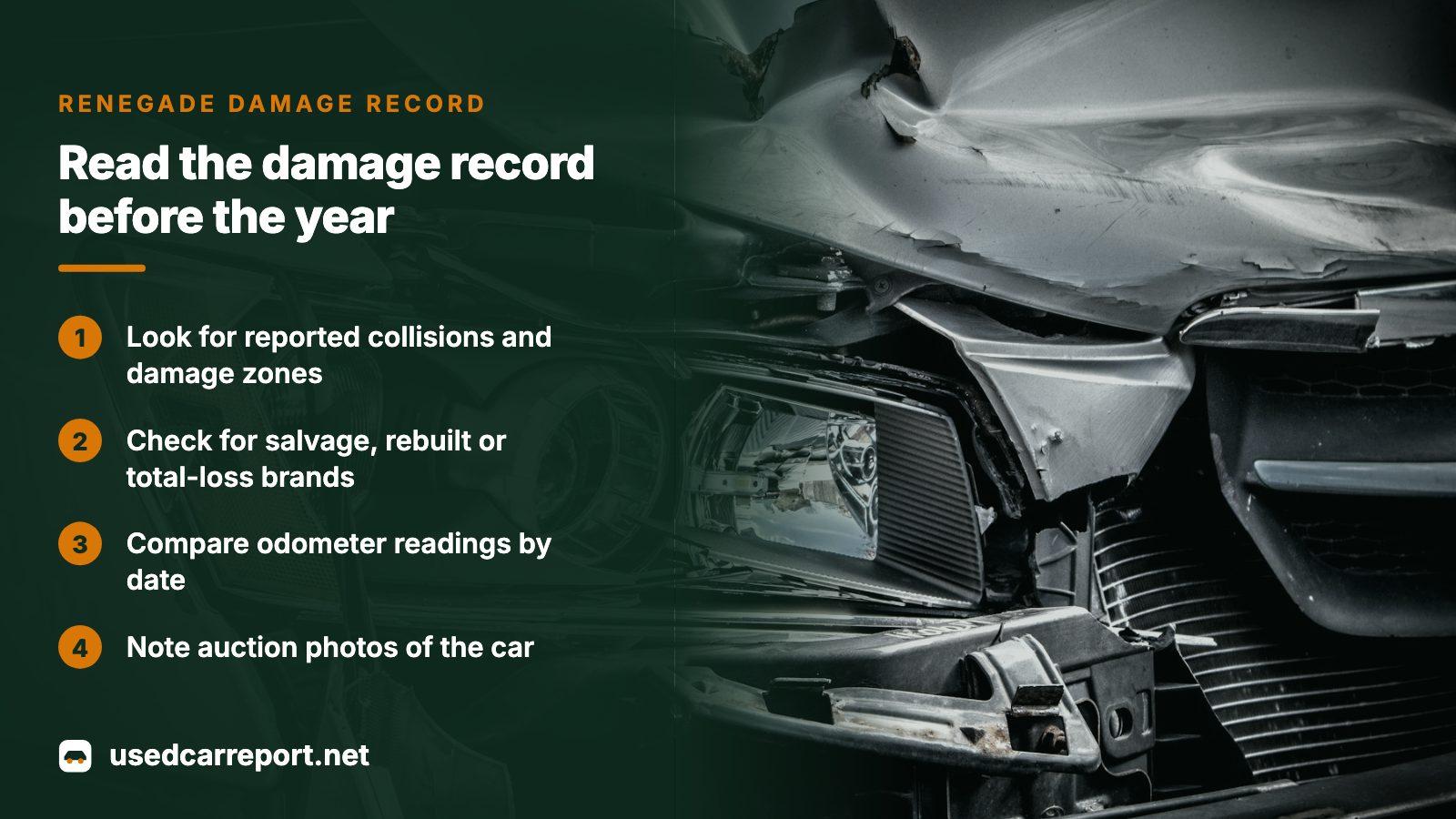
- Look for any reported collision, its severity and the damage zones.
- Check for a salvage, rebuilt or total-loss brand on the title.
- Compare odometer readings by date, since they should only climb.
- Note auction photos, which show the car at its worst moment.
Recalls belong to a VIN, not a model year
Several Renegade campaigns apply only to certain build dates, trims or engines. The trailer hitch recall, 16V545000, covers cars built between August 25, 2014 and June 25, 2016 with the factory hitch package, which found only one fastener per side where three belong. The 2019 restraint recall 19V438000 names the Upland trim. Two Renegades from the same year can therefore land on opposite sides of a campaign.
From an NHTSA owner complaint
A 2018 owner said the car cut out three separate times while rolling. An online recall matched the model year and the symptoms, yet the owner was told that no recall applied to this VIN, and felt bounced around by the maker.
So searching by model year settles nothing about the car in your driveway. Type the full VIN into NHTSA's recall search and keep a printout of the result.
2019 to 2023: quieter, with air bag and light campaigns
Complaints fall to 80 for 2019, 64 for 2020, 68 for 2021, 28 for 2022 and 21 for 2023, and electrical leads most of those years. The recalls shift too. The 2020 cars carry a right rear brake caliper campaign, 19V909000, where a caliper could have fractured in casting. Campaigns 24V510000 and 24V918000, received in July and December of 2024, reach the 2021 to 2023 cars, the second for a wrong bumper reverse light assembly that fails the federal lamp standard.
None of that is alarming next to the 2015 to 2018 record, and every campaign above states a free dealer remedy. It does mean a newer Renegade is not automatically clean. Ask whether the work was done.
The 15-year limit on free recall repairs
The rule sits in 49 U.S.C. 30120. Count back from the maker's notice or NHTSA's order: if the first retail sale falls beyond 15 calendar years earlier, the free-repair requirement stops applying. Renegades first sold in 2014 or 2015 reach that mark first, which could leave a late campaign outside it. For now the listed campaigns are still repairable at no charge, but a dealer can confirm for one VIN.
Run the VIN, then decide which year you want
The year only narrows the field. Begin with the free tools from others: NHTSA's recall search accepts a VIN, and the insurers' VINCheck at NICB compares one against member theft and total-loss reports. After that, try this site's preview, which carries no charge. If the preview looks right, the full report is bought once. You can take a bundle of 3, 5 or 10 while you shop around, and no plan sits waiting to renew. Amounts are on the pricing page.
On a Renegade, read the accident and damage records first, then title brands, odometer readings and salvage photos, and finally open recalls. If those come back clean, a lift inspection by an independent mechanic should be the last step. If they do not, the model year you were weighing no longer matters.
Where this information comes from
- NHTSA owner complaint 11715817 — owner experience, paraphrased
- NHTSA owner complaint 11727419 — owner experience, paraphrased
- NHTSA owner complaint 11709893 — owner experience, paraphrased
- NHTSA: vehicle safety and the complaint database — Where the Renegade complaints behind the yearly counts are filed.
- NHTSA: recalls by vehicle — Shows open campaigns on a single car from its VIN.
- 49 U.S.C. 30120: remedies for defects and noncompliance — The statute behind free recall repairs and the 15-year limit.
- NMVTIS: national motor vehicle title information system — The federal title-record program meant to protect buyers from fraud.
Sources and photos: Facts checked against the sources above in November 2026. Photos by Frederick Rosa, Clark Van Der Beken and Miles Loewen on Unsplash; diagrams by UsedCarReport.
Keep reading
- Jeep Compass years to avoid: 2018 leads, but read the VIN's damage recordThe Renegade's larger Jeep sibling, ranked the same way.
- VIN accident check: read the damage records before you buyWhat accident and damage records show on a VIN, and where they stop.
- Buying a car with an open recall: read the damage record firstWhat an unrepaired campaign means for price and paperwork.
- Salvage title check: five steps, damage records firstSpotting a salvage brand before it hits repairs and resale.
Frequently asked questions
Which Jeep Renegade years should I avoid?
Complaint volume puts 2017 first with 567, then 2015 with 512, 2018 with 444 and 2016 with 431, against a median year of 80. Complaints are unverified owner accounts, so read those years as a cue to inspect hard and haggle, not as a ban.
Are the newest Renegades safe to buy?
The 2022 and 2023 cars show only 28 and 21 complaints, but they are young, so low counts prove little. They also appear in two 2024 recall campaigns, one for an air bag sensor connection and one for reverse lights. Confirm both were completed on the exact VIN.
Does the 2015 Renegade have a transmission problem?
Owners tag power train most often on 2015, with 171 reports, and campaign 16V529000 covers a wiring harness fault that can drop the 9-speed automatic into neutral. The fix is free at a dealer. Ask the seller for proof it was performed, or have a dealer check the VIN.
Can a Renegade with few complaints still have been wrecked?
Yes. Counts reflect what owners of a model year filed, not what happened to one car. Any year can hide a collision, a salvage brand, an auction history or a wound-back odometer. Those facts live in the VIN's accident, title and mileage records, so run the VIN whichever year you choose.
Will Jeep still fix an old Renegade recall for free?
Usually, but not forever. The no-cost requirement stops applying once the first sale lies beyond 15 calendar years before the notice or order. The oldest Renegades are nearing that point, so a newly announced campaign could miss them. A dealer can say where a VIN stands.
Now check the car itself
The guide explains what to look for. The report shows what this VIN has on record.