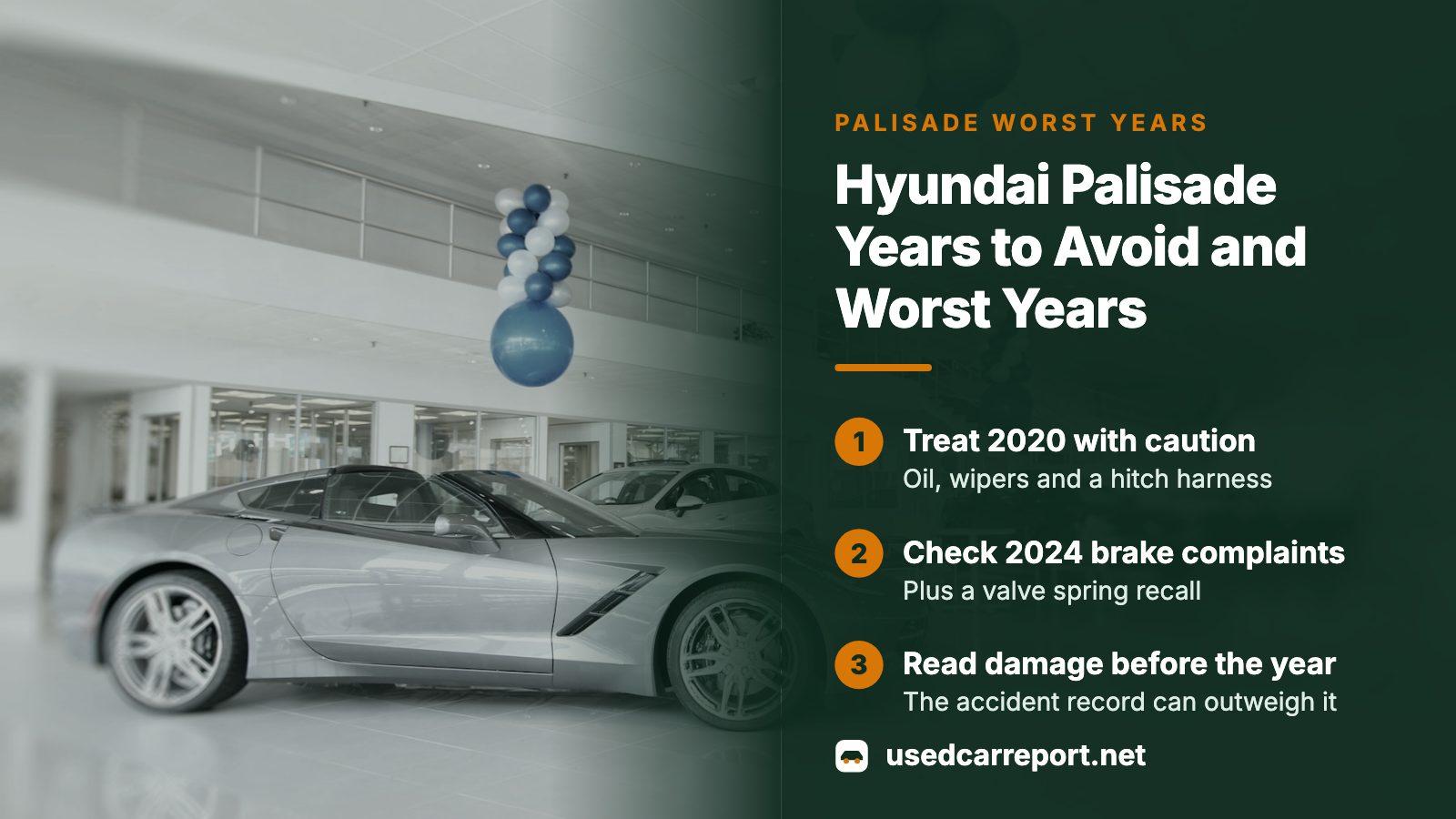
THE SHORT ANSWER
NHTSA holds 2,506 owner complaints on the 2020 to 2026 Palisade, with a yearly median of 398. The 2020 model is the worst by volume at 542, led by engine and wiper trouble. The 2024 model is the other one to treat carefully: 223 of its 398 complaints concern brakes, and it carries an engine recall for breaking valve springs. The 2022 and 2025 years look calmest so far.
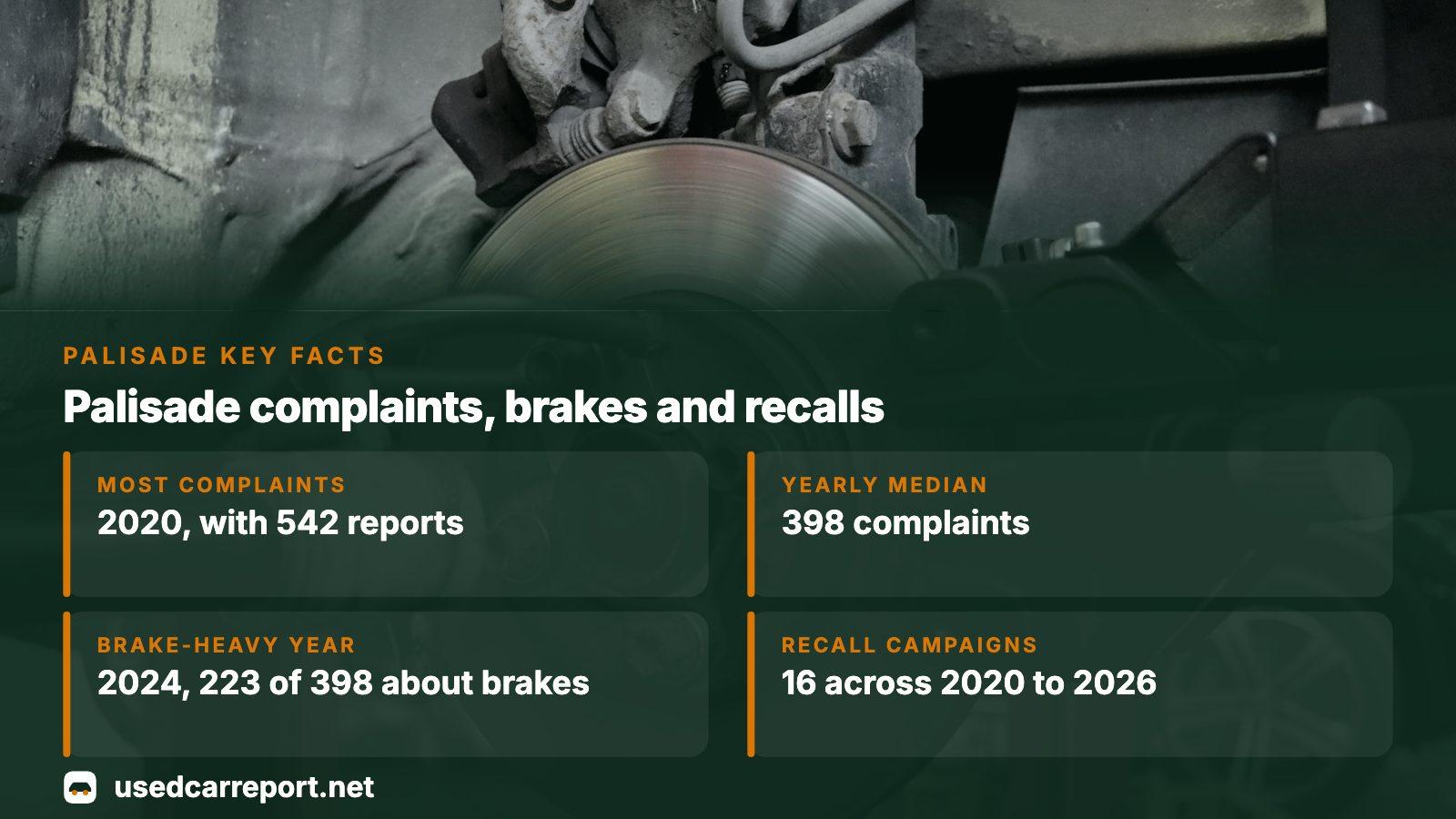
- Most complaints
- 2020, with 542 reports
- Yearly median
- 398 complaints
- Brake-heavy year
- 2024, 223 of 398 about brakes
- Recall campaigns
- 16 across 2020 to 2026
The verdict by model year
The Palisade is young, so the record is short: seven model years, 2020 through 2026. I pulled every complaint and recall NHTSA lists for each of them in November 2026 and set each year against the median of 398 complaints.
| Model year | Complaints | Versus the median | Biggest complaint area | Recall campaigns | Verdict |
|---|---|---|---|---|---|
| 2020 | 542 | 1.36 | Engine, 134 | 5 | Avoid or inspect hard |
| 2021 | 448 | 1.13 | Seat belts, 113 | 6 | Check recalls closely |
| 2022 | 319 | 0.80 | Seat belts, 72 | 5 | Calmer |
| 2023 | 411 | 1.03 | Service brakes, 84 | 5 | Average |
| 2024 | 398 | 1.00 | Service brakes, 223 | 5 | Avoid or inspect hard |
| 2025 | 257 | 0.65 | Service brakes, 96 | 3 | Calmer, but young |
| 2026 | 131 | 0.33 | Seats, 49 | 3 | Too new to judge |
Recalls and complaints measure different things. Hyundai concedes a recall defect and repairs it for nothing, whereas a complaint is a single owner's story that nobody has verified. Read the counts as arrows toward trouble spots, never as failure rates.
2020: the oil, the wipers and the hitch harness
The launch year draws the biggest pile of filings, and the spread is wide. Engine reports lead with 134, wipers and visibility follow with 115, and suspension adds 61. It also has the most fire-flagged complaints of any year, 7, and 13 flagged crashes.
The recalls match some of that. A 2022 campaign covers a tow hitch harness that can short out and start a fire, and owners were told to park outside until it is fixed. A separate wiper campaign replaces the driver-side wiper arm. The engine reports have no recall behind them, which is the part that should slow you down: owners describe oil use and no official fix.
From an NHTSA owner complaint
An owner of a 2020 Palisade wrote in May 2026 that the engine burned oil quickly and shuddered, and that spark plugs had to be replaced twice. The dealer ran an oil consumption test and found nothing wrong. Then the SUV shut off at 35 MPH with about 30,000 miles on it, and the engine was replaced.
One complaint proves little by itself. Still, it shows why the service record matters: ask the seller for oil-change dates and any engine work before you commit.
2024: brakes and a valve spring recall
The 2024 model has a lopsided record. Brake complaints number 223, which is 56 percent of everything filed on that year, and 10 of those are crash-flagged. Owners describe pedals going hard, shaking over bumps and long stops, and most of them were filed in 2024 and 2025.
Two recalls add weight. Campaign 24V106000 says engine valve springs can break while driving, which can cut drive power and possibly open a hole in the engine block; dealers replace the engine sub-assembly. Campaign 23V599000 covers 2024 SUVs with dark premium suede seats, where the passenger air bag could be switched off by mistake.
From an NHTSA owner complaint
A 2024 Palisade owner reported that, crossing railroad tracks at about 20 miles an hour in June 2026, the brakes did not respond at first when the car ahead slowed. They said the dealer could not schedule the recall visit for six weeks.
If you are shopping a 2024, confirm that the engine campaign was done and ask for a brake test drive over rough pavement.
2021, 2022 and 2023: the middle of the pack
The 2021 model has the most recall campaigns, 6, among them contaminated brake fluid that can swell the master cylinder seals and lengthen stopping distance. The fix is a new master cylinder and a fluid flush. It also logged 20 injuries across its complaints, the most of any year, and seat belt complaints reach 113.
The 2022 model is the quietest of the first four years at 319 complaints. Its notable recall covers an instrument cluster built with too much adhesive, which can blank the display.
The 2023 model sits on the median with 411. Brakes lead its complaints, and a campaign covers a misaligned brake booster that can cost you power assist. None of these is a bad buy by itself. Each is a reason to check that the open items were repaired.
2025 and 2026: calm, but short on evidence
The 2025 model has 257 complaints and the 2026 model 131, well under the median. Fewer miles and fewer owners mean fewer filings so far, which flatters a young model.
The 2026 recalls are specific. Two cover Limited and Calligraphy trims: rear power seats that may not sense a person, and a third-row belt buckle whose wiring can fault. A third is an instrument panel software error that Hyundai fixes over the air or at a dealer. If you are looking at a nearly new one, ask whether the software and seat updates have been applied.
- 2025: oil pump controller seal campaign, 25V291000
- 2026: power seat campaign, 26V160000
- 2026: belt buckle wiring campaign, 26V169000
- 2026: instrument panel software campaign, 26V047000
Read the accident and damage record before the year
A model-year ranking describes a production batch. It cannot tell you that the SUV in the driveway took a hit on the rear quarter, was written off by an insurer, or has had its mileage wound back. Those details sit in the VIN's records, not in NHTSA's tables.
For a Palisade, the accident and damage entries deserve the first look, because a three-row SUV with a repaired side impact can carry hidden problems with the curtain air bags that two recalls already touch. After that, look at the brand history on the title, the recorded mileage and any recalls still open.
You can run a VIN preview at no cost. Going further means a one-time purchase of the full record, no recurring plan, and the pricing page spells out the choices.
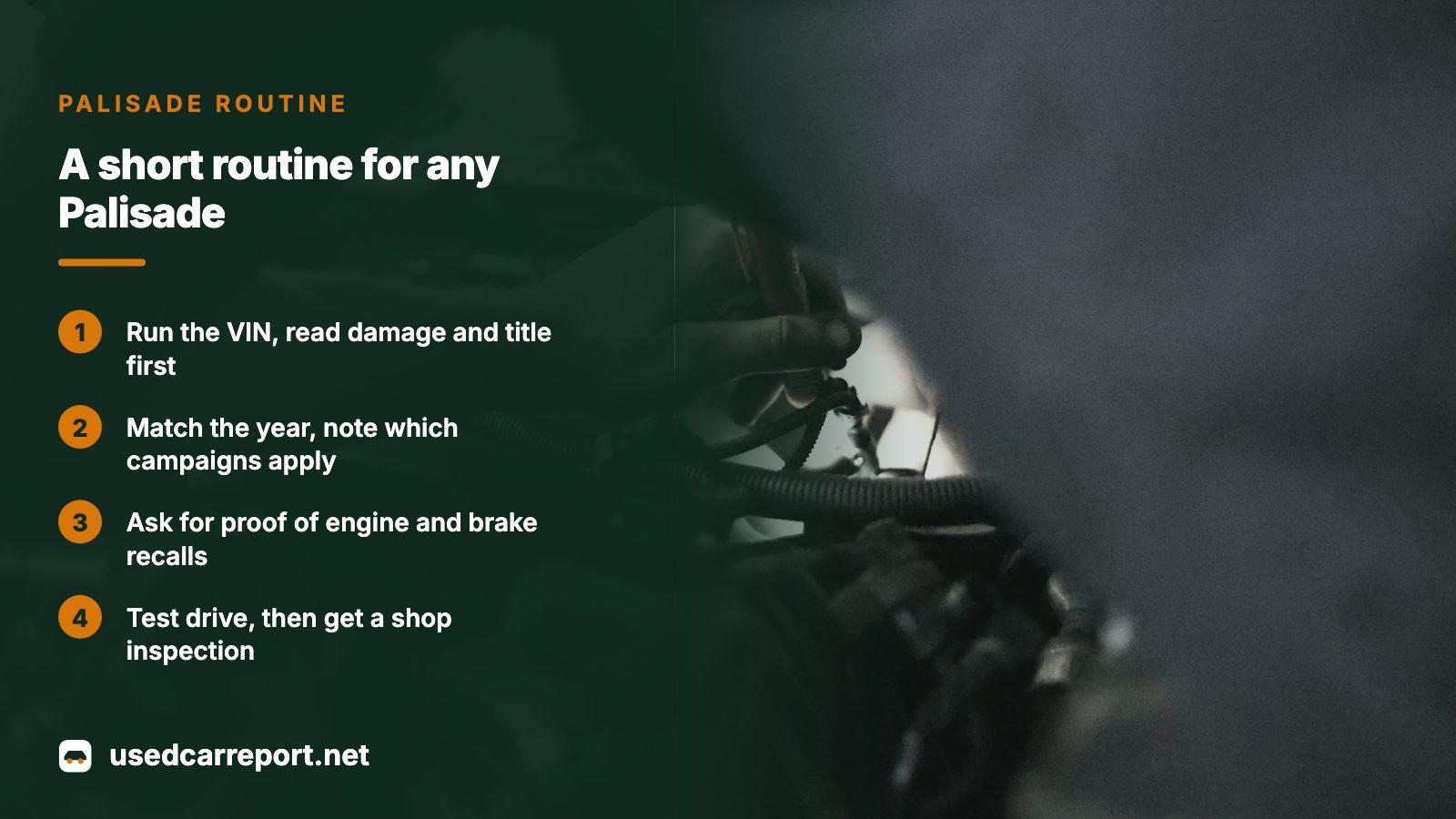
A short routine for any Palisade you are considering
- Run the VIN and read accident, damage and title entries before you call about the price.
- Match the year to the table above and note which campaigns apply.
- Ask the seller for proof the engine, brake and air bag recalls were done.
- Test drive over rough pavement and watch the brake pedal and any warnings on the dash.
- Have an independent shop check oil level and look for leaks before you sign.
The Justice Department's title database, NMVTIS, was set up to shield buyers from fraud and unsafe cars, so a clean title check belongs beside the recall list.
Where this information comes from
- NHTSA complaints API: Hyundai Palisade — complaint counts and components by model year, 2020 to 2026
- NHTSA recalls API: Hyundai Palisade — campaign numbers, dates and remedies
- VehicleHistory.gov: NMVTIS — what the federal title database is for
- NHTSA owner complaint 11736117 — owner experience, paraphrased
- NHTSA owner complaint 11746443 — owner experience, paraphrased
Sources and photos: Facts checked against the sources above in November 2026. Photos by Richard R, Mustafa Sheikhmouss and Media Digital on Unsplash; diagrams by UsedCarReport.
Keep reading
- Kia Telluride years to avoid, and what a VIN check addsThe Palisade's closest rival, with the same complaint-by-year method.
- Hyundai Santa Fe years to avoid, and the damage record to read firstAnother Hyundai SUV with its own engine-recall history.
- Buying a car with an open recall: read the damage record firstHow to handle an open campaign when you buy used.
- VIN accident check: read the damage records before you buyWhat a VIN accident check shows before you negotiate.
Frequently asked questions
Which Hyundai Palisade year is the worst?
By volume, 2020, with 542 NHTSA complaints against a median of 398. Engine and wiper reports lead, and it has the most fire-flagged filings. The 2024 model is the other year to treat carefully because brake complaints dominate it and an engine recall covers breaking valve springs.
Is the 2022 Hyundai Palisade reliable?
The data is kind to it so far. It has 319 complaints, below the median, and 5 recall campaigns, including an instrument cluster fix. Reliability is more than a count, though, so confirm the open campaigns were completed and read the VIN's damage record.
Should I avoid a Palisade with an open recall?
Not automatically. Recall repairs cost the owner nothing, but parts for the newest campaigns are still being sent out in phases. Get the campaign numbers from the VIN, ask for a written repair date, and price the car with that wait in mind.
Do complaint counts prove a model year is bad?
No. A complaint is an unchecked owner report, and older years have had longer to collect them. Treat counts as a map of where to dig, then trust the car's own records: service history, recalls done, and any accident or damage entries.
Will a VIN check show whether a Palisade has been crashed?
It can show accident and damage records that insurers, auctions and agencies reported, along with title brands and odometer readings. It cannot catch a crash nobody reported, so pair it with an inspection by an independent shop.
Now check the car itself
The guide explains what to look for. The report shows what this VIN has on record.