THE SHORT ANSWER
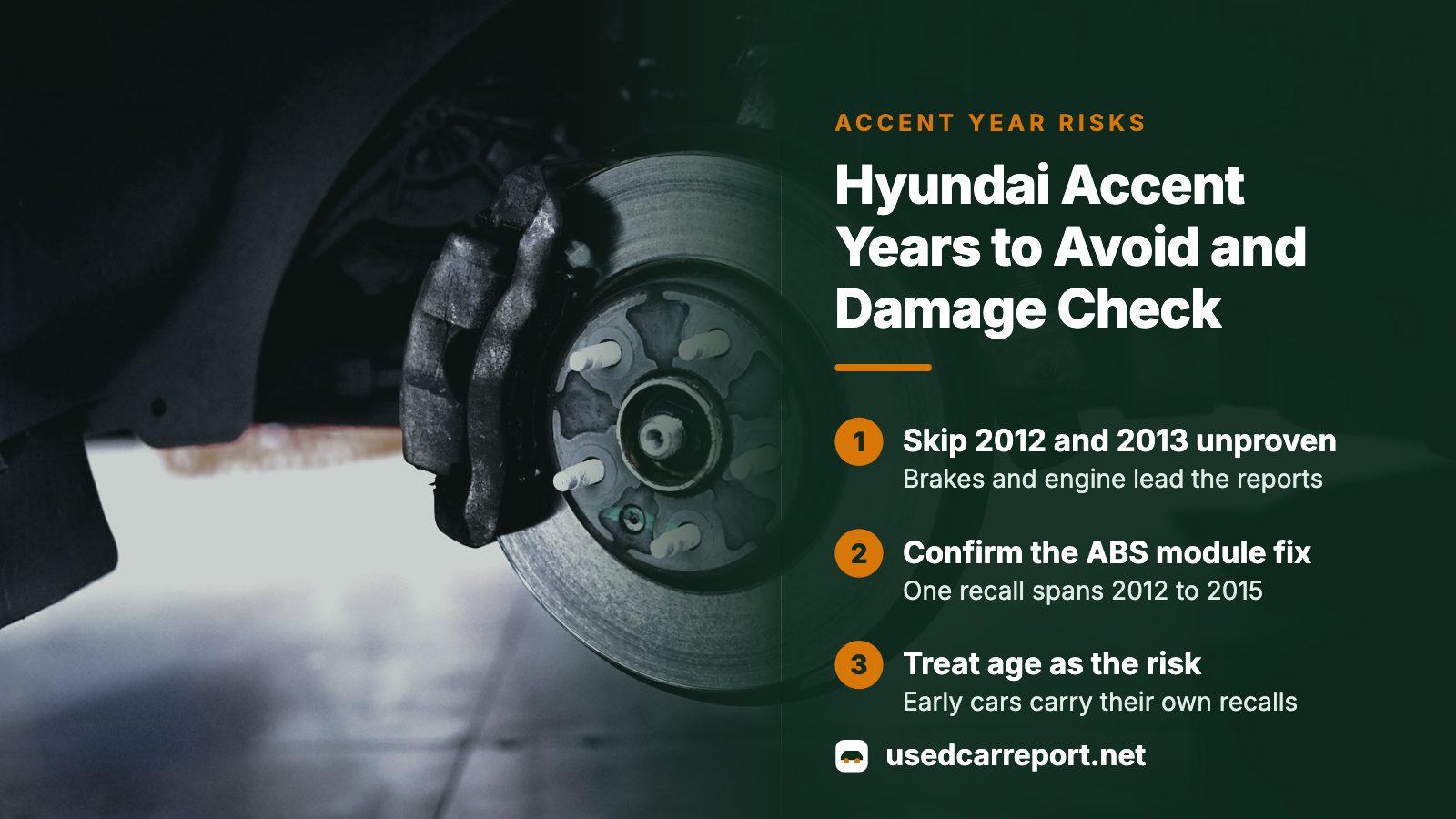
Skip 2012 and 2013 unless the recall work is proven. They draw 153 and 142 NHTSA complaints, mostly brakes and engine, and the 2012 to 2015 cars are covered by a recall over an ABS module that may short out and ignite an engine fire. Cars from 1995 to 2002 and 2006 to 2009 carry their own recalls. The calmest records belong to 2018 and 2019, with 19 and 31 complaints. Whatever the year, a VIN report showing prior damage or a title brand matters more.
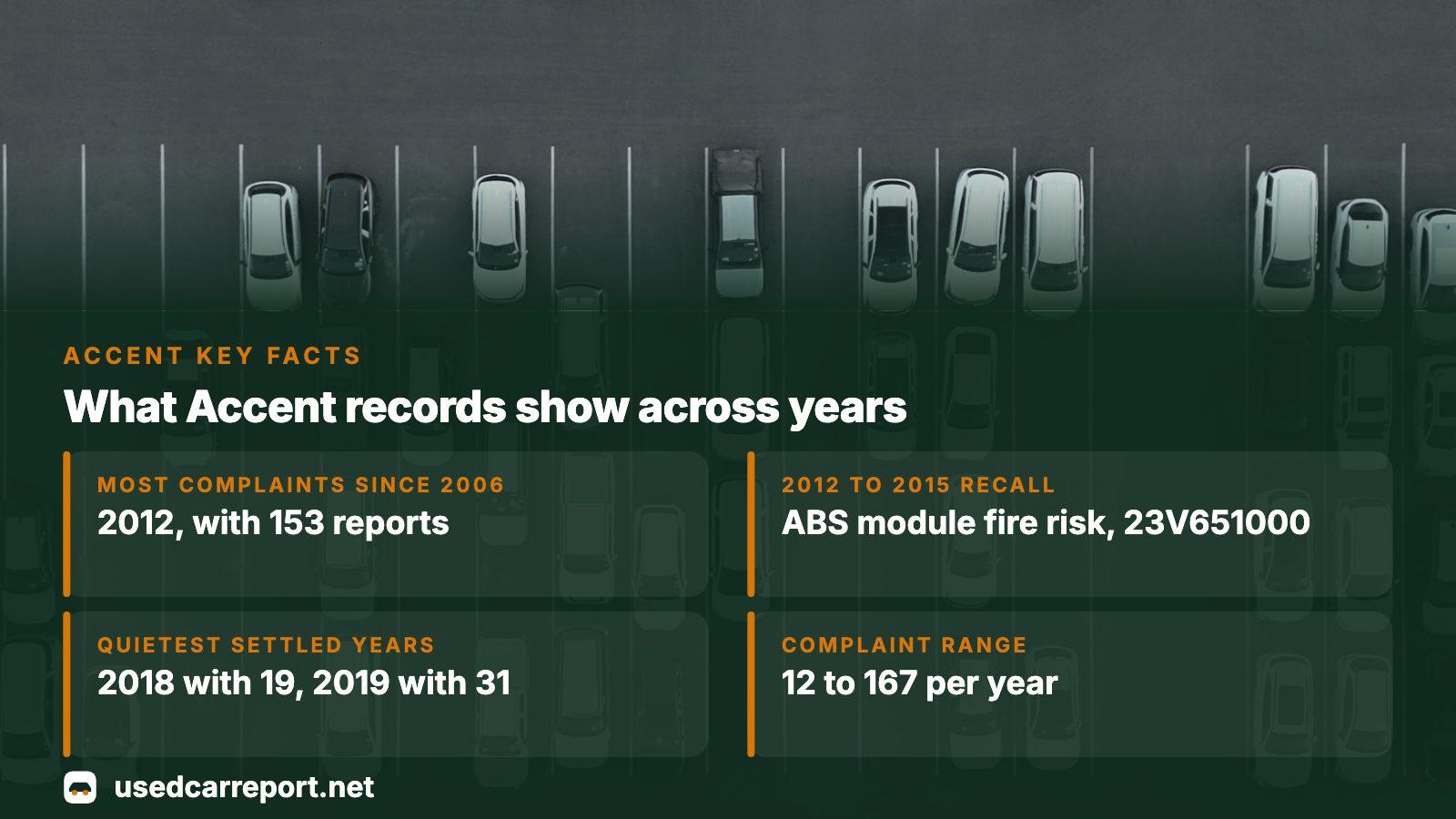
- Most complaints since 2006
- 2012, with 153 reports
- Recall covering 2012 to 2015
- ABS module fire risk, campaign 23V651000
- Quietest settled years
- 2018 with 19, 2019 with 31
- Complaint range, 1995 to 2022
- 12 to 167 per year
Which Accent years draw the most owner complaints
We pulled every Accent record NHTSA lists, 1995 through 2022, on 2026-11-07. The table keeps the years that deserve a second look in the order a buyer is most likely to meet them. Counts reflect sales volume and age as well as quality, so they point at where to look rather than prove a defect.
| Model year | Complaints | Recall campaigns | Fire-flagged complaints | Top complaint area |
|---|---|---|---|---|
| 2012 | 153 | 2 | 8 | Service brakes |
| 2013 | 142 | 1 | 9 | Service brakes |
| 2016 | 103 | 0 | 4 | Engine |
| 2008 | 101 | 1 | 1 | Air bags |
| 2009 | 101 | 2 | 1 | Air bags |
| 2014 | 80 | 1 | 9 | Service brakes |
| 2015 | 70 | 2 | 11 | Air bags |
The 2012 and 2013 cars lead everything built since 2006. The 2014 and 2015 cars look milder on raw complaints yet carry the most fire-flagged reports, which is why the next section matters.
The ABS module recall that ties 2012 to 2015 together
In September 2023 Hyundai filed campaign 23V651000 for Accents from 2012 through 2015, along with several other models. Inside the ABS module, brake fluid can seep where it should not and cause a short circuit, and the result is a possible blaze under the hood, parked or driving.
The remedy is modest: a dealer replaces the ABS fuse at no charge. Until then, owners are told to park outdoors and away from buildings. Owner letters went out between April and October 2024, so a seller who moved the car or bought it at auction after that may never have received one.
What to ask the seller
Request the repair order showing campaign 23V651000 was closed. A clean-looking engine bay tells you nothing about a fuse swap. If the seller has no paperwork, have a Hyundai dealer run the VIN and complete the work before you pay.
What owners say happened on the flagged cars
From an NHTSA owner complaint
An owner of a 2013 Accent wrote that the parked, switched-off car burned in the driveway. They noted it was listed under the ABS recall, the fire department put it out, and the car was a total loss. The dealer holding it reportedly could not find the issue, so the owner asked NHTSA for a review.
Take from this that a recall listing and a finished repair are different things. Complaints are unverified accounts, yet parked-car fires match what the recall describes.
From an NHTSA owner complaint
A 2012 Accent owner described a highway engine failure with three passengers aboard: a flashing check engine light, loud knocking, then a dealer saying the engine needed replacing. The dealer had applied a software fix only weeks before. The owner also said an earlier owner replaced the instrument cluster, so the dash mileage overstated what the engine had run.
That last detail is the buyer's lesson. A replaced cluster can make mileage look higher or lower than the engine has really run, so the odometer readings in a history report deserve a close read.
2006 to 2011: the brake light switch recalls
Before the ABS issue, the Accent's best-known problem was the stop lamp switch. Campaign 13V113000, filed in April 2013 and expanded later, covers 2006 to 2009 Accents among many Hyundai models, and 15V566000 extended the same fault to cars built from March 2009 to February 2011.
- Brake lights may fail to light when you press the pedal.
- Cruise control may not cancel when you brake.
- The shifter may leave Park without the brake pressed.
- The stability warning light may come on.
Dealers replace the switch free. Because the work is old, most surviving cars have had it done, but an unrepaired one is cheap to confirm and expensive to ignore.
1995 to 2002: why age is the main risk
The earliest cars draw the heaviest counts of all, with 167 complaints for 1995, 121 for 1996 and 144 for 2002. Their recalls read like a list of wear items: front coil springs that corrode in road-salt states, lower control arms, a fuel tank on the 1998 car, and an automatic transmission valve on 1999.
Most of these cars have had decades to rust, be wrecked and change hands. That is where an accident and damage record earns its keep. A car this old with a clean title is common, but one with a salvage brand or a thin history deserves a firm walk away, however low the asking price.
2016 to 2022: quieter files, but not recall-free
The 2016 cars have 103 complaints, split between engine, air bags and electrical items, with no recalls on file. Then 2018 and 2019 look the calmest of the settled years, at 19 and 31.
The newest cars carry little owner history, so their low counts say more about age than quality. Yet recalls pile up fast: 2020 has 4 campaigns and 2021 has 4, covering seat belt pretensioners, a brake master cylinder that can reduce stopping power, a steering column bolt that can loosen, and a trunk latch that may not release from inside.
| Model year | Complaints | Recall campaigns | What the recalls cover |
|---|---|---|---|
| 2018 | 19 | 1 | Trunk release latch |
| 2019 | 31 | 1 | Trunk release latch |
| 2020 | 12 | 4 | Seat belts, trunk latch |
| 2021 | 16 | 4 | Seat belts, master cylinder, steering bolt |
| 2022 | 17 | 2 | Steering bolt, seat belts |
Buy these with the recall list in hand and ask for proof of each completed repair.
Why the damage record can outweigh the year
Complaint counts describe a production year. They say nothing about whether the Accent in front of you went through a collision, a flood or an auction.
This is why we start with the accident and damage section of a VIN report. Check it for prior impacts, total-loss records, auction photos and any brand on the title. The federal title system behind many of these records covers title, brand history, the latest odometer reading and some theft data.
A quick order of operations
Run the VIN, read the damage and title sections first, then the odometer line, then open recalls. Only after the car clears those steps does its model year matter.
Running the check on an Accent before you buy
Find the VIN at the lower corner of the windshield or on the sticker along the driver door, then match it to the title paperwork. UsedCarReport shows a free preview first. After that, an Accent report is a one-time purchase that never renews, and if you are shopping around, 3, 5 or 10 can be bought together. Prices are on the pricing page.
- Confirm the VIN matches on the car, the title and the ad.
- Read the damage and title-brand sections before anything else.
- Compare odometer readings by date for signs of a rollback.
- Note each open recall and ask for proof of repair.
- Book an independent inspection if the record holds up.
If the record shows frame or structural damage, treat the Accent's year as irrelevant and move on to the next car.

Where this information comes from
- NHTSA owner complaint 11739389 — owner experience, paraphrased
- NHTSA owner complaint 11740739 — owner experience, paraphrased
- NHTSA: complaints API for the Hyundai Accent — Source of the yearly complaint counts and components; the same query works for any year.
- NHTSA: recalls API for the Hyundai Accent — Campaign numbers, defect descriptions and free remedies for each year.
- NMVTIS: information for consumers — Explains what the federal title system shows about brands and odometer readings.
Sources and photos: Facts checked against the sources above in November 2026. Photos by ün LIU, Jakub Żerdzicki and Iain on Unsplash; diagrams by UsedCarReport.
Keep reading
- VIN accident check: read the damage records before you buyWhat accident and damage records show on a VIN, and where they stop.
- Buying a car with an open recall: read the damage record firstHow an unrepaired recall affects price and safety.
- Kia Rio years to avoid: 2001, 2002 and 2013, then check the damageThe same year-by-year look at a close small-car rival.
- Pre-purchase inspection: read the damage records, then hire the mechanicWhat a mechanic should check after the records pass.
Frequently asked questions
What is the worst year for a Hyundai Accent?
Among cars from 2006 on, 2012 draws the most NHTSA complaints at 153, followed by 2013 at 142. Both fall under the ABS module fire recall. If you want the safest bet, the 2018 and 2019 cars have the thinnest complaint files, though a clean record for the specific VIN still matters most.
Is the Hyundai Accent a reliable car overall?
NHTSA counts reports, not failures per car sold, so it cannot settle that. It does show problems clustering by era: brake switches in the late 2000s, ABS fire risk in 2012 to 2015, and recalls on the newest cars.
How do I know if an Accent has an open recall?
To learn whether a given Accent has an unrepaired recall, enter its VIN on NHTSA's site or have a Hyundai service desk look it up. A VIN report also lists open recalls.
Should I avoid every 2012 to 2015 Accent?
Not automatically. The ABS fuse replacement is free and quick, so a car with proof the work was done is a different proposition from one without. Insist on the repair order and check the damage record.
Can a VIN check show if my Accent was in a crash?
It can show reported accidents, total-loss and salvage records, and auction photos when they exist. It cannot show a collision that was never reported to an insurer or a database, so pair the report with an inspection.
Now check the car itself
The guide explains what to look for. The report shows what this VIN has on record.