THE SHORT ANSWER
No official page we could open gives a time limit for accident entries on a Carfax report, so any specific number you see online is unconfirmed. Brand and salvage records kept by state agencies and the federal title system are history, not a countdown. Before buying, run the VIN, read the damage section and pay a mechanic to look underneath.
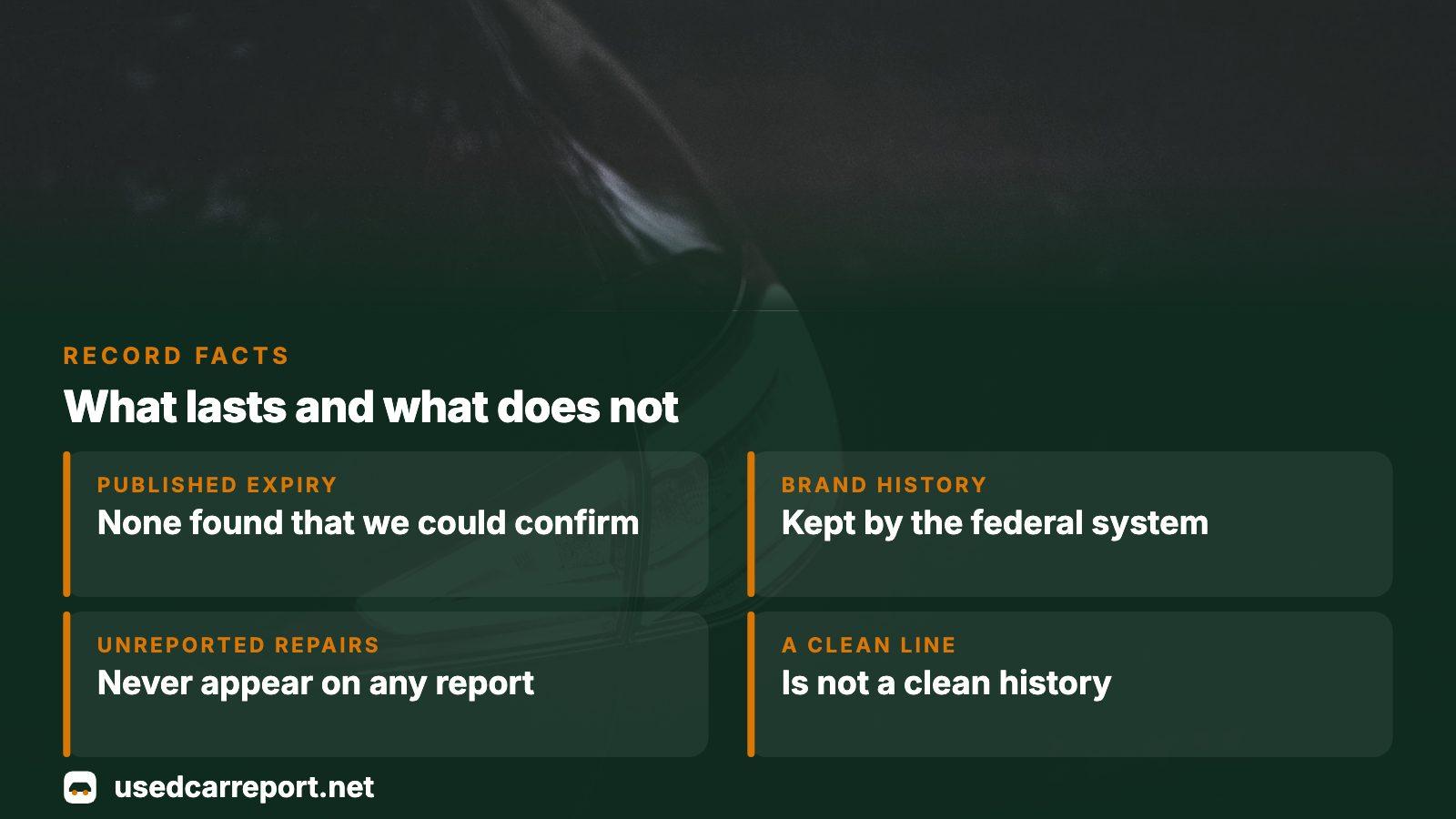
- Published expiry we could confirm
- None found
- Brand history
- Kept by the federal title system from any state
- Unreported repairs
- Never appear on any report
What we found, and what we could not open
Plenty of articles give a tidy number of years for how long a crash stays on a history report. We tried to find the source for that kind of claim. Carfax's own help and blog pages returned a block message when we asked for them with an ordinary request, and we stopped there. Federal and consumer-agency pages did open, and none of them states a retention period for accident entries.
So the honest position is narrow. We can tell you how the underlying records behave, which sources feed a report, and how to protect yourself. We cannot tell you the day a given entry will drop off a given company's report, and neither can a seller repeating something from a forum.
Records that are built to last
The federal title information system run for the Department of Justice keeps a history of every brand a state has put on a vehicle. A brand is the label a state titling agency applies, such as junk, salvage or flood. The system's own explanation says the point is to stop a buyer from overpaying for, or driving, a car that was never properly repaired.
That design matters for your question. If a crash ended in a total loss and a branded title, the event is a permanent part of how the car is described to the next buyer. It is a status on the vehicle, not a note that ages out.
What that means in practice
A brand or salvage entry is the part of a crash history least likely to disappear. A bumper scrape that never touched an insurer or a title agency may never have been recorded in the first place.
Why one report shows a crash and another does not
Accident entries depend on who reported the event. Police, insurers, body shops, auctions, salvage yards and state agencies each send different data to different companies. The federal consumer report is deliberately short, with five items: title state, brand history, odometer reading, total loss and salvage. It will not list a fender bender, and its operators say private providers add things it was never meant to include, such as repair and maintenance history.
The NICB's free VIN lookup is narrower still. It reports on theft and on salvage or flood status from participating insurers, and the bureau itself cautions that an empty result proves little about the car.
- A crash handled by an insurer can reach several databases.
- A crash paid for in cash at a body shop may reach none.
- A total loss that became a branded title lands in the state record.
- A repair done years ago can still be visible to a mechanic with a lift.
A clean line is not a clean history
Sellers sometimes tell a buyer that an accident is old and gone from the report. Even if that were true of one company's page, the car itself would not have changed. Restored cars can hide unsafe parts, according to the NICB, and the Federal Trade Commission tells shoppers that only a hands-on inspection by an independent shop can turn up hidden damage.
Air bags are the clearest example. After a crash with air bag deployment, NHTSA has warned that some repairs used counterfeit or substandard replacement inflators. Its advice to used-car buyers is to get a history report and have a reputable mechanic or dealership confirm the parts are genuine.
Ask this out loud
When a seller says the accident no longer shows, ask for the repair invoice, the insurer's claim paperwork if there was one, and permission to take the car to your own mechanic.
Checking a specific car before you pay
Start with the VIN, then read the damage section first instead of scrolling to the summary. UsedCarReport puts accident and damage entries at the top of its report. The preview of what a VIN returns costs nothing. If you go on, the report is a single purchase and the pricing page has the details.
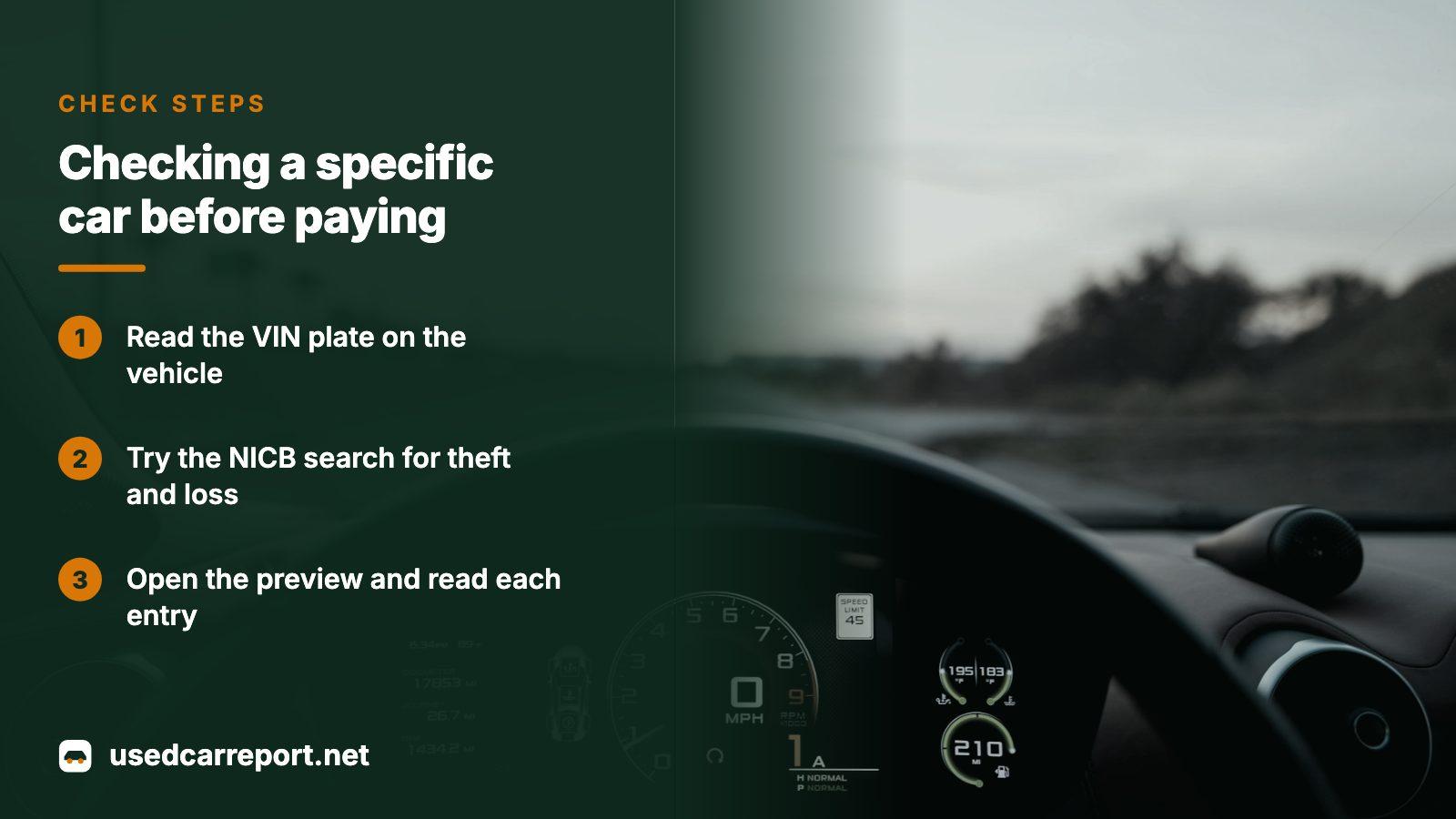
- Read the VIN plate on the vehicle and check it against what the seller hands you.
- Try the no-cost NICB search for theft and total-loss hits.
- Open our preview and read the damage and title sections.
- Spend on the full report once the car has survived your shortlist.
- Book an independent inspection and give the mechanic the report.
Our guide to how a VIN accident check works explains the sources behind each entry, and the damage-reported page covers how to read the vague wording some reports use.
If you are the one selling
Owners often ask whether a repaired crash will eventually vanish and make the car easier to sell. We found nothing official that promises it. A better plan is to keep the repair invoice, the photos from before and after, and any inspection note, then show them early. A buyer who sees a documented repair has less reason to assume the worst than one who finds an entry later.
Run your own VIN before listing so that nothing on the report surprises you. If an entry looks wrong, ask whoever reported it to correct the record, and keep a copy of the exchange.
What to do with this answer
Stop looking for a number of years. Treat every history report as a floor, not a ceiling: it shows what someone chose or was required to report. The price you should pay depends on what the car looks like underneath, and only an inspection settles that.
If you want to see how a car's VIN reads on our side, the preview takes a minute and costs nothing.
Where this information comes from
- NMVTIS: understanding a vehicle history report — what the federal title record covers and how brands are kept
- NMVTIS: used car buying tips — inspection advice and the free NICB database
- NICB VINCheck — free theft and salvage lookup and its limits
- FTC: buying a used car — reports do not replace an inspection
- NHTSA consumer alert on replacement air bag inflators — advice for buyers of cars with earlier air bag deployment
Sources and photos: Facts checked against the sources above in November 2026. Photos by Anastasiia Nelen, Dennis Eusebio and Maurice Sahl on Unsplash; diagrams by UsedCarReport.
Keep reading
- VIN accident check: read the damage records before you buyhow an accident check by VIN works and where its data comes from
- Damage reported on Carfax: how to read the line before you buyreading the vague damage line on a report
- How to tell if a car was in an accident: check the record, then the carphysical signs a report may not show
- Car accident history with pictures: what a VIN check showsseeing damage photos from past records
Frequently asked questions
Does an accident ever fall off a Carfax report?
We could not confirm a rule either way. Carfax's own pages would not open for us, and no federal page we read sets a retention period. Brand and salvage history is kept by the federal title system, so a serious crash should be treated as lasting. Check the actual car instead of waiting for an entry to clear.
Is a seven-year rule real?
We found no official source for a fixed period of years, so we do not repeat one. Treat any number from a forum or a seller as unverified.
Why does a car I know was in a crash show no accident?
Reports only hold what was reported. A repair paid in cash, a claim that never reached a database or a private fix leaves no trace. A clean report says nothing was recorded, which is different from nothing happening.
Can a branded title be removed?
We did not find an official page describing removal, and the federal title record lists brands applied in any state. If a seller claims a brand is gone, ask for the title records from each state the car has been titled in and run the VIN.
What should I check if the report looks clean?
Inspect the car with a mechanic, look for panel and paint differences, confirm air bags are genuine if there was ever a deployment, and try the NICB search. Then compare the title and odometer entries against the seller's paperwork.
Now check the car itself
The guide explains what to look for. The report shows what this VIN has on record.