THE SHORT ANSWER
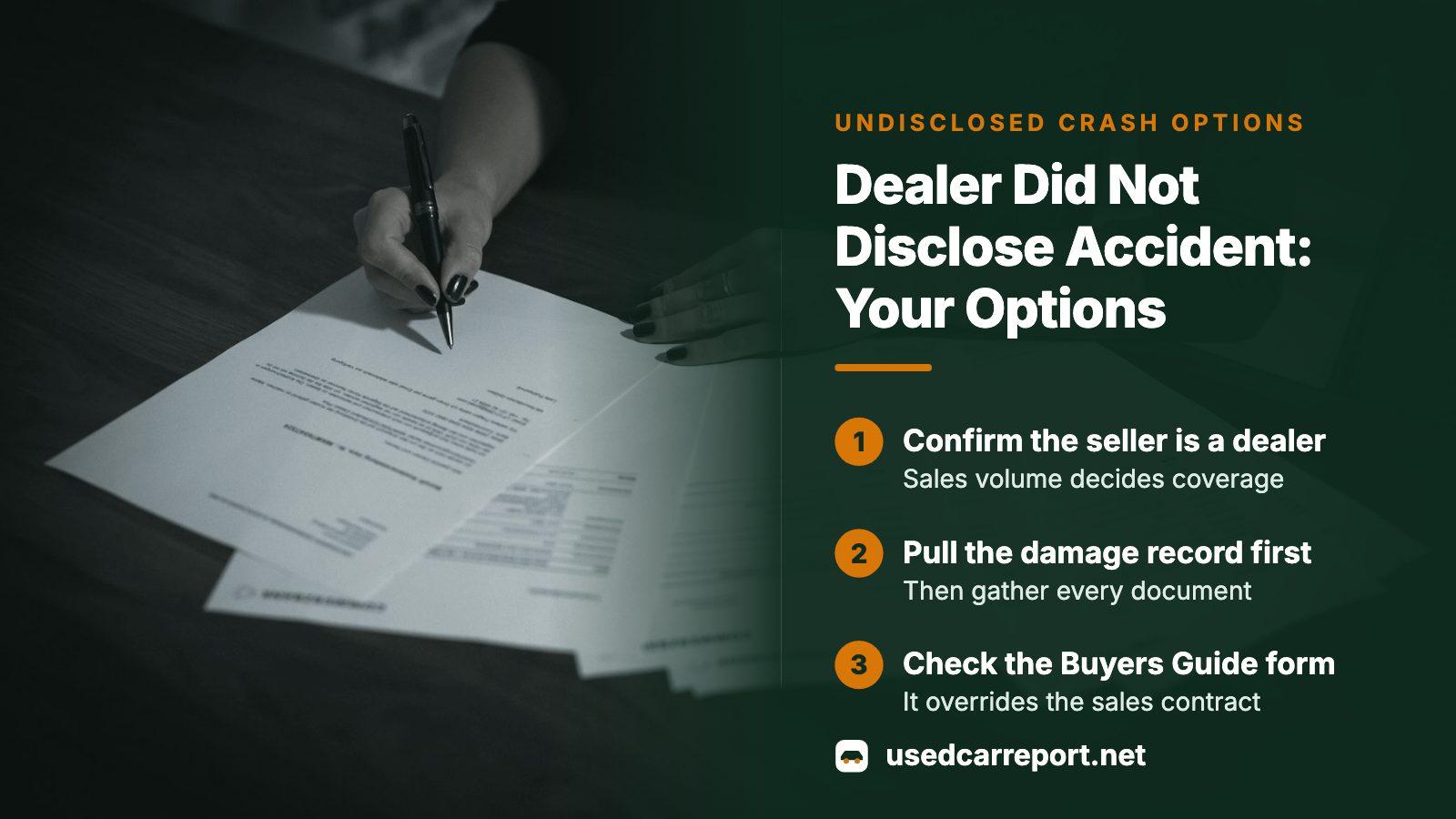
The federal Used Car Rule in 16 CFR Part 455 forbids a dealer from misrepresenting mechanical condition and from contradicting the Buyers Guide, but its text does not list accident history. Your strongest claims usually come from state consumer law, a false statement in writing, or a warranty. Start with the VIN's damage record, your contract and the Buyers Guide, then contact your state attorney general.
- Federal rule
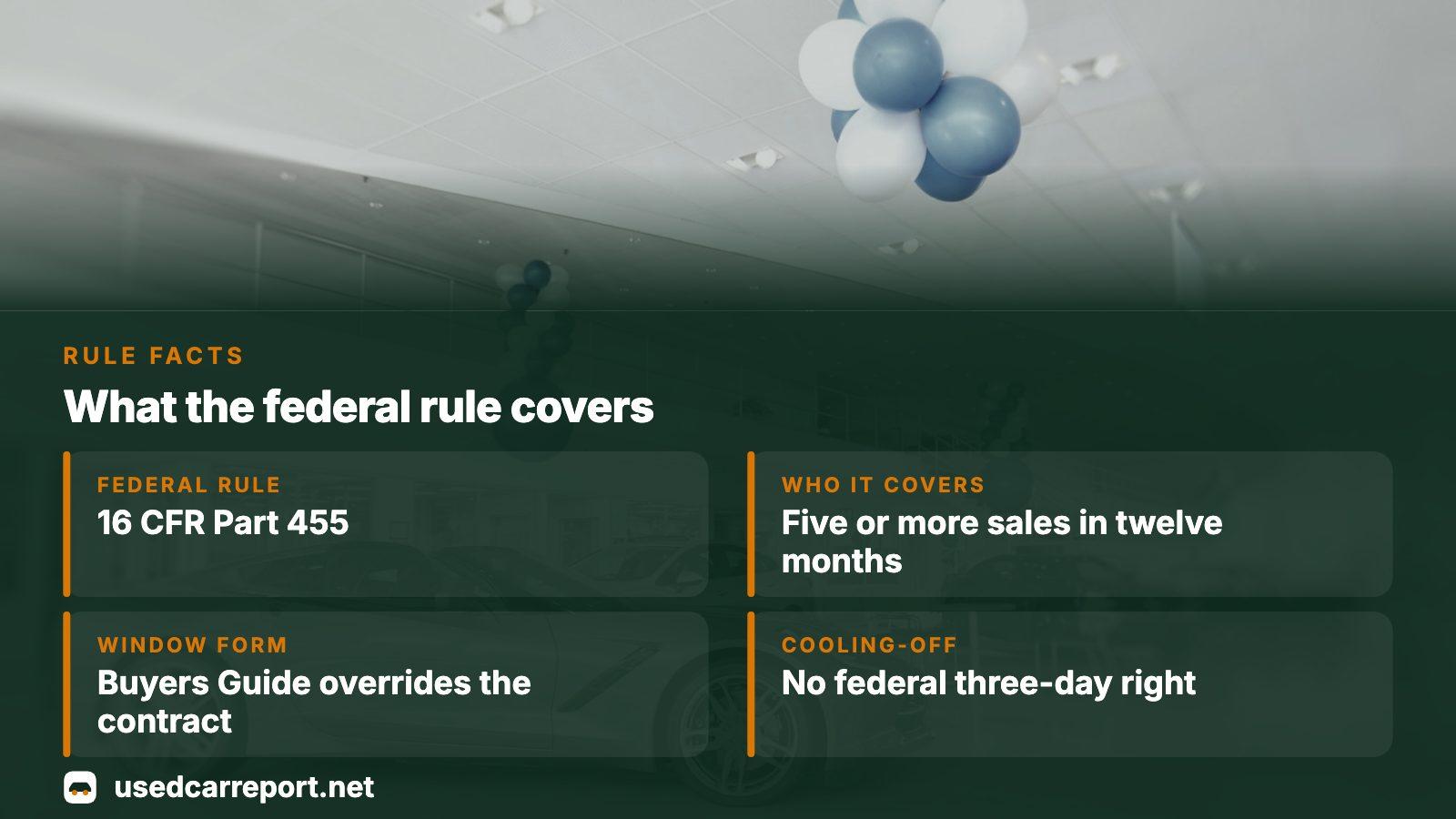
- 16 CFR Part 455 covers dealers with five or more sales in twelve months
- Window form
- The final Buyers Guide overrides the sales contract
- Cooling-off
- No federal three-day right to cancel
- First move
- Pull the VIN's damage record and keep every document
What the federal rule says, and what it leaves out
Most buyers assume a dealer must reveal every past crash. The federal rule that governs used car lots is narrower. It makes it a deceptive practice for a dealer to misstate a used vehicle's mechanical condition or its warranty terms, and it requires a Buyers Guide on the window. When I read the rule's full text, I found nothing in it that names accident history or earlier body damage as something a dealer must volunteer.
That gap does not make a hidden accident acceptable. It means the legal route often runs through other doors: a state consumer protection statute, a written statement that turned out false, or a warranty. Each of those depends on facts you can document, so the next steps are about evidence, not argument.
Not legal advice
State laws on damage disclosure vary, and this page cannot say what applies where you bought. Your state attorney general's consumer office can tell you which rules cover your sale.
Whether the seller counts as a dealer
The rule defines a dealer by volume. Anyone who has sold or listed at least five used cars over the past year counts when the next one goes up for sale. Banks, sales to the seller's own employee and certain lessor sales are carved out. A driveway seller with one car is outside the rule, while someone flipping cars every month is inside it whatever the sign says.
This matters because the window form, the contract override and the ban on contradicting statements apply only to a dealer as the rule defines one. If you are unsure which side your seller sits on, note how many cars they had listed and keep the advertisement.
Pull the damage record before anything else
A complaint with a dated record behind it gets taken more seriously than one built on a suspicion. Run the VIN through a report that shows accident and damage entries, salvage or total-loss history and title brands, and save the result with the date you ran it. Our free preview tells you whether entries like these exist for the VIN, and the detail sits behind one paid report.
Federal title data has limits worth knowing. The Justice Department's NMVTIS gathers data from state title offices, scrap and salvage operators, recyclers and insurers, and its reports are deliberately short. They do not carry repair histories. A minor collision repaired with cash may appear nowhere, so a clean record does not prove a clean car.
- Any accident, damage or total-loss entry, with its date and source
- A salvage, rebuilt or other title brand
- Odometer readings that fall out of sequence
- How the dates compare with the day you bought the car
Gather the paperwork that decides the outcome
Federal guidance is blunt that spoken promises are hard to enforce, so the written record carries the case. The final Buyers Guide is part of your contract and overrides any contrary term in it. A dealer also may not make statements that alter or contradict what that form discloses.
- The Buyers Guide you were handed at delivery, with the warranty box that was ticked
- The signed contract and every addendum
- The original listing, screenshots and any text or email in which the dealer described the car
- Your damage record and the date you pulled it
- Photos of the repair evidence, such as paint mismatch or uneven panel gaps
- Any independent inspector's written report
A line like 'no accidents' in an advertisement or message is a different kind of fact from silence. A statement you can show in the dealer's own words is the strongest thing in the pile.
How an as-is sale affects your options
If the as-is box was ticked, the dealer is not promising to pay for later problems, and the FTC tells buyers to write any verbal promise on the form itself. In states that limit or prohibit as-is sales, an implied warranty disclosure replaces that box, and implied warranties under state law may give you some rights to have serious problems addressed.
As-is language protects a dealer against repair bills. It does not by itself excuse a false statement about the car's history, which is a separate question that state law answers. Do not assume the box ends the matter, and do not assume it wins you the case either.
| What you hold | Why it helps |
|---|---|
| Written 'no accidents' claim | Shows a specific statement you can compare to the record |
| Buyers Guide with a warranty | Overrides contrary contract terms |
| Damage record dated after purchase | Shows the history existed and was findable |
| Only a spoken assurance | Hard to prove, so weigh it lightly |
Where to take the complaint
When talks with the dealer stall, the FTC points to three routes: the attorney general in your state, an independent dispute resolution body, or small claims court, which is often workable without a lawyer. A separate federal statute, Magnuson-Moss, allows suits over broken warranties or service contracts, with fee recovery for a winning buyer, so ask a lawyer whether your facts fit.
Write a short, dated letter to the dealer first. State what you bought, what the record shows, and what outcome you want, such as a repair payment, a price reduction or a return. Send it in a way that leaves a receipt, and keep a copy. A clear request often gets a faster answer than a phone call that nobody logs.
Do not count on a return period
No federal rule hands a dealer's customer three days to cancel. Some states require dealers to offer a right to cancel, and in others a return option exists only if the dealer chose to provide it. Check with your state attorney general, and read your contract for any return language the dealer wrote in.
If you are still weighing a purchase rather than complaining about one, this is the reason to run the damage check before you sign. After signing, you are negotiating. Before signing, you can simply walk away.
Stop it happening on your next purchase
Run the VIN yourself rather than relying on a report the dealer prints. Ask for the Buyers Guide before you talk price, and pay an independent mechanic for a written inspection. The FTC notes that a history report tends to show crashes and floods but not worn-out parts, which is why the two checks do different work.
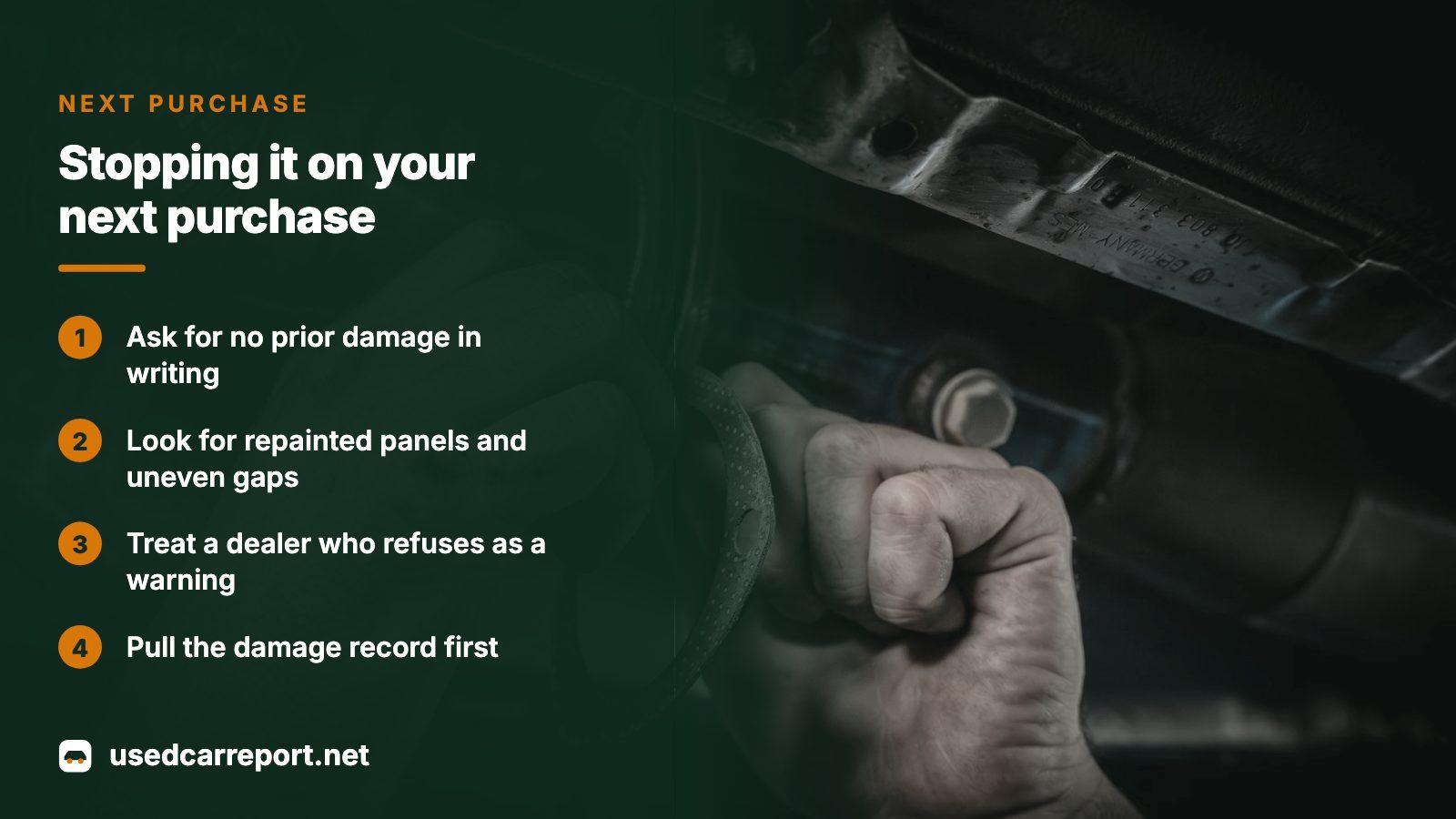
- Ask the dealer for 'no prior damage' in writing, on the contract
- Look for repainted panels and uneven gaps in daylight
- Treat a dealer that refuses an outside inspection as a reason to shop elsewhere
- Check your state's consumer protection office for unresolved complaints about the lot
Our accident check page explains how to read the entries once you have them, and the inspection page covers what a mechanic should look at.
Where this information comes from
- eCFR: 16 CFR Part 455, Used Motor Vehicle Trade Regulation Rule — dealer definition, Buyers Guide, contract override and contrary statements
- FTC Consumer Advice: Buying a Used Car From a Dealer — as-is sales, inspections, return rules and dispute options
- NMVTIS: Consumers — what title and brand data the federal system holds and where it comes from
- NMVTIS: Understanding the report — why the federal report is short and omits repair histories
Sources and photos: Facts checked against the sources above in November 2026. Photos by Dimitri Karastelev, Martin Fennema and Richard R on Unsplash; diagrams by UsedCarReport.
Keep reading
- VIN accident check: read the damage records before you buyHow to read accident and damage entries once you have a record.
- Used car private seller vs dealer: what each owes you and what neither doesWhat protections change depending on who sells the car.
- Pre-purchase inspection: read the damage records, then hire the mechanicWhat an independent mechanic should check before you pay.
- Damage reported on Carfax: how to read the line before you buyWhat a damage-reported entry means for the car's condition.
Frequently asked questions
Is a dealer legally required to tell me about a past accident?
The federal Used Car Rule's text covers mechanical condition, warranties and the Buyers Guide, and I found no line there that names accident history. State law is where disclosure duties usually sit, and they differ. Ask your state attorney general's consumer office which rules cover your sale.
Can I return the car if the dealer hid damage?
There is no federal three-day cancellation right. Some states require a cancellation right, and elsewhere a return window exists only if the dealer offers one. Your contract and a call to your state attorney general will tell you whether you have one, so do that quickly.
Does a clean damage report prove the car was never in a crash?
No. Records come from insurers, salvage yards, recyclers and titling agencies, so a crash repaid in cash or fixed privately may never be reported. A clean record lowers the odds. An independent inspection catches repair signs that a database cannot.
Does an as-is sticker mean I cannot do anything?
As-is means the dealer is not promising to pay for later repairs. It does not settle whether the dealer made a false statement about the car's history. That question depends on state law and on what the dealer said in writing, so keep every message and listing.
What should I do first after finding the accident?
Run the VIN and save the record with the date. Then collect the Buyers Guide, contract and any written description of the car. With those in hand, send the dealer a dated letter stating the problem and your requested remedy, and contact your state attorney general.
Now check the car itself
The guide explains what to look for. The report shows what this VIN has on record.