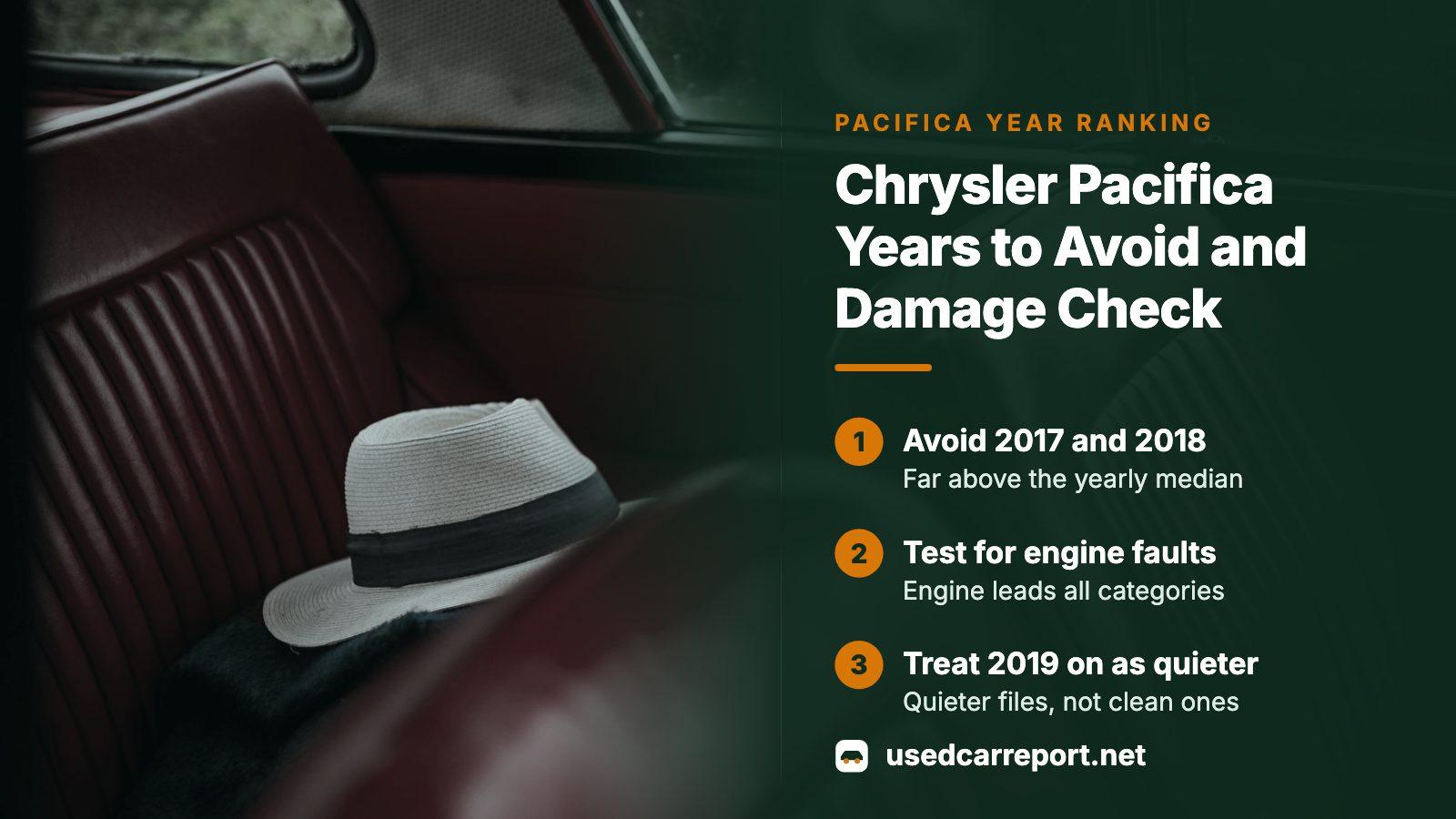
THE SHORT ANSWER
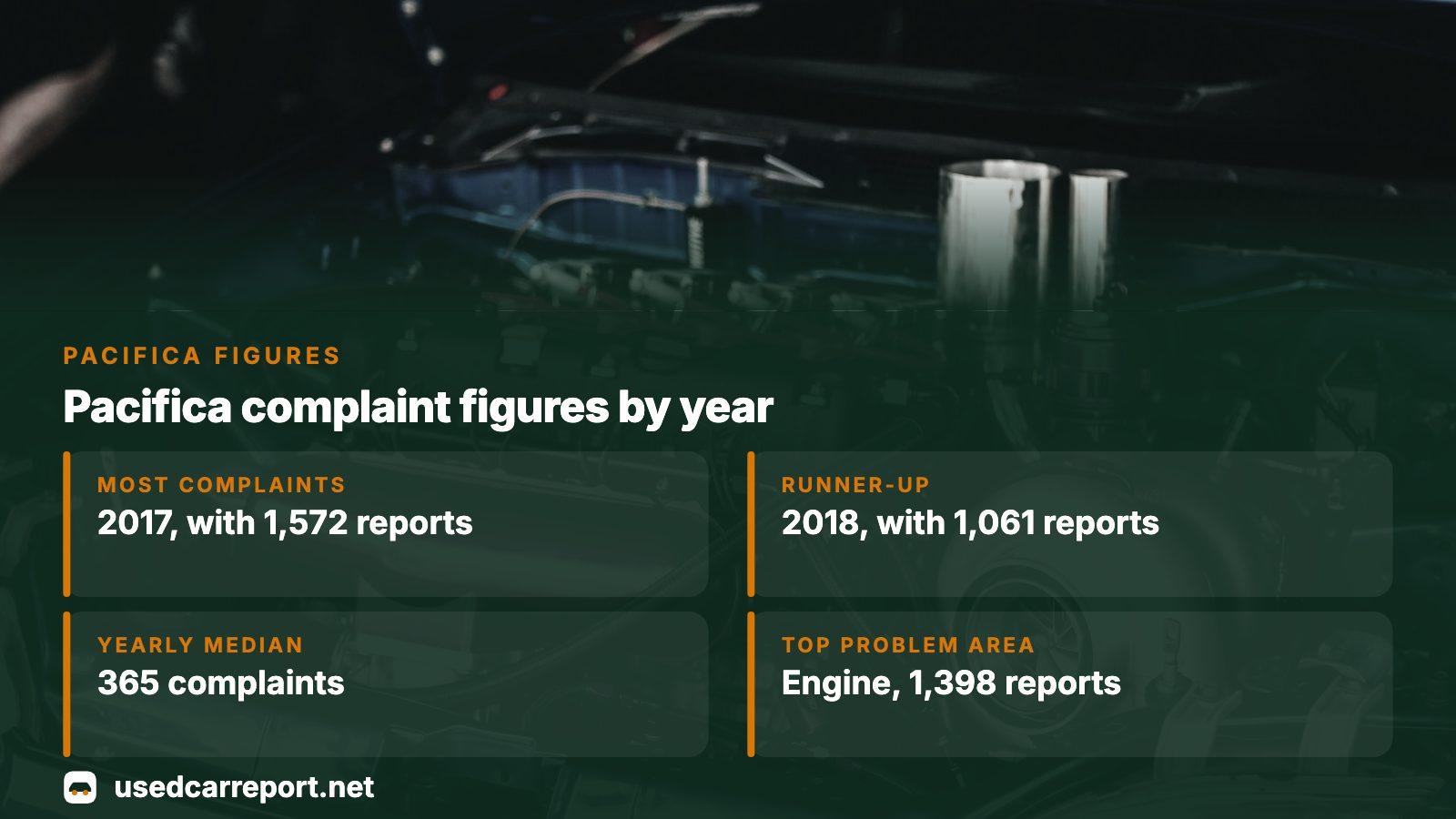
NHTSA holds 3,900 Pacifica complaints for 2017 to 2022. The 2017 and 2018 model years sit far above the median of 365, at 1,572 and 1,061, and engine is the biggest category overall. The 2019 to 2022 vans land near the median. No year is clean enough to skip an inspection, and one van's accident and damage record counts for more than its model year.
- Most complaints
- 2017, with 1,572 reports
- Runner-up
- 2018, with 1,061 reports
- Yearly median
- 365 complaints
- Top problem area
- Engine, 1,398 reports
How the six Pacifica years rank on owner complaints
The NHTSA file behind this ranking covers the 2017 to 2022 minivans: 3,900 owner complaints, pulled in August 2026. Anything older is outside it. The table's multiple divides a year's count by the median of 365, so 2 means twice a typical year.
| Year | NHTSA complaints | Versus the median | Recalls | Reading |
|---|---|---|---|---|
| 2017 | 1,572 | 4.31 | 11 | Well above |
| 2018 | 1,061 | 2.91 | 12 | Well above |
| 2019 | 344 | 0.94 | 7 | Near the median |
| 2020 | 222 | 0.61 | 5 | Fewest complaints |
| 2021 | 385 | 1.05 | 7 | Near the median |
| 2022 | 316 | 0.87 | 10 | Near the median |
Together, 2017 and 2018 hold about two thirds of all complaints. Totals drift: a live lookup on 5 November gave 1,545 for 2017 and 895 for 2018, with those two still far ahead. Trust the order over the exact counts.
What owners of the flagged vans write about
By component across all six years, engine tops the list at 1,398, then the electrical system at 1,236, the power train at 1,057 and steering at 457. In the newest 2018 filings a story repeats: one cylinder misfires, the check-engine light keeps coming back, then coolant shows up where it should not, ending in a head gasket or cylinder head job.
From an NHTSA owner complaint
A used 2018 Pacifica came home in October 2025 showing roughly 97,000 miles. A rough idle crept in and worsened until the van would not start, and it had about 107,000 miles by the time the owner filed. The selling dealer found a blown head gasket; Chrysler declined to help and the dealer offered to cover only part of the bill.
The owner accepts that warranties have limits but questions how a maker can sell something with an apparent defect and then refuse support. These are unverified accounts, so treat them as tests to run, not proof.
What an engine fault can cost, and how to test for it
From an NHTSA owner complaint
At 90,100 miles a 2018 Pacifica set a cylinder 5 misfire code three times in about a month. A shop changed the plugs and a coil, cleared the code once, then found coolant leaking into the cylinder and quoted $12,000 for an engine. A Chrysler dealer quoted $6,200, for a cylinder head. The owner says Chrysler and the dealer both refused goodwill help over the van's age, and calls it unsafe to drive.
One fault, two very different quotes: get a second opinion before agreeing to any repair, and leave goodwill help out of your offer math. Give your mechanic this list.
- Engine: start it cold, check the coolant level, ask for a scan of stored misfire codes.
- Electrical: note which warning lights linger after start-up and how stop/start behaves.
- Power train: feel for harsh or late shifts under load, and for hesitation.
- Steering: turn the wheel at parking speed and watch for sudden heaviness.
Recalls on the flagged years, and the 15-year clock
NHTSA lists 11 recall campaigns for 2017 and 12 for 2018, and only a VIN shows which touch one van, since campaigns follow production ranges. On the 2018 list, campaign 18V492000 covers a possibly mis-welded transmission part that could leave the van immobile. Campaign 18V524000 replaces the powertrain control module because an internal regulator chip may fail, causing a stall or no-start. Campaign 19V348000 ties power steering dropouts and stalls on stop/start vans to a loosened battery ground.
Free recall repairs also expire. The free-repair duty in 49 U.S.C. 30120(g) ends once more than 15 calendar years separate a van's first sale from the notice date, so age is judged then, not today. Ask the seller for dealer paperwork on every campaign, then enter the VIN on NHTSA's recall page, a lookup that costs nothing.
The 2019 to 2022 vans: quieter files, not clean ones
These four years sit between 0.61 and 1.05 times the median. The lightest is 2020 with 222 complaints, though newer vans have had fewer years to attract reports, which flatters them.
A thin complaint file can still hide a serious recall. Campaign 26V362000 covers 2020, 2021 and 2022 plug-in hybrid Pacificas, where the battery pack can ignite even when the van is parked and switched off. Owners are told to stop charging and keep the van outside, away from other structures, until repaired. On a plug-in, confirm the VIN shows it closed before talking price.
Why the accident and damage record outweighs the model year
Complaint counts show how a model year held up mechanically. A collision, an insurance claim or a stop at a salvage auction happened to one van. Take two Pacificas at the same asking price, a 2020 with 222 complaints and a 2018 with 1,061. The 2020 wins on paper. If it took a hard hit and a cheap repair, the unmarked 2018 may be the safer buy.
- Accident and damage entries first, with dates and the impact areas on the damage map.
- Brands on the title, including salvage and rebuilt, plus any insurance claim records.
- Salvage or auction photos, which show the van as it sat before repair.
- Open recalls, then ownership and use history, such as time as a rental.
A private-sale Pacifica and a mileage gap
From an NHTSA owner complaint
One owner paid for a 2017 Pacifica in a private deal with 139,000 miles on the dash. Trying to sell it on to a dealership later, the owner hit a mileage mismatch and puts the true figure at 158,000. The complaint is labelled odometer fraud and does not say how the gap was confirmed, who caused it, or what happened next.
On a van with several owners, put every mileage reading in date order before paying: dash, latest service receipt, inspection record and each history entry. A reading that drops, or a long stretch with none, needs the seller's answer while leaving is still free.
Run the VIN before you pay for an inspection
Ruling a van out on paper costs less than doing it on a lift. Find the 17-character number low on the windshield at the driver's corner and match it to the door-frame sticker, the title and the ad. Its tenth character encodes the model year, a quick test of a listed 2018.
- Photograph the VIN at each spot and compare the photos with the title.
- Run the preview, then open the full report on any van still in contention.
- Read accident and damage records first, then title brands, salvage photos and odometer readings.
- Check open recalls on NHTSA's own site; searching a VIN there carries no fee.
- Book an independent inspection using the list above.
The preview comes first, and it is free. A van that survives the cut gets the full report for a single payment, with no plan to cancel afterwards, and a set of 3, 5 or 10 suits a long shortlist. Pricing has its own page.

Where this information comes from
- NHTSA owner complaint 11748563 — owner experience, paraphrased
- NHTSA owner complaint 11758848 — owner experience, paraphrased
- NHTSA owner complaint 11761525 — owner experience, paraphrased
- NHTSA: vehicle safety and the complaint database — Where the Pacifica owner complaints behind the yearly counts are filed.
- NHTSA: recalls by vehicle — Shows which recall campaigns are open on one van, searched by VIN.
- 49 U.S.C. 30120: remedies for defects and noncompliance — The statute behind free recall repairs and the 15-year limit.
- NMVTIS: national motor vehicle title information system — The federal program aimed at title fraud and resale of stolen vehicles.
Sources and photos: Facts checked against the sources above in November 2026. Photos by Nik, Alejandro Escamilla and Willian Cittadin on Unsplash; diagrams by UsedCarReport.
Keep reading
- VIN accident check: read the damage records before you buyWhat the damage entries on a VIN record can and cannot tell you.
- Check mileage history by VIN: six steps, damage records firstHow to compare odometer readings and catch a rollback before paying.
- Buying a car with an open recall: read the damage record firstWhat an unfinished recall repair does to your price and paperwork.
- Toyota Sienna years to avoid: 2011, 2008, 2012 and the damage checkThe same year-by-year complaint ranking for a rival minivan.
Frequently asked questions
Which Chrysler Pacifica years are worth avoiding?
By NHTSA owner complaints, 2017 and 2018: 1,572 and 1,061 reports against a median year of 365, with engine the lead category. That earns a van a closer inspection and a firmer price, not a veto, since many from both years run fine. Read the specific van's VIN record first.
Is the 2017 Chrysler Pacifica a bad year?
It carries the heaviest file: 4.31 times the median year, at 1,572 complaints, plus 11 recall campaigns. Complaints are unverified, and recall repairs cost the owner nothing where a van falls in the affected range. Ask for dealer paperwork on each campaign, test the engine, and read the damage and odometer entries.
Which Pacifica years are the most reliable?
None earns a clean bill. The 2019 to 2022 vans sit near the median, and 2020 has the fewest complaints at 222, but newer vans have had fewer years to attract reports. A van's service records and a hands-on inspection say more than its year, and any 2020 to 2022 plug-in needs its battery recall checked by VIN.
Do more complaints mean a worse car?
No, not automatically. Complaint totals grow with the number of vans sold and the years they have been driven, and each entry is a single owner's unverified account. For that reason every year here is compared with the Pacifica's own median rather than with other models. A high total says where to look; it cannot say what happened to one van.
Can I skip the damage check if the year looks good?
No. Complaint files track mechanical trouble by model year. They cannot show whether a particular van was in a collision, sold through a salvage auction or had its mileage altered. Those facts live in VIN-linked records, so even the quietest year deserves a damage, title and odometer check before you pay.
Now check the car itself
The guide explains what to look for. The report shows what this VIN has on record.