THE SHORT ANSWER
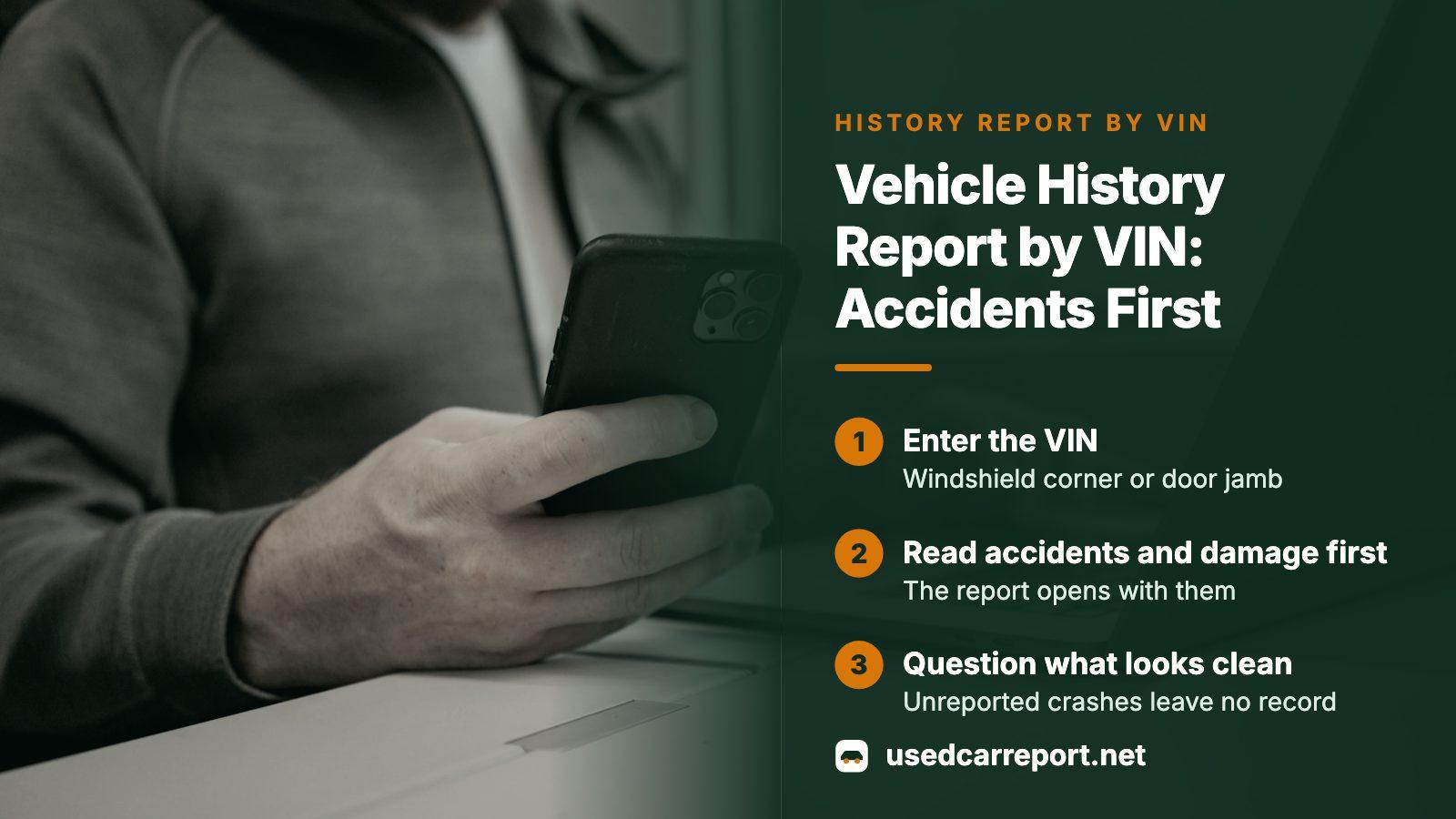
A vehicle history report is a VIN-based record of what has been reported on a car. Type in the VIN, scan the free preview for the record types that exist, and spend on the complete record only when the car keeps its appeal. Read accidents and damage first, then title brands and odometer readings. Government sites cover pieces of the record, not all of it, and a quiet report never proves that nothing happened.
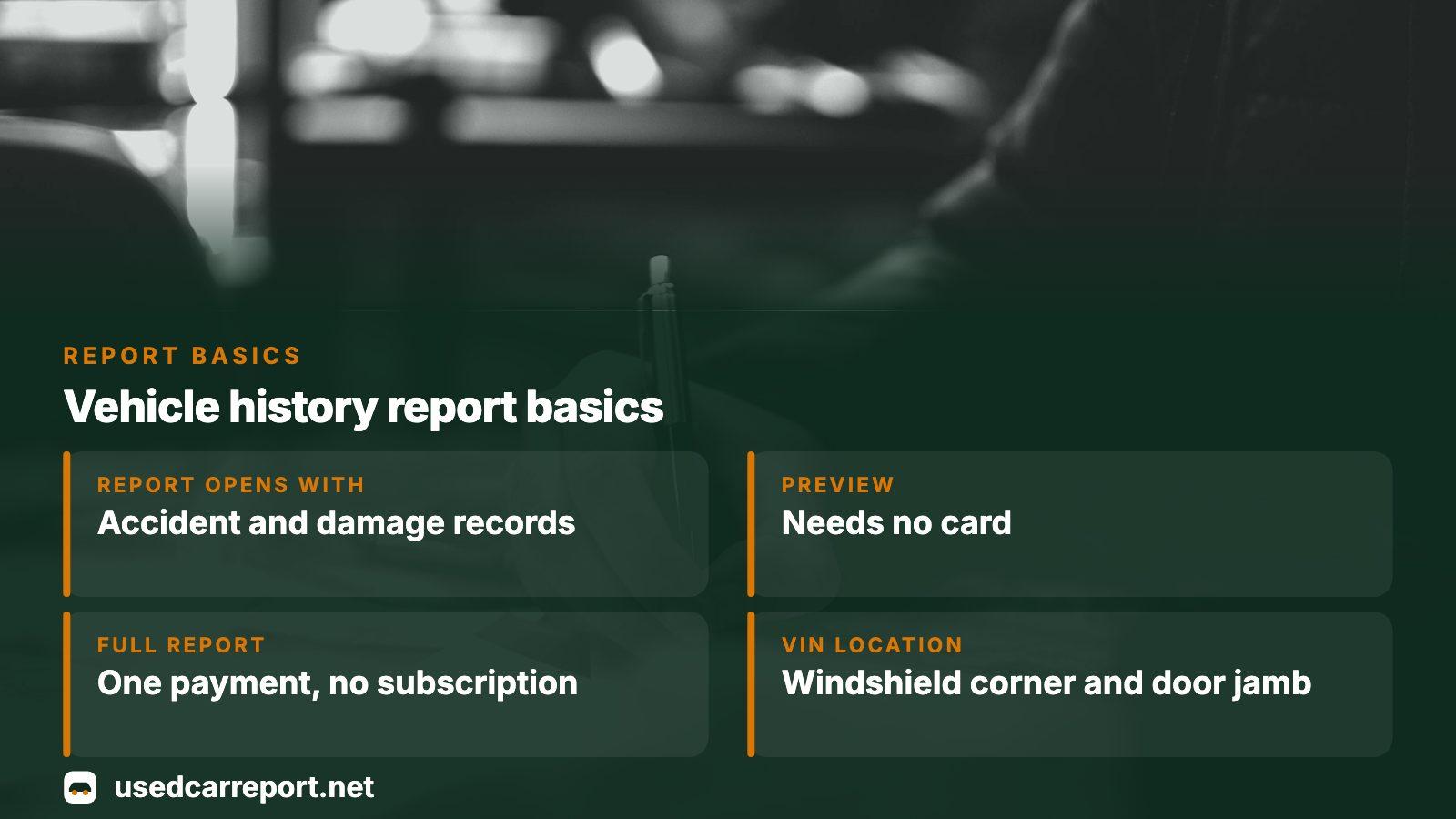
- Report opens with
- Accident and damage records
- Preview
- Free, no card needed
- Full report
- One payment, no subscription
- VIN location
- Windshield corner and door jamb sticker
What the report shows, in the order it shows it
Most buyers want one answer before any other: has this car been hit? The report starts there. Accident and damage records sit at the top, and every other record type follows beneath them.
| Record | What it tells you |
|---|---|
| Accident and damage | Collisions and damage that reached an insurer, a police agency or another reporting source |
| Title brands | Salvage, rebuilt, flood and other brands, and the state that applied each one |
| Odometer readings | Dated mileage from titles and inspections, so a rollback appears as a number that drops |
| Salvage and auction history | Auction listings and the photos that came with them |
| Liens and impounds | A lender with a claim on the car, or time spent in an impound lot |
| Theft and insurance records | Theft reports, plus insurer actions such as a total loss |
| Open recalls | Safety recalls that have not been repaired |
| Ownership and use type | How many owners, and whether the car was personal, rental or fleet |
| Market value and factory specs | A value estimate and the build the car left the factory with |
Running a vehicle history report online from start to finish
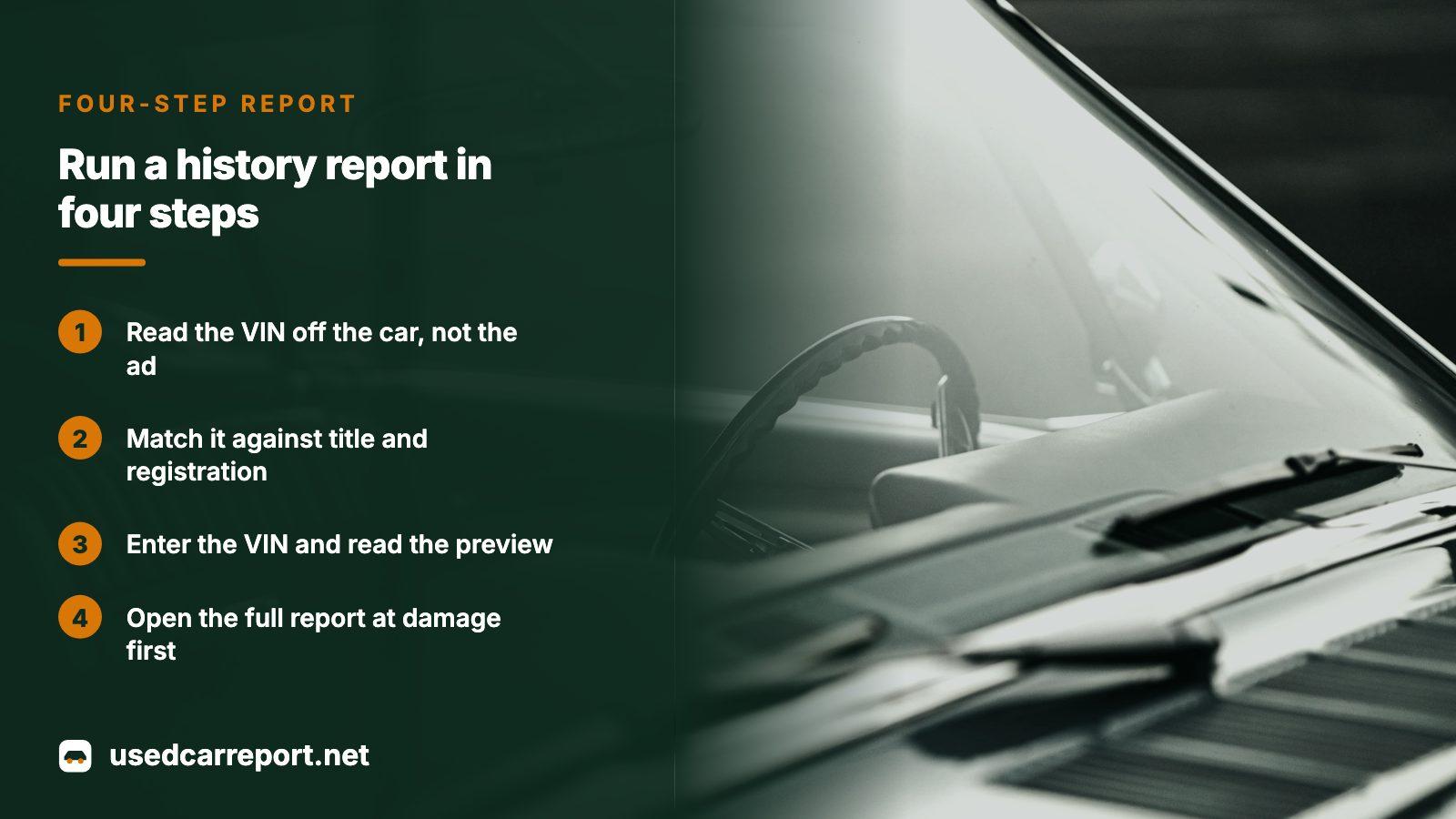
- Copy the VIN off the car in front of you, because the advert can be wrong. Look for the plate at the left end of the dash, just under the windshield, and a sticker repeats it where the driver's door closes.
- Match it against the title, the registration and the ad. All 17 characters should agree. A mismatch is a question for the seller before anything else.
- Enter the VIN on this page. The preview counts the records on file for that car, so you see what the full report holds before paying.
- Open the full report and go straight to the accident and damage section.
One more check costs nothing. The tenth character of a VIN stands for the model year. If it points to a different year than the seller states, ask why before spending another hour on the car.
Reading the results: what to question, and what to do about it
Read accidents first, brands second, mileage third, then the rest. These entries should change your offer or end the visit.
| Finding | What it suggests | Your move |
|---|---|---|
| Accident record, seller says nothing | A repair happened and its quality is unknown | Ask for the invoices, then book a body and frame inspection |
| Salvage, flood or rebuilt brand | The car is not an ordinary used car | Price it as one, and read the issuing state's definition of the brand |
| Mileage that drops between readings | Rollback, or a data error | Get both dates from the seller; no explanation means no deal |
| Auction photos showing damage | The car was wrecked and sold through an auction | Match the photos to the panels in person |
| Open lien | The loan on the car may not be paid off | Pay nothing until the lien is cleared in writing |
| Theft or impound entry | The car had a rough stretch in its past | Ask what happened and confirm the record is closed |
What a clean report does not prove
A clean report means the sources behind it had nothing to say about the car. That rules out the loud problems cheaply, and it still falls short of a guarantee. A collision paid for out of pocket, with no claim and no police report, leaves nothing for any report to carry. The obligation on insurers covers this model year plus four prior, leaving an older car that an insurer totaled outside what must be filed. Nobody measures a repaired frame for the record, and nobody publishes how an airbag system performs after a crash.
The report is the part you do from a chair
Structure, restraints and repair quality are physical questions. Hand the report to an independent shop doing a pre-purchase inspection, so the technician knows where to look first.
Government vehicle history report or an online one
Searches for a government vehicle history report tend to end at tools that each answer one narrow question. None of them is a full report. The federal title system, NMVTIS, does not sell to the public itself; a list of approved providers is published on a Justice Department site, and those providers charge. Some serve dealers only, so confirm a provider sells to individuals before entering a card.
| Source | Cost to you | What it answers |
|---|---|---|
| NHTSA recall lookup | No charge | Safety recalls still open on the VIN |
| NICB VINCheck | No charge | Reports of theft and total loss from insurers that take part |
| Approved NMVTIS provider | Paid per report | Title brands and total-loss, junk and salvage reports |
| UsedCarReport | Free preview, then one payment | Accidents and damage first, then title, odometer, liens, theft, insurance, recalls, ownership, value and specs |
An online report packs records like these together with accident, auction and insurance data for one VIN. That is the reason to buy one: a single sitting instead of four browser tabs.
What federal rules require, and what they leave to the seller of the report
No law sets out what a vehicle history report must contain. The duties sit on the data suppliers. Regulation 28 CFR 25.54 requires every state to pass its title data, brands included, to the national system on a 24-hour cycle. Insurers and salvage operators file monthly inventories of junk and salvage vehicles, and an operator handling fewer than five a year is exempt.
Salvage pools and salvage auctions count as salvage yards under the same rules, which is why auction entries so often turn up in a report. Everything past those filings, such as police accident reports, claims and service visits, is bought or gathered by each report seller. Two reports on one car can therefore differ without either being wrong.
What it costs: free preview, one payment
The preview is free and asks for no card. It lists which record types exist for the VIN, which is usually enough to judge whether the rest is worth paying for. Keep going and you pay a single time, per car or for a 3, 5 or 10 set when the shortlist is long. Nothing renews, since no subscription exists. Today's prices are listed on the pricing page. Make the call once you have seen the preview, not ahead of it: if the VIN shows nothing that interests you, you have lost a minute and nothing else.
After the report: negotiate, inspect or walk away
- Nothing found: keep going to the test drive and an inspection. A clean report earns the car a closer look, not a purchase.
- Findings the seller can document: use them to set the price, and let the inspection confirm the repair.
- Findings the seller cannot explain, such as a brand, an odometer drop or an open lien: leave. Other cars are listed.
If the seller hands you a report of their own, run the VIN yourself anyway. Read the number off the car, because a printout can describe a different vehicle.
Where this information comes from
- NMVTIS: Vehicle history and approved providers — Lists the approved providers consumers use to get federal title data, and flags which ones serve dealers only.
- 28 CFR 25.54: Responsibilities of the States — Sets the 24-hour reporting cycle and the title elements each state must send, brands included.
- 28 CFR 25.55: Responsibilities of insurance carriers — Covers the monthly junk and salvage inventory and its model-year window.
- FTC: Used cars, consumer advice — Federal buying guidance that includes getting a history report before you commit.
- NICB: VINCheck — The no-charge screen for theft and total-loss records from participating insurers.
Sources and photos: Facts checked against the sources above in November 2026. Photos by Anastasiia Nelen, Dylan Michaud and Owen Michael Grech on Unsplash; diagrams by UsedCarReport.
Keep reading
- VIN accident check: read the damage records before you buyA closer look at the accident and damage records that open the report.
- Sample reportSee how the records are laid out before you buy a report.
- PricingSingle report and pack options, with current prices.
- Pre-purchase inspection: read the damage records, then hire the mechanicThe hands-on step that covers what no report can.
Frequently asked questions
Is there an official government vehicle history report?
Not as one document. Federal and nonprofit tools each cover a slice: NHTSA for open recalls, NICB for theft and total loss, and the NMVTIS providers for title brands. The government pages mostly point you to those sellers.
How do I get a vehicle history report online?
Get the 17-character VIN, enter it on this site and read the preview. If the record types listed look worth seeing, pay once for the full report. It takes a few minutes, so you can do it on the lot.
Which is better for a vehicle history report, a .gov or a .com site?
They do different jobs. A .gov page explains the system and names approved sellers, and the recall lookup gives you a real answer at no charge. A commercial site sells the packaged report with accident and damage records. For a car you are about to buy, use both.
Does a vehicle history report show every accident?
No, only those that reached a source the report draws on, such as an insurer, a police agency or an auction. A crash repaired privately leaves no record. Treat a missing accident line as no information, then have a shop check the body and frame.
Is a vehicle history report ever free?
Only the preview is free. It needs no card and shows which records exist for the VIN. The full report costs one payment and never renews. Recall and theft screens from NHTSA and NICB cost nothing, though each covers one narrow question.
Now check the car itself
The guide explains what to look for. The report shows what this VIN has on record.