
THE SHORT ANSWER
Enter the 17 characters into an accident and damage check and it lists the crashes, total losses, auction photos and title brands tied to that car. It will not produce the officer's crash report. That file comes from the agency that investigated, and usually only goes to people involved, the owner or an insurer. Use the VIN check to learn what exists, then ask the seller for the report itself.
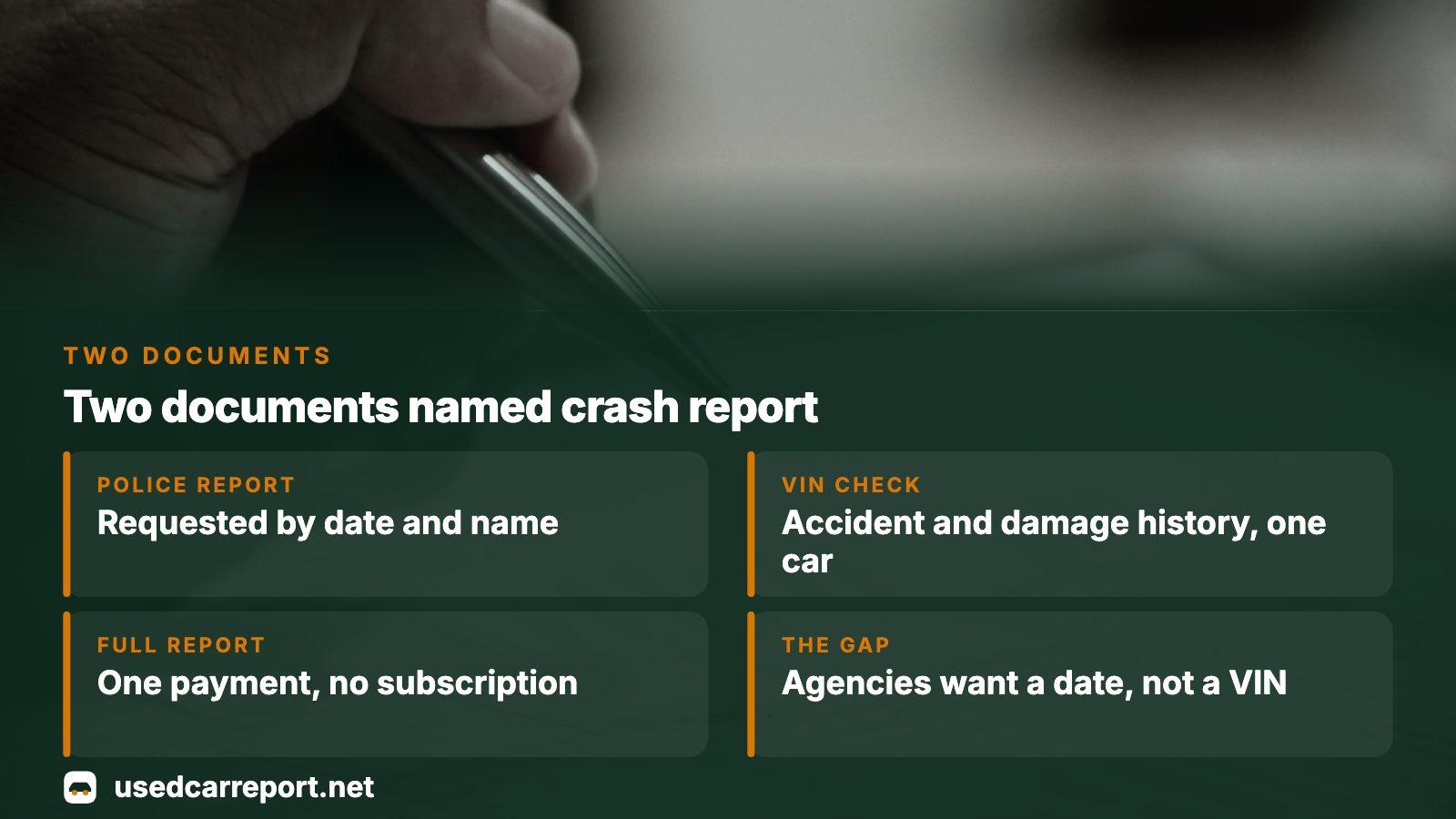
- Police crash report
- Requested from the agency by date, place and people
- VIN check
- Recorded accident and damage history for one car
- Preview
- Free, shows which records exist
- Full report
- One payment, no subscription
Two documents share the name crash report
Searches for a crash report by VIN number blur two different things. One is the police crash report, the form an officer completes after a collision. The other is an accident entry inside a vehicle history record, which a database assembles from insurers, auctions and title offices. Only the second can be found with a VIN.
| Question | Police crash report | Accident entry in a history report |
|---|---|---|
| Who writes it | The investigating officer or agency | Insurers, auctions, title offices and other reporting sources |
| How you find it | Crash date, place and the people involved | The car's VIN |
| Who can get it | Parties to the crash, owners and insurers | Any buyer who runs the VIN |
Why the police side asks for a date and a name, not a VIN
The agency pages we read treat the lookup as an event, not a vehicle. California's highway patrol asks for the crash date (an approximate one is accepted), the location and the driver or owner, and lets a party of interest, such as a driver, passenger, vehicle owner or an insurer with a claim number, request a copy.
Massachusetts sends police crash reports through its registry. An involved individual gives a license number, name and date of birth; the last four VIN digits appear only in the route for a registered business whose vehicle was in the crash. Texas sells its CR-3 online, with the full copy for people who have a proper interest and a redacted one for everyone else.
What the VIN search returns when the damage section leads
UsedCarReport builds its report around the first thing a buyer wants to know: has this car been hit? The accident and damage section opens the report. Entries differ in depth, so treat each as a lead to raise with the seller, not a verdict.
- Damage and accident entries, each tied to the source that reported it.
- Auction and salvage photos of the damage as it stood after the impact.
- Insurance entries, including a total loss where the insurer paid out instead of repairing.
- Title brands such as salvage or flood, and the state that issued the title.
- Dated odometer readings, which let you compare mileage from before and after a repair.
Running the VIN: where to read it and what to enter
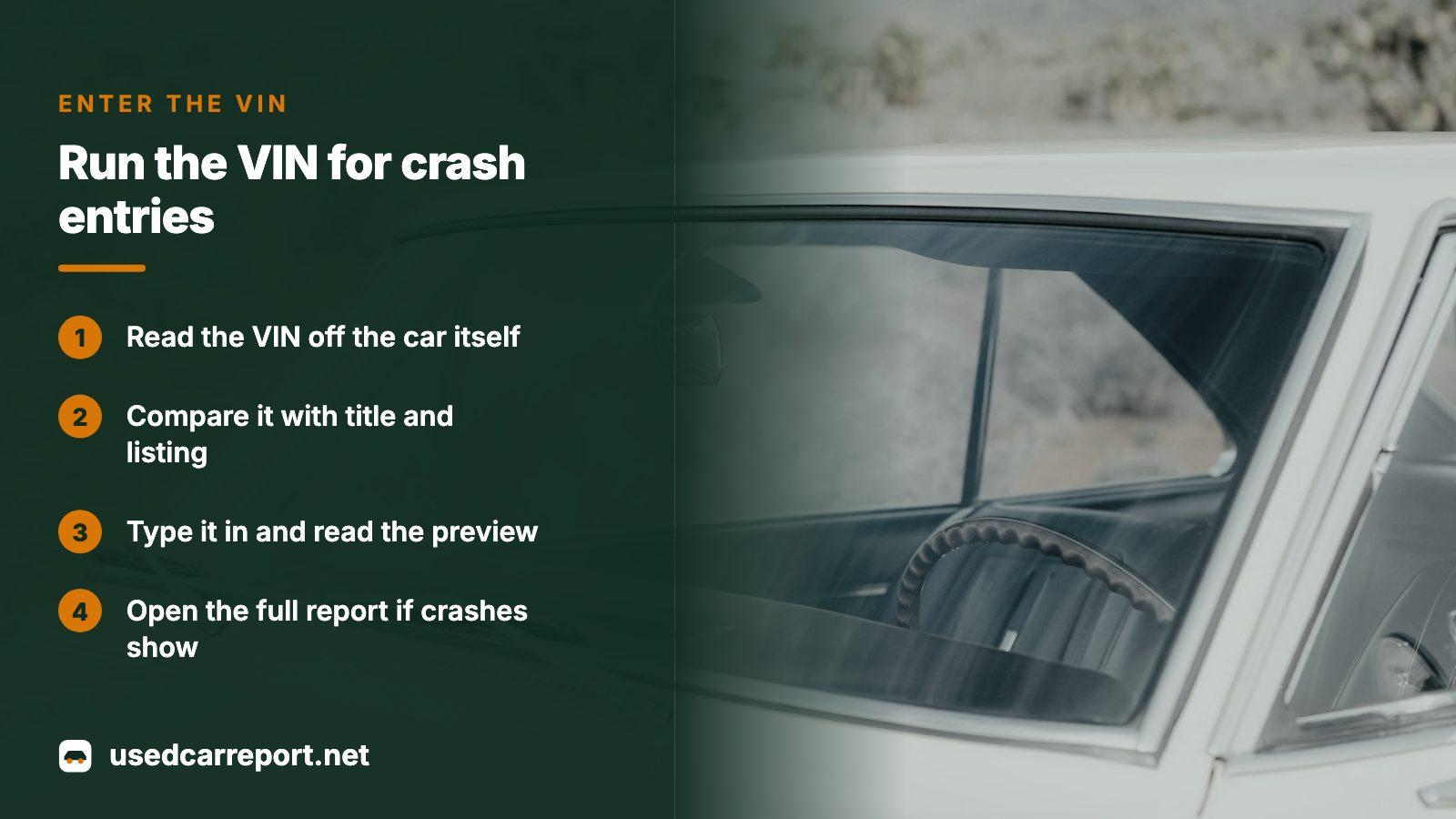
- Read the 17 characters from the car itself. NHTSA says to find it at the bottom left of the windshield; the registration card carries the same number, and the insurance card may too.
- Compare them with the title paperwork and the listing. A mismatch, even in one character, goes back to the seller before anything else.
- Type the VIN into the check and read the free preview, which lists the record types found for that car.
- Open the full report if the preview shows crash, damage or brand entries, or if the car is a serious candidate.
Work from the car, not the advert. NICB warns that a wrong VIN can miss a match, and a typo in a listing can return another vehicle's history.
Reading the results: what to ask when a crash entry appears
| What shows | What it suggests | What to do |
|---|---|---|
| A crash entry the seller skipped | A repair happened and nobody has shown you its quality | Ask for the invoice and the name of the shop |
| Auction photos with visible damage | The car changed hands after the impact | Match each photographed panel against the car in person |
| An insurer total loss | The repair bill passed the insurer's cutoff for the car's value | Look for a title brand and price the car as a branded one |
| Mileage that drops after a damage date | A rollback or a data error | Ask for both dates and leave without a clear answer |
| A crash date and place on the record | A police file may exist | Ask the owner to request it from the agency |
Quiet is not the same as cleared
NICB cautions that an empty VINCheck result is not proof of a spotless past. A crash nobody reported leaves nothing for any database to find.
No-charge checks, and where each one stops
| Tool | What it answers | Where it stops |
|---|---|---|
| NICB VINCheck | Whether participating insurers reported the VIN as stolen, salvage or flood-damaged | Insurer records only, no law enforcement data, and five searches in 24 hours per IP address |
| NHTSA recall lookup | Whether the car has an unrepaired safety recall | Repaired recalls, recalls older than 15 years and non-safety campaigns do not show |
| NMVTIS report from an approved provider | Issuing state, brands, odometer, plus any total loss and salvage history | No repair history, and accidents are not a category of their own |
Start with those, and buy a full report only for a car you would actually purchase. NICB says plainly that VINCheck cannot take the place of a full history report.
Getting the police report once a record points to a crash
When a history entry gives a crash date and place, the next move is the agency that investigated. A buyer is rarely a party to someone else's collision, so the seller, as the vehicle owner, is usually who the agency deals with. Owners are on the party lists in California and Texas and in the Massachusetts rules.
- Ask the seller for the crash date, the place and the agency's report number, if one exists.
- Ask the owner to request the report, or to authorize you to receive it where the agency allows that.
- Allow for processing. Massachusetts asks people to hold off for 4 weeks from the crash date, and Texas keeps its reports for 10 full calendar years plus the current one.
- Do not buy on a promise that the file will turn up later.
What the check costs here
The preview is free and shows which record types exist for this VIN. For the full report you pay once for each car, and if you are weighing a shortlist, there are multi-report packs in sizes of 3, 5 and 10. No plan renews, and the pricing page lists what each option costs. Pay when the preview points to crash, damage or brand entries, or when a missed collision would change your offer. If the car is already ruled out, stop at the preview.
After the check: inspect, negotiate or leave
- Nothing recorded: keep looking at the car. The FTC does not count a history report as a substitute for having the car inspected independently.
- An entry the seller can document: use the paperwork to set the price and let a mechanic confirm the repair. The FTC suggests a written estimate that lists the VIN, which backs up your offer.
- An entry the seller cannot explain, such as a brand, a mileage drop or a total loss: walk away. Other cars are listed.
- A seller who refuses an independent inspection: the FTC advises dealer shoppers to consider a different dealer.
A seller's printout is the seller's choice
Run the VIN yourself from the car, and compare the characters with the title. A page handed over by the seller shows only what the seller picked.
Where this information comes from
- NHTSA: Check for Recalls — Where the VIN is printed, and what a recall lookup does and does not return.
- NICB: VINCheck lookup — The no-charge insurer screen, its search limit and its stated gaps.
- NMVTIS: Understanding an NMVTIS vehicle history report — What the federal title record covers and which data it leaves out.
- FTC: Buying a used car from a dealer — Why a history report does not replace an independent inspection.
- California Highway Patrol: Request a crash report — Who may ask for a CHP crash report and what the request form asks for.
- TxDOT: Crash reports and records — Who gets a full copy of a Texas crash report, who gets a redacted one, and the retention period.
- Massachusetts RMV: Request a copy of a police crash report — Who may request a report, the waiting period and where VIN digits are used.
Sources and photos: Facts checked against the sources above in November 2026. Photos by Jakub Żerdzicki, Wesley Tingey and Masjid MABA on Unsplash; diagrams by UsedCarReport.
Keep reading
- VIN accident check: read the damage records before you buyThe accident check itself, with each kind of entry explained.
- Damage reported on Carfax: how to read the line before you buyWhat a damage entry tells you and what it leaves unsaid.
- Sample reportA look at how the accident and damage section is laid out.
- Pre-purchase inspection: read the damage records, then hire the mechanicThe hands-on step that finds repairs no record holds.
Frequently asked questions
Can I get a police crash report with just a VIN?
Usually not. The agency pages we read ask for the crash date, place and people involved, and release the file to drivers, owners, insurers and similar parties. A VIN check shows the car's recorded accident and damage history, which often supplies the date and place needed to ask for the police file.
Is there a crash report by VIN number that costs nothing?
Partly. NICB's VINCheck screens insurer-reported salvage, flood and theft records at no charge, and the NHTSA lookup covers recalls only. The free preview on UsedCarReport shows which records exist, and the full report with crash and damage detail is a one-time payment.
How long does a police crash report take to arrive?
It depends on the agency. Massachusetts says to wait before asking and then allow processing time, and its registry keeps searching until day 90 if the file is missing at first. Check the investigating agency's own page before planning a purchase around it.
Does a clean VIN accident check mean the car was never in a crash?
No. A record exists only when someone reported the event: an insurer, an auction, a title office or a police agency. A quiet result calls for a test drive and an independent inspection, not for skipping them.
Can a buyer request the crash report for a car they do not own yet?
Often only as a redacted copy, or not at all. Texas gives outside requesters a redacted version, and California limits requests to a party of interest. Get the crash date, place and report number from the owner, who can request it or authorize you where the agency allows.
Now check the car itself
The guide explains what to look for. The report shows what this VIN has on record.